Last reviewed: 2026-08-06 (UTC)
Replacing a failed water heater can look like a one-for-one appliance swap. The permit path may still involve plumbing, mechanical, electrical, or building approval, and the answer changes by address and scope. A same-location replacement often follows a quicker route than a relocation, fuel conversion, tankless, or heat-pump project. Urgent failures can also change timing without erasing the permit requirement.
Do you need a permit to replace a water heater?
Usually, yes. Many U.S. cities and counties require a permit to replace a water heater, including a like-for-like unit in the same location. Some jurisdictions exempt narrowly defined replacements, so the rule for the property address controls. Relocation, fuel conversion, tankless, and heat-pump projects can expand the permit scope. An emergency may allow later filing locally. It does not automatically waive the permit or inspection.
Start with this decision path
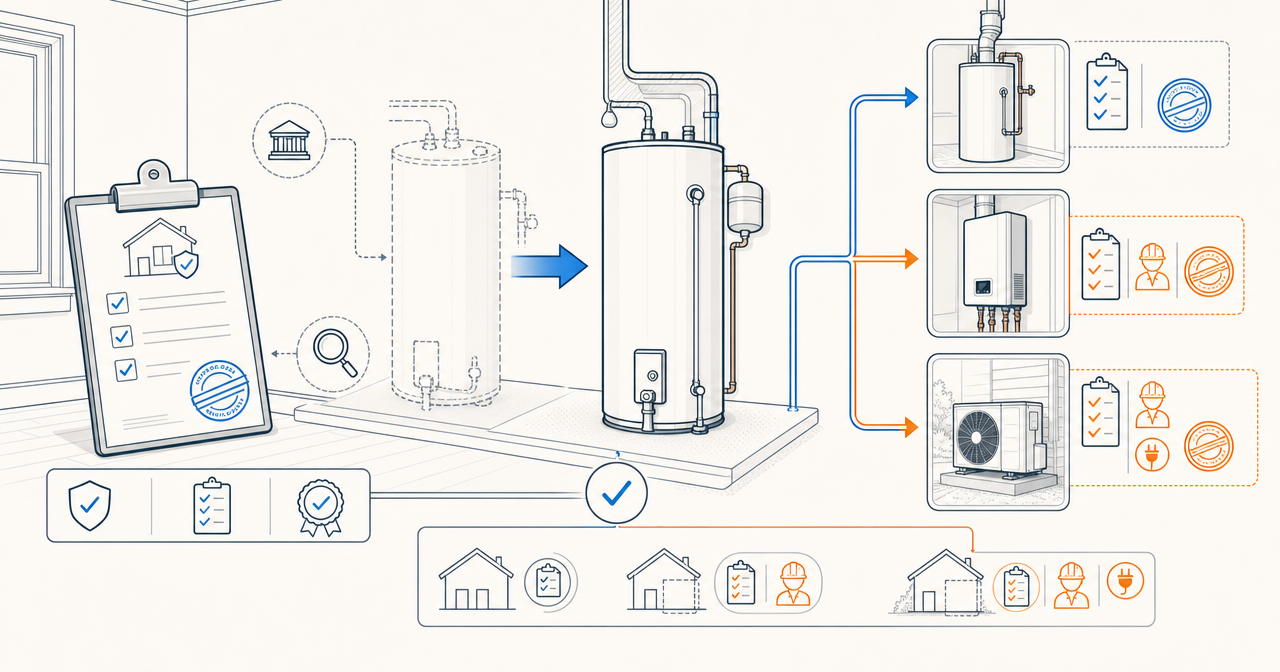
| Your project | Likely permit path | What changes the answer |
|---|---|---|
| Same type, similar size, same location | Often the simplest permit, sometimes issued online without plans | A local exemption may apply, especially when a licensed contractor does a true like-for-like replacement |
| Same location, different size | Permit review may expand | Capacity, connection, venting, clearance, or electrical changes |
| New location | Permit plus plans or added review is more likely | New piping, gas, wiring, venting, drainage, or opened walls and ceilings |
| Gas-to-electric or electric-to-gas | More than one trade permit or added documentation may be required | Electrical load, new circuit, gas sizing, gas-line removal, or vent changes |
| Storage tank to tankless | Usually broader than a tank swap | Gas demand, venting, combustion air, power, and exterior clearances |
| Storage tank to heat pump | Permit remains part of the job, even where an expedited path exists | Electrical capacity, circuit work, location, and any panel or service work |
| Urgent failed or leaking unit | The normal permit or a local emergency procedure | Notice rules, who may perform the work, filing deadline, and inspection timing |
The safest planning assumption is that the job needs a permit until the permitting authority for your address identifies an exemption that covers the exact work.
How to get the binding answer for your address
Permit rules are local. A state code summary, a plumber's website, or a neighboring city's process cannot settle the rule for your property.
Use this sequence:
- Identify the authority having jurisdiction. For a home inside city limits, this is often the city building or development department. An unincorporated address may fall under a county. Some areas assign plumbing permits to a separate public health or trade agency.
- Search the official site. Use the terms “water heater replacement,” “water heater changeout,” “plumbing permit,” “mechanical permit,” and “work exempt from permit.”
- Describe the full scope. Include the existing and proposed fuel, storage or tankless type, capacity, location, and any gas, vent, wiring, panel, piping, wall, or ceiling work.
- Get six points in writing. Ask which permit types apply, whether an exemption covers the work, who may apply, whether plans are needed, the fee and expected issuance time, and which inspections close the permit.
- Ask separately about an urgent failure. The question is whether the jurisdiction has an emergency procedure and filing deadline. The fact that the household has no hot water does not create an automatic exemption.
A concise message to the permit counter is enough:
I am replacing a [fuel] [storage/tankless/heat-pump] water heater with a [fuel and type] unit in the [same/new] location. The work [will/will not] change gas piping, venting, electrical service, wiring, water piping, walls, or ceilings. Which permits, plans, inspections, and emergency-filing rules apply at this address, and who may pull them?
Save the reply with the contract and permit record.
A like-for-like replacement can be simpler without being exempt
“Like for like” usually means the same fuel, the same basic water-heater type, a similar capacity, the same location, and no meaningful rerouting of plumbing, gas, venting, or electrical connections. Local definitions can be narrower.
Mountain View, California, shows the common streamlined model for single-family homes and duplexes. Its water-heater permit page requires a permit before every replacement in those property types, yet a same-location unit between 30 and 150 gallons needs no plans and can receive an automatically issued same-day permit. A new location or a unit over 150 gallons needs plans and a longer review.
Phoenix shows why the local caveat matters. The city's residential project guidance lists a water-heater replacement by a licensed contractor as permit-exempt in a one- or two-family dwelling. A do-it-yourself electric replacement still requires a permit, and changes such as gas-line work remain outside that narrow exemption. Permit-exempt work must still comply with the applicable code and manufacturer instructions.
Same location is therefore a scope description. It is not a national permit exemption.
When the replacement becomes a larger permit job
Moving the water heater or opening the building
Relocation can add water piping, drainage, venting, gas, electrical, access, clearance, and building work. A permit office may ask for a floor plan or separate building review when walls, floors, or ceilings must be opened. For the single-family homes and duplexes covered by its page, Mountain View requires plans for a new location, while Kirkland's replacement guide says wall, floor, or ceiling work can add a building permit.
Changing fuel
A gas-to-electric project may need an electrical permit, load information, a new circuit, and safe handling of the old gas connection. An electric-to-gas project may need gas sizing, a gas schematic, combustion air, and vent review. Pima County's replacement permit instructions require load calculations for a change to electric and gas-line details for a change to gas or propane. The same county offers a simpler contractor pathway when size and fuel stay the same.
Converting to tankless
A tankless heater can change the house systems that serve it. Gas-fired models may demand more gas than a storage tank, and the job may add controls, power, new venting, combustion-air provisions, or exterior clearance questions. Those details belong in the quoted scope and permit application before installation.
Converting to a heat-pump water heater
A heat-pump conversion can add electrical load and circuit questions even when the tank stays in the same spot. Some cities streamline this work. Santa Barbara's OnDemand permit program, for example, issues free permits by email for qualifying same-location heat-pump replacements in single-unit homes and duplexes. That is an expedited permit, not a blanket exemption.
Use our heat-pump water-heater cost guide to separate the tank, electrical work, site preparation, and permits in a quote. Our heat-pump water-heater tax credit guide explains the federal timing rules that apply to earlier qualifying installations and new 2026 projects.
What to do when the water heater fails urgently
An emergency can change when paperwork is filed only when the local rule says it can. It does not let a contractor quietly skip the permit.
Local procedures differ sharply. Streetsboro, Ohio, lists water-heater replacement among its emergency permit cases. Its rule requires written notice and a permit by the end of the second working day. Other departments require an application before work begins, even if staff expedite issuance or inspect later.
Use this urgent-replacement path:
- Address the immediate hazard. If there is a gas odor, leave the building and call 911 and the gas utility from a safe location. Austin's emergency repair guidance gives the same direction. Use a licensed emergency contractor for the replacement.
- Have the contractor contact the permitting authority. Ask for the emergency procedure, required notice, application deadline, and inspection timing for the address.
- Get the filing evidence. Keep the permit number, application receipt, notice email, or written department response.
- Complete the inspection and closeout. A post-install application is only a timing path. The permit still needs the required inspection and final approval.
A unit failing at night or on a weekend can support an emergency request. The local department decides whether that procedure applies.
Who normally pulls the water-heater permit?
For a contractor-led replacement, the licensed contractor normally pulls the permit and schedules the inspection. Put that responsibility in the written quote. The contract should identify the permit holder, included fees, inspection contact, responsibility for corrections, and the proof you will receive when the permit is final.
A homeowner permit or owner-builder path is different. It may be limited to an owner-occupied primary residence, and it can make the homeowner responsible for code compliance, inspection access, corrections, and final approval even when a contractor performs the work. Clark County, Nevada, allows a homeowner to pull a water-heater permit and hire a licensed contractor. Its inspection FAQ states that the homeowner then becomes the responsible party. California's Contractors State License Board likewise says an owner-builder assumes responsibility for permits, code compliance, and inspections.
If an installer asks you to pull an owner-builder permit, ask the permit office whether that arrangement is allowed and why the contractor is not applying under its own name. Do not sign as the permit holder until the shifted responsibilities are clear.
Permit cost and timing have no national average
A single nationwide fee or turnaround estimate would be misleading. The permit type, number of trades, plan review, application method, local workload, and inspection calendar all affect the result.
Official examples show the range of processes:
| Local path | Published permit fee | Published issuance time |
|---|---|---|
| Mountain View same-location replacement, single-family home or duplex | $50 | Same day |
| Mountain View new location, single-family home or duplex | $50 | 3 to 5 business days for initial staff review |
| Santa Barbara qualifying same-location heat-pump replacement | $0 | Instant by email |
These are local examples, not a U.S. price range. A contractor may also charge for permit administration separately from the agency fee. Ask for both lines to be identified, along with any plan-review, reinspection, or after-hours costs.
What the inspector checks and how the permit closes
The inspection is tied to the adopted local code, the approved scope, and the manufacturer's instructions. The exact checklist changes by equipment and location. Pima County's published water-heater list includes drain pans where applicable, supported exhaust vents, correctly installed temperature-and-pressure relief components, and supported gas lines.
A final inspection may cover:
- Approved scope: The installed fuel, type, capacity, and location match the permit.
- Water connections: Shutoff and piping are suitable, supported, and leak-free.
- Pressure relief: The temperature-and-pressure relief valve and discharge piping meet local requirements.
- Water damage protection: A pan and approved drainage are present where required.
- Gas equipment: Gas piping, shutoff, sediment trap, combustion air, venting, and clearances comply where applicable.
- Electrical equipment: Circuit, disconnect, wiring, grounding or bonding, and service capacity comply where applicable.
- Placement and access: Required working space, impact protection, elevation, and seismic bracing are present where locally required.
- Installation record: Manufacturer instructions are available when the inspector requires them.
Closeout deserves its own checklist:
- Confirm the permit is issued or that the documented emergency procedure allows later issuance.
- Schedule every required inspection. Kirkland tells contractors to schedule the inspection when they performed the installation and asks for scheduling within 48 hours.
- Correct any failed item and obtain reinspection. A permit with a failed inspection is still open.
- Confirm final status in the permit portal. “Installed” and “inspection scheduled” do not mean “finaled.”
- Save the permit and final approval. Keep them with the invoice, model information, and warranty records.
What happens if a water heater was installed without a required permit?
The predictable result is a local compliance process. The building department may issue a stop-work order or notice of violation, require an after-the-fact permit, inspect the installation, order corrections, charge added fees or fines, and require reinspection before closing the case. Access may be needed if finished surfaces hide work the inspector must see.
Consequences are jurisdiction-specific. Miami Beach's published building-violation process provides one concrete example: active work without a permit can be stopped, completed work can receive a violation notice, and the city assesses a double permit fee plus a first-offense fine. The case closes only after the permit is approved and inspections are finaled. Other jurisdictions use different fees and enforcement steps.
Do not assume that every unpermitted replacement automatically voids insurance coverage or prevents a home sale. Those outcomes depend on the policy, the loss, local law, and the transaction. The missing approval record and possible municipal enforcement are real enough without making a universal claim.
If the replacement has already happened:
- Search the official permit record for the address. Confirm whether a permit was issued and whether it is open or final.
- Contact the permitting authority. State that the water heater has already been replaced and ask for the exact legalization or after-the-fact process.
- Bring in the installer. Require the contractor to provide the model, scope, invoice, permit information, and any corrections the department requires.
- Leave required work accessible. Do not conceal connections or close opened surfaces before the authority says inspection access is no longer needed.
- Obtain final approval. Paying a fee or submitting an application does not close the record by itself.
Questions to ask before approving the quote
- Is this truly like for like? Confirm the fuel, technology, capacity, location, and every connection that will change.
- Which permit types apply? Ask about plumbing, mechanical, electrical, gas, and building scope.
- Who is the permit holder? Get the contractor's name and license as they will appear on the application.
- Is every permit cost included? Separate agency fees, contractor administration, plan review, and possible reinspection charges.
- Does an emergency procedure apply? Ask for the local notice and filing deadline rather than accepting “emergency” as a verbal waiver.
- Who schedules and attends inspection? Identify the contact and expected timing.
- Who pays for corrections? Put responsibility for installation-related corrections and reinspection in the contract.
- What proves closeout? Require the permit number and final approval record.
- What conversion work is included? For tankless or heat-pump equipment, itemize gas, venting, electrical, panel, piping, and location work.
Our quote-comparison guide gives you a clean way to line up those scope and savings assumptions across bids.
Settle the permit before you sign
A same-location replacement often has the shortest permit path. Any exemption must come from the authority for the property address. Relocation, fuel changes, tankless equipment, and heat-pump conversions can add review and trade permits. Put the permit holder, fees, inspection, corrections, and final closeout in the contract.
If a heat-pump water heater is part of the plan, browse our incentives library after the permitted scope is clear.