Last reviewed: September 18, 2026 (UTC)
California does not have one heat pump rebate. In 2026, the statewide programs that made headlines are reserved or closed to new single-family applications, while local utilities and regional agencies still publish live offers. The amount can change with your service territory, the equipment you replace, the model you install, and whether the program requires approval before installation.
We separate statewide status from local options, distinguish heat pump HVAC from water heaters, and show what a rebate-backed quote should include.
Quick answer
| Question | Practical answer |
|---|---|
| Is there one California heat pump rebate? | No. HEEHRA and TECH Clean California are statewide paths, while utilities, community choice aggregators, cities, and air districts run separate programs. |
| What was the large statewide rebate? | HEEHRA offered up to $8,000 below 80% of area median income (AMI) and up to $4,000 at 80% to 150% AMI for qualifying single-family heat pump HVAC projects. New single-family income verifications are closed, and the statewide funds are fully reserved. |
| What can still be available? | Address-specific programs such as LADWP, SMUD, Silicon Valley Clean Energy, and MCE still publish heat pump HVAC offers, with different equipment and timing rules. |
| Is the federal heat pump tax credit available for a 2026 installation? | No. The IRS says Section 25C does not apply to qualifying property placed in service after December 31, 2025. |
| What should a quote show? | The program administrator, gross price before incentives, exact equipment, reservation status, application owner, and deadline for installation or paperwork. |
Start by separating HVAC from a heat pump water heater
Most people searching for a California heat pump rebate mean a heat pump HVAC system, which heats and cools the home. A heat pump water heater is a separate appliance that heats domestic water. They can appear on the same incentive website, but they rarely share the same equipment rules, rebate amount, or application path.
| Project | What it replaces | California rebate questions that matter |
|---|---|---|
| Heat pump HVAC | A gas furnace, electric resistance heater, or older heating and cooling system | Is the project a gas-to-electric conversion? Is the model on the qualified list? What SEER2 and HSPF2 ratings, AHRI certificate, permit, or contractor network does the program require? |
| Heat pump water heater | A gas or electric-resistance water heater | What tank size, UEF rating, installation path, and utility account does the program require? Is the incentive a retail coupon, contractor discount, or post-installation rebate? |
The statewide HEEHRA amount most pages quote applies to qualifying heat pump HVAC projects. It should not be added automatically to a heat pump water heater quote. Watt Wallet's heat pump water heater rebate guide covers that separate search intent.
The statewide $8,000 answer is a status question now
The headline number comes from California's Home Electrification and Appliance Rebates (HEEHRA) program. The current TECH Clean California HEEHRA page lists these single-family amounts:
- Up to $8,000 for a household below 80% AMI.
- Up to $4,000 for a household between 80% and 150% AMI.
The program is narrower than a general home-improvement coupon. It applies to income-qualified California households replacing an existing, non-heat-pump primary heating source with a qualifying heat pump HVAC system. The project must move through a TECH-certified, HEEHRA-trained contractor, and the reservation must be approved before installation.
The same TECH page says single-family HEEHRA rebates are fully reserved statewide as of February 24, 2026. It also says the program stopped accepting new single-family income-verification applications. Unapproved Northern California requests, along with requests submitted after the cutoff, were placed on a waitlist. A waitlisted project becomes eligible only after the reservation is approved and the system is installed afterward.
That distinction matters when an old quote still shows “HEEHRA: $8,000.” The amount is a published program maximum. It is not proof that a new project has funding attached to it. The California Energy Commission's program page says Phase I is still processing completed projects with approved reservations, while Phase II availability will be announced later.
The separate market-rate TECH Clean California single-family HVAC and heat pump water heater incentives also closed to new reservations in November 2025. The current single-family incentive page preserves the status and points homeowners to local incentive searches. Watt Wallet's TECH Clean California rebate guide explains how to separate an old TECH amount from an approved HEEHRA reservation or a local utility offer.
Current California options by service territory
When the statewide bucket is reserved, the useful question becomes: which administrator serves this address? The following programs publish current heat pump HVAC paths, and each one has a different definition of a qualifying project.
| Program | Published heat pump HVAC offer | Rules that change the outcome |
|---|---|---|
| LADWP Consumer Rebate Program | Up to $2,500 per ton for qualifying heat pump HVAC systems. LADWP also lists up to $2,500 per heat pump water heater. | The home must have active LADWP residential electric service. HP HVAC systems need at least 15.2 SEER2 and 7.7 HSPF2, with higher amounts for higher ratings and ductless systems. LADWP requires an itemized invoice, matching AHRI certificate, final permit, and an application within 12 months of purchase. Funding is limited and first come, first served. |
| SMUD heating and cooling rebates | Up to $3,000 for an eligible heat pump heating and cooling system. | The customer needs an active, individually metered SMUD account. The system must be a qualifying two-stage or variable-stage heat pump with at least 15.2 SEER2, and a participating SMUD contractor submits the application. |
| Silicon Valley Clean Energy home rebates | $2,000 for a heat pump HVAC system replacing a gas furnace, or $3,000 for an income-qualified customer. Electric-resistance replacements have separate amounts. | Reserve the rebate before installation. The core program covers existing homes in SVCE territory, and city-specific amounts can differ for customers in Los Altos, Milpitas, Mountain View, and Sunnyvale. |
| MCE heat pump rebates | Up to $400 per 500 square feet for a heat pump heating and cooling system. MCE's 1,500-square-foot example reaches $1,200. | The customer must own and have lived in a single-family detached home in MCE territory for at least 12 months. A participating contractor must install the system and process the rebate. MCE does not accept retroactive claims. |
These examples are deliberately different. LADWP calculates its amount from system ratings and tons. SMUD focuses on system staging and its contractor network. SVCE requires a reservation before installation. MCE ties the amount to conditioned floor area and limits who can apply. A California-wide average would hide the rules that decide whether a project qualifies.
PG&E, SCE, and SDG&E customers should treat the utility name as a starting point, not the program name. A community choice aggregator, city, regional air district, or statewide administrator may control the incentive. A quote that says only “SCE rebate” or “PG&E rebate” leaves out the rules that determine eligibility.
Two regional programs people may still see in a quote
The South Coast AQMD GO ZERO page says its single-family rebate funding was depleted and its application portal closed on September 4, 2026. Previously, the program offered $1,500 for a general-community heat pump HVAC replacement and $3,000 in an overburdened community. A new quote should not count GO ZERO money unless it refers to an already submitted application that the program will fulfill.
TECH Clean California also published a separate San Fernando Valley incentive page for Aliso Canyon priority communities, including Porter Ranch, Granada Hills, Northridge, Chatsworth, North Hills, Canoga Park, Reseda, Winnetka, West Hills, Van Nuys, and Lake Balboa. The page says heat pump HVAC and water heater incentives begin in late summer 2026, and income-qualified incentives may cover the full installation cost. It does not publish a dollar table, so a quote should name the specific local program and approval status rather than borrow the old statewide HEEHRA amount.
How to find the right program for your address
California rebates are easier to handle when the order is fixed. Start with the address, then the project, then the equipment, then the paperwork.
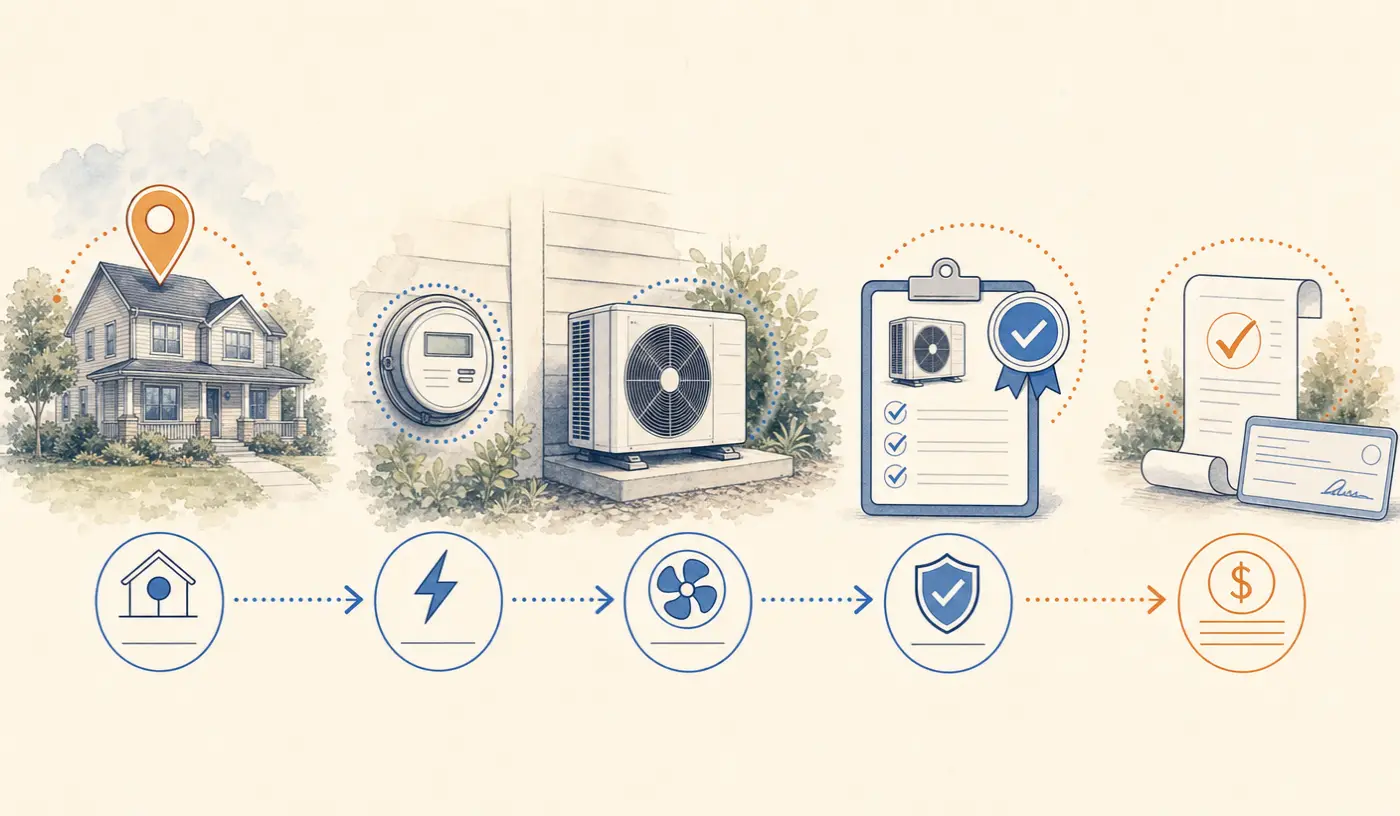
- Identify the electric service territory. The city name is not enough. A utility account, municipal utility, community choice aggregator, or local agency can change the available program. The Switch Is On incentive finder is built to route California homeowners by location and project type.
- Name the equipment category. Tell the program whether the project is heat pump HVAC or a heat pump water heater. A furnace replacement, electric-resistance replacement, and air-conditioner-only replacement can receive different treatment.
- Match the exact model to the program. Save the model numbers before the quote is finalized. Programs can require ENERGY STAR certification, AHRI matching, a qualified-products list, SEER2 or HSPF2 minimums, a tank capacity, or a refrigerant limit. HEEHRA-eligible residential heat pumps placed in service in 2026 also need a refrigerant with a global warming potential of 700 or lower under the program's current rules.
- Put the timing rule in writing. HEEHRA and SVCE require approval or reservation before installation. MCE does not accept retroactive claims. LADWP accepts its application after purchase and installation, subject to its documentation and 12-month window. SMUD routes the application through a participating contractor.
- Keep one project folder. Include the utility bill, income approval or reservation notice when relevant, itemized quote, model numbers, AHRI certificate, permit records, paid invoice, proof of installation, and final application. If the contractor submits the claim, keep a copy of what was submitted.
The key is a named path. “California rebate” is a description of a market. It is not an approval, reservation, or payment commitment.
Do not put the old federal tax credit in a 2026 quote
The federal Energy Efficient Home Improvement Credit, Section 25C, is a separate tax rule. The IRS says qualifying heat pumps and heat pump water heaters could receive a 30% credit with a separate annual limit of up to $2,000 for property placed in service through 2025. The credit does not apply to qualifying property placed in service after December 31, 2025.
For a new 2026 installation, the old 25C line should not reduce the contractor's net price. A qualifying 2025 installation belongs to the 2025 tax year, subject to the IRS equipment, home, and filing rules. A deposit, signed contract, or equipment order does not turn a 2026 installation into a 2025 project.
Rebates also arrive differently from tax credits. TECH says HEEHRA money could appear as an instant invoice discount or as reimbursement after processing. LADWP describes a post-installation application and rebate check. A tax credit changes a tax return later. Ask for each item to appear on its own line rather than accepting one blended “after incentives” number.
What a California heat pump quote should show
Use the same written scope for every installer. The quote should include:
- The gross installed price: equipment, labor, electrical work, ductwork, permits, and disposal before incentives.
- The named administrator: for example, LADWP, SMUD, SVCE, MCE, TECH, HEEHRA, or South Coast AQMD.
- The program status: approved reservation, submitted application, waitlist, or an estimate that still depends on funding.
- The exact equipment: indoor and outdoor model numbers, system type, capacity, SEER2 and HSPF2 ratings, AHRI reference, and any required qualified-products-list entry.
- The replacement assumption: gas furnace, electric resistance, existing air conditioner, or another system. This can change the rebate.
- The paperwork owner: the homeowner, contractor, retailer, or distributor, plus the documents each person must provide.
- The deadline: reservation expiry, installation window, application deadline, and any permit or inspection requirement.
- The fallback price: the amount due if the rebate is unavailable, waitlisted, or rejected.
That last line protects the project budget. A contractor can be experienced with a program and still quote money that is pending, capped, or tied to a model that changes before installation. Watt Wallet's HVAC contractor questions help turn these assumptions into a comparable scope.
If no rebate is open at your address
Do not add a future program to today's savings calculation. The California Energy Commission says HEEHRA Phase II availability will be announced later, and TECH's current program rules say HEEHRA rebates are not retroactive.
Financing can be a separate path. The CEC's Equitable Building Decarbonization Statewide Incentive Program expands GoGreen Home access and offers further reduced interest rates of 0% to 2% for eligible low-income households in low-income or disadvantaged communities. That is financing, not a rebate, so compare the total repayment amount with the cash price and any local incentive.
California heat pump rebate FAQ
Is the $8,000 California heat pump rebate still available?
The $8,000 figure is the HEEHRA maximum for a qualifying single-family household below 80% AMI. TECH says single-family HEEHRA rebates are fully reserved statewide and new income-verification applications are closed. A waitlisted project is not an approved rebate.
Can I still get a heat pump rebate if TECH is closed?
Possibly. LADWP, SMUD, SVCE, MCE, and local agencies publish separate programs for their territories. The qualifying equipment, contractor, reservation, and deadline rules belong to each administrator.
Are California heat pump HVAC rebates the same as heat pump water heater rebates?
No. They are separate equipment categories. A heat pump HVAC rebate pays toward space heating and cooling, while a heat pump water heater rebate pays toward domestic hot water. Model, efficiency, capacity, and installation rules can differ even when the same utility administers both.
Can I combine a local rebate with HEEHRA or another incentive?
Sometimes. The program rules decide whether incentives can be layered on the same equipment or only on different parts of the project. Keep every program separate in the quote, and never count a waitlisted or expired program as guaranteed savings.
Is a contractor required for every California heat pump rebate?
No single rule covers every program. HEEHRA requires a TECH-certified, HEEHRA-trained contractor. SMUD and MCE use participating contractor paths. SVCE describes a customer-selected contractor or DIY route for its home rebates, while LADWP focuses on equipment, permit, and application documentation. The program's installation path controls.
California heat pump rebates reward precise planning. Start with the service territory, separate HVAC from water heating, match the exact model to the administrator's rules, and keep the gross project price visible. When you have a contractor proposal, use Watt Wallet's rebate and quote comparison workflow to compare every incentive line before you sign.
Fast application checklist
- Step 1: Identify the electric service territory for the address, then use the Switch Is On incentive finder and the administrator's page to see which utility, community choice aggregator, city, or regional program applies.
- Step 2: Name the equipment category: heat pump HVAC or heat pump water heater. Do not carry an HVAC rebate amount into a water-heater quote.
- Step 3: Save the exact equipment model numbers and match them to the program's efficiency, qualified-products-list, AHRI, refrigerant, contractor, and permit rules.
- Step 4: Put the timing rule in writing. Confirm whether the program requires a reservation or approval before installation, accepts a post-installation claim, or does not accept retroactive applications.
- Step 5: Keep the utility bill, income approval or reservation notice, itemized quote, model numbers, AHRI certificate, permit records, paid invoice, proof of installation, and submitted application together.
Short FAQs
Does California still offer heat pump rebates?
Yes, but not as one simple statewide number. The main statewide HEEHRA path is fully reserved for single-family projects, while utility and regional programs can still vary by address.
How much is the California heat pump rebate?
It depends on the program. TECH Clean California historically highlighted up to $8,000 for lower-income HEEHRA households and up to $4,000 for moderate-income households, while utilities like LADWP and SMUD publish their own separate heat pump HVAC amounts.
Who qualifies for California heat pump rebates?
Qualification usually depends on service territory, household income when the program is income-based, approved contractors, qualifying equipment, and the timing of reservation or pre-approval before installation.
How do you apply for a California heat pump rebate?
Start with the live official program page, confirm whether you need a participating contractor or pre-approval, and save the quote, model numbers, utility details, and permit records before installation.
Can you stack California heat pump rebates with other incentives?
Sometimes, but you should separate rebate assumptions from federal tax-credit assumptions and verify current rules for your install date before you treat the savings as guaranteed.