Last reviewed: September 19, 2026 (UTC)
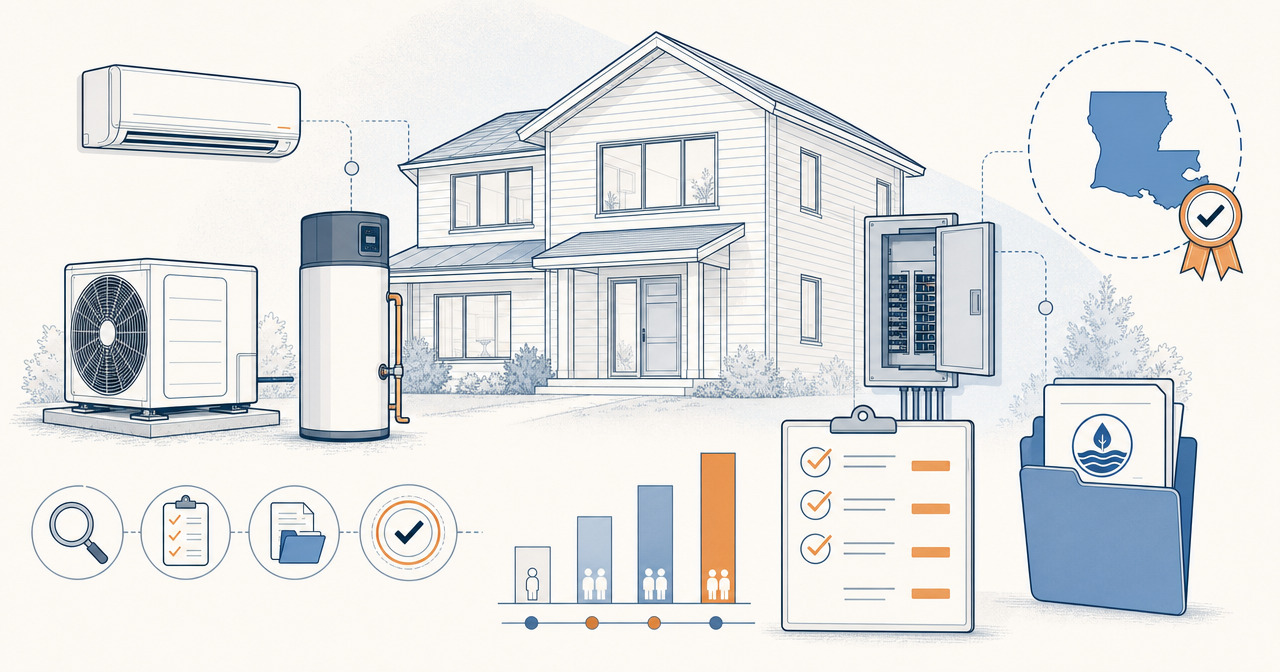
Most people search for HEEHRA rebates, while the current federal name is High-Efficiency Electric Home Rebates (HEEHR). The useful answer starts with your state. Some paths are open, some are paused or reserved, and the federal cap table is a ceiling rather than a promise of funding.
We show how to check live status, match your income and housing type to the right path, understand the 2026 fuel-switching change, and confirm approval or reservation before installation. Do not count HEEHR savings or start work until the live state path and its timing rules are confirmed.
Important: HEEHR rebates are administered through states, territories, and Tribal programs. Use the official administrator link for your location before you sign a quote, buy equipment, or schedule installation.
Quick answer
| Question | Practical answer |
|---|---|
| Is HEEHRA available everywhere? | No. Each state, territory, or Tribal administrator chooses its launch timing, measures, application route, contractor rules, and funding status. |
| Who can qualify? | The federal framework targets households below 150% of area median income (AMI). Households below 80% of AMI can receive up to 100% of eligible project cost, and households from 80% to 150% of AMI can receive up to 50%, subject to caps and state rules. |
| How much can the program cover? | The federal framework shows a maximum combined total of $14,000. Each listed amount is a ceiling. A state can offer fewer measures, a lower amount, or no new reservations. |
| Can a retrofit replace gas or oil with electric equipment? | Current HEEHR guidance removes fuel-switching allowances for new retrofit reservations. The current retrofit rule generally supports an upgrade from existing electric equipment to more efficient electric equipment. New-construction electric equipment remains allowable. |
| Do I need approval before installation? | Often. Income verification, preapproval, a reservation, or a retail coupon can each be a separate step. Follow the live state path and do not assume a later claim will fix work that started too early. |
| How do I apply? | Start with the official state or program-administrator page, then follow its income, contractor, reservation, coupon, and final-claim instructions. There is no single national consumer application. |
State and program status, checked September 19, 2026
The status that matters is the status for your state, housing type, and measure. Use this router to find the right official page, then open the administrator's current application or portal before you make a project decision.
| State or path | Plain status | What the official page says and where to go next |
|---|---|---|
| California HEEHRA | Single-family fully reserved; multifamily intake paused | The CEC notice says single-family reservations are fully reserved statewide, no new income-verification requests are being accepted, and unapproved or later requests go to a waitlist. The CEC says multifamily rebates remain available statewide, while TECH Clean California says new multifamily Application Stage 1 submissions are paused while existing applications are processed. The California portal is closed to new single-family verifications and reservations. |
| Georgia HEAR | Paused | Georgia says HEAR project submissions are paused until further notice. Its Home Efficiency Rebates path remains open, which is a different program. |
| New Mexico HEAR | Paused; waitlist | The state page describes a phased rollout, while the live ECAM portal says new rebates are temporarily paused and directs new applicants to a waitlist. It continues processing some already issued coupons, approved contractor estimates, and related work already in progress. |
| Minnesota HEAR | Not launched | Minnesota's current update says it is waiting for formal DOE approval and has no estimated launch date. Do not treat its published caps as an open application path. |
| Michigan MiHER | City-specific pauses | Michigan identifies temporary suspensions for new income-qualified applications in the Detroit, Warren, Grand Rapids, Lansing, and Kalamazoo districts. Use the MiHER page and contractor finder for the address-specific path. |
| Arizona Efficiency Arizona | Open; applications accepted | Efficiency Arizona says applications are still being accepted under the new federal guidelines. Approved applicants can use a qualified contractor or, for selected appliances, a retail coupon path. |
| Wisconsin Focus on Energy HEAR | Open; path restrictions | Focus on Energy continues to accept income qualification and offers contractor and retail routes. Since September 1, 2026, it no longer accepts new retail post-purchase or instant-discount coupon requests for equipment replacing fossil-fuel appliances. Earlier coupons may remain usable until their printed expiration date. |
| North Carolina Energy Saver NC | Open; phased by county | Energy Saver NC launched in January 2025 and publishes a county expansion map and an application path. Its current HEAR update says applications without reservation status by September 1, 2026 must follow the new no-fuel-switching and insulation or air-sealing rules. |
| New York Appliance Upgrade Program | Open; measure-specific | NYSERDA currently offers coupon paths for ENERGY STAR heat pump clothes dryers and necessary electrical upgrades. The page gives renters a landlord-attestation step and routes applicants through the MyEnergy Portal. This is a live measure path, not a promise that every HEEHR category is open. |
| Maine HEAR | Open; narrow initiatives | Maine says HEAR is live for new affordable multifamily housing and single-family manufactured or mobile homes. Efficiency Maine's multifamily path uses an incentive agreement to secure a reservation, while its mobile-home path requires preapproval and a participating installer. |
The table illustrates why a national answer can mislead. California's single-family path is reserved, while its multifamily allocation has a different intake status. New Mexico's public information page still describes a phased launch while its live portal pauses new intake. North Carolina's main page retains older fuel-switching language, while its current update applies DOE's newer rule to applications without a reservation. Use the newest administrator update for the live action step.
Our Heat Pump Rebates by State hub can help you identify likely local paths. Our ENERGY STAR Rebate Finder guide explains how to use a ZIP-code tool as a lead list. Use the official administrator page to decide whether your HEEHR project can move forward. California readers can also use our California heat pump rebate guide to separate statewide status from local programs.
What HEEHR means in 2026
HEEHRA is the search term many homeowners use for the High-Efficiency Electric Home Rebate Act and its consumer rebate program. The Department of Energy's current federal name is HEEHR, changed from Home Electrification and Appliance Rebates in Program Notice 26-2, effective May 29, 2026. State pages may still say HEAR or HEEHRA while they update their materials.
HEEHR sits inside the federal Home Energy Rebates framework. DOE says the program is available in select states, territories, and Tribal programs, with each local administrator setting the consumer path. Depending on the state path, eligible categories can include:
- electric heat pumps for space heating and cooling
- heat pump water heaters
- ENERGY STAR electric heat pump clothes dryers, including the combination washer-dryer expansion in the current notice
- electric stoves, cooktops, ranges, and ovens
- electric load service center or panel upgrades
- electric wiring
- insulation, air sealing, and ventilation
The federal list is a menu. States do not have to open every category or every housing type, and they can set narrower existing-condition, technology, or application rules. A measure appearing on a federal table does not prove that your state is accepting it today.
The 2026 rule changed retrofit eligibility
DOE Program Notice 26-2 applies only to the HEEHR program under IRA Section 50122. It says launched programs must make the changes within three months unless DOE approves an exception. Existing, approved reservations under the previous guidance may be executed. New reservations must conform to the new strategy. Programs that have not launched must align before launching.
For a current retrofit application, the important distinction is:
- Existing electric equipment to more efficient electric equipment: allowed under the current HEEHR direction, subject to the state's implementation rules.
- Gas, oil, or propane equipment to electric equipment: the new HEEHR retrofit guidance removes this fuel-switching allowance for new reservations. Do not budget a current HEEHR rebate for this scope unless the live administrator confirms a specific exception or an existing reservation protects the project.
- New construction: electric HVAC and appliances remain allowable, with the state still deciding which categories and pathways it will open.
- Existing fossil-fuel HVAC: a home may retain it when adding a heat pump, even when the heat pump will not be the primary heating and cooling source.
DOE also requires homes to use HEEHR rebates for insulation and air sealing before a heating or cooling upgrade, unless the home already meets a DOE-approved, state-specified insulation and sealing level. A state may explain that sequence through an assessment, contractor review, or documentation requirement.
There is a real source conflict to handle carefully. ENERGY STAR's currently published HEAR table still includes older applicability wording for replacing a non-electric appliance or making a first-time purchase. That page remains useful for the federal maximum amounts. DOE's newer Program Notice 26-2 controls the current HEEHR retrofit rule. Do not combine the older eligibility wording with the newer rule as if they were written at the same time.
Income tiers and federal rebate ceilings
The federal framework uses AMI, which is based on household size and location. The federal bands are a starting point:
| Household income | Federal framework |
|---|---|
| Below 80% of AMI | Up to 100% of eligible project cost, subject to the measure cap and state rules |
| 80% to 150% of AMI | Up to 50% of eligible project cost, subject to the measure cap and state rules |
| Above 150% of AMI | Outside the standard HEEHR income range |
Some states narrow this range. New Mexico's public program page, for example, currently describes eligibility below 80% of county AMI or through listed benefit programs. Other states ask for documentation from every household member, utility bills, benefit letters, or a landlord attestation. An online income calculator is a screening tool until the administrator accepts your documents.
The federal maximums below come from ENERGY STAR's table and DOE's Home Upgrades page:
| Upgrade | Federal maximum | What the ceiling does not tell you |
|---|---|---|
| Heat pump for space heating and cooling | $8,000 | Whether HVAC is open in your state, whether the existing system meets the current rule, and whether insulation or air sealing must happen first |
| Heat pump water heater | $1,750 | Whether the model, housing type, contractor, or retail path is accepted |
| Electric load service center or panel upgrade | $4,000 | Whether panel work must support another eligible upgrade and whether new construction is excluded |
| Electric wiring | $2,500 | Whether the state uses the full ceiling. North Carolina's current page, for example, lists up to $2,000 for wiring. |
| Insulation, air sealing, and ventilation | $1,600 | Whether the category is open and how the work must be sequenced with HVAC |
| Electric stove, cooktop, range, or oven | $840 | Whether the state accepts the model and whether current retrofit rules allow the existing equipment being replaced |
| Electric heat pump clothes dryer | $840 | Whether the retailer, coupon, contractor, and product-list requirements are met |
The federal maximum combined total is $14,000. The number is a ceiling across eligible categories. It is not a guaranteed state offer, a cash payment for every applicant, or permission to stack every category on one project. Your actual amount can be limited by project cost, income tier, state funding, measure availability, equipment, housing type, or an administrator's reservation decision.
Renters, multifamily properties, manufactured homes, and Tribal programs
Housing status changes the application route. The federal framework includes homeowners and renters, while the live administrator decides what documentation and owner participation are required.
- Renters: North Carolina allows tenants with owner permission. NYSERDA requires renters to obtain a Building Owner Attestation before starting its Appliance Upgrade Program application. Get the landlord's approval before choosing equipment or signing an installation agreement.
- Multifamily properties: DOE's current notice clarifies that multifamily eligibility is tied to at least 50% of occupied dwelling units having low- or moderate-income households. California's CEC says multifamily rebates remain available statewide, while TECH currently says new multifamily Application Stage 1 submissions are paused as existing applications are processed. Maine's live multifamily initiative is for new affordable multifamily construction and requires an application, incentive agreement, post-completion documentation, and an on-site inspection.
- Manufactured or mobile homes: California includes manufactured and mobile homes in its single-family description. Maine has a separate mobile-home initiative for income-eligible owners, with published preapproval, participating-installer, assessment, and quality-assurance steps.
- Tribal programs: DOE lists states, territories, and Tribes as administrators of Home Energy Rebates. Use the ENERGY STAR state and Tribal directory to find the applicable program rather than assuming a state path covers Tribal housing.
How the HEEHR application works
There is no single national HEEHR form. A live path can use a state portal, a qualified contractor, a retailer, or several of those together.
The terms that control the timing
| Term | What it means | What it does not mean |
|---|---|---|
| Application | Your submission of household, address, housing, equipment, or project information. | Submission alone is not approval or a reservation. |
| Income verification | The administrator reviews income or categorical-eligibility documents and places the household in an AMI tier. | It does not automatically attach funds to a project. |
| Preapproval | The administrator confirms that a proposed project can proceed under its rules. Some states use “approved reservation” and “preapproval” interchangeably. | It is not the same as simply passing an income screen. |
| Reservation | The program sets aside funding for an identified project, often after income approval and contractor or equipment details. | A waitlist position is not a reservation. |
| Coupon or point-of-sale discount | A code or invoice discount that tells a retailer or contractor to reduce the purchase price under the program. | A coupon does not make an ineligible model or project eligible. |
| Installation | The equipment or building work is physically completed. | Starting installation before the required approval can make the cost ineligible. |
| Inspection | The administrator or its contractor checks the completed work, records, or installation quality. | Passing an inspection does not replace income or project approval. |
| Final claim | The contractor, retailer, or applicant submits the final invoice, photos, inspection record, and other required evidence for payment. | There is no universal federal final-claim form or deadline. |
A safer order of operations
- Open the live state page. Confirm that your state, county or district, housing type, and measure are accepting new projects.
- Complete income verification. Prepare proof of income, benefit participation, address, utility account, and landlord or building-owner permission when the program requests them.
- Match the project to the current rule. Confirm existing equipment, new-construction status, ENERGY STAR or qualified-product requirements, contractor status, and insulation or air-sealing sequencing.
- Get the required approval. Obtain the administrator's preapproval, reservation, incentive agreement, or retail coupon before buying or installing whenever the state path requires it.
- Keep the project file. Save the quote, model numbers, approval notices, reservation ID, coupon, permits, photos, inspection records, and final invoice.
- Install through the approved route. California says projects must have an approved reservation before funding. Arizona shows a contractor path that ends in a post-inspection and a retail path that issues a coupon before redemption. New York issues coupon codes after application review. Those are different workflows under the same federal framework.
- Complete the final claim. Follow the administrator's deadline for post-installation documents, inspection, and payment. A point-of-sale discount may settle through the contractor or retailer, while another path may mail a check after documentation.
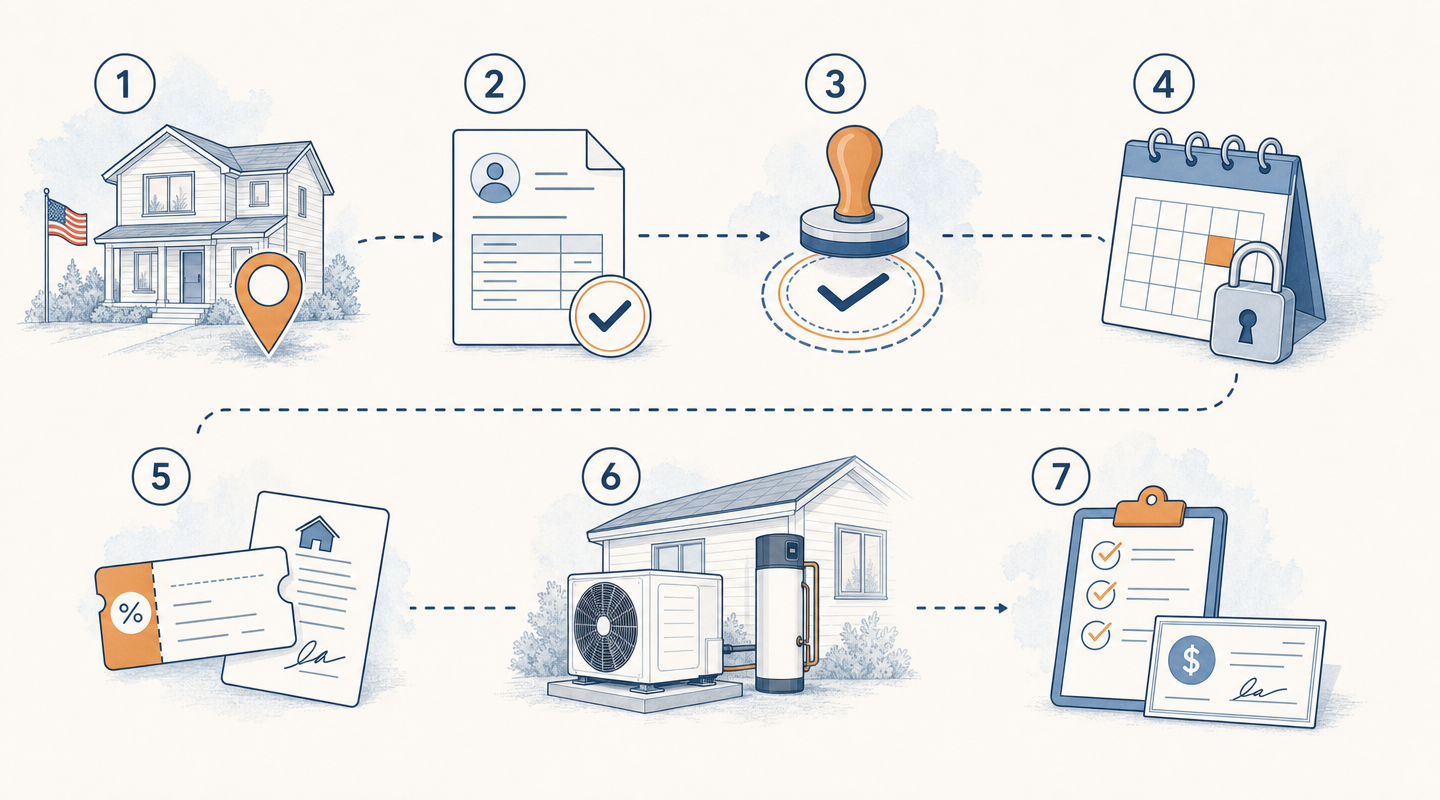
The order varies by state and measure. The live administrator's approval and timing rules control.
Common delays and avoidable mistakes
Most delays come from a mismatch between the quote and the administrator's process:
- the state, county, district, housing segment, or measure is paused or not launched
- the single-family allocation is fully reserved and the new request is only waitlisted
- the household submitted an income screen but has no project reservation
- the contractor is not qualified for that measure or retail route
- the equipment model is missing from the required product list
- a current retrofit quote assumes gas-to-electric funding under the old HEEHRA or HEAR wording
- insulation or air sealing is required before HVAC work and is missing from the scope
- the homeowner buys equipment or starts installation before approval, reservation, or coupon issuance
- the quote combines HEEHR, HOMES, utility rebates, and tax credits into one unqualified “after incentives” number
- the final claim lacks invoices, model numbers, permits, photos, inspection records, or other required proof
California's current page is explicit that equipment bought or installed before a HEEHRA rebate is reserved and approved is not eligible. New Mexico's public FAQ says applicants must apply before purchase, and its live portal distinguishes new requests from already issued coupons and approved estimates. Treat those state rules as examples of the timing risk, not as a universal form.
HEEHR vs. HOMES, utility rebates, and tax credits
The programs can appear in the same contractor quote while using different eligibility tests and payment timing.
| Incentive path | Main test | Payment and timing question |
|---|---|---|
| HEEHR | Income tier, eligible equipment or building material, live state path, and current Section 50122 rules | Is the discount, coupon, reservation, or contractor payment approved before installation? |
| HOMES | Whole-home energy savings through a modeled or measured pathway, with its own state implementation | Does the project meet the savings threshold and the state assessment or measurement process? |
| Utility or local rebate | Service territory, account status, equipment, contractor, and utility documentation | Is it an instant discount, reservation, post-purchase claim, or limited funding offer? |
| Federal tax credit | Federal tax rules, qualifying property, eligible cost, tax year, and filing documents | Does the tax treatment apply when the property is placed in service, and is it separate from the rebate reservation? |
Program Notice 26-2 changes HEEHR. It does not rewrite the HOMES program or federal tax credits. It also does not make a utility rebate follow HEEHR's rules. Federal funding generally cannot pay twice for the same qualified electrification project, and state or utility stacking rules still need to be read separately.
If a quote blends these programs, use our rebate and tax-credit comparison guide and rebate-stacking guide to split the scope, administrator, timing, and proof for each offer. For tax-credit timing, see our heat pump tax-credit income guide as a separate question.
What to confirm before you count the savings
Before you use a HEEHR amount in your budget, confirm all of these points in writing or in the live administrator portal:
- your state's current status for the exact measure and housing type
- the current HEEHR name and rule set the administrator is applying
- your AMI tier and accepted income documents
- the existing appliance or HVAC equipment and whether the project is a retrofit or new construction
- the product-list, ENERGY STAR, efficiency, refrigerant, or model-number requirement
- the insulation and air-sealing sequence for heating and cooling work
- the approved contractor, retailer, or DIY route
- whether you need income verification, preapproval, a reservation, a coupon, or an incentive agreement before purchase or installation
- the inspection, final-claim, and deadline requirements
- whether another federal, state, utility, or tax incentive pays for the same scope
Do not count the $14,000 ceiling as savings. Do not start work because a contractor included a rebate line in a quote. Confirm the live state path first, then confirm the approval or reservation attached to your project.
For the next step, start with our Heat Pump Rebates by State hub, open the official administrator page for your address, and bring the administrator's written requirements into your quote review.
FAQ
Are HEEHRA rebates still available?
Some state and measure paths are open, while others are paused, not launched, fully reserved, or waitlisted. Arizona, Wisconsin, North Carolina, New York, and Maine currently publish open paths with different scopes. California's single-family path is fully reserved, Georgia's HEAR submissions are paused, New Mexico's portal is paused with a waitlist, and Minnesota has not launched. The status for your address and project type controls.
Does HEEHR cover a gas-to-electric retrofit?
Do not assume it does. DOE's May 29, 2026 notice removes fuel-switching allowances from current HEEHR retrofit reservations and permits upgrades from existing electric equipment to more efficient electric equipment. New-construction electric equipment remains allowable, and an existing fossil-fuel HVAC system may remain when a heat pump is added. Existing approved reservations under the previous guidance may proceed. A live state administrator must confirm how it applies the rule to your project.
Is income verification the same as a reservation?
No. Income verification establishes the household's eligibility tier. A reservation or incentive agreement attaches funding to a defined project. A state may require both, in that order, and a waitlist position does not replace either one.
Can renters use HEEHR?
The federal framework includes renters, and some state paths accept them. Landlord permission is common. North Carolina requires owner permission for tenants, and NYSERDA requires a Building Owner Attestation before a renter starts its application. Ask the administrator which party receives the rebate and signs the project documents.
Is the $14,000 HEEHR amount guaranteed?
No. It is the federal maximum combined total. The state can offer fewer categories or a lower amount, and the project can be limited by cost, income tier, funding, equipment, housing type, reservation status, or installation rules.
Can HEEHR and HOMES pay for the same project?
Treat them as separate programs with separate pathways. The current HEEHR notice does not change HOMES. Federal rules generally prevent two federal rebates or grants from paying for the same qualified electrification project, while different upgrades may have different paths. Read the state rules before assigning the same cost to both programs.
Are HEEHRA rebates retroactive?
Do not assume they are. Many live paths require approval, a reservation, an incentive agreement, or a coupon before purchase or installation. California says projects bought or installed before reservation and approval are not eligible. New Mexico tells applicants to apply before purchase. Follow your administrator's written timing rule before work starts.