Last reviewed: September 23, 2026 (UTC)
Can you combine tax credits and rebates? Often, yes, when both programs allow the same project costs and the rebate is handled correctly in the credit calculation. Project timing matters: qualifying 2025 work can still require stacking calculations, while the federal 25C and 25D home energy credits are closed to new 2026 projects. The practical task is to map each incentive to a cost, keep incompatible federal funding apart, and preserve the paperwork.
The answer depends on the incentive pair
| Incentive combination | Can you combine them? | Rule that decides the answer |
|---|---|---|
| 2026 rebate + federal 25C or 25D credit | No for a new 2026 project | Both federal home energy credits ended for new qualifying activity after December 31, 2025. |
| Qualifying 2025 project + rebate + 25C or 25D credit | Often | Subtract rebates and subsidies that reduce qualified cost, then calculate the credit and apply its cap. |
| DOE Home Energy Rebate + state, local, or utility funding | Often | Non-federal funding may cover remaining project costs if each program permits the combination. |
| DOE Home Energy Rebate + another federal grant or rebate for the same upgrade | No | Federal law prohibits both sources from funding the same single upgrade or qualified electrification project. |
| Two federal programs for separate measures in one project | Potentially | Each source must fund a distinct, separable measure supported by itemized costs. |
| Utility rebate + state or local tax credit | Often | The utility program and state or local tax law each set their own stacking and eligible-cost rules. |
| Utility rebate + manufacturer or contractor rebate | Sometimes | Either offer may exclude other discounts, restrict models, or cap total incentives. |
The word “stacking” only means using more than one incentive. It does not mean that every program calculates its benefit from the original contract price.
Start with the project date
The old federal tax-credit amounts still appear on contractor proposals and incentive pages. Their dates now decide whether there is a federal credit to combine.
Work completed in 2025
A qualifying 2025 project can still claim the Energy Efficient Home Improvement Credit under section 25C or the Residential Clean Energy Credit under section 25D on the 2025 federal return. The 2025 Form 5695 instructions say both credits ended for expenditures or property placed in service after December 31, 2025.
For 25C, “placed in service” generally means the improvement was installed and ready for use. For 25D, paying a deposit or the full bill in 2025 did not preserve the credit if installation finished in 2026. The IRS expiration guidance addresses that timing directly.
New work in 2026
A heat pump, heat pump water heater, insulation, window, panel, solar, battery, or geothermal installation completed in 2026 cannot receive a new 25C or 25D credit. The same IRS guidance sets a later cutoff for the residential Alternative Fuel Vehicle Refueling Property Credit under section 30C, but it also ended for EV charging property placed in service after June 30, 2026.
For a project starting now, build the savings plan around current state, utility, local, Tribal, manufacturer, contractor, HOMES, and High-Efficiency Electric Home Rebate (HEEHR) programs. Our guide to federal tax credits in 2026 separates closed federal credits from incentive paths that remain available.
A rebate and a tax credit affect cash flow differently
A rebate can reduce the invoice at the point of sale or arrive as a reimbursement. A tax credit usually affects the tax return filed later. The 2025 25C and 25D credits were nonrefundable, so the usable amount could also depend on federal income-tax liability. Unused 25D credit can carry forward, while unused 25C credit cannot.
This distinction matters when a proposal shows one “after incentives” price. A $2,000 rebate applied at purchase can reduce the amount due to the contractor. A projected $2,000 nonrefundable tax credit does not provide the same upfront cash.
Keep these lines separate when comparing quotes:
- Gross contract price.
- Contractor or manufacturer discounts.
- Rebates paid at the point of sale.
- Rebates paid after installation.
- Tax credits claimed later.
- Financing principal, interest, and fees.
Financing changes when you pay. It does not reduce the project price, and interest and loan fees were not qualifying 25C or 25D expenses. Our quote-comparison guide shows how to keep those amounts separate across bids.
Which rebates reduce the cost used for a tax credit?
For a qualifying 2025 federal claim, begin with qualified project costs, subtract rebates or subsidies treated as price reductions, and calculate the percentage credit from the remainder.
The IRS incentive rules distinguish the following sources:
| Payment type | Federal treatment for a qualifying 2025 claim |
|---|---|
| Public-utility subsidy for an energy conservation measure | Generally subtract the subsidy from qualified cost, whether it is paid to you or the contractor. |
| DOE HOMES or HEEHR rebate | Subtract the rebate. The IRS treats it as a purchase-price adjustment rather than household income. |
| Cost-based manufacturer, distributor, seller, or installer rebate | Subtract it when it is connected to the sale and is not payment for your services. |
| State energy incentive | Facts control. It reduces qualified cost only when it qualifies as a rebate or purchase-price adjustment under federal tax law. It may otherwise be taxable income. |
| Net-metering payment for electricity sent to the grid | It is not an installation subsidy and does not reduce qualified cost on that basis. |
The calculation follows this order:
- Add the costs that qualify for the specific credit.
- Subtract the rebate or subsidy allocated to those costs.
- Multiply the remaining amount by the credit percentage.
- Apply the equipment limit, annual limit, and tax-liability limit.
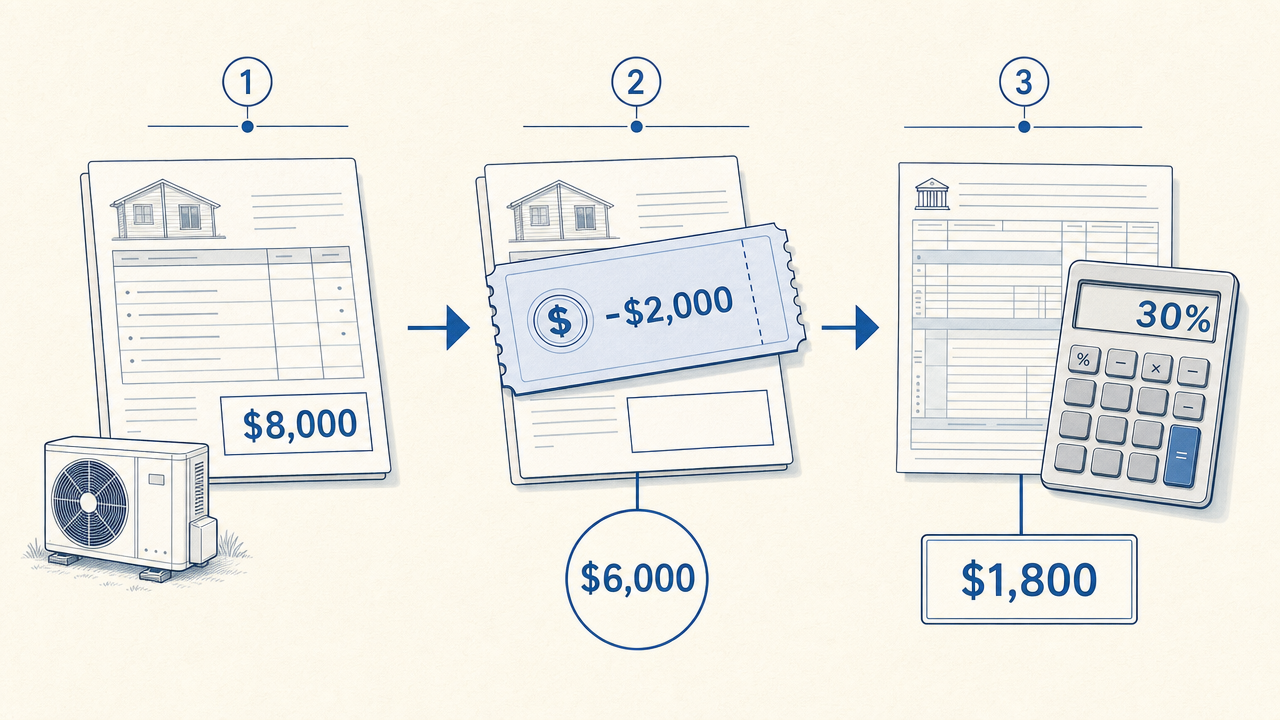
Do not apply the credit percentage to the gross price and subtract the rebate afterward. That method overstates the credit whenever the percentage, rather than a dollar cap, controls the result.
Worked examples
These examples explain the order of operations. They assume every equipment, home, installation, and filing requirement is met.
A single heat pump installed in 2025
Assume a qualifying heat pump cost $8,000 and a public utility provided a $2,000 installation subsidy.
| Calculation | Amount |
|---|---|
| Gross qualified cost | $8,000 |
| Utility subsidy | -$2,000 |
| Adjusted qualified cost | $6,000 |
| 30% tentative 25C credit | $1,800 |
| 25C heat-pump limit | $2,000 |
| Allowed credit before the tax-liability limit | $1,800 |
| Rebate plus credit | $3,800 |
The homeowner's final cost is $4,200 if they can use the full nonrefundable credit. Calculating 30% from the $8,000 gross price would produce $2,400 and then hit the $2,000 cap. That result is $200 too high because the subsidy must come out first.
A whole-home rebate allocated across several measures
A HOMES rebate can cover a package with more than one line item. For a qualifying 2025 tax claim, the IRS allows the rebate to be allocated proportionately across the itemized project costs.
Assume a $12,000 project contains an $8,000 heat pump and $4,000 of insulation, then receives a $3,000 HOMES rebate:
- Allocate $2,000 of the rebate to the heat pump because it represents two-thirds of the project cost.
- Allocate $1,000 to insulation because it represents one-third of the project cost.
- Calculate the heat-pump credit from $6,000 and the insulation credit from $3,000.
- Apply the separate heat-pump and general 25C limits after those calculations.
Do not assign the entire rebate to the line item that creates the smallest tax effect. IRS Announcement 2024-19 provides the proportional-allocation rule.
The same heat pump installed in 2026
If the $8,000 heat pump and $2,000 utility rebate instead apply to equipment placed in service in 2026, the federal 25C credit is $0. The project costs $6,000 after the rebate, before any compatible state or local incentive. If the project is a heat pump water heater, use our heat pump water heater cost guide to separate equipment, electrical work, and installation costs before applying the incentive math.
Current rules for combining DOE Home Energy Rebates
DOE's current programs are the Home Owner Managing Energy Savings (HOMES) Rebate Program and the High-Efficiency Electric Home Rebate (HEEHR) Program. Older pages may call the second program HEAR or HEEHRA.
Effective May 29, 2026, DOE's HEEHR Program Notice encouraged states and territories to stack and braid HEEHR funding with other programs where the statute permits it. The same notice preserves the federal restriction: a HEEHR rebate cannot combine with another federal grant or rebate for the same qualified electrification project. The HOMES statute contains the parallel rule for the same single upgrade.
In practical terms:
- A utility, state, or local incentive can often cover eligible cost left after a HOMES or HEEHR rebate.
- Another federal program can potentially fund a separate measure in the same home. For example, one source could fund air sealing while HEEHR funds an eligible heat pump.
- Two federal grants or rebates cannot both pay for the same heat pump, wiring run, insulation work, or other single upgrade.
- HOMES and HEEHR cannot both fund the same single upgrade.
- The quote and final invoice must separate equipment, labor, and measures well enough to show which source paid for each cost.
DOE calls the use of separate federal funding streams for distinct measures “braiding.” Its funding-combination guide allows non-federal money to co-fund remaining costs and explains how distinct federal measures can be braided.
HEEHR eligibility also changed in 2026. For retrofits, DOE removed rebates for replacing non-electric appliances and now limits appliance and HVAC rebates to upgrades from existing electric equipment to more efficient electric equipment. Launched programs received a three-month implementation window, and existing approved reservations can proceed under the prior guidance. Our HEEHRA rebate guide explains the current scope and state rollout.
Use this six-step stacking workflow before you sign
- Name every incentive. Record the program name, administrator, funding source, expected amount, and whether it is a rebate, discount, tax credit, grant, or loan.
- Map each incentive to a cost. Identify the equipment, labor, wiring, panel work, weatherization, permit, or other line item it funds.
- Separate federal and non-federal money. Two federal sources require distinct measures. A state or utility program may have a different cap or order of payment.
- Complete approval steps first. Income verification, a reservation, an energy assessment, an approved contractor, or pre-install photos may be required before a deposit or installation.
- Demand an itemized quote and final invoice. Show the gross price, each discount, each rebate, exact model numbers, labor, electrical work, permits, and who receives each payment.
- Recalculate from final amounts. Use confirmed rebates and eligible costs rather than the proposal's estimates. Save applications, approval notices, invoices, proof of payment, completion records, and product documentation together.
If a DOE measured-savings rebate amount is still uncertain when a 2025 tax return is due, the IRS says the later rebate must still be excluded from the 25C calculation. Announcement 2024-19 notes that filing for an extension may be useful in that situation.
Frequently asked questions
Can I combine a utility rebate with a tax credit?
Often, yes. For a qualifying 2025 federal claim, a public-utility subsidy generally reduces the qualified cost used to calculate the credit. For a current state or local tax credit, its own law determines the eligible-cost calculation.
Can I combine two rebates on the same purchase?
Sometimes. A utility rebate and a manufacturer rebate may stack if neither offer excludes the other. HOMES or HEEHR cannot combine with another federal grant or rebate for the same single upgrade.
Is a rebate taxable income?
DOE Home Energy Rebates and qualifying purchase-price rebates generally are not household income for federal tax purposes. A state payment can receive different treatment depending on how it is structured. Its label alone does not decide the tax result.
Can rebates and tax credits exceed the project cost?
DOE Home Energy Rebate rules cap combined upfront funding at the total project cost. The Treasury coordination guidance also says a federal rebate plus tax credit cannot exceed the cost of the improvement or product. Other programs can impose lower caps, and a nonrefundable tax credit cannot exceed the applicable tax-liability limit.
Can I combine a rebate with the federal tax credit for a 2026 installation?
No for the expired 25C and 25D home energy credits. A 2026 installation may still combine a rebate with an active state or local tax credit when both programs permit it.
The bottom line
Stacking succeeds when every incentive has its own cost line, timing rule, and paper trail. For qualifying 2025 work, subtract price-reducing rebates before calculating the federal credit. For a new 2026 project, leave 25C and 25D out of the budget and focus on compatible current programs. Browse our incentive pages to start with our selective state and utility coverage.
Tax rules and program eligibility depend on the facts of each project. This information is general guidance, not tax advice.