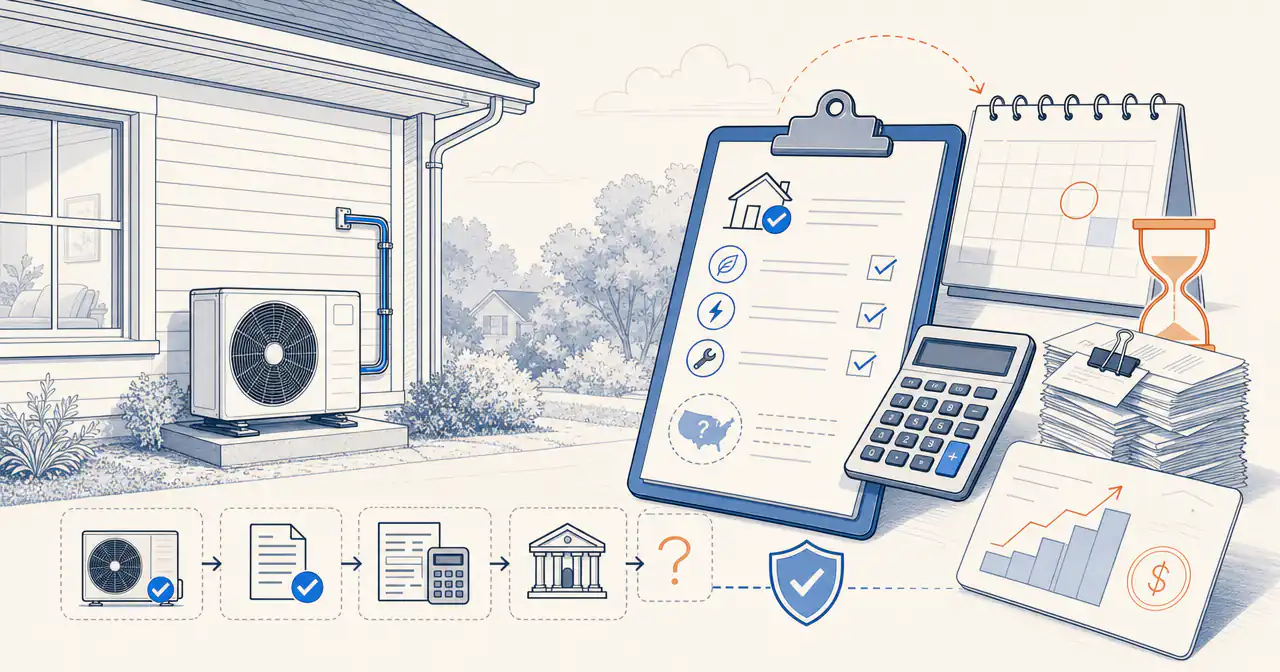
In 2026, the heat pump tax credit question turns on the placed-in-service date. A qualifying air-source heat pump placed in service by December 31, 2025 can still be claimed on the 2025 federal return filed in 2026. A new installation placed in service in 2026 or later does not qualify for Section 25C. This guide explains the 2025 credit amount, model rules, documentation, rebate treatment, and Form 5695 steps.
Last reviewed: 2026-09-16 (UTC)
Quick answer
2026 status: Section 25C does not apply to property placed in service after December 31, 2025. A qualifying 2025 installation can still be claimed on the 2025 federal return filed in 2026. A new 2026 installation needs a separate state, utility, or other incentive path.
- Placed in service by Dec. 31, 2025: The former federal credit may apply if the equipment, residence, cost, documentation, and tax-liability rules are met.
- Bought in 2025 but placed in service in 2026: The purchase date does not preserve the credit.
- Placed in service in 2026 or later: There is no federal Section 25C heat pump credit.
- Heat pump water heater: It was a separate 25C equipment category that shared the $2,000 annual bucket with heat pumps and biomass equipment through 2025.
Does the heat pump tax credit still apply in 2026?
This is the first question many homeowners actually need answered. The IRS Energy Efficient Home Improvement Credit guidance and the 2025 Form 5695 instructions state that Section 25C does not apply to property placed in service after Dec. 31, 2025. The credit covers qualifying property placed in service from Jan. 1, 2023 through Dec. 31, 2025. That creates two different situations:
- Your heat pump was placed in service by Dec. 31, 2025. You can still claim the credit on your 2025 return filed in 2026, as long as the system and documentation meet the rules.
- You are planning a new heat pump installation in 2026 or later. The federal 25C credit no longer applies. Plan around state and utility rebates instead, and do not budget the federal credit into a 2026 install.
Filing in 2026 is not the same thing as installing in 2026. The relevant date is when the property was placed in service, not when you first got the quote, signed the contract, paid a deposit, or ordered the equipment. The Dec. 31, 2025 deadline is an installation deadline, not a federal-return filing deadline. If you are trying to separate that federal question from rebate questions, Watt Wallet's Heat Pump Tax Credit Income Limit guide covers the income-limit confusion.
What can still help with a 2026 installation?
The federal 25C credit is closed for new property placed in service in 2026. The remaining incentive paths are separate from Form 5695:
- State and utility rebates: Amounts, income rules, eligible models, contractor requirements, and application timing vary by program. Start with Heat Pump Rebates by State.
- Home Energy Rebates: The U.S. Department of Energy says its state-, territory-, and Tribe-administered programs are available in select locations and can include heat pumps and other electrical upgrades. The DOE Home Energy Rebates program explains the program framework and availability.
- Installer, manufacturer, or retailer incentives: These are purchase-price reductions or promotions, not federal tax credits. Their treatment can affect the cost used for a 2025 25C claim.
Do not combine these programs into one assumed savings number. A 2026 rebate can reduce the project price even though a new 2026 installation cannot receive the federal 25C credit.
How much is the heat pump tax credit?
Here, "heat pump" means an air-source system for space heating and cooling. A heat pump water heater is a separate equipment category with its own model rules, even though both categories shared the $2,000 25C bucket through 2025. State and utility rebates follow their own program rules.
For a qualifying 2025 installation, the federal heat pump tax credit was generally:
- 30% of eligible project cost
- up to $2,000 per year for qualifying heat pumps, heat pump water heaters, and biomass systems combined
The air-source heat pump and heat-pump-water-heater amounts share that $2,000 annual bucket with biomass equipment. Installing two of those equipment types in the same year does not create two separate $2,000 limits. There is also a broader annual structure behind the scenes:
- up to $2,000 for the heat pump / heat pump water heater / biomass bucket
- up to $1,200 for certain other 25C categories
- up to $3,200 total in one year across the eligible buckets
That does not mean every heat pump project gets a full $2,000. The cap matters only after you calculate 30% of eligible cost.
Simple example
If your qualifying heat pump project costs $12,000 installed and you receive a $1,000 utility rebate that has to be treated as a purchase-price reduction, your adjusted qualified cost may be $11,000.
- 30% of $11,000 = $3,300
- but the annual heat pump bucket is capped at $2,000
- so the credit would be $2,000, assuming the rest of the rules are met
If you are stacking multiple incentives, use Can You Stack Rebates and Tax Credits? before you rely on the first savings number a contractor gives you.
What heat pumps qualify?
A qualifying heat pump is not just "any high-efficiency system." The IRS says qualifying heat pumps must meet or exceed the applicable highest CEE efficiency tier, excluding any advanced tier, for the year the property was placed in service. ENERGY STAR's 2025 air-source heat-pump guidance translates that into a practical rule: eligible air-source heat pumps need to be recognized as ENERGY STAR Most Efficient. That is important for three reasons:
- central ducted heat pumps can qualify
- ductless mini-split heat pumps can qualify
- a salesperson saying "this unit is high efficiency" is not the same thing as satisfying the tax-credit rule
2025 model lookup workflow
The DOE 25C Product Lookup is the year-specific tool for the rated performance information used with the CEE tiers. For a 2025 claim:
- Set the installation year to 2025, not 2026.
- Select the heat-pump system type and enter the exact outdoor model number.
- Add the indoor model numbers or AHRI reference when the system is split or ductless and the tool requests them.
- Save the result for the installed configuration with the invoice and manufacturer paperwork.
For split systems, the indoor and outdoor components must be installed as a qualifying system and meet the applicable CEE requirements. ENERGY STAR's 2025 rules include two paths, one for heating-dominated cold-climate applications and one for cooling-dominated or dual-fuel applications. Either path can be used regardless of the home's location. The eligible list includes central and ductless systems, so the exact model combination matters more than a generic efficiency label.
Who can claim the heat pump tax credit?
The IRS says a qualifying air-source heat pump must be installed in a home located in the United States and used as a residence by the taxpayer. The IRS qualifying-residence FAQ also says this equipment category can include a second home and a rental home where the taxpayer makes the eligible improvement. The improvement must be to an existing home or an addition to or renovation of one, not a newly constructed home. For most homeowners, the practical requirements are:
- the home is in the United States
- the property is an existing home you improve or add onto
- you use the home as a residence, including a qualifying second home
- you paid for the qualifying improvement
- you have enough tax liability to use a nonrefundable credit
The credit is never available to a landlord who does not use the property as a residence. A renter who pays for an eligible heat pump improvement may qualify. If the home is used partly for business, the IRS limits the credit to the nonbusiness share when business use exceeds 20%.
What costs count toward the credit?
For qualifying heat pumps, the IRS residential-energy-property guidance says costs may include labor properly allocable to onsite preparation, assembly, or original installation. That matters because many homeowners underestimate the tax-credit basis by looking only at equipment price. An itemized invoice should separate:
- equipment
- installation labor
- electrical work
- permits or related project costs
- nonqualifying add-ons
That helps with two common problems:
- proving what part of the project is actually tied to the qualifying heat pump
- separating the heat pump credit from other items with their own rules, such as the electric panel upgrade tax credit
Related project costs do not automatically ride along with the heat pump credit. Financing interest, loan origination fees, and extended-warranty costs are not eligible expenditures under the IRS FAQ. A clear invoice makes the qualified and nonqualified portions easier to separate.
How rebates and other incentives affect the tax credit math
This is where homeowners often lose clarity. The IRS rebate guidance says public utility subsidies for buying or installing clean energy property are subtracted from qualified expenses. Manufacturer, distributor, seller, or installer rebates tied to the purchase price may also reduce the amount you can claim. The IRS also says state energy-efficiency incentives are generally not subtracted from qualified costs unless they function as a true rebate or purchase-price adjustment under federal tax law. A state program can use the word "rebate" while receiving different federal tax treatment. That means "I got a rebate" is not specific enough to know the tax treatment. Use this rule of thumb:
- utility subsidy tied to the install -> usually reduces your qualified cost
- state incentive -> may or may not reduce qualified cost depending on how it is structured
- contractor discount or manufacturer rebate -> often reduces purchase price
- federal tax credit -> claimed separately at filing time, not as an upfront discount
If you are sorting out the local side of that math, use Heat Pump Rebates by State, the Heat Pump Water Heater Rebate Guide for water-heater projects, and How to Compare Rebates, Tax Credits, and Installer Quotes before you approve the project budget.
How to claim the heat pump tax credit
The IRS Form 5695 guidance says to file Form 5695, Part II with your federal tax return for the year the property was placed in service. A clean claiming workflow looks like this:
- Use the exact heat pump model and 2025 DOE lookup result for the installation year.
- Use the placed-in-service date to identify the federal tax year. For this credit, a qualifying 2025 project belongs on the 2025 return filed in 2026.
- Save the invoice, proof of payment, model details, and any manufacturer documentation.
- File Form 5695 Part II for the tax year the property was placed in service. The 2025 form uses lines 29a and 29b for electric or natural gas heat pumps, with the QMID and cost entered for the applicable item.
- Keep the documentation in case you need to support the claim later.
There is one more 2025-specific detail worth catching early. The IRS says that for 2025 property placed in service, no credit is allowed unless the item was produced by a qualified manufacturer and the taxpayer reports the Qualified Manufacturer Identification Number (QMID) on the return. The IRS QMID FAQ describes the 2025 QMID as a four-character alphanumeric QM Code that can be used in place of the full product identification number. For a heat pump with indoor and outdoor units, the manufacturer identification is assigned to the outdoor unit. The manufacturer or contractor paperwork should include the code.
What paperwork should you save?
Keep one folder with:
- the final itemized invoice
- proof of payment
- the installed model number and manufacturer documentation
- the saved 2025 DOE lookup result or other qualifying-model evidence
- the four-character QMID or QM Code for the 2025 claim
- the installation completion date
- related rebate paperwork if you stacked programs
- your Form 5695 support records
The IRS generally does not require these records to be attached to the return, but they may be needed if the return is audited. The most common mistake is waiting until tax season to reconstruct the paperwork from email threads, screenshots, and a vague contractor invoice.
Common mistakes homeowners make
Most heat pump tax-credit problems come from one of these mistakes:
- assuming every heat pump qualifies
- mixing up the install date with the order date
- budgeting the full $2,000 before doing the 30% math
- treating all rebates as if they affect tax basis the same way
- confusing a federal tax credit with an income-based rebate program
- failing to save model and manufacturer documentation for a 2025 claim
If your project includes multiple incentives, run the federal credit, the state or utility rebate, and the contractor quote as three separate tracks instead of one blended savings number.
FAQ
What is the deadline for the federal heat pump tax credit?
The property had to be placed in service by December 31, 2025. A qualifying 2025 installation belongs on the 2025 federal return filed in 2026. A 2026 installation does not qualify, even though its federal return would be filed in 2027.
Is there a federal income limit for the heat pump tax credit?
The 25C rules do not use the income tiers associated with many rebate programs. The practical limit is federal tax liability. The credit is nonrefundable, so it can reduce tax owed to zero, but it cannot create a refund for an amount above that liability and unused 25C credit does not carry forward.
Does a mini-split qualify for the heat pump tax credit?
It can. ENERGY STAR's 2025 guidance includes central and ductless systems, including mini-splits, when the exact installed configuration meets the year-specific efficiency rules. The DOE 25C Product Lookup is designed for the installation year and model numbers.
Can I combine the heat pump tax credit with rebates?
Often yes, but the programs keep separate eligibility and tax-treatment rules. Public utility subsidies and purchase-price rebates can reduce the qualified cost used for 25C. State energy-efficiency incentives may not reduce it unless they meet the federal definition of a rebate or purchase-price adjustment.
What if I bought the heat pump in 2025 but it was installed in 2026?
A 2025 purchase date does not protect the credit. The IRS focuses on when the property was installed or placed in service, not when you first paid a deposit or signed the contract. A heat pump placed in service in 2026 does not qualify for 25C, even if you paid for it in 2025.
Can I claim the credit on a second home or as a renter?
For an electric or natural gas heat pump, the home must be in the United States and used as a residence by the taxpayer. The category can include a second home and a rental home where the renter pays for the eligible improvement. A landlord who does not live in the property cannot claim this credit.
Bottom line
For a qualifying air-source heat pump placed in service by Dec. 31, 2025, the former federal credit can still reduce the 2025 tax bill when the model, QMID, qualified costs, residence, and records line up. A new system placed in service in 2026 or later cannot receive Section 25C.
If you are planning a 2026 installation, start with Watt Wallet's Heat Pump Rebates by State guide and keep those program rules separate from any 2025 federal tax filing.