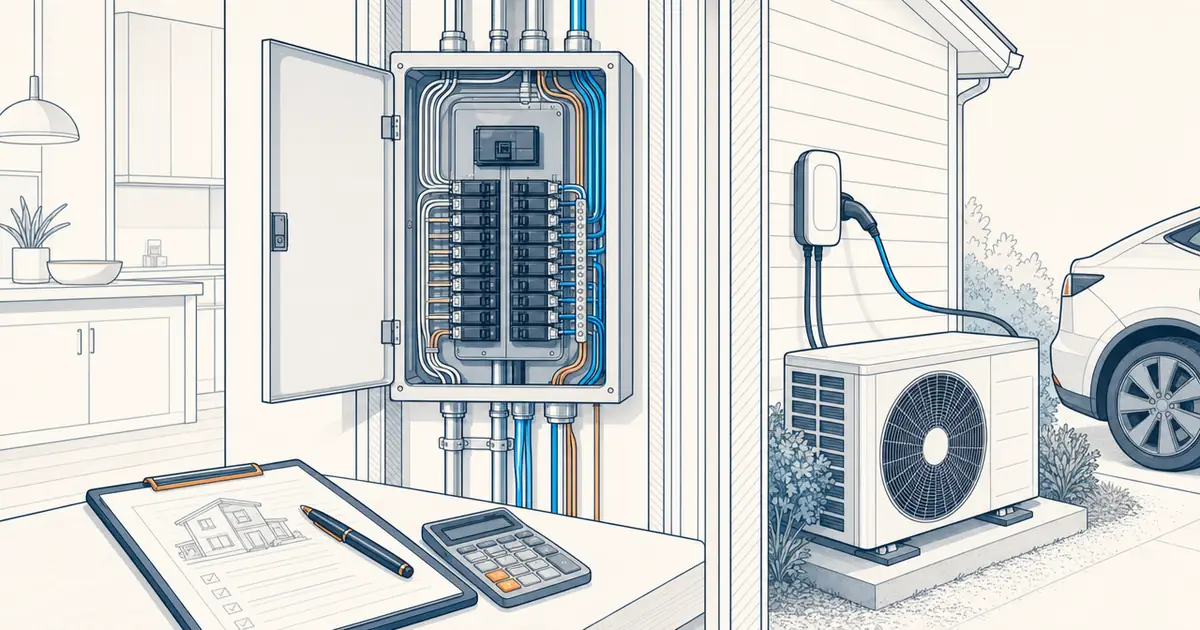
The federal electric panel upgrade tax credit is limited to projects placed in service by December 31, 2025. A new panel project placed in service in 2026 does not qualify for 25C. A qualifying 2025 project may still be claimed on the 2025 federal return filed in 2026.
We explain the 200-amp and enabling-property rules, the $600 limit, the tax-liability cap, eligible residences, QMID, Form 5695 lines 25a-25e, and 2026 incentive paths.
Last reviewed: 2026-09-14 (UTC)
We provide general information, not tax, legal, or financial advice. A qualified tax professional can apply the rules to your return.
Quick answer
| Situation | Federal 25C result |
|---|---|
| New panel project placed in service in 2026 | No federal 25C panel credit. Screen state, utility, and other local programs instead. |
| Qualifying panel project placed in service by December 31, 2025 | It may be claimed on the 2025 federal return filed in 2026, if every 25C requirement is met. |
| Standalone panel replacement | It does not satisfy the panel category by itself. The work must enable separate qualifying property or an eligible efficiency improvement. |
| Panel credit amount | 30% of eligible panel-related cost, up to $600. The result also fits inside the $1,200 annual 25C bucket and the taxpayer's available tax liability. |
| Residence | For the panel category, the home must be in the United States and used as a residence by the taxpayer. A qualifying second home or rented home can fit this rule. |
| Form | Use Part II of the form for the applicable tax year. The 2025 panel section is lines 25a-25e, with QMID on line 25d. |
Start with the project year, not the filing year
The IRS expiration guidance says the Energy Efficient Home Improvement Credit is unavailable for property placed in service after December 31, 2025. The IRS credit page also says qualifying property placed in service from January 1, 2023, through December 31, 2025, can fall within the credit window. ENERGY STAR lists the electric panel credit over the same 2023-2025 period.
That creates two different answers for people searching in 2026.
A new 2026 project
If the panel work is placed in service in 2026, the federal 25C panel credit is unavailable. Filing a 2026 return later does not move that project into the 2025 credit window. The same rule applies to new qualifying equipment installed in 2026 as part of the panel project.
A qualifying 2025 project filed in 2026
If the panel work and the enabled property were placed in service within the 2025 window, the claim belongs on the 2025 federal return, even when that return is filed in 2026. Use the tax-year form that matches the project, along with the documentation that supports the project dates and scope.
A project split across two tax years
The 2025 Form 5695 instructions include a safe harbor for enabling property and the property it enables when they were installed in consecutive tax years. You may treat both as installed in the later of those two years. For example, a panel installed in 2024 and a qualifying heat pump water heater installed in 2025 can be treated as a 2025 project under the safe harbor.
The safe harbor cannot bring a 2026 installation back into the federal credit window. If the later installation year is 2026, the panel path does not create a new 25C credit.
The panel must enable qualifying property
The IRS and ENERGY STAR panel criteria describe the panel work as enabling property. The qualifying scope can include an improvement to or replacement of a:
- panelboard,
- subpanelboard,
- branch circuit, or
- feeder.
The work must meet all three conditions below:
- It is installed in a manner consistent with the National Electrical Code.
- It has a load capacity of at least 200 amps.
- It is installed in conjunction with, and enables the installation and use of, a separate qualified energy efficiency improvement or qualified energy property.
The 2025 instructions list these enabled-property codes for line 25b:
- A: qualifying windows and skylights
- B: qualifying central air conditioners
- C: qualifying natural gas, propane, or oil water heaters
- D: qualifying natural gas, propane, or oil furnaces or hot water boilers
- E: qualifying electric or natural gas heat pumps
- F: qualifying electric or natural gas heat pump water heaters
- G: qualifying biomass stoves or boilers
This is the boundary between a panel project that can fit 25C and an ordinary electrical upgrade. A standalone replacement for safety, capacity, service, or future readiness does not have an enabled property to report on line 25a. A 200-amp label alone also does not establish the required relationship.
The tax rule speaks to load capacity. It does not determine whether your home needs a utility service change or which electrical design is safe. Keep the electrician's actual scope, permit records, and equipment details with the tax documents. For the broader 25C categories, our Energy Efficient Home Improvement guide provides the larger credit map.
The $600 panel limit is a ceiling
For qualifying panel-related work, the calculation is:
- 30% of eligible cost
- up to $600 for the panel-related item
Examples:
- $1,000 of eligible cost produces a $300 credit before other limits.
- $2,000 of eligible cost produces a $600 credit before other limits.
- $3,000 of eligible cost still produces no more than a $600 panel credit.
The panel amount flows into the broader $1,200 annual 25C bucket, which also covers several other property categories and home energy audits. The separate heat pump, heat pump water heater, and biomass category has its own annual limit, where applicable. A panel credit does not automatically add $600 to every other 25C category.
Your tax liability can reduce the final amount
The credit is nonrefundable. It can reduce your federal income tax for the year to zero, but it cannot exceed the tax liability available for the credit. The IRS 25C guidance says you cannot apply excess Energy Efficient Home Improvement Credit to future tax years.
The carryforward statement at line 16 of the 2025 Form 5695 instructions appears under Part I, Residential Clean Energy Credit. It applies to that separate credit, not to the panel claim in Part II, Energy Efficient Home Improvement Credit.
For example, a $600 panel calculation can produce a final 25C credit of $250 for 2025 when the Form 5695 tax-liability worksheet limits the amount usable in that year to $250. The remaining $350 cannot be carried to 2026. This is separate from the $600 project cap.
Rebates, utility subsidies, and certain other incentives can also reduce the cost used for the federal calculation. Keep those amounts separate from the tax-credit estimate instead of treating every discount as additional federal tax-credit value. Our guide to stacking rebates and tax credits explains how to keep the buckets distinct.
Who can claim the panel credit?
For panel-related residential energy property, the home must be:
- located in the United States,
- an existing home, addition, or renovation rather than a newly constructed home, and
- used as a residence by the taxpayer.
The IRS residence rules make this category broader than the principal-residence rule used for some windows, doors, insulation, and air-sealing claims. For panel work, a taxpayer's qualifying second home can fit the residence rule. A renter who pays for eligible improvements to a rented home can also fit it. A landlord who does not use the property as a residence cannot claim the credit for that rental home.
Property used entirely for business does not qualify. When business use is limited, the credit may be limited to the nonbusiness share under the IRS rules.
Keep a project file that matches the tax rule
The panel invoice should tell the same story as the Form 5695 entry. Keep:
- an itemized invoice identifying the panelboard, subpanelboard, branch-circuit, or feeder work,
- the invoice or scope for the qualifying property the panel work enabled,
- placed-in-service dates for both parts of the project,
- permit or contractor records showing NEC-consistent work,
- specifications or scope notes showing the panel's load capacity,
- proof of payment,
- records of utility subsidies, rebates, or other price adjustments, and
- the manufacturer's Qualified Manufacturer Identification Number (QMID) or other required manufacturer identification for the 2025 filing.
For a 2025 claim, the QMID is a four-character alphanumeric identifier assigned through the qualified-manufacturer process. The 2025 Form 5695 specifically asks for the QMID of the enabling property on line 25d. A model number or equipment name is a different record.
The 2025 Form 5695 instructions say to keep manufacturer certifications for your records rather than attach them to the return. Keep the project file together when the panel and enabled property were installed in consecutive years, since the safe-harbor treatment depends on both dates.
How lines 25a-25e work on the 2025 Form 5695
The 2025 Form 5695 puts the panel claim in Part II, Section B. The five-line sequence is designed to capture the relationship between the panel work and the property it enabled.
| Form 5695 line | What it covers |
|---|---|
| 25a | Yes-or-no question asking whether the panel-related work enabled separate qualifying property and whether both properties were installed in 2025, with the instructions covering the consecutive-year safe harbor. A “No” answer ends the panel section. |
| 25b | The code for the enabled property, from A through G. |
| 25c | The amount paid for the panelboard, subpanelboard, branch-circuit, or feeder work. |
| 25d | The QMID or QMIDs for the enabling property. |
| 25e | 30% of line 25c, capped at $600. |
The amount from line 25e joins the other standard 25C items on line 27 and is limited by the $1,200 amount on line 28. Form 5695 line 31 applies the tax-liability limit, and line 32 carries the final Energy Efficient Home Improvement Credit to Schedule 3.
For a qualifying 2025 project filed in 2026, use the 2025 form and instructions. The form year follows the tax year of the qualifying project, not the year you happen to submit the return.
For the rest of the form, use our Form 5695 guide.
Screen 2026 programs separately
There is no new federal 25C panel credit for property placed in service in 2026. A 2026 project can still have other incentive paths, and those programs use different rules.
The Department of Energy says state, territory, and Tribal programs manage Home Energy Rebates and decide which products are eligible. Its Home Upgrades guidance lists electrical panel upgrades as potentially eligible for:
- a High-Efficiency Electric Home Rebate of up to $4,000 for an electrical panel, and
- a Home Owner Managing Energy Savings Rebate of up to $8,000 for projects that significantly reduce household energy use.
Those are program ceilings, not automatic payments. Income, energy-savings, product, contractor, timing, and local funding rules can change the result. The DOE Home Energy Rebates page says the rebates are available in select states and directs homeowners to state, territory, or Tribal program information.
Use this short screen for a new project:
- Location: Find the state, territory, Tribal, utility, and local programs serving the home's ZIP code.
- Measure: Match the project to panel, circuit, wiring, heat pump, water-heating, or whole-home efficiency categories.
- Household rules: Note income limits, residence rules, and any required energy-savings threshold.
- Project timing: Note application, reservation, inspection, participating-contractor, and completion requirements before the work begins.
- Quote detail: Ask for separate lines for panel work, enabled equipment, permits, rebates, and the homeowner's remaining cost.
For a paired heat pump project, our rebates and installer quote guide can help separate program estimates from contractor pricing.
FAQ
Can a renter or second-home owner claim the panel credit?
The panel category can apply to a U.S. home used as a residence by the taxpayer, including a qualifying second home and a rented home where the renter paid for the eligible improvement. A landlord who does not live in the rental cannot claim the credit for that property.
What if the panel and the enabled equipment were installed in different years?
The 2025 instructions allow a consecutive-tax-year safe harbor that treats both items as installed in the later year. The later year still has to fall inside the 25C window. A 2025 panel and a 2026 enabled property do not create a new 2026 federal panel credit.
Can unused 25C credit carry forward?
No. The 25C Energy Efficient Home Improvement Credit is nonrefundable, and the IRS says you cannot apply excess credit to future tax years. If the tax-liability limit lets you use only $250 of a $600 panel calculation on a qualifying 2025 return, the unused $350 cannot be carried to 2026. The line 16 statement in the 2025 Form 5695 instructions appears under Part I, Residential Clean Energy Credit. It describes a carryforward for that separate credit, not for the Part II panel claim under 25C.
The decision is simple once the dates and project relationship are separated: a qualifying 2025 panel project can be part of a 2025 return filed in 2026, while a new 2026 installation needs a different incentive plan. For that project, start with our incentives library to screen programs by location and upgrade type.
Sources
- IRS: Working Families Tax Cuts
- IRS: Energy Efficient Home Improvement Credit
- IRS: Qualifying residence FAQs
- IRS: Instructions for Form 5695 (2025)
- IRS: Form 5695 (2025 PDF)
- ENERGY STAR: Electric Panel Upgrade Tax Credit
- DOE: Home Upgrades
- DOE: Home Energy Rebates Program
- Rewiring America: 25C Electrical Panel Tax Credits