Last reviewed: 2026-06-30 (UTC). All amounts re-verified against Efficiency Maine's official rebate pages.
Efficiency Maine still offers real heat pump rebates in 2026, but homeowners need to separate the rebate path before they trust a net-price quote.
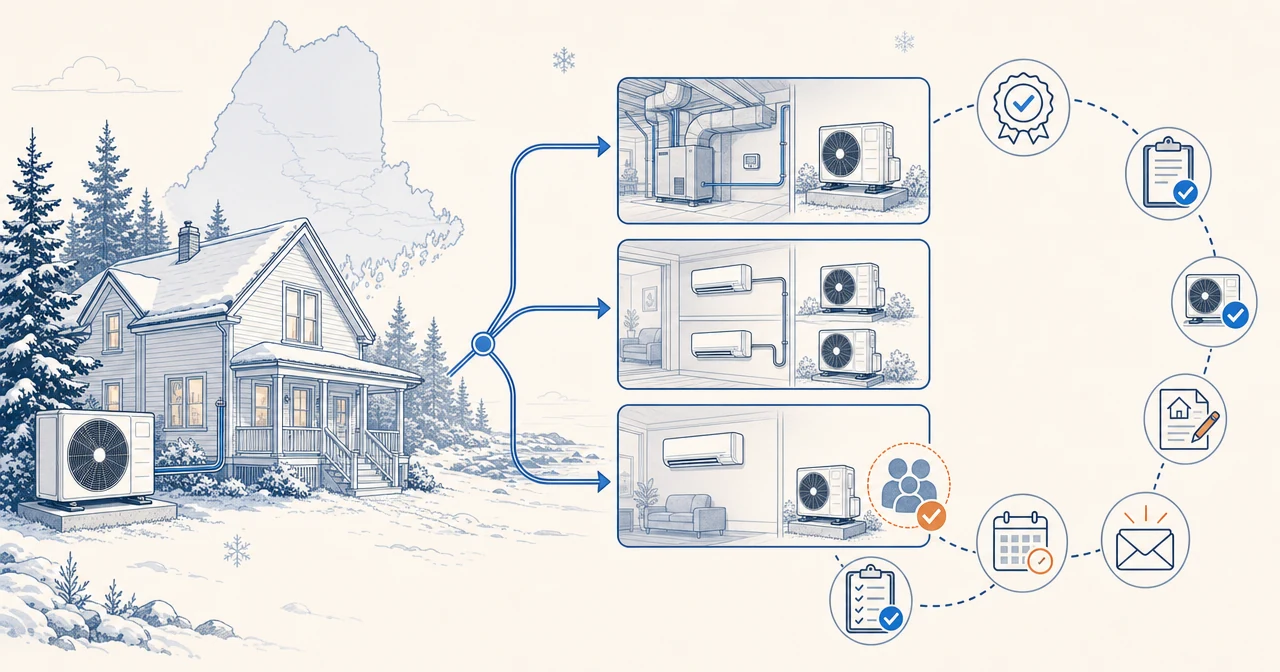
The most common planning mistake is treating every Maine heat pump project as if it qualifies for the same rebate number. It does not. Your amount changes based on whether the system is ducted whole-home, non-ducted whole-home / other, or the low-income first-heat-pump path, and the official pages also change the rules based on income verification, equipment type, building type, and application timing.
Quick answer
Efficiency Maine's current residential pages show up to $9,000 in heat pump rebates for qualifying low-income whole-home projects, lower caps for moderate-income and any-income households, and a separate $3,000 low-income path for a first rebate-eligible single-zone heat pump. The official whole-home heat pump page also says qualifying whole-home upgrades completed in 2026 can add a $500 per housing unit bonus when the rebate claim is emailed or postmarked in the official window.
The right number depends on three things first: which rebate path applies, whether you qualify for the low- or moderate-income tier, and whether the proposed equipment plus installation rules actually match Efficiency Maine's published requirements.
2026 Maine heat pump rebate amounts to compare first
| Rebate path | Low income | Moderate income | Any income |
|---|---|---|---|
| Whole-home ducted systems | $9,000 per housing unit | $6,000 per housing unit | $3,000 per housing unit |
| Whole-home non-ducted or other systems | $3,000 per rebate-eligible outdoor unit up to $9,000 lifetime | $2,000 per unit up to $6,000 lifetime | $1,000 per unit up to $3,000 lifetime |
| Low-income supplemental first-heat-pump path | $3,000 for one rebate-eligible single-zone heat pump | — | — |
The official whole-home page says qualifying whole-home upgrades can add $500 per housing unit when the upgrade is completed and the rebate claim is emailed or postmarked between March 1 and December 31, 2026.
Efficiency Maine also runs a narrow Mobile Home Initiative for income-eligible owners of qualifying single-wide mobile (manufactured) homes that currently heat with a fossil fuel such as propane. That page says homeowners must prequalify for the enhanced $12,900 rebate, use a participating installer, and that these projects are not eligible for the $500 whole-home bonus. It also notes a separate optional $400 rebate from the Maine Department of Environmental Protection for removing an existing fuel tank through a participating contractor.
Which Efficiency Maine rebate path actually fits your project
Efficiency Maine effectively gives homeowners three different questions to answer before they budget the rebate.
1. Whole-home ducted systems
Use the ducted rebate page when the project uses ducted heat pumps as the home's primary heating system.
The official ducted page says the heat pump must be on Efficiency Maine's eligible list, sized for at least 100% of the home's peak heating load, and installed according to the installation checklist. For existing homes, it also says fossil-fuel forced-hot-air furnaces must be removed as part of the upgrade.
2. Whole-home non-ducted or other systems
Use the main residential heat pump rebate page when the project is whole-home but not the ducted path above.
That page says single-zone heat pumps on Efficiency Maine's eligible list can qualify, multi-zone heat pumps are not rebate-eligible themselves even though their design-temperature heating capacity can count toward the home's total calculation, and dual-fuel heat-pump / fossil-fuel furnace systems are not eligible. It also says new and previously installed heat pumps must be sized for at least 80% of the home's peak heating load, and the heat pumps plus allowed supplemental heat must cover 100% of peak load.
3. Low-income first heat pump path
Efficiency Maine describes this separately on its official $3,000 Supplemental Heat Pump Rebate for Low-Income Households page for a household installing its first heat pump.
This path pays $3,000 for one rebate-eligible single-zone heat pump, counts toward the housing unit's lifetime maximum, and applies only when the homeowner or a household member participates in MaineCare, HEAP, SNAP, or TANF. The official supplemental page says the home must be an owner-occupied principal residence in an eligible small residential building, must not have a natural-gas utility account before the upgrade, and must use a qualifying single-zone heat pump as the first heat pump at the residence.
That same supplemental page also says an installer reservation is recommended before work begins, installers can use the reservation request form, and the registered vendor submits the Low-Income Supplemental Heat Pump Claim Form.
The eligibility checks that change more projects than the headline rebate amount
The current official pages show that the rebate is not just "available in Maine." These are the checks that most often change the outcome.
1. Income verification and principal-residence rules
The income-verification page is not optional if you want the higher low- or moderate-income amounts.
Efficiency Maine says moderate-income eligibility currently means adjusted gross income up to $70,000 for individual filers or $100,000 for joint filers. The low-income paths rely on participation in programs such as MaineCare, HEAP, SNAP, or TANF. The official residential and ducted pages also say the home must be the owner's principal residence for low- and moderate-income homeowners.
2. Equipment and load-calculation rules
Before you sign a quote, check the proposed model against the rebate-eligible heat pump list.
The current residential page says single-zone units can qualify directly, multi-zone units can affect the heating-load math but are not rebate-eligible on their own, and dual-fuel heat-pump / fossil-fuel furnace systems are not eligible. The official pages also split the sizing rule: ducted systems need at least 100% of peak heating load, while qualifying non-ducted whole-home projects need at least 80% of peak load from the heat pumps and 100% total coverage when allowed supplemental heat is included.
3. Building, fuel, and primary-heating rules
The official residential pages repeatedly narrow the qualifying building types to small residential properties such as single-family homes, duplexes, condominiums, or mixed-use buildings with one or two housing units and no commercial electric meter.
For the non-ducted whole-home path, Efficiency Maine says any fossil-fuel system that remains must be reserved for emergency backup only, its heating capacity cannot count toward the total, and the home must not have had a natural-gas utility account before the upgrade. For the ducted path, the official page says existing homes must remove fossil-fuel forced-hot-air furnaces as part of the upgrade, and new homes must be built without fossil-fuel furnaces or boilers.
4. Vendor, form, and timing rules
Both the residential and ducted rebate pages say the system must be installed by an Efficiency Maine Residential Registered Vendor and installed according to the published installation checklist.
The paperwork is also path-specific. The official pages show that whole-home non-ducted or other systems use the Residential Heat Pump Claim Form, ducted whole-home systems use the Residential Ducted Heat Pump Claim Form, and the supplemental low-income path uses the Low-Income Supplemental Heat Pump Claim Form plus its separate reservation workflow.
The official pages also say the relevant claim form must be emailed or postmarked within 6 months of project completion. The supplemental low-income page adds that an installer reservation is recommended before work begins. Across all paths, incomplete submissions can delay or disqualify the rebate and some projects may be inspected.
How the Maine rebate application flow actually works
The published pages support a more careful homeowner workflow than "install first and hope the rebate applies."
- Match the project to the right path first. Separate ducted whole-home, non-ducted whole-home / other, and low-income first-heat-pump scenarios before you compare installer numbers.
- Complete income verification early if needed. If the quote assumes low- or moderate-income pricing, use the official income-verification process before you rely on the higher amount. If the supplemental low-income path may apply, ask the vendor about the recommended reservation step before work begins.
- Use a registered vendor and confirm the exact model. Check the vendor locator and confirm the proposed equipment is on the eligible list.
- Ask for the sizing logic in writing. For whole-home projects, get the heating-load math and the backup-heat assumptions in writing before you sign.
- Save the paperwork as you go. Keep the quote, invoice, sizing worksheet, and any income-verification documents together with the path-specific paperwork: the residential form, the ducted form, or the supplemental low-income form and reservation request.
- Submit the right form on time. The official pages say the claim form must be emailed or postmarked within 6 months of project completion, and whole-home homeowners who want the extra 2026 bonus must also hit the bonus window on the official whole-home page.
Financing and quote-comparison notes
Efficiency Maine says the Home Energy Loan can help finance qualifying heat pump work, including some related scope.
That loan can help with cash flow, but it does not replace rebate verification. One thing to watch in 2026: the federal 25C Energy Efficient Home Improvement Credit that used to add up to $2,000 for a qualifying heat pump no longer applies to systems placed in service after December 31, 2025, so a Maine quote should not assume that federal credit on top of the Efficiency Maine rebate this year (only 2025 installs remain claimable, on a 2025 return). If a contractor bundles the Maine rebate together with federal savings or financing assumptions in one blended "after incentives" number, separate the math before you approve the project. Watt Wallet's guide to comparing rebates, tax credits, and installer quotes is the best next read if the savings stack still feels fuzzy. If the monthly-payment question matters as much as the rebate amount, compare heat pump financing options before you assume borrowing solves the whole problem.
Recommended next step for most homeowners
Before you treat a Maine heat pump rebate number as real money, ask the installer for three things in writing:
- the exact Efficiency Maine rebate path they are using;
- the exact model numbers and eligible-equipment references they are using; and
- the exact claim form and documentation package they expect you to submit.
That one check usually exposes whether the quote is grounded in the current Efficiency Maine rules or just using a best-case incentive headline.
Official sources
- Efficiency Maine: Residential Heat Pump Rebates
- Efficiency Maine: Residential Ducted Heat Pump Rebates
- Efficiency Maine: $3,000 Supplemental Heat Pump Rebate for Low-Income Households
- Efficiency Maine: Whole-Home Heat Pump Rebates
- Efficiency Maine: Mobile Home Initiative
- Efficiency Maine: Income-Based Eligibility Verification
- Efficiency Maine: Rebate-Eligible Heat Pumps list
- Efficiency Maine: Residential Registered Vendor locator
- Efficiency Maine: Residential Heat Pump Installation Checklist
Fast application checklist
- Step 1: Match the project to the right Efficiency Maine path first — ducted whole-home, non-ducted whole-home / other, or the low-income first-heat-pump path.
- Step 2: If the quote assumes low- or moderate-income pricing, complete Efficiency Maine's income-verification process before you rely on the higher rebate amount. If the supplemental low-income path may apply, ask the vendor about the reservation step before work begins.
- Step 3: Hire an Efficiency Maine Residential Registered Vendor for heat pumps and confirm the exact proposed model appears on the rebate-eligible equipment list.
- Step 4: Ask the installer to document the heating-load calculation, backup-heat treatment, and whole-home vs. first-heat-pump logic before you sign.
- Step 5: Save the path-specific paperwork in one folder — the residential form, the ducted form, or the supplemental low-income form and reservation request — alongside the quote, invoice, sizing worksheet, and income-verification documents.
- Step 6: Email or postmark the correct claim within 6 months of project completion. If the project qualifies for the 2026 whole-home bonus, make sure it also hits the official bonus window.
- Step 7: If the savings math still blends rebates, financing, or federal assumptions together, separate those pieces before you approve the project budget.