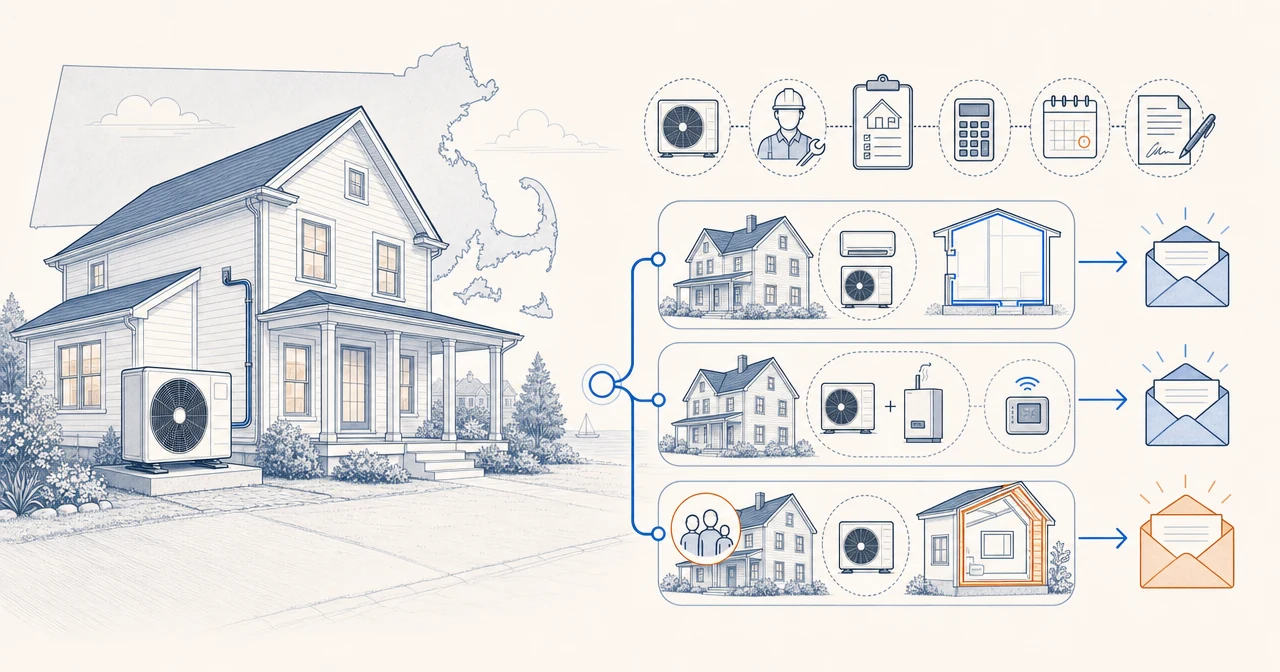
Mass Save's 2026 heat pump rebate is not one flat amount. The right path can be $250 per ton, $2,650 per ton, $13,500 per home, or an enhanced income-qualified amount. We separate the options in the order that matters for a quote: system type, existing fuel, utility sponsor, weatherization, and use of backup heat.
2026 Mass Save heat pump rebates at a glance
Use this table to identify the project lane before comparing contractor quotes. Standard and enhanced rebates are separate paths. Tonnage is based on AHRI cooling capacity divided by 12,000 BTUs.
| 2026 project path | Standard rebate | Enhanced income-qualified path | Main condition |
|---|---|---|---|
| Air-source whole-home | $2,650 per ton, up to $8,500 per account | Up to $16,000, or up to no cost through Turnkey Services | The heat pump is the sole source of space heating and cooling, with sufficient weatherization and a signed Whole-Home Verification Form. |
| Air-source partial-home | $1,125 per ton, up to $8,500, plus a possible $500 weatherization bonus and $500 sizing bonus | Up to $16,000 | The heat pump supplements the existing system or serves part of the home. Integrated controls or documented zone disconnection may be required. |
| Air-source basic | $250 per ton, up to $2,500 | No enhanced amount is listed for this path | The project does not displace fossil-fuel or electric-resistance heat, such as a replacement heat pump or a newly conditioned space. |
| Air-to-water | $2,650 per ton, up to $8,500 | Up to $16,000, with Mass Save stating eligibility for 80% of installed cost | The 2026 page describes a whole-home path with weatherization and the Whole-Home Verification Form. |
| Ground-source whole-home | $13,500 per home | Up to $25,000, with Mass Save stating eligibility for 80% of installed cost | The system is the sole source of heating and cooling and meets the weatherization and verification rules. |
| Ground-source partial-home | $2,000 per ton, up to $13,500 statewide | Up to $25,000, with Mass Save stating eligibility for 80% of installed cost | The ground-source system serves part of the home and the project follows the partial-home requirements. |
The enhanced amounts require income verification. The statewide enhanced rebate page limits the listed electric-sponsor path to Cape Light Compact, Eversource, National Grid, and Unitil. It also requires the pre-existing heating system to be oil, propane, or electric resistance. Natural-gas customers use the standard sponsor path instead of the statewide enhanced heat pump path.
A heat pump water heater uses a separate Mass Save program, so use our heat pump water heater rebate guide for that project.
Cape Light Compact rules need their own check
Cape Light Compact customers should use the Compact's 2026 heat pump page alongside the statewide Mass Save pages. The standard air-source amounts match the table above, but some enhanced and ground-source details differ:
- Cape Light Compact's page lists $16,000 per home for moderate-income air-source whole-home and partial-home projects. Its income-eligible column lists 100% of total installation cost for those two air-source paths. Basic rebates have no enhanced amount listed.
- Its air-to-water table lists $2,650 per ton up to $8,500 standard and $16,000 per home for moderate-income customers.
- Its ground-source table lists $13,500 per home for whole-home systems and $2,000 per ton up to $15,000 for partial-home systems. That $15,000 partial-home cap is different from the $13,500 cap on the statewide Mass Save ground-source page.
- Cape Light Compact lists $25,000 per home for moderate-income whole-home and partial-home ground-source projects.
- The Compact's residential heat pump program is for existing Eversource electric account holders on Cape Cod and Martha's Vineyard. For income verification, it directs customers to 1-800-797-6699.
Cape Light Compact also gives partial-home integrated controls a specific switchover rule: the system must switch to the existing fossil-fuel system at an outdoor temperature no higher than 30°F for oil and natural gas, or 5°F for propane. Customers can choose a lower switchover temperature. Do not carry a statewide enhanced or ground-source number into a Cape Light Compact quote without separating the Compact's path.
Whole-home, partial-home, and basic mean different things
The rebate category follows how the heat pump operates in the home, not the size of the equipment or the contractor's preferred wording.
Whole-home
Whole-home means the heat pump is the sole source of space heating and cooling throughout the conditioned home. The existing system must be removed or disconnected. The 2026 verification form allows the old system to remain for domestic hot water only when space heating is disabled.
The form also requires equipment sized to meet 90% to 120% of the total heating load at the outdoor design temperature, under ACCA Manual J design conditions, across 100% of the conditioned space. A contractor may need to provide Manual J or Manual D documentation if Mass Save requests it.
Partial-home
Partial-home applies when the heat pump serves only part of the home or an existing boiler or furnace stays in service to supplement it. If oil, propane, or natural gas remains in a heat-pump-served zone, a control from the Integrated Control Qualified Product List is required.
There is one important alternative. When the heat pump fully replaces the old fuel system in an entire zone, the installer can remove or disable the old system in that zone instead of installing an integrated control. The invoice must document the removal or disconnection. The control requirement is a condition of the partial-home rebate. It is separate from the $500 sizing and weatherization bonuses.
Basic
Basic is for projects that do not displace fossil-fuel or electric-resistance heat. Mass Save lists replacing an existing heat pump or central air-conditioning system, adding a heat pump to a previously unconditioned space, and installing a heat pump in a home that is not occupied in winter as examples. Basic has no sizing or weatherization bonus.
Adding a heat pump to an unconditioned space can qualify for a basic rebate in addition to a whole-home or partial-home air-source rebate, subject to the account cap. The basic form is still a separate application path.
Eligibility checks that change the rebate amount
Start with the sponsor and the fuel being replaced
For the standard whole-home and partial-home paths, Mass Save separates customers into two sponsor groups:
- Electric sponsor customers replacing oil, propane, or electric resistance: Cape Light Compact, Eversource, National Grid, or Unitil. Apply with a residential electric account.
- Natural-gas sponsor customers replacing natural gas: Berkshire Gas, Eversource, Liberty Utilities, National Grid, or Unitil. Apply with a residential gas account.
The basic rebate is listed for customers of a Mass Save electric sponsor who apply with a residential electric account. A customer in a municipal-electric territory may qualify for a natural-gas replacement when the home's natural gas comes from a Mass Save natural-gas sponsor and the application uses that residential gas account. The residential pages separately say customers with municipal-gas heating are not eligible for heat pump rebates, so do not turn a municipal-gas case into a basic-rebate claim by pointing to a different electric account.
The standard forms also require an existing account and expressly exclude new construction projects. Whole-home and partial-home rebates are for residences occupied full time during the winter heating season. A summer home may fit the basic category instead.
Meet the equipment and installer rules
Air-source systems must meet the program efficiency requirements and appear on the Mass Save Heat Pump Qualified Product List. Air-to-water systems must be listed on that list. Ground-source systems must meet the program's qualified-equipment rules, including ENERGY STAR and AHRI requirements shown on the ground-source page.
The qualified-products page says new residential and light-commercial heat pump systems with global-warming potential above 700, including R-410A systems, were removed from the list on January 1, 2026. Have the quote identify the exact indoor and outdoor model combination, rather than relying on a brand name or a generic equipment description.
Installation must be completed by a contractor in the Mass Save Heat Pump Installer Network. Network contractors provide proof of EPA certification, Massachusetts insurance, and heat-pump training. Network participation satisfies a program gate, but Mass Save does not guarantee a contractor's workmanship. Compare experience, references, scope, and price separately.
Weatherization, verification, and the two $500 bonuses
Weatherization is where many whole-home quotes become partial-home quotes.
For a standard whole-home project, sufficient weatherization can be shown in any of these ways:
- The home was built in 2000 or later.
- A Mass Save Home Energy Assessment recommends less than $1,000 of weatherization work.
- Weatherization recommendations made during or after 2013 have been completed.
The 2026 Whole-Home Verification Form must be completed and signed by the customer and installer. It records the sole-source heating requirement, the old-system removal or disconnection, sufficient weatherization, winter occupancy, and customer and sponsor account information. A whole-home project that does not meet the weatherization rule may receive the partial-home amount instead.
The enhanced path has a stricter process. Mass Save requires all weatherization updates recommended during the Home Energy Assessment to be completed before the enhanced rebate application. Weatherization is available at no cost for income-verified customers through that program. Whole-home enhanced rebates also require an individually metered 1-4 unit building or townhouse under the statewide page.
The partial-home air-source bonuses work as follows:
- $500 weatherization bonus: complete a Home Energy Assessment and install its recommended weatherization within one year before, or up to six months after, the partial-home heat pump installation.
- $500 sizing bonus: install equipment sized to meet 90% to 120% of the total heating load at the outdoor design temperature throughout 100% of the conditioned space, and submit the required Manual J load calculation.
Mass Save says the heat pump rebate and applicable bonus must be applied for together through the online portal. A quote that says “right-sized” without including the load calculation does not establish the sizing-bonus path.
Which form and application path to use
Use the online path when possible. The paper forms show the same 2026 requirements and give a mail option.
| Project | Online application | Paper form |
|---|---|---|
| Air-source whole-home or partial-home | Air-source online portal | 2026 air-source form |
| Air-source basic | Air-source online portal | Basic heat pump form |
| Air-to-water | Air-to-water portal | Air-to-water form |
| Ground-source | Ground-source portal | Ground-source form |
| Enhanced income-qualified | Enhanced eligibility portal, then enhanced claim portal | Enhanced heat pump form |
The standard paper forms direct applicants to mail completed paperwork to:
- Mass Save Residential Heating and Cooling Program
- 1337 Massachusetts Ave, PO Box #228
- Arlington, MA 02476
Submit the form after installation with the required documentation. The air-source form asks for an itemized invoice from an HPIN installer showing the installer name and address, indoor and outdoor model numbers, installation date and address, total installed cost for each system, and proof of payment. Add the following when they apply:
- the signed Whole-Home Verification Form;
- Manual J load documentation for the sizing bonus;
- the Home Energy Assessment and weatherization completion evidence for a whole-home or weatherization-bonus claim;
- the integrated-control model and installation details, or the invoice record of zone disconnection;
- the AHRI reference and cooling capacity used to calculate tons; and
- the income-verification confirmation for an enhanced claim.
2026 deadlines, inspection, and the HEAT Loan
For 2026 projects, the equipment must be installed between January 1 and December 31, 2026 by a participating HPIN contractor. Mass Save's program pages say the rebate form and supporting documents must be received by February 28, 2027. The standard paper form uses a postmark deadline, so a paper application should be mailed ahead of that date. The 2025 application deadline, February 28, 2026, has passed.
Some projects are selected for a random inspection. If selected, schedule it before expecting the rebate to process. The form terms say refusing a post-installation inspection can forfeit the rebate. Mass Save's forms say to allow about six to eight weeks after processing and approval, with longer handling when documents are missing.
The Mass Save HEAT Loan is separate from the rebate. Qualified homeowners may receive up to $25,000 at 0% interest for eligible upgrades, including heat pumps. The maximum is a lifetime total across eligible energy-efficiency upgrades. Apply before installation with a signed contractor proposal, receive the loan authorization, use a participating lender, and then complete the work. Mass Save requires a Home Energy Assessment for a whole-home heat pump and for a partial-home project when you are pursuing bonus incentives. After installation, apply for the rebate separately.
HEAT Loan financing is an allowed exception to the same-equipment stacking restriction in the rebate form. It gives you a way to manage cash flow, but it does not change the rebate category or guarantee the rebate amount.
What your quote and application file should show
Ask the contractor to put these items in writing before you sign:
- The exact path: standard or enhanced, air-source whole-home, air-source partial-home, basic, air-to-water, or ground-source, plus the sponsor and account being used.
- The equipment identity: indoor and outdoor model numbers, AHRI reference, cooling capacity, calculated tons, and the Mass Save HPQPL or ENERGY STAR qualification.
- The installer identity: HPIN company name and company ID.
- The gross project cost: equipment, labor, electrical work, removal or disconnection, weatherization, permits, and other line items before subtracting any incentive or loan.
- The whole-home evidence: weatherization basis, signed verification form, old-system disposition, and the Manual J sizing calculation.
- The partial-home evidence: integrated-control model and switchover setting, or a clear invoice line documenting the old system's removal or disconnection from the served zone. Include the documents for either $500 bonus.
- The timing: planned installation date and a submission plan that reaches Mass Save before February 28, 2027.
- The incentive assumptions: Mass Save standard or enhanced amount, any Cape Light Compact difference, HEAT Loan amount, and a separate line showing that the 2026 federal heat-pump credit is not being counted.
The IRS says the Energy Efficient Home Improvement Credit under Section 25C applies only to qualifying property placed in service through December 31, 2025. Its Section 25D guidance also ends the residential clean-energy credit for expenditures made after December 31, 2025. A new 2026 heat pump installation should therefore have $0 in the quote for those old federal heat-pump or geothermal credits. Mass Save's own 2026 equipment pages carry the same warning. The IRS credit page is the right primary source for the federal cutoff.
Before you commit, run the gross cost and incentive assumptions through Watt Wallet's rebate and quote comparison guide, then submit the form that matches the documented Mass Save path.
Fast application checklist
- Step 1: Match the project to the correct Mass Save system path first: air-source, air-to-water, or ground-source, then whole-home, partial-home, or basic.
- Step 2: Confirm the sponsor path, the existing heating fuel, and whether enhanced income-qualified or Cape Light Compact-specific rules change the rebate assumptions.
- Step 3: Get quotes from Mass Save Heat Pump Installer Network contractors that identify model numbers, qualified-product references, tonnage, and a heating-load calculation if you may pursue the sizing bonus.
- Step 4: If the project is whole-home, confirm the weatherization requirement and complete the Whole-Home Heat Pump Verification Form. If it is partial-home, verify whether integrated controls or documented zone disconnection will be required.
- Step 5: Submit the correct online or mail-in rebate form with the invoice and supporting documents before the applicable deadline, and keep the file ready in case the project is selected for inspection.
- Step 6: If cash flow matters, ask about the 0% HEAT Loan before installation instead of treating rebate timing as the financing plan.