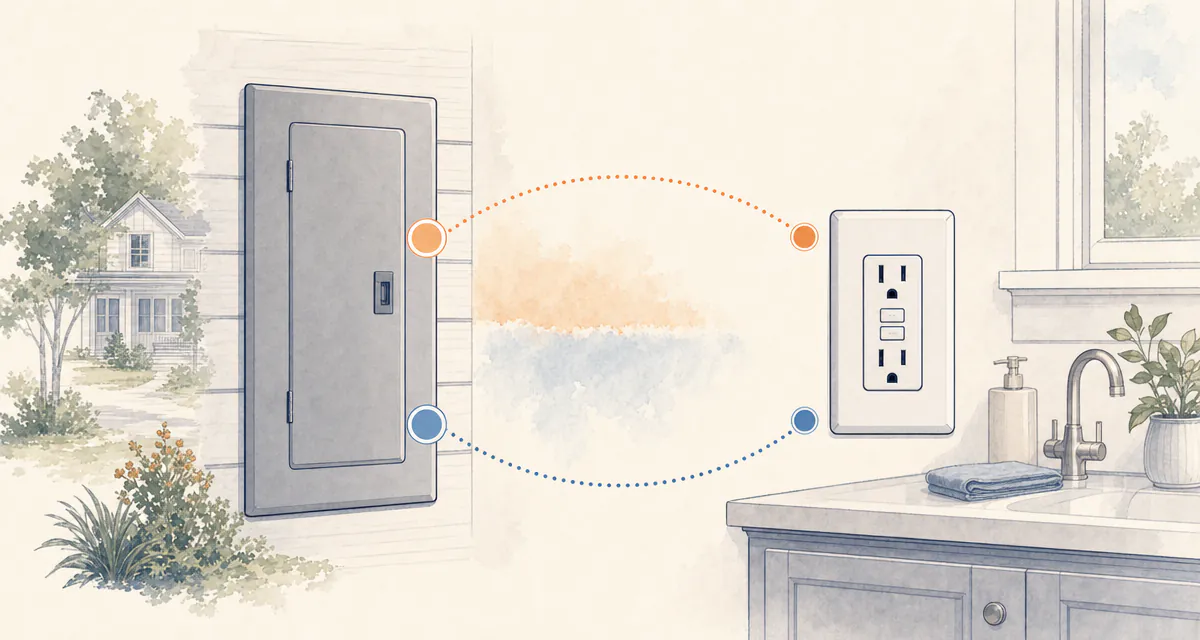
A GFCI breaker and a GFCI outlet can provide the same kind of ground-fault protection while creating very different homeowner experiences. One puts the protective device in the panel; the other puts it at a receptacle. That choice affects how much of a circuit is covered, where a trip is reset, whether a retrofit works, and what an electrician must verify. We focus on those practical differences without turning a comparison into a wiring lesson.
Last reviewed: September 24, 2026 (UTC)
This guide is for planning and comparison, not electrical or code advice. Use a licensed electrician for installation, replacement, diagnosis, and any work inside a panel or outlet box.
GFCI breaker vs. GFCI outlet: the quick answer
Both devices monitor for current leaving its intended path and interrupt power when they detect a ground fault. The CPSC's GFCI fact sheet describes the two installed forms this way: a GFCI breaker protects the branch circuit it supplies, while a GFCI receptacle protects itself and outlets farther downstream when the circuit is connected for that protection.
The practical distinction is placement. A GFCI breaker sits in the electrical panel, so its protection normally starts at the panel and reaches the branch wiring and loads it supplies. A GFCI receptacle sits at one outlet box, so it protects that receptacle and later devices only when the listed device and circuit provide downstream protection. It does not protect the wiring or devices between the panel and the receptacle.
A GFCI breaker is not whole-home protection. It protects the branch circuit connected to that breaker. Neither form is automatically better. The right choice depends on the coverage you need, where you can reach the reset point, the circuit and load, and whether the product is listed for the exact installation.
| Decision factor | GFCI circuit breaker | GFCI receptacle, often called a GFCI outlet |
|---|---|---|
| Where it lives | In the electrical panel or load center | In an outlet box at a receptacle location |
| Where protection starts | At the panel, before the branch wiring and supplied loads | At the receptacle, with downstream coverage only when the listed setup provides it |
| Typical coverage | The branch circuit from the panel outward, including remote outlets, fixtures, and eligible hardwired loads | The receptacle itself and later outlets or loads on the protected side; nothing upstream of the device |
| Test and reset | At the breaker in the panel; controls and indicators vary by model | TEST and RESET buttons are on the protecting receptacle; ordinary downstream outlets may have no buttons |
| Overcurrent protection | The breaker also provides the branch circuit's overcurrent function | The receptacle adds ground-fault protection; the ordinary branch breaker still handles overcurrent |
| Retrofit signal | Requires panel work and a breaker listed for the exact panel and circuit | Can suit a localized retrofit when the box, wiring, device depth, and downstream path are suitable |
| Access tradeoff | One device can cover many points, but the panel may be remote, locked, or inconvenient | The reset can be near the point of use, but the actual protecting receptacle may be elsewhere on the circuit |
Where the protection lives in the circuit
Think of upstream as closer to the panel and downstream as farther along the branch circuit. This is the idea behind the breaker-versus-receptacle decision.
A GFCI breaker is upstream of the branch circuit it supplies. If the device is correctly selected and installed, it can monitor the branch wiring from the panel onward, along with the outlets, lighting fixtures, and appliances on that branch. That makes the breaker form useful when coverage needs to include a hardwired load or several remote points.
A GFCI receptacle protects its own face. If the circuit is correctly configured for downstream protection, the receptacle can also protect later outlets and loads. The later points might be in another room, so the receptacle with the TEST and RESET buttons is not always the outlet that has lost power. A line-only or individual-load arrangement has a narrower coverage result than a feed-through arrangement.
The important homeowner question is not “Which outlet is closest to the sink?” It is “Where does the protective device sit in relation to every point I want protected?” The answer comes from the circuit layout and the electrician's design, not from the room name alone.
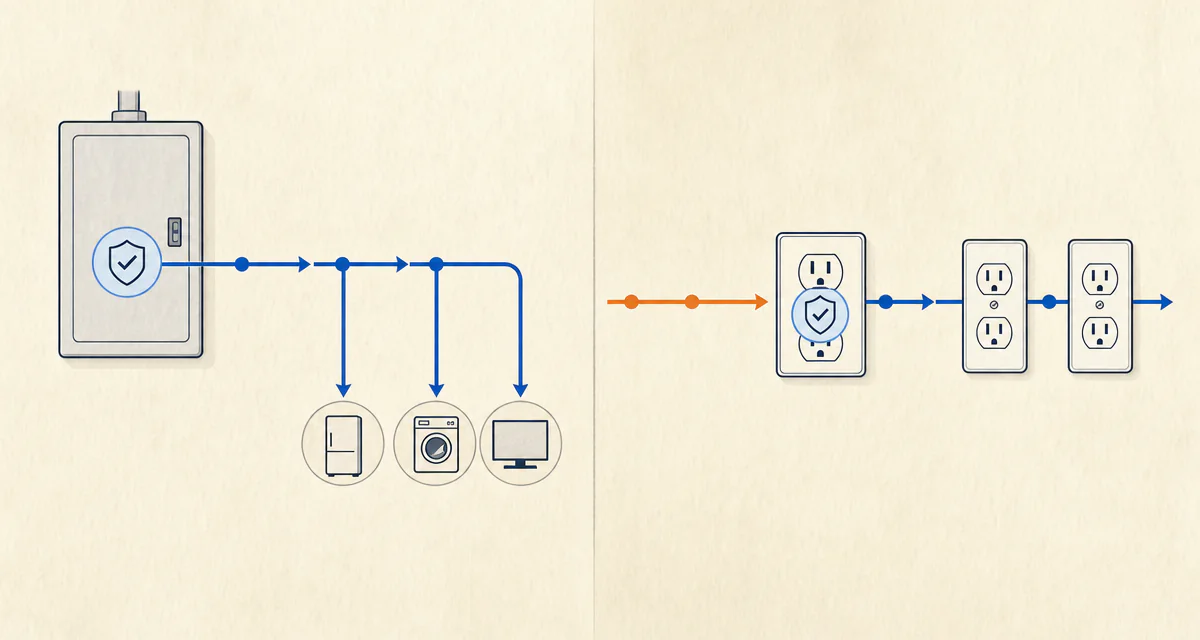
Simplified layout, not wiring instructions.
Test and reset access is part of the design
Reset location matters most when the device trips or a test shows a problem. With a GFCI breaker, the homeowner goes to the panel. That can be simple when the panel is in an accessible utility room, and inconvenient when it is in a garage, basement, shared building area, or locked space. One breaker reset can restore several outlets and loads at once.
With a GFCI receptacle, the TEST and RESET buttons are on the protective device. That is convenient when the receptacle is visible and reachable. A standard receptacle downstream may have no buttons, so a dead outlet does not prove that the outlet itself is the GFCI. The protecting receptacle can be across the room, in another room, or on a different side of a shared branch.
At the homeowner level, use the device's labeled TEST and RESET controls only as the exact product instructions direct. The CPSC recommends testing GFCIs after installation, at least monthly, after a power failure, and according to the manufacturer's instructions. A failed test or a device that will not reset needs professional evaluation. Do not remove a cover or open a panel to find the cause.
Which option fits a retrofit?
We start with the coverage map and reset location, then look at access and compatibility. These are planning signals, not a universal rule for every home.
| Homeowner situation | Option that may fit | Why the electrician still has to confirm it |
|---|---|---|
| One accessible receptacle or a small downstream group needs protection, and the panel is not part of the project | GFCI receptacle | The box must accept the device, and the circuit must support the intended downstream arrangement |
| A branch serves multiple remote points or an eligible hardwired load | GFCI breaker | The panel, circuit topology, neutral arrangement, load, and local requirements must accept the breaker |
| The first accessible receptacle is buried behind equipment or cabinetry | Either form, based on access | A nearby receptacle is useful only if it is the actual protecting device; panel access may be better in some homes |
| The panel is already being replaced or upgraded | Compare both as part of the larger design | The new panel, listed breaker options, branch wiring, permits, and inspection scope can change the answer |
| The box is shallow, the wiring is unusual, or the circuit has a shared neutral | Do not choose from appearance alone | The exact product instructions and circuit design determine whether a receptacle, breaker, or another listed solution works |
A localized receptacle retrofit can be less panel-intensive. A GFCI breaker can avoid multiple protected-device locations or cover hardwired equipment that has no plug-in receptacle. Labor, box depth, wiring condition, panel access, permits, and the number of locations can outweigh the part-price difference, so a national dollar comparison is not a useful decision rule.
If the GFCI question is part of a broader panel or service project, keep the scopes separate. Our panel upgrade guide explains when a project has moved beyond a device choice, and our panel replacement cost guide helps separate a panel quote from a branch-device quote.
Listed products and panel compatibility set hard limits
GFCI protection is a function. The product that provides it still has to be listed for the place and circuit where it will be used.
For a GFCI breaker, the electrician will typically verify the exact panel or load-center brand and series, the breaker listing, pole and circuit requirements, available space, neutral arrangement, conductor configuration, and the load. A breaker that appears to fit the bus is not automatically approved for that panel. The amp number alone is not enough.
For a GFCI receptacle, the electrician will check the circuit rating, box depth and space, conductor and terminal configuration, environmental rating, and whether the device is intended to protect downstream receptacles or only its own connected load. Devices for damp or wet locations may need the appropriate weather-resistant listing and cover. Product status lights, lockout behavior, and end-of-life signals also vary by model, so one manufacturer's indicator pattern cannot be used as a universal diagnosis.
Shared-neutral or multi-wire branch circuits deserve special care. Some products require a particular circuit arrangement, while others are not permitted for a given topology. That is a design and compatibility question for the electrician. It is not a reason to experiment with conductors or to select a device from a store shelf based on its shape.
A GFCI also does not create an equipment-grounding conductor. It can provide ground-fault protection in some older ungrounded installations when the applicable rules allow that solution, but the receptacle still needs the required marking and does not turn two-slot wiring into a grounded circuit. The exact label and permitted use depend on the adopted code and installation.
NEC and AHJ rules do not produce one national answer
The National Electrical Code is a model code. States, counties, and cities adopt an edition on their own schedule and may add amendments. The authority having jurisdiction, or AHJ, applies the rule through its local permitting and inspection process.
GFCI protection is commonly required in locations such as bathrooms, garages, outdoors, kitchens, laundry areas, and other places near water. That list is only orientation. The adopted edition, local amendments, permit date, new versus existing work, occupancy, receptacle or appliance type, and circuit details can change what applies. A code requirement for protection does not mean that every project must use a receptacle with buttons at the point of use.
Use NFPA 70 / the NEC as the starting point for the model code, and use the NEC enforcement maps to understand why adoption differs by location. Neither replaces the local AHJ or a licensed electrician. Ask the electrician which edition and local amendments govern the work, whether a permit is required, and what labeling or inspection closeout belongs in the scope.
AFCI versus GFCI is a separate question about different electrical hazards and may require a different device function.
What a homeowner can do, and where to stop
You can collect useful information without opening electrical equipment:
- Photograph the closed panel door and any visible manufacturer or model information.
- Note which receptacles have TEST and RESET buttons and which ordinary outlets lose power together.
- Record whether the proposed load is plug-connected or hardwired.
- Tell the electrician whether the panel, receptacle, box, and circuit are indoors, outdoors, damp, wet, remote, or difficult to reach.
- Ask for the proposed protection point, covered portion of the circuit, reset location, product listing, permit path, and final labels in the quote.
Stop before removing a panel cover, replacing a breaker or receptacle, opening an outlet box, identifying conductors, changing a LINE or LOAD connection, diagnosing a shared neutral, or testing energized wiring. Turning off one branch breaker does not make the inside of a panel safe. Our electrical panel guide explains what you can read from outside the enclosure and where the safe homeowner boundary begins.
Do not bypass GFCI protection, replace it with a standard receptacle to stop an interruption, or repeatedly reset an unexplained trip. Stop using the affected equipment and arrange professional help for a failed test, refusal to reset, repeated trips, moisture, heat, discoloration, buzzing, sizzling, burning odor, shock, tingling, exposed wiring, or damaged insulation. Smoke, flame, or active arcing is an emergency. Leave the area and call emergency services from a safe location.
Questions to ask before an electrician installs either form
The best quote makes the coverage and access decision visible. Ask:
- Which part of the branch circuit will the proposed device protect, including wiring, downstream receptacles, fixtures, and hardwired loads?
- Where will TEST and RESET be located, and can the person who needs them reach that point?
- Is the exact breaker listed for this panel, and is the receptacle listed for this circuit, box, conductor, and environment?
- Does the circuit have a shared neutral, unusual topology, older ungrounded wiring, or a hardwired load that changes the device choice?
- What permit, AHJ review, labeling, testing, and closeout documents are included in the scope?
GFCI breaker vs. outlet FAQs
Is a GFCI breaker better than a GFCI outlet?
Neither is the universal winner. A breaker is often the cleaner way to cover a whole branch, remote points, or an eligible hardwired load. A receptacle can be a practical fit for a localized, accessible retrofit. Coverage, reset access, exact compatibility, and local requirements decide the choice.
Does a GFCI outlet protect downstream outlets?
It can, when the listed receptacle and circuit are configured for downstream protection. It protects the device itself and later points, but it does not protect the upstream wiring between the panel and the receptacle. Downstream outlets can be in another room.
Where do I reset a GFCI outlet with no buttons?
Look for the upstream GFCI receptacle or a GFCI breaker that protects that point. A standard downstream receptacle may carry protected power without having TEST and RESET buttons. If the protecting device is not obvious or will not reset, stop using the affected equipment and contact a licensed electrician. Do not remove covers to search for it.
Can any GFCI breaker go in my electrical panel?
No. The breaker must be listed and approved for the exact panel or load center, circuit, neutral arrangement, and load. Physical fit and matching amp numbers do not prove compatibility.
Does a GFCI add an equipment ground?
No. GFCI protection monitors leakage and interrupts power; it does not add an equipment-grounding conductor. An older ungrounded receptacle may qualify for a GFCI-based protection and labeling arrangement in some situations, subject to the adopted code and electrician's design.
Can a GFCI breaker protect a hardwired appliance?
Often, a properly selected and listed breaker can protect a hardwired load on the branch it supplies. The appliance, circuit rating, breaker, panel, installation method, and local rules all matter. A GFCI receptacle cannot protect a load that has no receptacle at the point where the device is installed.
Start with the coverage map and the reset location, then give a licensed electrician the panel information you can safely read from the outside, the circuit's known loads, and the local address. That produces a better device choice than treating every GFCI breaker and GFCI outlet as interchangeable.