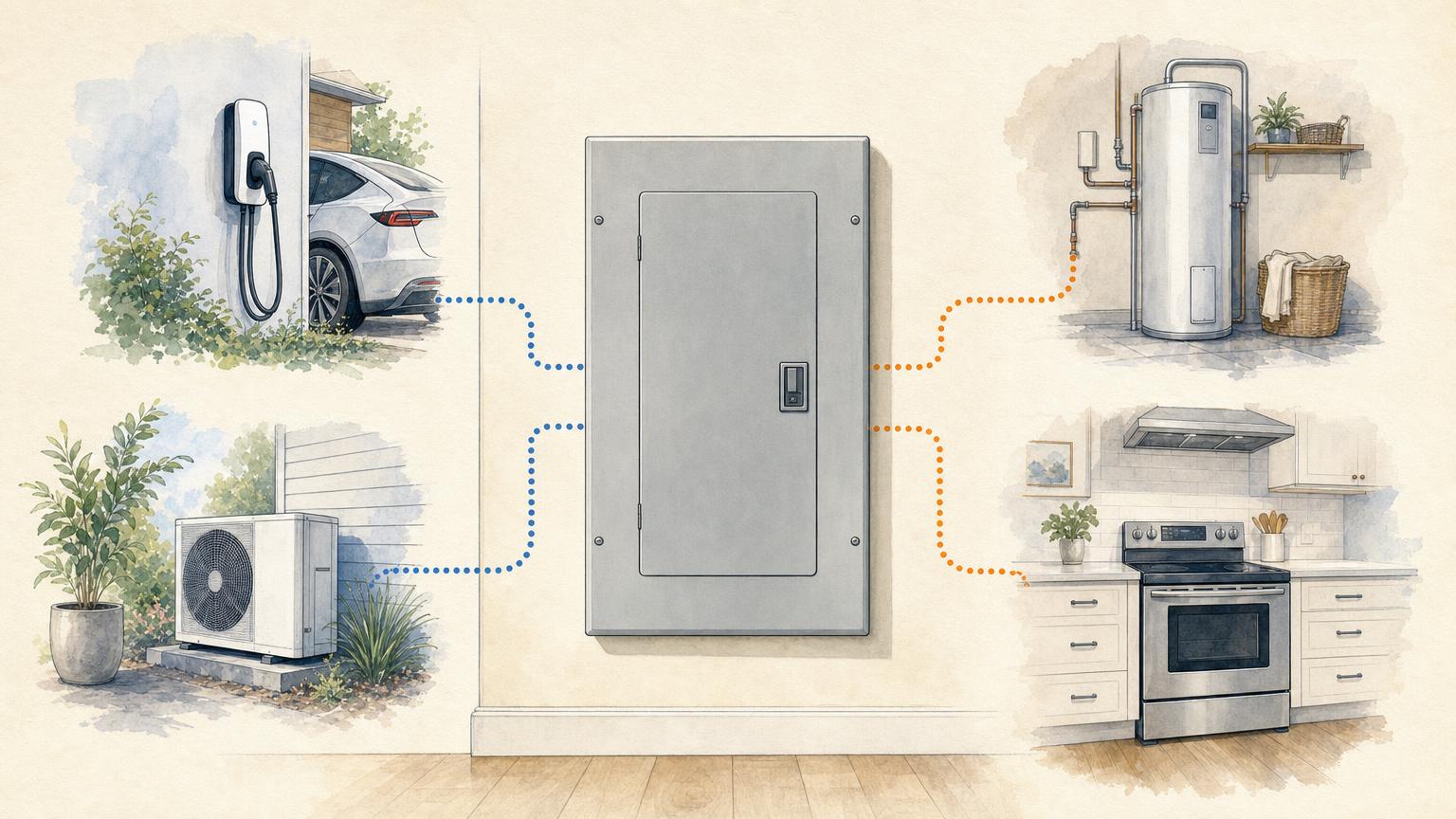
Most homeowners ignore the electrical panel until a breaker trips, an inspector flags it, or an EV charger or heat pump raises a bigger question: can the house handle another major load? The panel routes utility power, protects branch circuits, and sets the ceiling for the service your home can use at one time.
The number on the main breaker and the number of empty slots answer different questions. We will show you how the panel works, what its parts mean, which warning signs need prompt attention, and how to decide between a repair, replacement, subpanel, load management, or service upgrade.
At Watt Wallet, we treat the panel as the first planning checkpoint for home electrification. We separate safety, physical space, service capacity, and load management before comparing quotes, then organize location-based incentives around the scope that remains.
Last reviewed: September 14, 2026 (UTC)
Panel work is not a DIY project. You can read the exterior label and operate a breaker when there are no warning signs, but do not remove the screwed-on interior cover or touch wiring. If you see smoke, flames, sparks, or a burning odor, leave the home and call 911 from a safe location.
What is an electrical panel?
An electrical panel is the metal enclosure where incoming electricity is divided into branch circuits for lights, receptacles, appliances, heating, cooling, and other loads. Each branch circuit has overcurrent protection, usually a circuit breaker. If current rises beyond what the circuit can safely carry, the breaker trips and interrupts power.
You may hear the same equipment called a breaker panel, breaker box, service panel, load center, or panelboard. In ordinary residential conversation, those terms usually describe the same central distribution equipment. A subpanel is a downstream panel supplied by the main panel or another upstream disconnect.
The electric meter measures the electricity that passes between the utility and your home. The electrical panel distributes that electricity and protects the wiring. A panel does not create more electricity, lower your bill by itself, or automatically make room for a new appliance.
How electricity moves through the panel
In a typical U.S. home, the utility delivers service to the meter, conductors carry it to the main disconnect and panel, and bus bars distribute it to branch breakers. Branch circuits feed lights, outlets, appliances, and equipment. A feeder can carry power from the main panel to a subpanel serving a garage, addition, workshop, or another area.
Residential service is commonly split phase. A single-pole branch circuit normally uses one hot leg and a neutral to supply 120 volts. A two-pole circuit uses both hot legs to supply 240 volts for equipment such as some electric ranges, heat pumps, water heaters, dryers, and Level 2 EV chargers. A 240-volt load uses two distinct hot conductors. The breaker handle count is not a way to add up the home's total service rating.
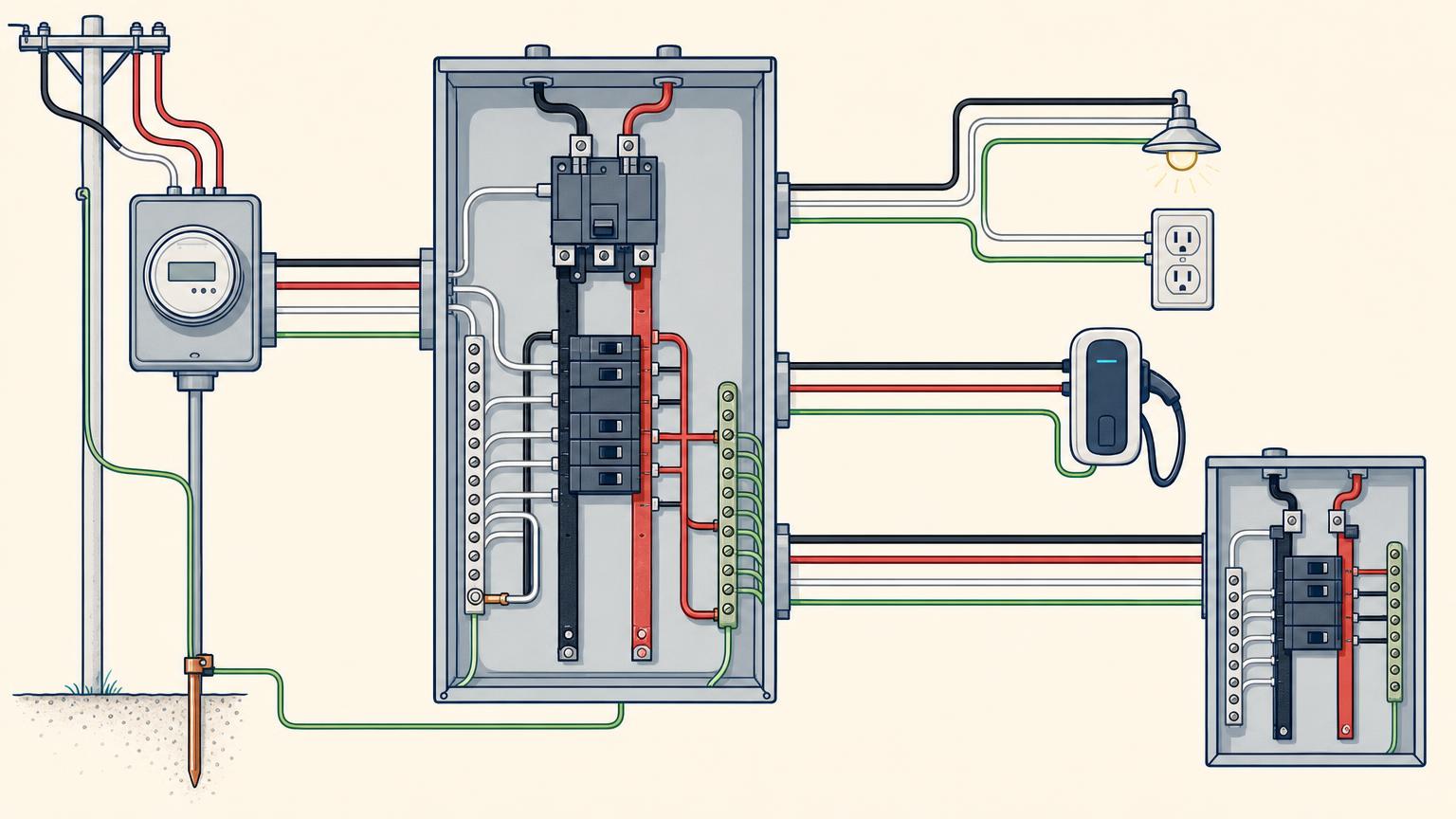
Simplified power flow, not wiring instructions.
The diagram separates the service path, the two hot legs, the neutral, and the grounding path. In real equipment, the exact arrangement depends on the panel, service type, adopted code, and listed components. A licensed electrician handles any work inside the enclosure.
Electrical panel parts, explained
| Part | What it does | What a homeowner should know |
|---|---|---|
| Enclosure and door | Protects the equipment and keeps the operating area enclosed. | Keep the door closed and the space in front of it clear and accessible. |
| Main breaker or disconnect | Limits and disconnects the home's incoming service. | Its amp rating is a starting point for identifying service size. It does not prove how much unused capacity remains. |
| Branch breakers | Protect individual circuits and open when an overload or fault occurs. | A breaker that trips repeatedly needs diagnosis, not a larger replacement. |
| Bus bars | Carry power from the service connection to the branch breakers. | The panel and breaker combination must be listed for use together. Physical fit does not make a breaker compatible. |
| Neutral bar | Provides termination points for neutral conductors that return current from many circuits. | Its relationship to the grounding system differs between a main service panel and a subpanel. |
| Grounding bar and conductor | Provide a path for fault current and bond metal parts as required by the installation. | Grounding is a safety system, not a substitute for correct overcurrent protection. |
| AFCI or GFCI protection | Detects certain arc or ground-fault conditions and disconnects the circuit. | These devices respond to different problems and may be built into breakers or installed at receptacles. |
The most important distinction is between a breaker that controls a circuit and the panel's service equipment that supplies the whole home. Turning off a branch breaker does not make the inside of the panel safe to touch. Service conductors can remain energized even when the main breaker is off.
Main panel, subpanel, fuse box, or smart panel?
These terms describe different roles.
- Main breaker panel: Contains the main service disconnect and the branch breakers for much of the home.
- Main-lug-only panel: Uses lugs for the incoming feeder and relies on a separate upstream disconnect.
- Subpanel: Adds breaker spaces for an area or group of circuits. It redistributes available service capacity; it does not increase the utility service rating.
- Fuse box: Uses fuses instead of resettable breakers. Have older fuse equipment assessed before adding loads or replacing fuses.
- Smart electrical panel: Adds monitoring, remote control, load prioritization, backup coordination, or automated load management. Smart features do not automatically increase the service rating. Our smart panel guide compares full replacements with targeted controllers and monitors.
A subpanel can solve a space problem when the calculated load fits the existing service. It cannot fix a damaged main panel, make an undersized service larger, or turn an unsafe installation into a safe one.
What the amp rating means
The amp rating describes the maximum current the service equipment is designed to carry under its listed configuration. Find the main breaker or service label, which commonly shows a value such as 60, 100, 125, 150, or 200 amps. Older homes may have smaller services, while newer homes often have 200-amp service or more.
| Service rating | What it tells you | What it does not tell you |
|---|---|---|
| 60 or 100 amps | The home may have an older or smaller service. It can still be adequate for some households after a load calculation. | It does not automatically mean the panel is unsafe or that every electrification project requires 200 amps. |
| 125 or 150 amps | The home has an intermediate service size that may fit many current and planned loads. | It does not replace a calculation for an EV charger, heat pump, or other major addition. |
| 200 amps or more | The service has a larger designed current capacity and often more physical space. | It does not guarantee open breaker positions, compatible equipment, or enough capacity for every simultaneous load. |
Two separate constraints matter:
- Space: Is there a listed position for the new breaker, and is there room for the conductors and equipment?
- Capacity: Can the service, panel, conductors, and utility connection support the existing and planned loads under the applicable calculation method?
A panel can have empty slots and still be at its calculated service limit. A full panel can have enough service capacity for the home's loads and need a subpanel or replacement for physical space. A 2026 Berkeley Lab analysis estimated that at least 20% of panels across all sizes have no available breaker space, while many homes still have enough calculated headroom for additional loads. Read the Berkeley Lab analysis as evidence that panel size and breaker space are separate questions.
ENERGY STAR's electric-ready guidance recommends checking the main breaker, available slots, and planned equipment before deciding whether electrical upgrades are needed. The final answer belongs to the electrician's load calculation and the local authority having jurisdiction.
How to read your electrical panel without opening it
You can collect useful information without removing the interior cover:
- Find the main panel. It is often near the electric meter, on an exterior wall, in a garage, basement, utility room, or closet. If you see more than one, the one closest to the meter is often the main panel, but labels and service conductors determine the arrangement.
- Read the main breaker and label. Record the amp number, manufacturer, and model. Take a photo from outside the enclosure if needed.
- Count spaces and read the directory. Empty positions show physical room only. Note whether major equipment already has a dedicated circuit.
- Stop at the dead front. Do not remove the metal cover held by screws. An electrician can inspect the bus, connections, grounding, bonding, and conductors.
A consumer energy monitor answers a different question: it shows when and how much electricity selected circuits use, while the panel shows service rating and circuit arrangement. Our home energy monitor guide explains when measured usage adds useful information to an electrical plan.
Warning signs that need attention
The CPSC wiring guide identifies arcs or sparks, unusual sizzling or buzzing, overheating, odors, dim or flickering lights, and power outages as warning signs. Around a panel, take these signs seriously:
- Smoke, flames, sparks, or active arcing
- A burning or overheated-plastic odor
- Sizzling, crackling, or unusual buzzing
- A panel door or surrounding wall that feels hot
- Scorch marks, melted plastic, discoloration, rust, water, or corrosion
- Breakers that trip repeatedly under ordinary use
- Lights that dim or flicker when a large load starts
- Fuses, damaged equipment, or a panel flagged by an inspector or insurer
If there is smoke, fire, or active arcing, leave the home and call 911. Do not touch the panel or use water. For heat, odors, sounds, repeated trips, or visible damage without an active fire, stop using the affected equipment and arrange a prompt inspection by a licensed electrician. If the problem may be on the utility side of the meter, contact the utility from a safe location.
A single trip can happen when too many loads share a circuit. If there is no heat, odor, smoke, or other warning sign, turn off or unplug the equipment that was running and reset the breaker once by moving it fully to off and then on. If it trips again, leave it off and call an electrician. Never replace a breaker with one that has a higher rating.
Does a new EV charger or heat pump require a panel upgrade?
No. The equipment, existing service, other loads, panel condition, available spaces, and local calculation method determine the answer.
Start with a list of everything already in the home and everything you may add during the panel's service life:
- EV charging and space-heating or cooling equipment, including electric backup heat
- Heat-pump water heating, electric or induction cooking, and a dryer
- A hot tub, pool equipment, workshop, accessory dwelling unit, solar, batteries, or a generator
Then have an electrician calculate the existing and planned service load. Do not add the amp numbers printed on every breaker. That sum can exceed the main rating because the code calculation accounts for how loads operate and whether they are expected to run together.
The size of the panel constraint is real, but a bigger panel is not the only response. A preliminary DOE and NREL analysis found that 62% of homes faced a panel constraint under its business-as-usual electrification scenario. The same analysis found that capacity or space management could allow nearly half of those homes to keep their existing panels as the least-cost solution. These are national modeling results, not a conclusion about one house. Read the DOE/NREL panel study for the assumptions.
Depending on the constraint, the electrician may compare:
- Same-size replacement: Corrects obsolete, damaged, or crowded equipment while keeping the service rating.
- Subpanel or listed space solution: Adds breaker positions when the calculated service load fits.
- Lower-power equipment or listed load management: Reduces or sequences flexible loads such as EV charging. Our EV load-management guide explains this narrower path.
- Smart panel or controller: Coordinates multiple flexible loads, backup priorities, or selected circuits. It still has to be listed, configured, and accepted for its intended use.
- Service upgrade: Increases upstream capacity when the calculation, conductors, meter, or utility infrastructure requires it.
A safety defect changes the order of operations. Repair or replace unsafe equipment first. Capacity planning comes after the system is safe enough to evaluate.
What an electrical panel upgrade costs
The word upgrade can describe several scopes, so the price range is wide. As a planning reference, Rewiring America's cost guidance places a typical panel upgrade around $2,000 to $4,000. If the work reaches the service conductors, meter, underground lateral, or transformer, it can rise to roughly $5,000 to $25,000.
| Scope | Rough planning range | What moves the price |
|---|---|---|
| Same-size replacement | Often below a larger service upgrade, but highly site-specific | Panel condition, breaker count, wiring corrections, permits, labor, wall repair, and outage work |
| Panel upgrade, often 100 to 200 amps | About $2,000 to $4,000 | New panel and main breaker, service conductors, grounding and bonding, circuits, labor, and permits |
| Service or utility-heavy upgrade | About $5,000 to $25,000 or more | Meter equipment, long or underground conductors, trenching, utility engineering, transformer work, and relocation |
The panel's retail price is only one line in the quote. Ask whether the total includes breakers, grounding and bonding corrections, permit and inspection fees, utility disconnect and reconnect, wall repair, circuit labeling, and final documentation. Our panel replacement cost guide breaks out the scope differences.
What to require in the electrician's quote
A useful proposal should let you compare the same work across contractors. Ask it to state:
- Existing and proposed service ratings, panel models, condition, spaces, and the written load calculation
- Every planned large load included in the calculation
- Whether the job is a repair, replacement, panel upgrade, subpanel, or full service upgrade
- Breaker compatibility, new circuits, load management, backup equipment, and any conductor, meter, grounding, or bonding work
- Permit, inspection, utility coordination, outage, reconnect, wall repair, trenching, and disposal responsibilities
- Warranties, commissioning, labels, final documents, and any incentive paperwork
Put the permit question in writing. Main-panel replacements, service changes, new subpanels, and new high-load circuits commonly need permits, but the authority having jurisdiction sets the exact process. Our panel permit guide explains the questions to put in the scope.
Electrical panel incentives in 2026
Old federal tax-credit pages can make a current panel quote look cheaper than it is. The IRS says the federal Energy Efficient Home Improvement Credit under Section 25C is unavailable for property placed in service after December 31, 2025. Read the IRS's current energy-credit FAQ before relying on a federal panel credit.
State, utility, and local programs can have different dates, income rules, equipment requirements, and application steps. Some programs support panel or wiring work only when it enables a qualifying heat pump, water heater, or other project. Treat any savings as a separate line from the gross electrician quote until the program administrator confirms the project qualifies.
Electrical panel FAQ
Is a breaker box the same as an electrical panel?
Usually, yes. Breaker box, breaker panel, service panel, and load center are common names for the equipment that distributes power through branch circuits. A subpanel is a separate downstream panel, and a fuse box uses fuses instead of breakers.
Is a 200-amp panel always better than a 100-amp panel?
No. A 200-amp service has a larger designed capacity, but the right size comes from the home's calculated load, equipment, conductors, meter, utility connection, and future plans. A 100-amp service can work for some fully electric homes with efficient equipment or approved load management. A 200-amp panel can still have no open breaker space or an unsafe installation.
Can I add a breaker because there is an empty slot?
An empty slot shows physical room, not permission or capacity. The panel must accept that breaker, the circuit must be correctly designed and protected, and the service load must support the new equipment. Have an electrician evaluate the full installation.
Can an electrical panel lower my electric bill?
A standard panel does not lower electricity use. A monitor can show which circuits use energy, and a listed control system can schedule or limit selected loads. Bill savings depend on the equipment, rate plan, timing, and household behavior. Monitoring alone does not guarantee savings.
When should I call an electrician?
Call for panel installation, replacement, service changes, new circuits, repeated trips, heat, odors, buzzing, sparks, damage, or uncertainty about the panel's condition. Treat smoke, fire, and active arcing as an emergency and leave first.
Start with the constraint, then price the work
An electrical panel is a safety and distribution system with switches inside. Identify whether the real issue is a hazard, missing breaker space, calculated service capacity, or a need to coordinate flexible loads. Then compare a written electrician's scope with the alternatives before agreeing to a 200-amp upgrade.
Once you have that scope, use Watt Wallet's incentive finder to look for state, utility, and local programs that may reduce the cost of the electrical work your home actually needs.