Last reviewed: 2026-06-27 (UTC)
If you are comparing a subpanel vs main panel, start with this rule:
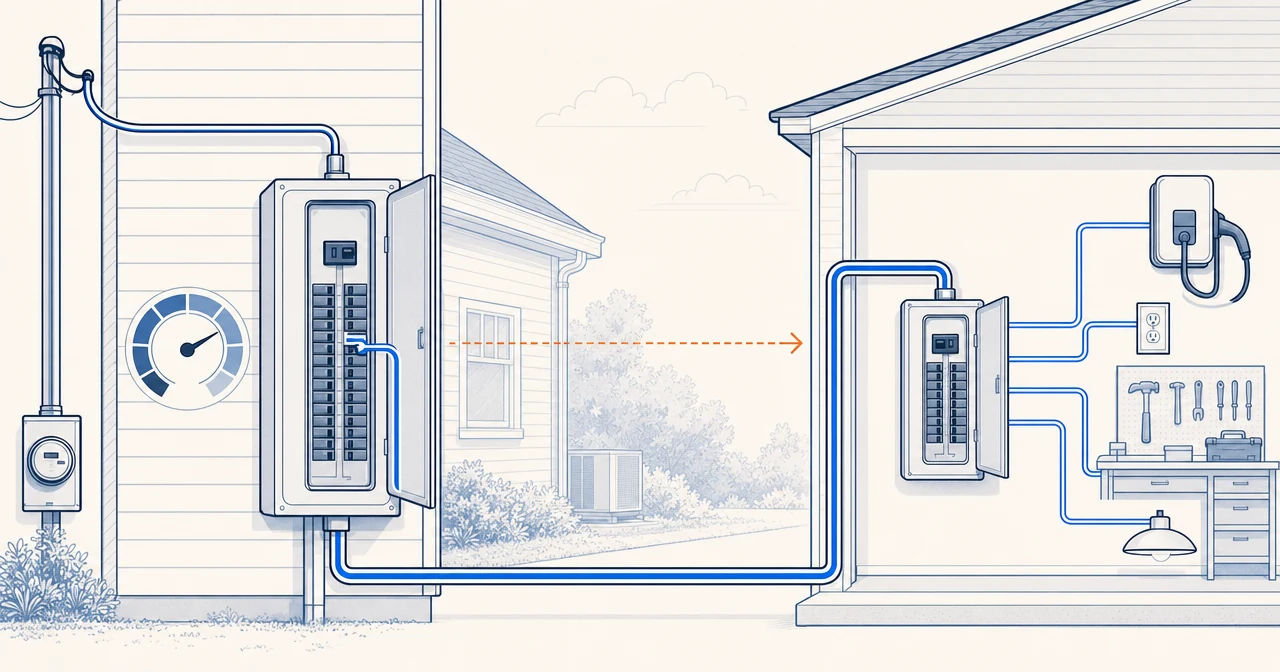
A main panel is the home's central electrical control point. A subpanel is a smaller downstream panel that helps distribute circuits to one area or group of loads.
That means a subpanel can be the right move when you need more circuit space, better organization, or a cleaner way to serve a garage, addition, workshop, or detached structure.
It does not automatically give your house more total electrical capacity.
That distinction is where a lot of homeowner confusion starts. Some projects need a simple subpanel. Some really need a larger main panel, a service upgrade, or a different workaround like a smart electrical panel. If you are planning around an EV charger, heat pump, or larger renovation, choosing the wrong path can waste time and money.
This guide is informational, not electrical, code, or contractor advice. Use it to pressure-test quotes and understand your options, then use a licensed electrician and local permit guidance for the final design.
Quick answer
| If your situation looks like this | The more likely answer |
|---|---|
| Your main panel still has capacity, but you need more circuits in a garage, basement, addition, workshop, or outbuilding | A subpanel may be a good fit |
| Your main panel is crowded, but the electrician says the house still has room in the load calculation | A subpanel may solve the problem |
| You are adding an EV charger or other big load, and the real question is how to distribute circuits near that area | A subpanel may be part of the answer |
| Your house is already short on total electrical capacity or the service is undersized | You probably need a main-panel or service-upgrade conversation, not just a subpanel |
| The existing panel is outdated, unsafe, or due for replacement anyway | Start with electrical panel replacement cost or cost to upgrade to 200 amp service |
| You are not sure whether the issue is raw capacity or load timing | Also look at a smart electrical panel or other load-management options |
Main panel vs. subpanel at a glance
| Question | Main panel | Subpanel |
|---|---|---|
| Where the power comes from | Directly from the utility service / service entrance | From a feeder breaker in the main panel |
| What it controls | The whole home's central distribution | A specific area, structure, or group of circuits |
| Can it shut off the whole house? | Usually yes, through the main breaker or service disconnect | No |
| Best fit | Whole-home control, service size, branch-circuit distribution | Localized circuit distribution, remote areas, added circuit space |
| Does it increase total electrical capacity? | Only if the main panel / service itself is larger | No, it mainly improves distribution and circuit access |
That last row is the most important one.
A subpanel can make a house easier to wire, easier to organize, and easier to expand in the right circumstances. It does not magically turn a constrained 100-amp or overloaded service into a higher-capacity house.
What a main panel actually does
Your main panel is the central breaker box for the house. It is the point where utility power enters the home's electrical distribution system and where the home's branch circuits get divided up.
This Old House describes the main service panel as the home's distribution center. In plain English, that means it is the box that feeds power to the rest of the house and gives you the whole-home shutoff point.
For homeowners, the practical jobs of the main panel are:
- receiving power from the home's service,
- feeding branch circuits throughout the house,
- protecting those circuits with breakers,
- and giving the electrician the central place to evaluate available capacity.
That is why so many bigger electrical decisions eventually come back to the main panel, even when the new work will be on the other side of the property.
What a subpanel actually does
A subpanel is a smaller secondary panel fed from the main panel.
It usually exists for one of two reasons:
- you need more convenient circuit distribution for a specific area, or
- you need more circuit spaces than the current layout handles well.
Angi frames a subpanel as a branch from the main panel for areas like garages, home additions, and workshops. This Old House gives similar real-world examples such as garages, workshops, and outbuildings.
So when homeowners say they "need another breaker box," they are often really describing a subpanel use case.
A subpanel can be helpful when:
- the garage or workshop needs several dedicated circuits,
- an addition or finished basement would be cleaner to serve from a nearby panel,
- a detached structure needs its own local breaker access,
- or one area of the house is collecting more new electric loads than the current branch-circuit layout handles gracefully.
When a subpanel is the right answer
A subpanel is usually the right answer when the house still has enough overall electrical capacity, but the existing layout is awkward or crowded.
That often looks like one of these cases.
1. The main panel still has capacity, but you need more circuit space
This is the classic subpanel case.
The existing main panel may be functionally full, or close enough to full that adding one more project cleanly is getting messy. If the load calculation still says the house has room, a subpanel can be the simpler way to add circuits without rebuilding the entire service.
That is different from a house that truly needs more amperage.
2. You are serving one concentrated area of the property
Subpanels make the most intuitive sense when one zone needs several circuits of its own.
Examples include:
- a garage with tools and an EV charger,
- a basement buildout,
- a workshop,
- a large addition,
- or a detached building.
In those cases, the value is not just "more breakers somewhere." It is better local distribution and easier future expansion in the area that actually needs the power.
3. You are adding new electric equipment, but the home does not clearly need a full service upgrade
This is where the topic matters most for Watt Wallet readers.
If you are adding an EV charger, a heat pump water heater, or other new electric loads, the right question is not automatically "Do I need 200 amps now?"
Sometimes the right question is:
- Does the house still have enough total capacity?
- Is the real problem just circuit layout?
- Would a subpanel make the project cleaner?
- Or is the house actually short on raw capacity?
If you are still early in that EV decision, it helps to compare your charging needs first. A lot of homeowners jump to bigger electrical work before sorting out whether Level 1 vs. Level 2 EV charger changes the electrical scope in the first place.
When a subpanel is not enough
A subpanel is the wrong answer when the home's real bottleneck is total capacity, not circuit organization.
That matters because many quotes and conversations blur those two problems together.
1. The main panel or service is already at full capacity
This is the clearest no-case.
The U.S. Department of Housing and Urban Development's rehab guide says a subpanel can add more circuits or help serve a remote location, but that loads must be calculated so the main panel is not overloaded. It also says the option is not available if the service panel is already at full electrical capacity.
That is the key homeowner takeaway:
A subpanel can redistribute available capacity. It cannot create capacity that is not there.
2. The house really needs a larger main panel or bigger service
If the electrician is talking about:
- a 100-amp to 200-amp jump,
- utility coordination,
- meter work,
- service conductors,
- transformer constraints,
- or other service-side upgrades,
then you are already beyond a simple "just add a subpanel" conversation.
At that point, it is better to start with cost to upgrade to 200 amp service and electrical panel replacement cost so you understand the larger scope.
3. The existing panel is unsafe, outdated, or due for replacement anyway
A subpanel is not a workaround for a bad main panel.
If the existing panel is old, damaged, overheated, unreliable, or otherwise a replacement candidate, the smarter conversation is often about replacing or upgrading the main equipment first.
4. The real issue is load management, not another breaker box
Sometimes the problem is not that you need another downstream panel. It is that several large loads may overlap at the wrong time.
That is where a smart electrical panel or another load-management approach can be more relevant than a subpanel. A smart panel does not create more raw capacity either, but it can help sequence loads more intelligently when the underlying service is still workable.
The code-adjacent basics homeowners should know
This article is not a wiring tutorial, a DIY checklist, or a universal code summary. Use these points to pressure-test a quote and to recognize when the job clearly belongs in licensed, permitted work.
Proper subpanels are not wired like a shortcut breaker box
The California Real Estate Inspection Association's subpanel grounding reference says a properly wired 120/240-volt subpanel includes a 4-conductor feeder.
That matters because the same reference also says neutrals and grounds must be isolated after the main service panel. In a subpanel, the neutral bus should be insulated from the enclosure, while the ground bus should be bonded to it.
For a homeowner, the practical takeaway is not that you should inspect or approve the wiring details yourself. It is that a real subpanel design includes specific feeder and grounding choices. If someone describes the job as a quick add-on without clearly explaining the feeder plan, the grounding approach, and the permit path, slow the conversation down.
Detached structures add extra nuance
Detached garages, workshops, and outbuildings are common subpanel cases, but they are also the situations where grounding, feeder, and permit details can get more specific.
Because those details can change with the building layout and local code cycle, treat detached-structure work as a planning conversation that needs a licensed electrician and a clearly defined scope, not as a generic add-on.
Permit and inspection expectations are normal here
Local rules vary, so this guide is not trying to give you a universal permit rule for every city or county. The safer homeowner assumption is that if the quote touches the main panel, adds a subpanel, changes feeder wiring, or supports a meaningful new load, permit and inspection questions belong in the conversation before work starts.
A good quote should make it clear who is pulling the permit, whether inspection is expected, and whether the work stops at the subpanel or expands into broader panel or service changes.
Watt Wallet's guide on do I need a permit to upgrade my electrical panel is the right next read when the quote starts blending subpanel work with broader panel or service changes.
Cost: subpanel install vs. main-panel or service upgrade
If you are budgeting, keep the scope labels straight.
A subpanel install is usually a different class of project from a main-panel upgrade, and both are a different class from a full service upgrade.
As a broad homeowner planning signal, Angi says subpanel installation often lands around $400 to $1,750, while main-panel upgrades can run roughly $500 to $4,000 depending on the home's needs.
Those are broad national planning numbers, not a promise for your specific house.
The real quote changes based on things like:
- feeder distance,
- panel location,
- labor complexity,
- permit and inspection requirements,
- wiring corrections,
- whether the panel is just crowded or actually undersized,
- and whether the project drags in service-side work.
That is why comparing a "subpanel quote" to a "200-amp upgrade quote" without looking at scope is a mistake. In many homes, those are not competing bids for the same job at all.
My recommendation by homeowner scenario
Choose the subpanel path if:
- the electrician's load calculation says the house still has capacity,
- you mainly need more circuits in one area,
- the project is about better distribution, not a bigger service,
- or you want local breaker access for a garage, workshop, addition, or outbuilding.
Start the bigger main-panel or service conversation if:
- the home is already short on total capacity,
- you are stacking multiple major electrification loads,
- the existing panel is unsafe or due for replacement,
- or the quote already includes service-side work.
Pause and ask more questions if:
- one contractor says "just add a subpanel" and another says "you need 200 amps",
- the project includes a detached structure,
- the quote mixes subpanel work with load-management gear,
- or the electrical scope depends on what EV charging speed you actually need.
That last one matters more than people think. If an EV charger is the trigger, first figure out whether the house really needs a higher-power setup and what installation path fits best. The guides on do I need a permit to install EV charger and Level 1 vs. Level 2 EV charger help answer that before you overbuy electrical work.
FAQ
Does a subpanel increase my home's electrical capacity?
Usually, no. A subpanel adds a new distribution point and more circuit organization, but it does not automatically increase the total amount of utility power the house can draw. If the main service is already at capacity, the real fix is usually a larger panel, a service upgrade, or a different load-management strategy.
Does a subpanel need its own main breaker?
Not always. A subpanel in the same building, fed from the main panel, usually does not need its own main breaker, because it is already protected by the feeder breaker back in the main panel. A separate main disconnect is required when the subpanel serves a detached structure: a feeder to a separate building needs a disconnecting means at that building. You can also choose a subpanel that has a main breaker in the same structure for convenience, so you can shut it off without walking back to the main panel. Either way, confirm the exact configuration and disconnect requirement with your electrician or local inspector before the work is signed off.
Can I run an EV charger or heat pump off a subpanel?
Yes, potentially. A subpanel can be part of the setup for an EV charger, heat pump, workshop, or addition if the home's overall load calculation still works. What it does not do is make an undersized service become adequate on its own. The load still has to fit the house.
Do I need a permit to install a subpanel?
In almost all cases, yes. Installing a subpanel means running a new feeder and adding a panel, which is electrical work that normally requires a permit and at least one inspection. The exact process varies by jurisdiction, so ask your electrician who is pulling the permit and what inspection to expect, and confirm whether the quoted scope stays at the subpanel or expands into broader panel or service work.
How do I know if I need a 200-amp upgrade instead?
If the house is already short on total capacity, if multiple new large loads are being added, or if the quote is drifting into utility or service-side work, you are probably in 200-amp-upgrade territory rather than simple subpanel territory. That is the point where cost to upgrade to 200 amp service becomes the better next read.
Bottom line
If you remember only one thing from the main-panel vs subpanel decision, make it this:
A subpanel is a good tool for distribution and circuit organization.
A main-panel or service upgrade is the answer when the house needs more real capacity.
That is why the smartest next step is not asking for "another breaker box" in the abstract. It is figuring out whether your project needs:
- more circuits in one place,
- better load management,
- or a genuinely bigger electrical backbone.
Once you know which problem you are solving, the right quote gets much easier to spot.