Last reviewed: September 23, 2026 (UTC)
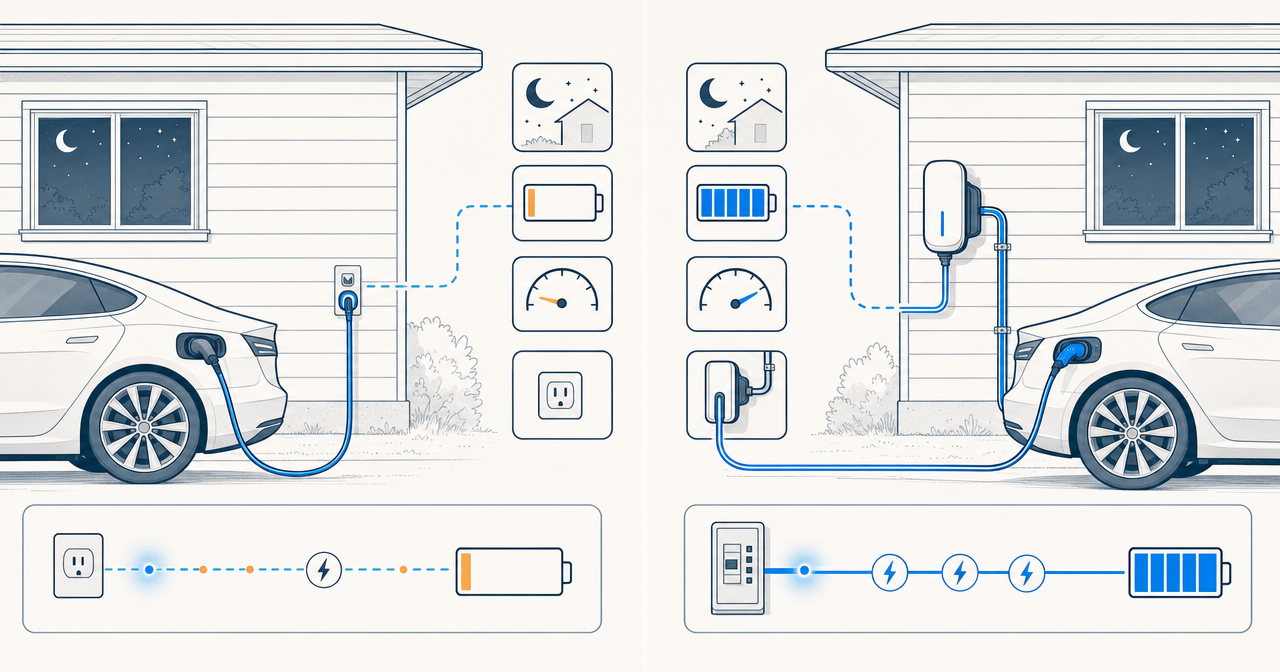
For home charging, the real Level 1 vs. Level 2 decision is simple: keep Level 1 if your car reliably refills overnight on a standard outlet, and upgrade to Level 2 when your routine keeps outrunning that setup.
Level 1 charging uses a regular 120-volt outlet. A Level 2 EV charger uses 240-volt power and refills much faster. That speed difference matters most when you drive longer distances, own a larger-battery EV, share charging between two vehicles, or need a meaningful overnight refill instead of a slow top-off.
Just as important, this is mostly a time and convenience decision, not a question of whether one charging level magically gives you cheaper electricity. If Level 1 already covers your daily use, there is no prize for upgrading early. If it keeps leaving you short, Level 2 is usually the home setup that makes EV ownership feel easy.
This guide is informational, not electrical, code, or contractor advice. Use it to pressure-test installer quotes and ask better questions about your own home, circuit capacity, and local permit rules.
What Level 1 vs. Level 2 means at home
At home, Level 1 means charging from a standard household outlet. It is the slowest home-charging option, but it is also the simplest because many EVs can start there with the cord that comes with the vehicle.
A Level 2 EV charger uses a 240-volt circuit instead. That is the same general voltage class homeowners already know from bigger electric appliances, but for EV charging it usually means a dedicated circuit, wall-mounted charging equipment, and an electrician checking whether your panel and wiring can support the load safely.
That is why home charging conversations so often turn into the same practical question: do you actually need to upgrade, or is Level 1 still enough for your routine?
You may also see Level 3 mentioned in EV charging explainers. That is DC fast charging, the public rapid-charging category used on road trips and commercial sites, not the normal home-charging decision most homeowners are making in a garage or driveway.
Level 1 vs. Level 2 at a glance
| Question | Level 1 home charging | Level 2 home charging |
|---|---|---|
| Power source | Standard 120V household outlet | 240V circuit with dedicated charging setup |
| Typical speed | About 2-5 miles of range per hour; actual rate depends on the vehicle and equipment | About 10-30 miles of range per hour; actual rate depends on the vehicle, onboard charger, equipment, and circuit |
| Best fit | Lower daily mileage, many plug-in hybrids, long overnight parking windows | Longer commutes, larger batteries, multiple EVs, or tighter overnight windows |
| Installation | Often little to no new equipment if the existing setup works | Usually needs electrician review, a dedicated circuit, and sometimes permits or panel work |
| Main tradeoff | Slow but simple | More upfront work, but much more everyday flexibility |
The DOE's AFDC consumer comparison uses 2-5 miles of range per hour for Level 1 and 10-30 miles per hour for Level 2 as illustrative ranges. Your actual result depends on the vehicle, onboard charger, charging equipment, circuit, battery state, and other operating conditions.
A rough timing example shows why the choice changes with the vehicle. Qmerit says many plug-in hybrids can refill overnight on Level 1 in about 5 to 10 hours, while a larger battery EV can take 20 to 50+ hours from near empty. The same source says Level 2 often cuts that down to roughly 2 to 4 hours for many PHEVs and around 6 to 10 hours for many BEVs.
Most homeowners do not need the fastest possible setup. They need a setup that can recover meaningful range overnight, and Level 2 is where that becomes realistic for heavier daily use.
When Level 1 is still enough
A lot of homeowners can stay on Level 1 longer than the internet makes it sound.
The strongest case for sticking with Level 1 is simple: your routine is modest enough that the battery reliably recovers while the car is parked anyway. The U.S. Department of Energy's Alternative Fuels Data Center says many EV drivers can meet daily driving needs with overnight Level 1 charging on a dedicated branch circuit. That lines up with homeowner-focused guidance from EnergySage and Car and Driver: lower-mileage drivers, many plug-in hybrid owners, and some people driving only around 20 miles a day may be perfectly fine without a Level 2 upgrade.
Level 1 is often still enough when:
- you drive well under about 50 miles on a typical day
- you have a plug-in hybrid with a smaller battery to refill
- the car sits parked overnight for a long stretch most nights
- you are not regularly trying to recover from near-empty in one evening
- you want to delay electrical work until you know your long-term driving pattern
That does not mean Level 1 is always pleasant. It means the setup can still be rational if the battery charge lost during the day is modest and the car has enough time to catch back up before morning.
In practice, the key question is not whether Level 1 is "fast enough" in theory. It is whether it is fast enough for your actual week. If the car keeps ending the week with less margin, or one longer driving day takes two nights to undo, you are already seeing the signal that Level 2 may be worth it.
When a Level 2 EV charger is worth the upgrade
A Level 2 EV charger starts to make sense when home charging needs to do more than slow maintenance.
For many battery EV owners, the upgrade becomes worthwhile when daily mileage climbs, battery size grows, or the household loses charging flexibility. That can happen because of a longer commute, multiple drivers sharing one charger, colder weather reducing range, or a schedule that leaves only a short overnight window to refill.
This is where Level 2 changes the experience. Instead of asking whether a standard outlet can gradually catch up over time, you are more often able to recover a meaningful amount of range in a single night.
A Level 2 upgrade is usually worth it when:
- your normal driving regularly outruns what Level 1 can replace overnight
- you own a larger-battery EV and want dependable overnight recovery
- you need faster turnaround between evening and morning trips
- two EVs share the same home charging setup
- you want to make better use of shorter off-peak utility windows
- you are installing home charging once and want the long-term setup
This does not mean every Level 2 installation has to chase the highest possible output. Car and Driver notes that a typical 240V/24A setup already delivers about 6.0 kW, while the high end of Level 2 can reach about 19.2 kW if the home and equipment support it. In other words, most homeowners are not choosing between "slow" and "maximum." They are choosing between a standard outlet that may or may not keep up and a practical overnight setup sized to real life.
What it takes to install Level 2 at home
For most homeowners, the real downside of Level 2 is the installation work.
Unlike Level 1, a Level 2 EV charger usually means a dedicated 240-volt circuit and a real look at your home's electrical capacity. Depending on the layout and the panel, that may be straightforward. In other homes, the installer may need to check breaker space, feeder capacity, wire run length, or whether a service upgrade is creeping into the picture.
The AFDC notes that a licensed electrician can assess electrical capacity and install the needed circuit, and that local or state code compliance and permits may be part of the process. EnergySage also frames Level 2 as the point where professional installation becomes the normal path rather than the exception.
What actually changes the installation scope
Not every Level 2 quote covers the same job. The scope changes based on the charger, the circuit, and what is already in the garage.
- Plug-in vs. hardwired: Some Level 2 chargers are designed to plug into a suitable 240-volt receptacle, while others are hardwired directly into the dedicated circuit. That choice changes what the electrician has to install and what the final quote includes. If you are stuck on that exact hardware choice, compare NEMA 14-50 vs. hardwired EV charger setups before you sign the install quote.
- Existing outlet reality: An old dryer, NEMA-style, or other 240-volt outlet is not automatically EV-ready just because the voltage looks right. EnergySage says Level 2 normally needs a dedicated 240-volt circuit, and AFDC notes that EV charging is treated as a continuous load. In practice, an electrician still needs to confirm the circuit, capacity, and code fit before reusing an existing outlet.
- Amperage and panel capacity: The charging power you want can change the job quickly. Higher output can mean a larger breaker, heavier wire, more available capacity in the panel, or a different installation plan. AFDC says electricians can assess whether the home has enough electrical capacity for Level 2 charging and add circuits when capacity allows.
For homeowners, the practical checklist looks like this:
- confirm whether the charger will need a new dedicated circuit
- ask whether the existing panel has capacity for the added load
- clarify whether permits and inspection are required locally
- understand whether outlet-based or hardwired installation changes the scope
- separate charger hardware cost from electrical labor and permit cost
If you are still sorting out the permit side, WattWallet's guide on whether you need a permit to install an EV charger is the next useful read.
Does Level 2 change what you pay to charge?
Usually, no, not in the way many homeowners mean.
A Level 2 EV charger does not automatically lower the electricity price you pay per kWh. Your charging cost is still mostly a utility-rate and vehicle-efficiency question. The AFDC makes the same point from a different angle: home-charging cost depends on factors like electricity price, equipment, and time-of-use structure rather than charging level alone.
What Level 2 often changes is convenience:
If you want the actual rate-and-efficiency math before you optimize the setup, start with the guide to cost to charge an electric car at home.
- it makes it easier to refill during cheaper overnight windows
- it reduces the odds that you need pricier public charging because home charging could not keep up
- it can make a time-of-use rate plan more usable because the car can finish charging inside the off-peak period
So the money question has two layers. Electricity cost per mile usually does not change much just because you changed charging level. Total charging experience and flexibility often do.
If you are still not sure what your utility means by the cheap overnight window, read the primer on off-peak electricity hours before you compare plans.
If off-peak timing is part of your decision, WattWallet's guide to time-of-use electricity plans is the better next step than treating Level 2 itself as the savings mechanism.
My recommendation by homeowner scenario
For most full battery EV households, Level 2 is the better long-term home setup once daily driving stops fitting comfortably inside overnight Level 1 charging. But that is not the same as saying every home needs it right away.
Keep Level 1 if:
- your routine is modest enough that the car reliably refills overnight
- you drive relatively low daily mileage most weeks
- you own a plug-in hybrid or smaller-battery EV
- you want to learn your true charging pattern before paying for electrical work
- you are not often trying to recover from a near-empty battery overnight
Upgrade to Level 2 if:
- Level 1 keeps leaving you short by the next morning
- a longer commute or larger battery has changed the math
- you want dependable overnight recovery instead of slow top-offs
- two EVs or multiple drivers share the same charging setup
- you want a setup that better fits off-peak charging windows
- you are planning the long-term homeowner solution rather than the bare minimum
Pause and ask more questions if:
- your installer has not checked panel capacity yet
- quotes do not separate charger hardware from electrical work and permits
- you are being told a reused outlet is automatically "good enough"
- you are not sure whether your driving pattern is temporary or permanent
A simple rule of thumb is this: if Level 1 quietly keeps up, keep it. If it keeps asking you to plan around its limitations, Level 2 is worth the upgrade.
FAQ
Can I plug a Level 2 charger into a regular outlet?
No. A regular household outlet is Level 1 territory. A Level 2 charger needs a 240-volt setup, which may be hardwired or may use a suitable 240-volt receptacle depending on the equipment and installation plan.
Do I really need a Level 2 charger at home?
No, not automatically. You need Level 2 when Level 1 cannot reliably replace the range your routine uses before the next drive. Keep Level 1 if you drive modest distances, park overnight, and regularly recover the charge you use. Level 2 is worth the installation when a longer commute, larger battery, second EV, or short overnight window keeps leaving you short.
Does a Level 2 charger lower electricity cost?
Not directly. Level 2 usually changes charging speed and timing flexibility more than the underlying electricity rate. The savings case is usually about fitting charging into cheaper off-peak hours or avoiding public charging, not about Level 2 itself changing your utility's price.