Last reviewed: 2026-08-13 (UTC)
Published: June 12, 2026
There is no single national schedule for off-peak electricity hours. Overnight periods are common, but the exact clock comes from your utility rate code. Two homes in the same ZIP code can follow different schedules when one uses a whole-home time-of-use rate and the other uses an EV-only plan. Start with the code on your bill, then match each flexible load to the hours that actually apply to its meter.
Find your off-peak hours from the rate code
A utility name or ZIP code is too broad. The full plan identifier may appear on a bill or online account as rate, rate schedule, pricing plan, service classification, or tariff. Common formats include E-TOU-C, TOU-D-4-9PM, and Schedule 1G.
A flat residential rate has no lower-priced off-peak period. If you are deciding whether to move from a flat rate to a time-based plan, our time-of-use plan guide covers that separate choice.
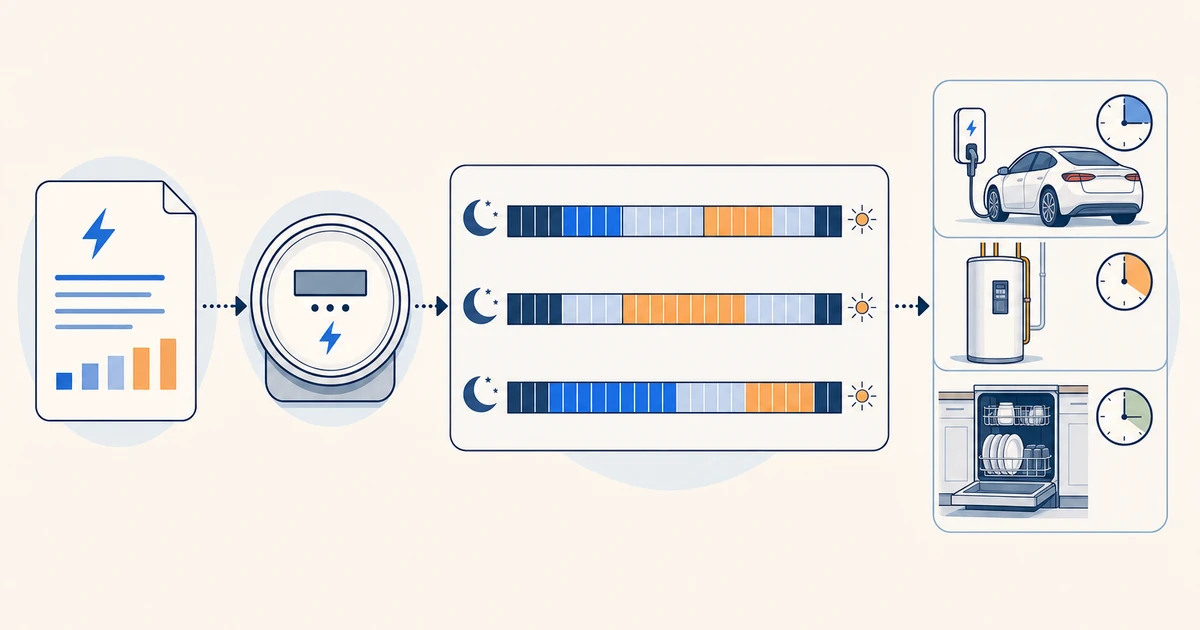
Use this order to find the schedule for an existing time-based plan:
- Locate the complete rate code. Include every letter, number, and suffix shown on the bill.
- Match the code to the current official schedule. Use the tariff or regulator record with the latest effective date for that exact code.
- Identify the meter it covers. A whole-home plan applies behind the main meter. A second-meter EV plan applies only to the charging circuit.
- Read season, day type, and time block in that order. Summer can differ from winter. Weekdays, weekends, observed holidays, and super off-peak periods may each follow a different clock.
These labels describe the time blocks:
- Off-peak: a lower-priced period.
- On-peak or peak: the highest-priced regular period.
- Mid-peak or partial-peak: a period between peak and off-peak.
- Super off-peak: the lowest-priced period on a plan that uses an extra tier.
The type of plan determines which equipment follows the schedule:
| Plan type | Where the schedule applies |
|---|---|
| Whole-home time-of-use | Every load measured by the main meter |
| EV-only rate with a second meter | The EV charging circuit only |
| Managed EV charging | Charging controlled through the enrolled vehicle, charger, or utility program |
| Dynamic or hourly pricing | Market-priced intervals that can change daily, with no fixed off-peak block |
| Controlled-load rate | A dedicated water-heating or heating circuit operated under its own tariff |
Off-peak electricity hours by exact plan
Overnight demand is often low, which is why many plans place off-peak hours at night. The U.S. load pattern also varies by season and region, so it cannot replace the schedule attached to a household's rate code.
Schedule status: The examples below were in effect on August 10, 2026.
| Location and official plan | Off-peak or super off-peak hours | Other time blocks |
|---|---|---|
| Northern California, PG&E E-TOU-C | Before 4 p.m. and after 9 p.m. every day | Peak is 4 p.m. to 9 p.m. every day. The clock stays the same across seasons. |
| Southern California, SCE TOU-D-4-9PM | June to September: before 4 p.m. and after 9 p.m. October to May: super off-peak is 8 a.m. to 4 p.m.; off-peak is 9 p.m. to 8 a.m. | June to September: 4 p.m. to 9 p.m. is on-peak weekdays and mid-peak weekends. October to May: 4 p.m. to 9 p.m. is mid-peak every day. |
| Colorado, Xcel residential TOU | Before 5 p.m. and after 9 p.m. on non-holiday weekdays, plus all day on weekends and listed holidays | Peak is 5 p.m. to 9 p.m. on non-holiday weekdays throughout the year. |
| Virginia, Dominion Schedule 1G | Super off-peak is midnight to 5 a.m. every day. Other hours outside the peak blocks are off-peak. | May to September: peak is 3 p.m. to 6 p.m. weekdays. October to April: peak is 6 a.m. to 9 a.m. and 5 p.m. to 8 p.m. weekdays. Weekends and listed holidays have no peak block. |
| New York City and Westchester, Con Edison Rate III | Off-peak is midnight to 8 a.m. every day | Delivery peak is 8 a.m. to midnight every day, including holidays. Full-service customers also have a 2 p.m. to 6 p.m. super-peak supply period from June through September. |
Are weekends and holidays always off-peak?
No. Xcel's Colorado schedule makes weekends off-peak, while PG&E's E-TOU-C keeps its 4 p.m. to 9 p.m. peak block every day. Con Edison's delivery peak also applies every day, including holidays. Use the holiday list attached to the exact tariff because utilities do not all observe the same dates.
Why can midday be super off-peak?
Solar-rich grids can have abundant electricity in the middle of the day and a steep evening ramp after sunset. Recent CAISO grid data show batteries charging when midday solar output exceeds grid needs and discharging later. That pattern helps explain SCE's winter super off-peak period from 8 a.m. to 4 p.m.
Choose the biggest flexible loads first
We prioritize loads that use meaningful electricity and can wait without disrupting the household. The order is usually EV charging, tank water heating, dishwashing and laundry, then limited HVAC pre-conditioning.
1. EV charging
EV charging is often the easiest large load to move because the car can remain plugged in for hours. Program the off-peak window in the vehicle or the charger, and let one scheduler control the session. Overlapping schedules can prevent charging from starting.
The window must be long enough for the required charge. Four hours may work with Level 2 charging and fall short with Level 1. Add the next departure time and leave a short buffer before the higher-priced period begins.
2. Tank water heating
A tank stores hot water, so heating can often occur before a peak period and pause during it. Use a built-in TOU mode, manufacturer control, or enrolled utility program. A generic plug timer is inappropriate for a hardwired 240-volt water heater.
A DOE field validation involving almost 250 water heaters found that connected heat pump water heaters reduced evening peak power by 90% compared with uncontrolled electric resistance units. Participants used the opt-out function in 4% of events.
3. Dishwashing and laundry
Delay-start controls can move a dishwasher or washer out of an evening peak. Daytime and weekend off-peak periods are useful because the appliance can run while someone is home and awake.
Keep dryer safety ahead of the schedule. Follow the appliance instructions, clean the lint filter every cycle, maintain the vent, and avoid running a dryer while asleep or away. The U.S. Fire Administration's dryer fire data identify failure to clean as the leading ignition factor in home dryer fires from 2018 through 2020.
4. Heating and cooling
HVAC is a large load with less flexibility. Modest pre-cooling or pre-heating before the peak block can reduce later compressor use. Deep setbacks can create an uncomfortable rebound when the system recovers. Safe temperatures, health, and humidity control take priority over the rate clock.
Cooking, lighting, and refrigeration are poor scheduling targets. Keep the refrigerator running, use lights when needed, and leave meal timing alone. Concentrate on the large loads that already have a delay setting, stored energy, or a departure deadline.
Program one schedule for each load
Use one control point per device: the car or EV charger, the water heater's approved control, or the appliance's delay-start setting. Enter the applicable season and day type, then allow enough time for the job to finish before the next higher-priced block.
The useful sequence is simple: rate code, meter, season, day, time block, then load. That prevents a generic overnight rule from overriding the schedule that actually appears on the bill.