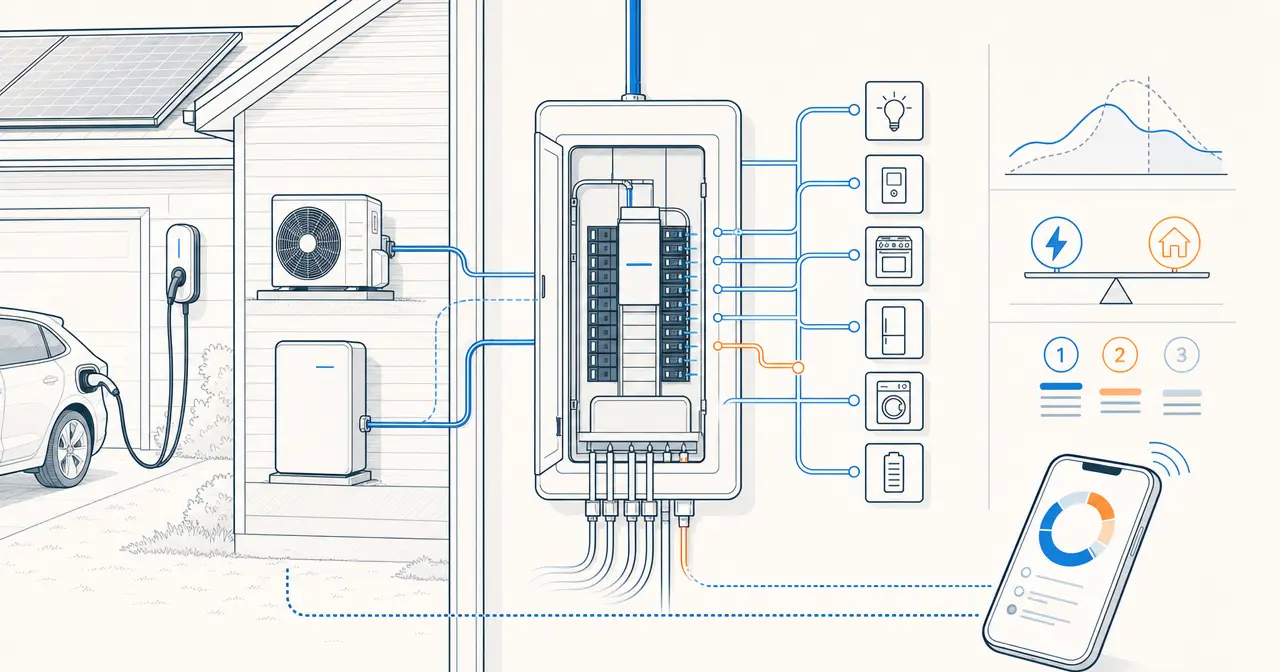
A smart electrical panel can show where electricity goes and control selected circuits. The hard question is whether those functions solve an actual constraint in your home. A full smart panel can coordinate an EV charger, heat pump, battery, and other large loads, while a targeted controller may solve the same capacity problem for less. The right choice depends on service size, breaker space, load calculations, backup plans, and the exact installed cost.
We provide project-planning guidance. Final electrical design, Power Control System settings, permit treatment, and tax position belong to the licensed electrician, local authority having jurisdiction, and tax professional responsible for the project.
Quick answer: which electrical upgrade fits?
Use the smallest scope that resolves the documented problem.
| Your situation | Best starting point | Why |
|---|---|---|
| You want circuit-level usage data | Circuit-level energy monitor | Adds visibility without replacing the panel |
| One new EV charger causes the capacity issue | EV energy-management system or circuit-sharing controller | Manages the one flexible load |
| The existing panel is unsafe, recalled, damaged, or out of breaker space | Conventional panel replacement | Fixes the panel problem directly |
| Several flexible loads strain the service calculation | Listed Power Control System, retrofit controller, or full smart panel | Coordinates loads under a configured limit |
| You want battery backup for selected circuits | Battery-oriented smart subpanel or controller | Creates a managed backup-load group |
| You want whole-home backup with circuit priorities | Full smart panel or compatible whole-home controller | Automates which loads remain available during an outage |
| The calculated load still exceeds the existing service after approved management | Service upgrade | Adds real upstream capacity |
A standard panel replacement and a service upgrade are different projects. A replacement can keep the same service rating. A service upgrade may change the meter, conductors, disconnect, utility connection, or transformer.
What a smart electrical panel does
“Smart panel” covers several product types. The differences matter more than the label.
- A full smart panel replaces the main load center or a major distribution panel. It can monitor and control many branch circuits.
- A retrofit controller sits beside an existing panel and manages a limited number of selected circuits.
- A battery smart subpanel groups circuits for backup and coordinates them with a particular battery ecosystem.
- A smart-breaker system adds measurement and remote switching through compatible breakers and a hub.
- A circuit monitor measures consumption through current transformers. It does not open a breaker or create capacity by itself.
Common functions include circuit-level monitoring, remote on/off control, schedules, load priorities, battery backup coordination, and automated load shedding. Those functions can improve visibility and operating control. They do not increase the service rating.
Load management can make existing capacity more useful
Traditional load calculations assume that specified loads may operate together. An approved load-management system can keep selected flexible loads from exceeding a set limit. An EV charger might slow or pause while an electric range and clothes dryer are running, then resume as capacity becomes available.
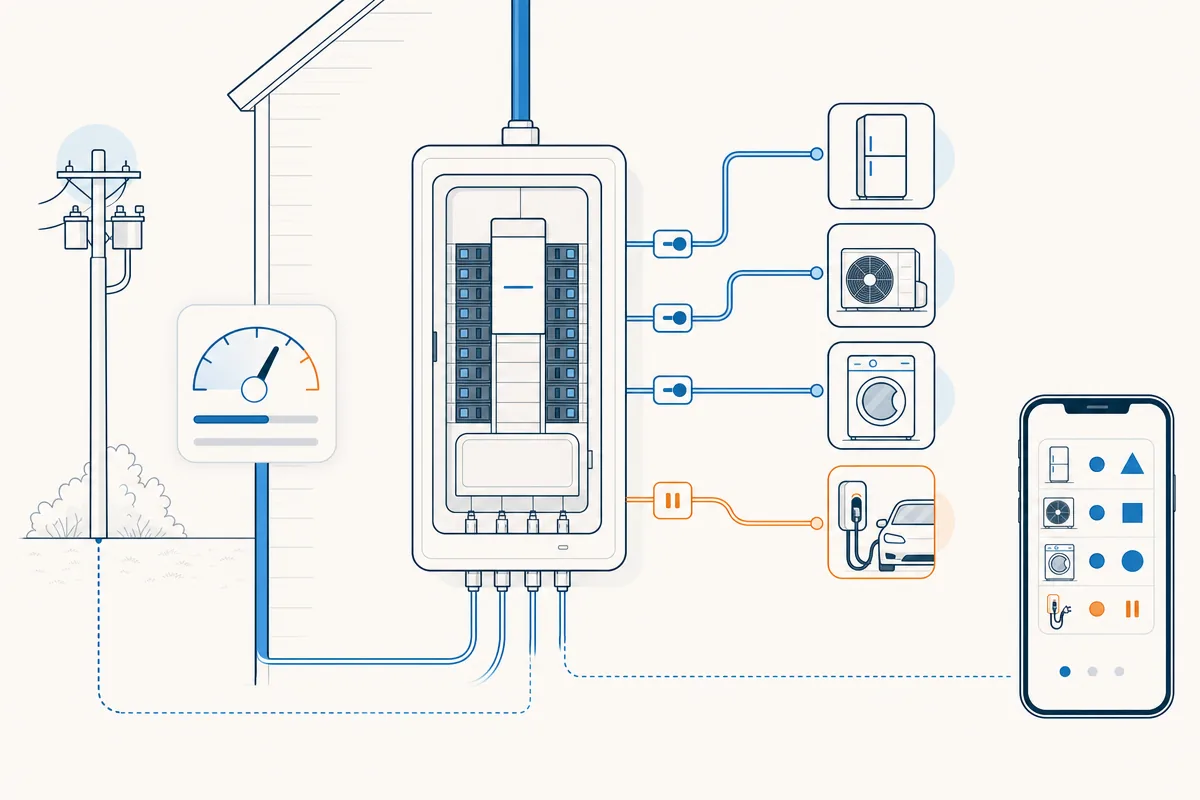
The service remains the same size. The system controls timing so the home stays within that limit.
This approach works best with loads that can wait, such as EV charging, water heating, pool equipment, and some heating or cooling stages. It is a weaker fit when the home has many large loads that must run simultaneously.
Smart features do not automatically earn load-calculation credit
A monitoring app, connected breaker, or generic “smart” label is insufficient for a permit calculation. To receive service-load-calculation credit through a Power Control System, the exact installed configuration must be listed and labeled for that PCS use under the locally adopted code. The listing and installation instructions define the compatible components, measurement point, controlled loads, maximum current setting, and required labels.
The 2023 National Electrical Code addresses listing for energy-management systems in Section 750.6, Power Control Systems in 750.30, and service or feeder load limits in 220.70. The 2026 edition moved broader listing rules into Article 130. Local adoption varies. UL's code guidance also explains that a PCS can consist of multiple devices operating as one listed system.
That distinction changes product selection. A full smart panel may have one approved PCS configuration and another configuration that provides only monitoring or user-directed control. A smart breaker can retain its normal protective function without giving the project permission to reduce the calculated service load. The permit set must identify the exact models, configuration, setpoint, listing, labels, and installation instructions accepted by the local authority having jurisdiction.
Representative products and prices on August 5, 2026
These products represent the main categories available now. Equipment prices exclude tax, shipping, permits, branch-circuit work, and electrician labor unless the row says otherwise.
| Product | Category and scope | Current equipment price | Best fit | Important limit |
|---|---|---|---|---|
| SPAN Panel range | Panel family with 16 to 48 controllable circuit spaces, including main-breaker and main-lug-only models. PowerUp load management is embedded in every SPAN Panel. | $2,550 to $4,100 | Several controllable loads, whole-home circuit control, and battery coordination | An authorized installer must enable and configure PowerUp. Load-calculation treatment depends on the exact listed configuration, labels, and permit approval. |
| Square D Energy Center QOWC60M200PFY | Full 200-amp meter-main panel with a 225-amp bus, whole-home monitoring, surge protection, and distributed-energy connections | $3,499 list | A planned full replacement that needs solar, battery, generator, or EV-ready distribution | This exact model is semi-flush, underground-feed, and uses a ringed meter socket. Smart Power Manager is included software. Compatible control relays are separate hardware. |
| ABB ReliaHome Smart Panel ABBHEM2 | Retrofit controller for up to 12 one-pole or six two-pole circuits | $2,568 for the indoor unit at current retail | Keeping a conventional load center while adding selected-circuit management | Installation and commissioning are extra. The exact CT layout and configured operating mode determine its function. |
| Lumin Smart Panel | Retrofit controller for up to 12 circuits | Installer quote; no current public MSRP | Selected-circuit control without replacing the load center | It controls only the circuits routed through it. Project price depends on panel layout and branch-circuit work. |
| EcoFlow Smart Home Panel 2 | 12-circuit battery-oriented subpanel and controller | $1,599, currently marked sold out. The $2,000 installation option without permit processing and $2,500 option with it are also marked sold out. | Managed backup with compatible EcoFlow batteries and generators | It is a backup subpanel in a specific ecosystem, not a service panel or automatic service-capacity solution. |
| Leviton 2nd Gen Smart Circuit Breakers with LWHEM-2R | Modular smart-breaker system for a Leviton Load Center | $390.95 for the hub, plus $236.63 for a representative 40-amp two-pole remote-control breaker | Adding monitoring and switching circuit by circuit in a compatible load center | It requires Leviton equipment. Remote switching alone does not establish a listed service-limiting PCS. |
| Eaton AbleEdge Smart Breaker | Two-pole BR smart breaker, available from 15 to 60 amps | Dealer quote; no current public MSRP | One compatible 240-volt load that needs measurement, schedules, or remote switching | It manages one circuit. Cloud schedules do not operate during an internet outage, while normal breaker protection remains active. |
| Emporia Vue 3 | Monitor-only device for mains and up to 16 branch circuits | $99.99 to $199.99 | Low-cost circuit data before deciding on larger work | It measures loads but cannot shed them or create load-calculation credit. Key monitoring requires internet, with no direct local access or persistent local data storage. |
What smart-panel projects cost
The equipment price is only one part of the quote. Panel condition, conductor length, breaker replacement, wall repair, permit fees, utility coordination, and working clearance can change the installed total.
| Project scope | Current price anchor | Cost usually added |
|---|---|---|
| Monitor only | $99.99 to $199.99 for Emporia Vue 3 hardware | Electrician labor if professionally installed |
| One EV load-management package | $599 for the Emporia Pro Level 2 EV Charger bundled with Vue 3 and PowerSmart | New circuit, wire, permit, and installation |
| Modular smart-breaker control | $390.95 Leviton hub plus $236.63 for one representative 40-amp two-pole breaker | Compatible load center, more breakers, and labor |
| 12-circuit controller or backup subpanel | $1,599 EcoFlow list price, currently marked sold out, or $2,568 ABB indoor controller | Circuit rerouting, CTs, breakers, commissioning, and permit |
| Full smart panel | $2,550 to $4,100 for SPAN hardware; $3,499 list for one Square D Energy Center model | Breakers, panel labor, utility outage, permit, and wall repair |
| Conventional panel replacement at the same service size | About $2,000 to $4,000 in current cost guidance | Site-specific remediation and utility work |
| Service or transformer upgrade | About $5,000 to $25,000 in the same current guidance | Trenching, long conductor runs, utility charges, and local complexity |
A recent SMUD program reported a $1,100 median cost for an EV branch-circuit installation. SMUD separately describes circuit sharing and an EV-focused energy-management device, both targeted alternatives to a whole-home smart panel.
Some older cost figures need a narrower label. A California field study used partner estimates of $2,000 to $5,000 for panel or subpanel work and $3,000 to $28,000 for a service upgrade. Those figures described electrical interventions for 240-volt heat-pump water heater projects in California. They are not national smart-panel price bands.
The relevant comparison is the installed cost of each code-compliant path. A $4,500 controller project can be financially sensible if it avoids a documented $15,000 service upgrade. It is harder to justify if a $3,000 conventional panel replacement already resolves the safety and space issue.
Federal tax credits now have a narrow role
The federal 25C home-improvement credit is unavailable for property placed in service after December 31, 2025. The 25D residential clean-energy credit is unavailable for expenditures made after that date. For 25D, an expenditure is generally treated as made when the original installation is complete, so paying in 2025 did not preserve the credit for an installation completed in 2026. IRS termination guidance explains the separate timing rules.
The 30C alternative-fuel refueling credit remained available for qualifying home EV-charging property placed in service through June 30, 2026, subject to eligible-census-tract rules. For a personal-use project, the credit was 30% of qualified cost, up to $1,000 per charging port. IRS 30C guidance says associated panel, conduit, and wiring costs can count when they are integral to and solely attributable to the charging property. Shared panel or wiring costs must be allocated, and costs serving other uses can be partly or fully excluded. Projects placed in service after June 30, 2026, do not qualify for 30C.
State, utility, and local programs vary. Our incentive finder helps organize those programs before bids are compared.
When a full smart electrical panel earns its premium
Several flexible loads share a constrained service
A home adding an EV charger, heat pump, heat-pump water heater, and induction range may have enough annual energy capacity while failing a conventional peak-load calculation. A listed PCS can prioritize those loads under a fixed service limit.
A Berkeley Lab builder guide reports that most homes in its new-home analysis needed only one or two controlled devices. The guide reports typical interruptions of about 15 minutes, almost always under one hour, across about 1% of annual hours. Those figures support targeted control in suitable new-home designs. They are not a guarantee for an existing home with different weather, loads, and usage.
A narrower controller may still win when only one or two loads cause the problem. The full panel earns more of its premium when many circuits need coordinated priorities or when the existing panel is due for replacement.
Battery backup needs change by circuit
A battery has finite power and energy. Automatic circuit priorities can keep refrigeration, lights, communications, and selected outlets available while dropping an electric dryer, resistance heater, or EV charger. A battery-oriented subpanel can do this for a limited circuit group. A full smart panel makes more sense when priorities span much of the house or need to change in the app.
Size backup around required loads and outage duration before choosing panel controls. Circuit priorities help allocate stored energy. They do not compensate for an undersized battery or inverter.
The panel already needs replacement
Obsolete equipment, damage, recalled components, insufficient breaker positions, or a renovation can make replacement necessary regardless of smart features. The useful comparison is then the incremental cost of a smart panel over a compliant conventional replacement.
If the panel is safe and has space, replacing it solely for energy charts usually has a weak financial case. A monitor provides much of the diagnostic value at a fraction of the equipment price.
When a narrower alternative is better
One EV charger is the only new constraint
A listed EV energy-management system can adjust charging to the capacity available at the service. A circuit-sharing device can prevent two mutually exclusive loads from operating together. These approaches preserve the existing panel and target the flexible load directly.
Our home EV charger guide explains charging levels, circuit sizing, and load-management choices.
The problem is breaker space
A full panel, subpanel, or approved tandem-breaker solution may solve a physical-space problem. Software cannot create breaker positions, improve working clearance, or repair damaged equipment.
The household needs simultaneous peak loads
Load management shifts or pauses demand. It is a poor fit when medical equipment, heating, cooking, hot water, charging, and other large loads must all operate together. A 200-amp service upgrade may be the appropriate path when the calculated demand remains above the existing limit.
The goal is only lower bills
Monitoring can reveal a failing appliance, unnecessary standby use, or a poor schedule. Remote circuit control does not guarantee savings. Price signals, flexible loads, and household behavior determine the result. For many homes, a lower-cost monitor and targeted controls produce the useful data without a full replacement.
Installation and ownership details that affect the choice
A good proposal covers the full operating life, not only the hardware model.
| Topic | Decision guidance |
|---|---|
| Installation scope | A full replacement usually needs a planned outage, permit, and sometimes utility coordination. A retrofit controller still requires CT placement, selected-circuit rerouting, conductor space, and working clearance. Smart breakers require the named compatible load center. |
| Commissioning | The final record identifies every monitored and controlled circuit, CT direction and phase, PCS limit, load priority, restart behavior, labels, listing instructions, and approved one-line diagram. Commissioning is incomplete if the app works but the permitted control logic is undocumented. |
| Offline behavior | Breaker protection, automatic load control, local app control, and cloud access are separate functions. SPAN PowerUp retains its latest configured settings without internet. Lumin local control during an internet outage requires the phone and panel to remain powered and connected to the same functioning local network. Eaton's cloud schedules stop offline while breaker protection continues. Emporia Vue 3 has no direct local data access or persistent local storage. If PowerSmart is unavailable, the Emporia Pro charger falls back to the Guaranteed Charge Rate set by the electrician. |
| Warranty | Emporia Vue 3 publishes one year and the Leviton LWHEM hub publishes two years. ABB ReliaHome and Lumin cover their sensor boards and processor board for two years, while all other components receive ten-year limited coverage. SPAN publishes a ten-year limited warranty. EcoFlow's ten-year Smart Home Panel 2 warranty requires purchase from EcoFlow or an authorized reseller and installation by an EcoFlow-recommended technician or a certified electrician. Labor, travel, removal, and reinstallation may have separate coverage. |
| Serviceability | The proposal names the installer responsible for support, local availability of compatible breakers or relays, account-transfer steps, manual operating options, and the procedure if a sensor, controller, or cloud service fails. A familiar conventional panel plus a replaceable controller can reduce ecosystem dependence. |
Industry research has identified first cost, contractor familiarity, permitting uncertainty, and manufacturer support as adoption barriers for load-management products. The VEIC market study also notes that simple binary control can leave capacity unused. Variable charging or staged control can make better use of the service when the load and approved equipment support it.
Build a decision-ready electrical proposal
The quote should separate needs from optional features and make competing paths easy to compare. It should include:
- Existing service rating, main-breaker size, panel model, condition, breaker spaces, and grounding or bonding issues.
- Current utility interval data where available and an inventory of existing large loads.
- Planned additions with nameplate ratings, including EV charging, batteries, or solar, heat pumps, water heating, cooking, and accessory units.
- The load calculation under the locally adopted code, both before and after any allowed PCS treatment.
- At least two scopes when practical: targeted management or conventional replacement, and the full smart-panel or service-upgrade path.
- Itemized equipment, breakers, labor, permits, utility fees, wall repair, commissioning, and recurring software costs.
- The exact listing, compatible components, setpoint, labels, and failure behavior for any configuration expected to receive load-calculation credit.
- Backup priorities, installer support responsibility, warranty handling, replacement-parts path, and internet-outage behavior.
This package keeps a useful technology from becoming a substitute for electrical design.
Smart electrical panel FAQ
Is a smart electrical panel the same as a 200-amp panel?
No. “Smart” describes monitoring and control functions. “200 amp” describes a service or panel rating. A smart panel can be installed in different service configurations, and a conventional 200-amp panel can have no connected features.
Can a smart electrical panel prevent a service upgrade?
Sometimes. An exact listed PCS configuration can keep flexible loads under an approved limit when local code and the authority having jurisdiction allow that treatment. It cannot correct unsafe equipment, create breaker space, or serve a home whose required simultaneous demand remains above the service capacity.
What happens if the internet goes down?
Core breaker protection does not depend on an app. Other behavior is product-specific. Some systems keep automatic load-management settings and local control, while cloud dashboards, notifications, remote commands, or cloud schedules may stop. The required offline functions belong in the equipment specification and commissioning record.
Do smart panels work with solar and batteries?
Many do, but compatibility is model- and ecosystem-specific. A compatible setup can coordinate grid power, solar production, battery state of charge, and circuit priorities. The inverter, transfer equipment, panel configuration, and communication path must be part of the approved design.
Will a smart panel lower the electric bill?
It can support savings by exposing loads and shifting flexible use into lower-rate periods. Savings depend on the tariff, controllable loads, automation, and household routine. Monitoring alone does not reduce consumption.
Choose the smallest system that solves the real constraint
A smart electrical panel is most valuable when several flexible loads need coordination, battery priorities change by circuit, or a panel replacement is already necessary. A targeted EV manager, retrofit controller, circuit monitor, conventional replacement, or service upgrade can be the better fit when the problem is narrower.
Document the capacity, safety, space, backup, and operating requirements before comparing hardware. Then compare complete installed scopes under the same assumptions. Use Watt Wallet to find the rebates and local programs that can reduce the cost of the electrical work your home actually needs.