Last reviewed: 2026-06-29 (UTC)
For many homeowners, an EV charger with load management is the right middle path between a slow standard-outlet setup and an expensive full panel upgrade.
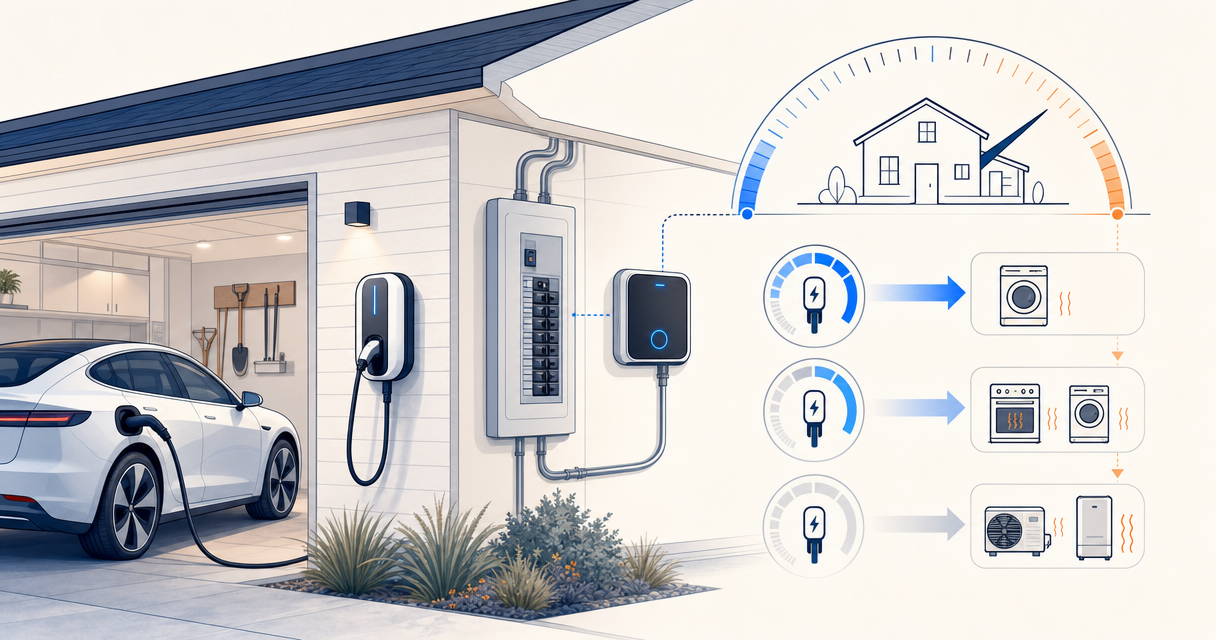
The idea is simple: instead of letting the charger pull the same power no matter what the rest of the house is doing, a managed system watches total home demand and slows charging when the panel gets busy, then speeds it back up when capacity opens up again. That can let many 100-amp or crowded-panel homes add useful Level 2 charging without jumping straight to 200-amp service.
But this is not a magic workaround for every house. If the home already struggles with major electric loads, the panel is outdated or overloaded, or bigger electrification projects are coming next, a panel or service upgrade may still be the smarter long-term answer.
This guide is informational, not electrical, code, or contractor advice. Use it to pressure-test quotes, compare solution types, and ask better questions before you buy hardware.
Quick answer
| Your situation | Usually the smarter answer | Why |
|---|---|---|
| 100-amp service, moderate driving, and some major gas appliances | A managed or lower-amp Level 2 setup may work well | The charger can throttle around the rest of the house instead of demanding max power all at once |
| 100-amp service, but you already have all-electric heat / hot water or frequent breaker issues | Plan for a deeper electrical review, not just a managed charger | Load management cannot create real headroom if the house is already crowded |
| 200-amp service with obvious spare capacity | You may not need load management at all | A standard Level 2 setup may fit fine without extra control hardware |
| You only need modest overnight miles | Level 1 or a smaller Level 2 setup may already be enough | Many homeowners do not need 40A-48A charging to make home charging practical |
What an EV charger with load management actually does
An EV charger with load management treats the charger as the flexible load in the house.
That matters because the rest of the home is not equally flexible. The refrigerator needs to stay on. The oven, heat pump, or dryer may turn on when they turn on. EV charging is different because it can often happen a little slower for part of the evening without causing a real problem.
Emporia's homeowner explanation of load management describes it as monitoring total home usage and automatically adjusting charging power to stay within the home's safe electrical limit. Enphase's Power Control Software overview explains the same idea from another angle: the system compares household demand against the main panel limit and reduces charger output when big loads like air conditioning, ovens, or heat pumps push demand higher.
In plain English, that means the charger is not trying to "win" against the rest of the house. It is trying to fit inside the real capacity your home has left at that moment.
It also helps to know that "load management" is not one single product format. Depending on the quote, it may show up as:
- a charger paired with a panel monitor,
- a charger ecosystem with built-in dynamic control,
- a panel-side load-shed device,
- or a broader smart-panel / smart-splitter approach.
The label matters less than the actual job: how the system measures available capacity, and how it changes charging automatically when the house gets busy.
When it helps on 100-amp or crowded panels
This is why homeowners search the topic in the first place.
A lot of older homes still have 100-amp service. That is common, and it does not automatically mean home EV charging is impossible. Fischer Electric's homeowner guide on 100-amp service and EV charging says many older homes can still support some EV charging with the right load calculation, planning, and possibly load management.
The important phrase there is load calculation.
A real charger decision depends on what else the house is already carrying, including:
- whether heating is gas or electric,
- whether the water heater is gas or electric,
- whether the range and dryer are electric,
- whether there are other big loads like a hot tub, workshop tools, or air conditioning,
- and how much actual headroom is left in the panel.
That is why two houses with the same 100-amp label can get very different answers.
A home with gas heat, gas hot water, and moderate driving may have a much easier path to a managed Level 2 setup. A home with all-electric heat, electric hot water, and other large loads may hit its limit much faster.
The Alternative Fuels Data Center also makes an important point here: electricians can assess whether the home has adequate electrical capacity for Level 2 charging, and some homes will need a different installation path than others. In other words, the right question is not just "does the home have 100 amps?" It is "what can this specific house safely support once the rest of the load is counted?"
Dynamic vs. static load management vs. load sharing
This part gets confusing fast because product pages use the terms loosely.
Static load management
Static load management means the charger or charger group is given a fixed ceiling.
Emporia's load-management explainer says a static approach uses pre-set limits that do not change based on actual live usage. In practice, that can mean the charger stays capped at a lower output all the time, even when the rest of the house is barely using power.
Dynamic load management
Dynamic load management is the smarter version for most homes.
Instead of staying at one fixed cap, the system looks at what the house is actually doing right now. If the oven and dryer are running, charging may slow down. Once those loads back off, the charger can ramp up again automatically.
That is the better fit for homes where usage changes throughout the day, which is most houses.
Load sharing
Load sharing is related, but it often describes multiple chargers sharing one available power bucket.
Commercial explanations from EV Connect and Chargie are useful here. They show how several chargers can stay inside one site limit by redistributing power as more vehicles plug in.
For a single-family homeowner, the exact term matters less than the behavior. What you usually care about is this:
- Does the system react in real time?
- Does it watch the whole house, or only the charger circuit?
- Does it keep charging useful when the home is busy, instead of simply shutting the project down or forcing one rigid low limit?
If you are shopping for one charger at home, dynamic whole-home control is usually the most relevant concept.
Right-size the charger before you assume you need max power
One of the biggest mistakes homeowners make is assuming that "better" means chasing the highest-amp charger they can buy.
Often, the smarter move is to right-size the project.
Rewiring America's guide to electrifying on a 100-amp panel gives the cleanest example. It says a 16A Level 2 charger can still deliver at least 100 miles of charge overnight, which is more than enough for many drivers. The same guide says Level 1 may still deliver about 50 miles overnight for many routines.
Fischer's 100-amp guide makes the same practical point differently: some homes can still support Level 2, but often on 20A-30A circuits instead of 40A-60A, and that may still be fast enough when the car plugs in every night.
That changes the homeowner decision completely.
Instead of asking only, "Can I install the fastest charger?" the better question is often:
"How much overnight recovery do I actually need?"
A managed setup can be a strong answer when:
- you want Level 2 convenience without insisting on the highest possible output,
- a smaller or adjustable charging rate still covers your normal miles,
- or you want a charger that can stretch the home's capacity intelligently instead of demanding a huge fixed circuit.
It also means some households should not skip straight past simpler options. The AFDC home-charging guide says many EV owners can still meet daily needs with overnight Level 1 charging if a dedicated branch-circuit outlet is available. That does not make Level 1 ideal for everyone, but it is an important reminder: not every charging problem needs a max-output hardware solution.
When load management still will not replace a panel or service upgrade
This is where the article needs to be blunt.
Load management can help a tight project. It cannot fix every electrical bottleneck.
A panel or service upgrade is still more likely to be the smarter path when:
- the home already has all-electric heat, hot water, range, and other heavy loads with very little spare capacity,
- breakers already trip when several large appliances run,
- the existing panel is outdated, degraded, or unsafe,
- you are planning other major electrification projects soon, such as a heat pump, hot tub, workshop equipment, or a second EV,
- or the quote is already drifting into utility, meter, or broader service-side work.
Fischer's homeowner guide says these are exactly the conditions where 100-amp service may stop being a good long-term fit for EV charging. Emporia's own homeowner explainer also admits the flip side: some newer homes with 200-amp service and relatively low current use may simply have enough spare capacity already and may not benefit much from load management at all.
That is why managed charging should be treated as a fit question, not a universal upgrade-avoidance hack.
If a quote is already turning into a larger service discussion, the more useful next read is Watt Wallet's guide on cost to upgrade to 200 amp service. The planning difference between a relatively clean panel-side upgrade and a broader service project is often much bigger than homeowners expect.
What to look for when comparing load management options
If you are shopping for an EV charger with load management, the right comparison points are not just brand names.
Start with these questions instead:
1. How does the system measure available capacity?
The most important feature is not the app or the cable length. It is whether the system can actually tell how much room the house has left.
For many homeowners, that means some kind of whole-home monitoring or clearly documented panel-side control logic.
2. Does charging adjust automatically in real time?
This is the dynamic-vs-static split.
If the system only uses a fixed low cap, it may solve the safety problem but leave charging slower than it needs to be most of the time. A dynamic system is usually more useful because it can give the car more power when the rest of the house quiets down.
3. What kind of solution is this, exactly?
The quote may involve:
- a charger paired with a panel monitor,
- a panel-side load-shed device,
- a smart splitter or circuit-sharing approach,
- or a broader smart panel.
Those are not identical paths, even if they all get marketed under "load management."
4. Is this also a plug-in vs. hardwired decision?
Connection method is a separate question from load management.
Some homeowners are really deciding between a plug-in 240V setup and a hardwired charger. If that is the real fork in the road, Watt Wallet's guide to NEMA 14-50 vs. hardwired EV charger is the better next step.
5. Is the system sized for one charger or future growth?
If the household may add a second EV later, future expandability matters more than it does in a one-vehicle home with stable driving habits.
The goal is not to buy the most sophisticated option on the market. It is to buy the option that matches the home's electrical reality and the charging routine you actually have.
Questions to ask your electrician before you buy
Before you commit to hardware, ask these questions plainly:
What did the load calculation actually show?
You do not need a vague answer like "the panel is tight." You need to know whether the house truly lacks capacity, or whether the project can work with a managed or lower-amp setup.
Could a smaller or adjustable Level 2 setup already solve the problem?
A lot of projects get framed as all-or-nothing when the real answer is simply "not max speed."
Is this home a good fit for dynamic load management, or does it really need bigger electrical work?
That separates the homes that are merely crowded from the homes that are already overcommitted.
Will this charger be plug-in or hardwired, and how does that change the scope?
That answer affects the circuit, parts list, and sometimes the future flexibility of the setup.
Is the existing outlet or circuit actually reusable?
Do not assume an existing 240V outlet is automatically EV-ready. Outlet condition, circuit details, code treatment, and charger compatibility still matter.
Are permits, inspection, or utility coordination part of this job?
The AFDC says home charging installations must comply with local and state code, and permits may be required. Watt Wallet's guide on whether you need a permit to install an EV charger is a useful companion if that part of the quote is still fuzzy.
If we avoid a bigger upgrade today, what future projects could change the answer?
That question matters if the home may soon add a heat pump, second EV, hot tub, electric water heater, or other large loads.
Bottom line
An EV charger with load management can be an excellent homeowner solution when the panel is tight but not truly out of room.
The strongest case is a home that still has workable headroom, a driver who does not need the highest possible charging speed every night, and an electrician who confirms that dynamic control can keep the project safely inside the home's real limit.
The weakest case is a house that is already struggling with major electric loads, a bad or crowded panel, or bigger electrification plans that are going to outgrow the workaround quickly.
So the real goal is not "avoid a panel upgrade at all costs." It is match the charging setup to the home's real capacity and to the miles you actually need to recover overnight.
FAQ
Is load management the same as load sharing?
Not exactly. The terms overlap, but they are not always identical. In homeowner use, load management usually means watching total available electrical capacity and adjusting charging to stay inside it. Load sharing often describes multiple chargers splitting one available power bucket. Some companies use the terms loosely, so it is better to ask what the system actually measures and controls.
Can a 100-amp service still support Level 2 EV charging?
Often yes, but not always. Many 100-amp homes can still support some form of Level 2 charging, especially with the right load calculation, moderate household loads, and a smaller or managed charger setup. Other homes will still need a bigger panel or service upgrade.
Do I still need a permit for a managed EV charger install?
Very often, yes. Load management does not erase the usual electrician, code, and permit path for Level 2 charging or new-circuit work. The exact answer is local, but homeowners should treat permit and inspection as normal parts of a real charger install, not as unusual extra paperwork.
Sources
- Alternative Fuels Data Center: Charging Electric Vehicles at Home
- Rewiring America: How to electrify on a 100 Amp panel
- Fischer Electric: Is EV Charging Possible on a 100-Amp Service?
- Emporia: What Is Load Management? How It Saves You From Expensive Electrical Panel Upgrades
- Enphase: Protect homes from electrical overload
- EV Connect: EV Charging Station Load Management
- Chargie: Load Sharing and EV Charging Load Management Explained