Last reviewed: September 23, 2026 (UTC)
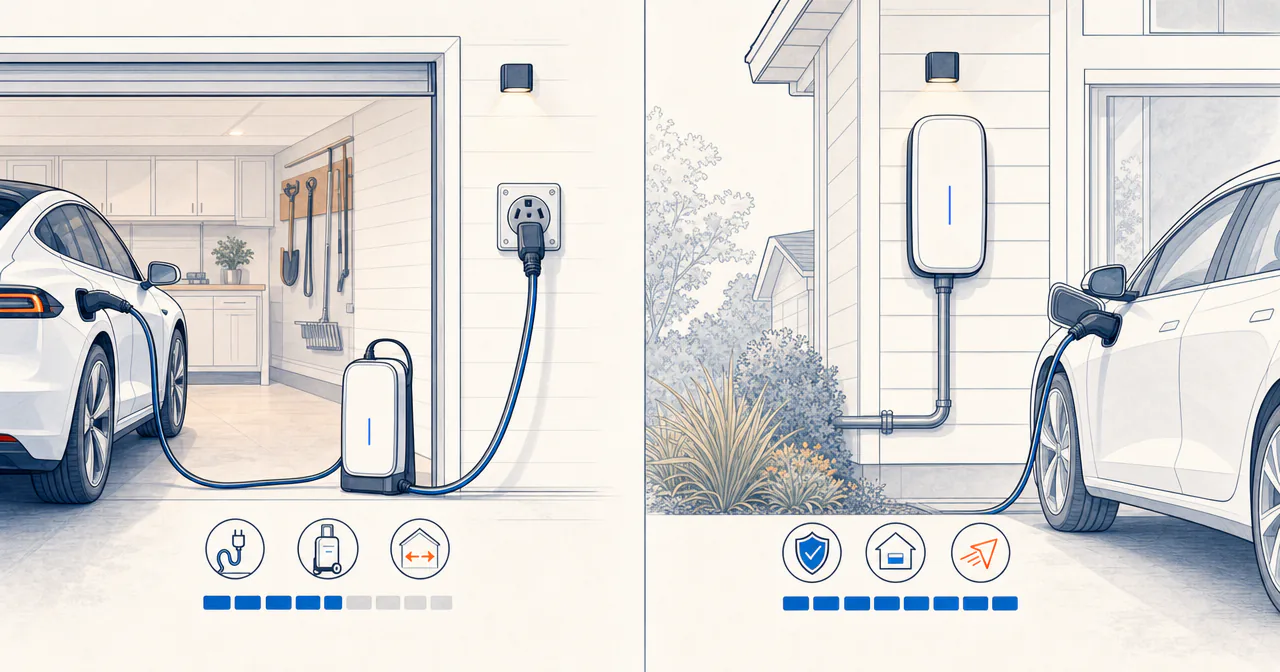
NEMA 14-50 vs hardwired EV charger is a connection-method decision before it is an amperage decision. For a long-term home, we favor hardwiring because it removes the receptacle from the charging path and gives the installer more ways to match the EVSE to the circuit. A NEMA 14-50 plug-in setup is the better fit when portability matters, 32A or 40A meets your routine, and the receptacle is suitable for the equipment and locally adopted code. Service capacity, code, location, cost, and future needs still decide the installation.
NEMA 14-50 vs hardwired EV charger: the comparison
The two setups can deliver the same charging output. A plug-in charger is easier to remove, while a hardwired charger is more permanent and can give the installer more circuit and placement options. The choice changes when you compare the full installation rather than the charger alone.
| Decision factor | NEMA 14-50 plug-in charger | Hardwired EV charger |
|---|---|---|
| Connection | Charger cord ends in a NEMA 14-50 plug and receptacle | Charger connects directly to the branch circuit through its enclosure or raceway |
| Typical charging ceiling | Many products use a 32A setting on a 40A circuit or a 40A setting on a 50A circuit | Product and circuit dependent. Some units reach 48A or 50A on larger circuits, while many can be set lower |
| Service capacity | Still needs a load calculation. An open breaker position does not prove spare service capacity | Same requirement. Hardwiring does not add service capacity; a lower setting or compatible load management may change the design |
| Load management | Possible with compatible equipment, though the receptacle itself does not provide it | Some hardwired products support configurable or dynamic power management, subject to the product and electrical design |
| Indoor or outdoor location | Works indoors. Outdoors requires a weather-rated charger, receptacle, enclosure, fittings, and cord | Often the cleaner outdoor path, with the charger, raceway, fittings, and terminations rated for the environment |
| Portability | Unplug the charger for a move or replacement | Relocation or replacement usually involves electrical work |
| Maintenance access | The charger can be removed from a de-energized receptacle, but the receptacle needs inspection for heat and wear | Fewer plug and receptacle connections, with service access to the charger, breaker, and any disconnect still required |
| Installer scope | Branch circuit, breaker, NEMA 14-50 receptacle, enclosure, charger, and any permit or inspection work | Branch circuit, breaker, cable or raceway, terminations, charger mount, and any permit or inspection work |
| Ground-fault protection | Local code may require GFCI protection, and the breaker, receptacle, and charger must work together | The code path can differ, but hardwiring is not a blanket exemption from ground-fault requirements |
| Cost drivers | Can cost less when a compliant outlet already exists. Receptacle quality, breaker, route, labor, and permit work still count | Circuit route, panel capacity, conduit or cable, charger hardware, labor, load management, and permit work drive the total |
| Best fit | Existing EV-ready outlet, likely move, easy charger swaps, and a 32A or 40A routine that meets your needs | Long-term ownership, outdoor placement, fewer receptacle-related compromises, or a compatible higher-output setup |
NEMA 14-50 vs hardwired EV charger: choose the plug-in path for flexibility and a verified outlet; choose hardwire for permanence, outdoor placement, receptacle-free service, or a compatible higher-output setup. The right amperage still depends on the branch circuit, home service, charger, and vehicle.
A NEMA 14-50 is an outlet, not a charging speed
A NEMA 14-50 is a 240-volt receptacle commonly used with plug-in Level 2 electric vehicle supply equipment (EVSE). The receptacle identifies the connection. It does not determine how much power the charger will draw.
Some Level 2 EVSE can be installed either way. Other products are hardwired only or limit their plug-in settings to particular circuits. Follow the equipment listing and installation instructions for the exact product. A NEMA 14-50 on the wall does not automatically make every charger a 40A charger.
An existing range or dryer outlet deserves the same caution. The outlet shape may differ, the circuit may have other design limitations, or the receptacle may be unsuitable for repeated EV charging. Have a licensed electrician assess the circuit, conductors, breaker, receptacle condition, location, and local requirements before reusing it.
How continuous-load amperage changes the choice
The U.S. Department of Energy's home-charging guidance treats EV charging as a continuous load. It also says charging installations must follow local and state requirements, and that a qualified electrician should assess whether the home has enough electrical capacity.
That is why the familiar 50A circuit and 40A charging pairing exists. A 50A circuit divided by the usual 125% continuous-load planning factor gives a 40A charging ceiling. The result is a planning relationship, not permission to choose a breaker, wire size, or charger setting without a complete design.
Hardwiring can open a wider range of settings, but the product still controls the available options. Tesla's Wall Connector output table lists 48A on a 60A breaker, 40A on a 50A breaker, and 32A on a 40A breaker. ChargePoint's Home Flex installation FAQ lists plug-in operation at 32A on a 40A circuit or 40A on a 50A circuit; its 48A and 50A settings require hardwire installation. These are useful product examples, not universal limits. The vehicle's onboard charger can also accept less current.
Service capacity is separate from branch-circuit size
The branch circuit is the final circuit serving the charger. The service and panel must also carry the home's other loads. Electric heat, a heat-pump water heater, an electric range, a dryer, air conditioning, a hot tub, workshop equipment, and a second EV can change the answer.
A 100A service can sometimes support a lower-output or managed charger, while a 200A service can still be crowded. The electrician's load calculation matters more than the service label by itself. If the home is close to its limit, compare three paths:
- a lower charging setting that still replaces your daily miles
- compatible dynamic load management that reduces charging when the home is busy
- a panel or service change that supports the charger and future electrical projects
Our guide to EV charger load management explains when managed charging can fit a crowded panel and when it does not solve a larger capacity problem. Load management can control the charger within a documented limit. It cannot repair an unsafe panel or create capacity for an already overloaded service.
Safety differences: GFCI, location, and access
GFCI requirements depend on the jurisdiction and code edition
The current-code answer is more nuanced than “plug-in needs GFCI, hardwire never does.” The NFPA's final 2026 NEC decision on Section 625.54 says the proposed revision that would have extended the section to permanently wired EVSE will not be included in NFPA 70's 2026 edition. A jurisdiction may still be using an earlier NEC edition, a local amendment, or another rule that changes the result.
For a homeowner, that means the authority having jurisdiction, the installation location, the equipment listing, and the manufacturer's instructions all matter. A plug-in NEMA 14-50 quote may need a GFCI-protected receptacle or breaker. A hardwired quote may follow a different code path, but removing the receptacle does not guarantee an exemption from every ground-fault requirement.
The charger's own protection also matters. ChargePoint says Home Flex includes charging circuit interrupting device (CCID) protection and warns that an upstream GFCI breaker can cause nuisance trips in some circumstances. Its guidance recommends hardwiring when local code requires a GFCI breaker for the plug-in installation. That is a product-specific example, not a universal code rule.
Indoor and outdoor placement are different planning problems
The DOE says outdoor home charging can be safe when the equipment is rated for outdoor use. For a plug-in setup, that means the charger, NEMA 14-50 receptacle, enclosure, cover, fittings, and cord all need to suit the exposure. A garage outlet that is acceptable indoors is not automatically suitable on an exterior wall.
Hardwiring is often the cleaner outdoor choice because it avoids a weather-exposed plug and receptacle connection. It still needs an outdoor-rated charger, appropriate raceway or cable, sealed fittings, drainage or mounting details where required, and a location that protects the cable from vehicles and foot traffic.
Whichever method you choose, leave the charger, cord, breaker, receptacle if present, and any disconnect accessible for service. Do not hide a receptacle behind a permanently parked appliance or place a hardwired unit where the electrician cannot reach its termination area.
Maintenance access favors different things
Plug-in equipment is easier to remove when you want to take it with you or replace the charger without changing the branch circuit. The trade-off is a mechanical connection that stays in use during repeated charging. A loose, hot, discolored, or damaged receptacle is a reason to stop using the setup and have it assessed.
Hardwired equipment has fewer plug and receptacle contacts in the charging path. The charger stays in place, so the installation should leave the breaker, any required disconnect, cable entry, and manufacturer service area reachable. A permanent connection is useful only when it is installed with future service in mind.
Already have a NEMA 14-50 outlet?
Treat an existing outlet as a starting point, not as proof that the setup is ready. Ask the electrician to confirm:
- Dedicated circuit: The circuit is intended for the EVSE and has no other outlet or appliance sharing it.
- Breaker and conductors: The breaker, conductors, grounding, terminations, and charger setting match the equipment and the locally adopted code.
- Receptacle quality: The receptacle is listed and suitable for the intended EV charging duty, installed securely, and free from heat damage or looseness.
- Location: The cord reaches the vehicle without a trip or crush hazard, and the receptacle and enclosure are rated for the environment.
- Capacity: The service and panel load calculation can carry the charging load, or the quote includes a documented lower setting or load-management plan.
- Approval path: The permit, inspection, utility, and any building or association requirements are included where they apply.
If the outlet is worn, overheated, loose, or an old appliance outlet with uncertain history, replacing it or hardwiring may be a better use of the electrician's time than preserving it because it already exists.
Which option costs less?
There is no reliable universal price difference. A plug-in setup can be less expensive when a compliant, well-placed NEMA 14-50 already exists and the charger can use it at the desired setting. A new plug-in installation adds a receptacle, enclosure, and possibly a different breaker or ground-fault solution.
Hardwiring can be close in price when the electrician is already running a new circuit. It can also cost less than a plug-in design when the alternative requires a high-quality receptacle, additional weatherproofing, or a GFCI arrangement that adds parts and labor. Either method costs more when the panel is far from the parking space, the route requires difficult access or trenching, the service is short on capacity, or a permit and inspection add scope.
Ask for the quote in separate lines:
- Charger or EVSE model and configured charging current
- Load calculation and any service or panel work
- Branch-circuit conductors, breaker, and raceway or cable
- Receptacle and enclosure, if the setup is plug-in
- Ground-fault protection and outdoor-rated equipment, if applicable
- Load-management equipment, if proposed
- Labor, permit, inspection, testing, and commissioning
Our guide to EV charger permits can help you separate the electrical work from the local approval path. Permits, inspections, utility notifications, and equipment rules vary by jurisdiction and manufacturer instructions, so the quote should name what is included rather than assume the process is the same everywhere.
Our recommendation by homeowner scenario
Choose hardwire when:
- You expect to stay in the home and want a permanent installation.
- The charger will be outside or in a location where a weather-exposed receptacle is awkward.
- You want to remove the NEMA receptacle as a long-term wear and maintenance point.
- You want the highest practical charging setting your service, circuit, charger, and vehicle can support.
- You want a lower or dynamically managed setting that fits a tight panel without committing to a plug-in receptacle.
- You may have a larger battery, a second EV, or a shorter overnight or off-peak charging window later. Our time-of-use electricity guide explains why the charging window can matter as much as the car's battery size.
Choose a NEMA 14-50 plug-in setup when:
- You already have a dedicated, correctly sized, EV-suitable outlet in the right place.
- You may move and want to take the charger with you.
- Easy charger removal or replacement matters more than a permanent connection.
- A 32A or 40A charging setting replaces your normal daily driving energy within the time the car is parked.
- The installation is indoors or the outdoor receptacle and enclosure are explicitly rated for the exposure.
Pause before choosing either one when:
- Someone is recommending an old dryer or range outlet without a circuit and load assessment.
- The quote treats an open breaker position as proof that the home has capacity.
- A plug-in quote omits the receptacle grade, breaker, ground-fault protection, or permit scope.
- A hardwired quote promises 48A without naming the charger, circuit, vehicle limit, and service-capacity basis.
- The installer dismisses GFCI, outdoor rating, heat damage, maintenance access, or inspection questions.
FAQ
Does a NEMA 14-50 charger always deliver 40A?
No. A common 50A branch circuit is paired with a charging setting up to 40A because EV charging is a continuous load. The charger may be set lower, the circuit may be designed differently, or the vehicle may accept less. The equipment instructions and electrical design control.
Does hardwiring always charge faster?
No. A hardwired charger can use the same 40A setting as a plug-in charger when both are designed for a 50A circuit. Some hardwired equipment supports higher output on a larger circuit, while other products or vehicles set a lower limit.
Can I use the dryer outlet I already have?
Do not assume that you can. The receptacle, conductors, breaker, grounding, circuit configuration, condition, charging duty, location, and local requirements all need to match the charger. An electrician should assess the existing circuit before anyone treats it as EV-ready.
Is 40A enough for overnight charging?
Often. The useful question is how many miles you need to recover during the time the car is parked. A 40A setup may be plenty for a regular commute, while a larger battery, high daily mileage, or a short charging window can make additional output useful. The DOE notes that Level 2 is especially helpful for longer commutes, irregular schedules, and larger batteries.
Is hardwire better for an outdoor EV charger?
It is often the simpler outdoor path because it avoids a weather-exposed plug and receptacle. A plug-in installation can also work when the charger, receptacle, enclosure, fittings, and circuit meet the outdoor requirements. The product listing and local code determine what is allowed.
What about NEMA 6-50?
NEMA 6-50 is another receptacle-based path. It does not change the main decision: compare portability, outlet condition, continuous-load amperage, location, ground-fault requirements, capacity, and long-term service access against a hardwired installation.
Sources
- U.S. Department of Energy home-charging guidance
- Tesla Wall Connector output table and Gen 3 installation table
- ChargePoint Home Flex installation FAQ
- NFPA's final 2026 NEC decision on Section 625.54 and public NEC code record
- Our EV charger permit workflow
Bottom line
Choose a NEMA 14-50 plug-in setup when a verified outlet already exists, portability matters, and 32A or 40A meets your charging routine. Choose hardwire when you want a permanent installation, outdoor placement, fewer receptacle-related compromises, or a compatible charging setting that better matches your service and future plans.
Before you approve either path, use our EV charger permits guide to map the local approval questions onto the electrician's quote.