Last reviewed: 2026-07-09 (UTC)
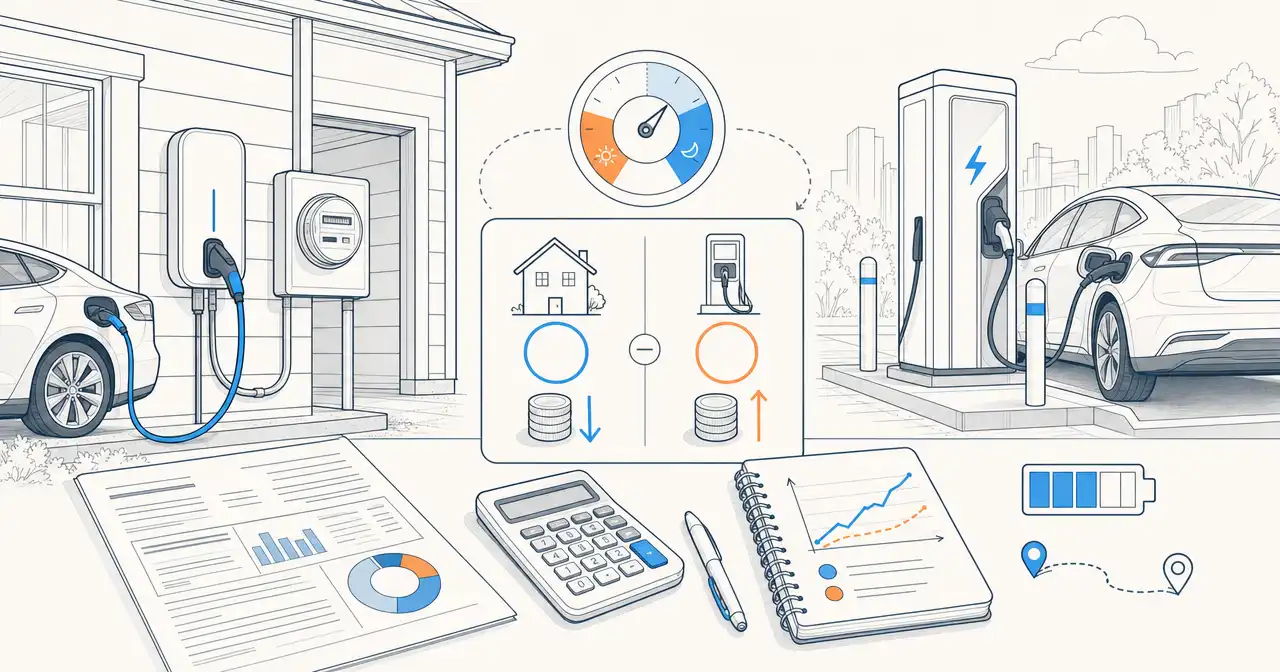
If you want the short answer, a homeowner using the U.S. Energy Information Administration's Electric Power Monthly Table 5.6.A benchmark of 18.83 cents per kWh for the April 2026 U.S. Total residential row lands around $4.71 to $6.28 per 100 miles, about $7.53 to $13.56 for a typical home charging session, and roughly $47 to $63 for a round 1,000-mile driving month. Those are planning benchmarks, not universal tariffs: the home examples here use the EIA table exactly as published, while the public-charging comparisons below use separately attributed Qmerit and Drive Clean California examples. Home charging is usually cheaper than public Level 2 or DC fast charging because it uses residential electricity rates instead of network pricing.
This guide is about the ongoing electricity cost of charging. If you are really asking about the one-time cost to install a Level 2 setup, treat that as a separate project and start with Watt Wallet's guide to whether you need a permit to install an EV charger and NEMA 14-50 vs. hardwired EV charger breakdown.
This guide is informational, not utility, tax, or financial advice.
Quick answer: what EV charging at home usually costs
| Question | Practical answer |
|---|---|
| What does 100 miles usually cost at home? | Using the EIA's April 2026 U.S. Total residential average of 18.83 cents per kWh, an EV that gets 4 miles per kWh costs about $4.71 per 100 miles, while one that gets 3 miles per kWh costs about $6.28. |
| What does a home charging session usually cost? | At that same rate, a 40 kWh charge is about $7.53, and a 72 kWh charge is about $13.56. |
| What does a month of home charging usually cost? | Using a round 1,000-mile month, that works out to about $47.08 per month at 4 miles per kWh or about $62.77 at 3 miles per kWh. |
| Is home charging cheaper than public charging? | Usually yes. In this guide's EIA home benchmark, home charging is 18.83 cents per kWh. Recent Qmerit and Drive Clean California public examples put Level 2 around 25 to 30 cents per kWh and DC fast charging around 40 to 53 cents per kWh, so the same driving usually costs more away from home. |
| Does Level 2 change the price per kWh? | Usually not on the same utility plan. Level 2 mostly changes speed and can make off-peak charging easier. |
| What if I actually mean charger installation cost? | That is a separate home-electrical project. Use this guide for ongoing energy cost, then compare setup questions with Watt Wallet's permit guide and home-charger setup guide. |
EV charging cost calculator: the simple math
Two formulas answer almost every version of this question:
- Cost to add energy = kWh added x electricity rate
- Cost per 100 miles = kWh per 100 miles x electricity rate
If your EV shows efficiency in miles per kWh instead of kWh per 100 miles, convert it like this:
- kWh per 100 miles = 100 / miles per kWh
Here is a simple example using the U.S. Energy Information Administration's Electric Power Monthly Table 5.6.A. The April 2026 U.S. Total residential row shows 18.83 cents per kWh:
- If your EV gets 4 miles per kWh, it uses 25 kWh to drive 100 miles, so the electricity cost is about $4.71.
- If your EV gets 3 miles per kWh, it uses about 33.3 kWh to drive 100 miles, so the electricity cost is about $6.28.
- If your EV uses about 27 kWh per 100 miles, the same rate works out to about $5.08 per 100 miles.
You may see slightly higher "national average" planning numbers elsewhere because some articles average the 50 states and DC instead of using the EIA's published U.S. Total row. This guide sticks with the U.S. Total residential row shown in the linked table so readers can verify the exact benchmark used in the math.
That is why cost per 100 miles is usually the cleanest planning number. A full-charge figure is easy to picture, but cost per 100 miles makes it easier to compare one EV with another and to compare home charging with gas or public charging.
What a full charge, 100 miles, and a month at home usually cost
Home charging is usually the cheapest default because it uses normal residential electricity pricing rather than public network pricing.
For this guide's national planning benchmark, use the EIA's Electric Power Monthly Table 5.6.A. The April 2026 U.S. Total residential row shows 18.83 cents per kWh. At that rate:
- A 40 kWh charging session is about $7.53.
- A 72 kWh charging session is about $13.56.
- Driving 100 miles often lands around $4.71 at 4 miles per kWh and $6.28 at 3 miles per kWh.
For a round planning month of 1,000 miles, the same math works out to around:
- about $47.08 per month if your EV gets 4 miles per kWh
- about $62.77 per month if your EV gets 3 miles per kWh
If you want to adapt the monthly figure to your own driving, multiply your cost-per-100-miles number by your monthly miles divided by 100.
Those are planning numbers, not a universal tariff. Your actual bill depends on your local rate, your EV's efficiency, and whether your home charging happens entirely on a residential plan or partly through more expensive public sessions.
One more reality check: simple battery math can slightly understate what your utility meter sees. Charging is not perfectly efficient, so the wall can show somewhat more electricity use than the battery capacity alone.
Home charging vs. public charging cost
The big reason home charging is usually cheaper is simple: home charging uses your household electricity rate, while public networks charge more for access, equipment, maintenance, and, in the case of DC fast charging, speed.
The comparison ranges below are illustrative, not fixed national rates. The home row uses the EIA's April 2026 U.S. Total residential average of 18.83 cents per kWh. The public rows reflect Qmerit's June 2026 25-cent Level 2 and 53-cent DC fast examples plus Drive Clean California's current 30-cent Level 2 and 40-cent DC fast examples.
| Charging setup | Illustrative electricity price | Typical cost per 100 miles at 3 to 4 miles per kWh | Example cost for a 40 kWh session | Example cost for a 72 kWh session |
|---|---|---|---|---|
| Home charging | 18.83 cents per kWh | About $4.71 to $6.28 | About $7.53 | About $13.56 |
| Public Level 2 | About $0.25 to $0.30 per kWh | About $6.25 to $10.00 | About $10.00 to $12.00 | About $18.00 to $21.60 |
| Public DC fast | About $0.40 to $0.53 per kWh | About $10.00 to $17.67 | About $16.00 to $21.20 | About $28.80 to $38.16 |
Two source-backed examples make that spread easier to picture:
- Qmerit's June 2026 comparison shows a 72 kWh battery at about $18.00 on public Level 2 at 25 cents per kWh and about $38.16 on DC fast charging at 53 cents per kWh. At this guide's EIA home benchmark, that same 72 kWh charge would be about $13.56 at home.
- Drive Clean California's current charging overview shows a 40 kWh Nissan LEAF at about $12 on public Level 2 at 30 cents per kWh and about $16 on DC fast at 40 cents per kWh. At this guide's EIA home benchmark, a 40 kWh home charge would be about $7.53.
That does not make public charging a mistake. It means public charging usually trades a higher price for convenience, speed, or access.
Public charging still makes sense when:
- you live in an apartment or rental without reliable home charging,
- you are on a road trip and need faster turnaround,
- you need an occasional top-off away from home, or
- your home setup is not ready yet and you are bridging the gap.
For many EV owners, the cheapest pattern is still home charging most of the time and public charging only when convenience or distance requires it.
Does Level 1 vs. Level 2 change what you pay?
Usually, not very much on a per-kWh basis if you are charging at home on the same utility plan.
The bigger difference is charging speed. Drive Clean California's current charging overview describes Level 1 as adding roughly 3.5 to 6.5 miles of range per hour and Level 2 as adding roughly 14 to 35 miles of range per hour. It also notes that DC fast charging can be much faster again, sometimes up to about 10 miles per minute in favorable conditions.
That is why Level 2 is mostly a convenience and scheduling upgrade. It can refill the car overnight more easily and can make it much easier to stay inside a cheaper off-peak charging window.
If you are deciding between home charging setups, pair this page with Watt Wallet's Level 1 vs. Level 2 EV charger guide, NEMA 14-50 vs. hardwired guide, and time-of-use electricity plans guide.
What changes the answer most
There is no one universal cost to charge an EV at home because a few variables do most of the work.
1. Your electricity rate
This is the biggest swing factor. The same EV can look inexpensive in one utility territory and much more expensive in another because the dollars-per-kWh number changes.
2. Your EV's efficiency
A more efficient EV needs fewer kWh to go the same distance. A car that gets 4 miles per kWh costs less to drive than one that gets 3 miles per kWh at the same electricity rate.
3. Charging losses
Real charging is not perfectly efficient, so the electricity pulled from the wall can run somewhat higher than the battery capacity alone suggests.
4. When you charge
Some utilities offer lower overnight or off-peak rates. If you can shift charging into those windows, your home charging cost can drop materially. That is one reason Level 2 can make sense even when the base home rate itself does not change.
If off-peak timing is part of your decision, Watt Wallet's off-peak electricity hours guide and time-of-use electricity plans guide are the natural next reads.
FAQ
How much does it cost to fully charge an electric car at home?
It depends on the battery size and your electricity rate. At the EIA's April 2026 U.S. Total residential average of 18.83 cents per kWh, a 40 kWh charge is about $7.53, while a 72 kWh charge is about $13.56. Larger batteries, higher rates, and charging losses can push the real number higher.
How much does it cost to drive 100 miles in an EV?
At 18.83 cents per kWh, an EV that gets 4 miles per kWh costs about $4.71 per 100 miles, while one that gets 3 miles per kWh costs about $6.28. Use your own miles-per-kWh or kWh-per-100-miles number for a better estimate.
How much does it cost to charge an electric car at home per month?
Using a round 1,000-mile month, home charging comes out to about $47.08 per month at 4 miles per kWh or about $62.77 at 3 miles per kWh when electricity is 18.83 cents per kWh.
Is it cheaper to charge an EV at home or in public?
Usually home. In this guide's EIA benchmark, home charging is 18.83 cents per kWh, while recent Qmerit and Drive Clean California public examples put Level 2 around 25 to 30 cents per kWh and DC fast charging around 40 to 53 cents per kWh.
Does Level 2 cost more than Level 1?
Usually not on a per-kWh basis if both are on the same home utility plan. Level 2 mainly changes speed, convenience, and how easily you can charge during off-peak hours.
Will my electric bill go up if I get an EV?
Yes, your electricity use will usually go up, but the size of the increase depends on your rate and how much you drive. For many households, EV charging feels more like an added utility line item than a gas-station refill pattern.
Is charging an EV usually cheaper than gas?
Often, yes, especially when most charging happens at home. The cleanest comparison is cost per 100 miles: for gas, use 100 / mpg x gas price per gallon; for an EV, use kWh per 100 miles x electricity rate.
Bottom line
If you want the shortest useful answer, here it is: charging an electric car at home is usually cheaper than charging in public, and a homeowner using the EIA's April 2026 U.S. Total residential average of 18.83 cents per kWh lands around $4.71 to $6.28 per 100 miles and about $7.53 to $13.56 for a common home charging session.
The most useful number is usually not the full-charge figure. It is cost per 100 miles, because that helps you compare vehicles, estimate monthly driving cost, and see how much more public charging really costs.
If your real decision is whether to install a charger, compare wiring setups, or shift charging into off-peak hours, use Watt Wallet's EV charger permit guide, NEMA 14-50 vs. hardwired guide, and time-of-use electricity plans guide next.
Sources
- Alternative Fuels Data Center: Electricity basics
- Alternative Fuels Data Center: Charging at home
- Fueleconomy.gov: All-electric vehicles
- U.S. Energy Information Administration: Electric Power Monthly Table 5.6.A
- Qmerit: How Much Does EV Charging Cost?
- Drive Clean California: Electric Car Charging Overview