Last reviewed: September 29, 2026 (UTC)
How many solar panels do you need for an electric car?
For the EV alone, a rough starting range is 6 to 10 modern panels, often rated at 400 to 450 watts each. That range assumes moderate driving and a productive roof. It is a sanity check, not a system design.
A driver covering 8,000 miles per year in an efficient EV can need fewer panels. A driver covering 15,000 miles on a less efficient model, or a home with shade and a less productive roof, can need many more. Whole-home solar also has to cover the home's other loads.
The useful answer comes from a labeled calculation.
Use a reproducible panel-count formula
1. Convert driving into wall-metered energy
Annual miles are the cleanest starting point. If the driving estimate is monthly, multiply it by 12 before sizing the array. A single high-mileage or low-mileage month can distort the result.
Vehicle efficiency is usually expressed as kilowatt-hours per 100 miles. The AFDC home-charging guidance uses that unit for EV energy and cost calculations, and FuelEconomy.gov EV data explains that battery charging efficiency varies.
Keep these two energy boundaries separate:
- Battery or vehicle energy: electricity that reaches the vehicle battery or is used by the vehicle. Convert it to wall energy by dividing by charging efficiency.
- Wall-metered energy: electricity pulled from the home electrical system. Use it directly. Do not add charging overhead a second time.
For a battery-energy input:
Annual wall kWh
= annual miles × battery kWh per 100 miles ÷ 100 ÷ charging efficiency
For a wall-metered input:
Annual wall kWh
= annual miles × wall kWh per 100 miles ÷ 100
FuelEconomy.gov cites battery charging efficiency assumptions in the 84% to 93% range for its EV energy model. That does not make one charging-efficiency assumption universal. The important part is to state which boundary the input uses and apply the conversion once.
2. Use PVWatts AC production
Panel wattage is a DC nameplate rating. The energy available to the home is AC production after the modeled PV system losses and inverter conversion.
The PVWatts calculator estimates annual and monthly AC energy for a location and a specified DC system. A useful per-panel input is:
PVWatts AC production per installed DC kW
= annual PVWatts AC output ÷ modeled system size in DC kW
The run should represent the roof that will actually carry the array. Tilt, azimuth, array type, panel type, shade, soiling, snow, wiring, inverter efficiency, and other losses all affect the result. The PVWatts manual documents a 14% default total system-loss input. That default is already part of the modeled production, so subtracting another 14% from the result would count the same loss twice.
PVWatts reports monthly output too. Keep the monthly values because an annual match can still leave a winter or cloudy-month gap.
3. Convert production into panels
Convert each panel's nameplate wattage to kilowatts:
- 400 watts = 0.40 kW DC
- 450 watts = 0.45 kW DC
Then use:
Panels
= annual wall kWh for the EV
  ÷ (PVWatts annual AC kWh per installed DC kW × panel size in kW)
Round up to a whole panel. This gives an energy target. Roof layout, inverter limits, electrical design, setbacks, and the rest of the home's load still belong in the solar and charger design.
Worked example with explicit assumptions
This is an illustrative sensitivity example. The production figure is an input that a location-specific PVWatts run could return, not a national average or a quote for every roof.
| Input | Example assumption |
|---|---|
| Driving | 12,000 miles per year, or 1,000 miles per month |
| Vehicle efficiency | 30 kWh per 100 miles at the battery |
| Charging efficiency | 85% of wall input reaches the battery; 15% of wall input is lost during charging |
| PV production | 1,300 kWh AC per installed DC kW-year from the PVWatts run |
| Panel wattage | 400 watts, or 0.40 kW DC |
The wall-metered EV load is:
12,000 miles × 30 kWh ÷ 100 ÷ 0.85
= 4,235 kWh per year
The 15% loss is a fraction of wall input. Relative to the 3,600 kWh delivered to the battery, the extra wall energy is about 17.6%.
The panel count is:
4,235 kWh ÷ (1,300 kWh per DC kW × 0.40 kW per panel)
= 8.14, rounded up to 9 panels
The result is 9 panels for this illustrative EV-only case. If the 30 kWh per 100 miles already described wall-metered energy, the calculation would use 3,600 kWh instead and would not divide by 0.85.
Sensitivity example
The table keeps charging efficiency at 85% and changes one or more of the other inputs. PVWatts production is stated per installed DC kW-year, and every result is rounded up.
| Scenario | Annual miles | Battery kWh per 100 miles | PVWatts AC kWh per DC kW-year | Panel wattage | Wall kWh per year | Panels |
|---|---|---|---|---|---|---|
| Lower use, productive roof | 8,000 | 27 | 1,500 | 400 W | 2,541 | 5 |
| Illustrative middle case | 12,000 | 30 | 1,300 | 400 W | 4,235 | 9 |
| Same driving, lower roof production | 12,000 | 30 | 1,000 | 400 W | 4,235 | 11 |
| Same driving, larger panels | 12,000 | 30 | 1,300 | 450 W | 4,235 | 8 |
| Higher mileage and efficiency load | 15,000 | 34 | 1,000 | 400 W | 6,000 | 15 |
The table shows why a universal panel number is weak. Driving, battery efficiency, roof production, and panel wattage all move the result. A 6 to 10 panel estimate remains useful as a quick check for a moderate EV load. It should not replace a production model.
If you already have solar, start with the surplus and the equipment
An existing solar system may already produce enough annual energy for the EV. Compare its annual and monthly AC production with the EV's wall-metered load, then separate energy balance from charging timing.
A home can have enough annual solar to offset an EV while still importing electricity for nighttime charging. The inverter's AC capacity, the system's interconnection limit, available roof area, and the home's service capacity also determine whether expansion is possible.
For the project cost side, our guide to solar panel installation cost is a useful companion. It keeps the EV load separate from the rest of the home's system size.
What equipment do you need for solar EV charging?
A typical grid-connected setup includes:
- rooftop PV panels and an inverter
- a home EV charging station
- monitoring or energy-management equipment when the charger needs to follow excess solar
- an optional battery for shifting solar energy into a later charging window
The charger does not need to be a special solar-only product. The important question is whether the charging system can use the operating strategy the home needs.
Level 1 versus Level 2
Level 1 can meet light daily driving needs when a suitable dedicated branch circuit is available near the parking space. Level 2 is typically 240 volts and fits longer commutes, larger batteries, or shorter overnight parking windows. The AFDC home-charging guidance covers these home-charging boundaries.
Our guide to Level 1 versus Level 2 charging explains the daily-driving tradeoff. Our guide to NEMA 14-50 versus hardwired chargers covers the equipment and installation choice without treating one connection as universal.
Having solar is different from charging directly from solar
A standard charger usually responds to the vehicle and its schedule. It does not automatically know whether the roof has unused solar at that moment. If the array is producing less than the home is using, the charger can draw from the grid while the home still owns solar.
A solar-first system adds a monitoring, scheduling, or energy-management layer that responds to excess production. A compatible controller can reduce or pause charging when the solar surplus falls. Some systems allow the grid to fill the gap, while others wait for enough solar. The quote needs to name that behavior.
Our guide to the best home EV chargers covers charger features. Our guide to EV charger load management covers how the electrical load is coordinated with the rest of the home.
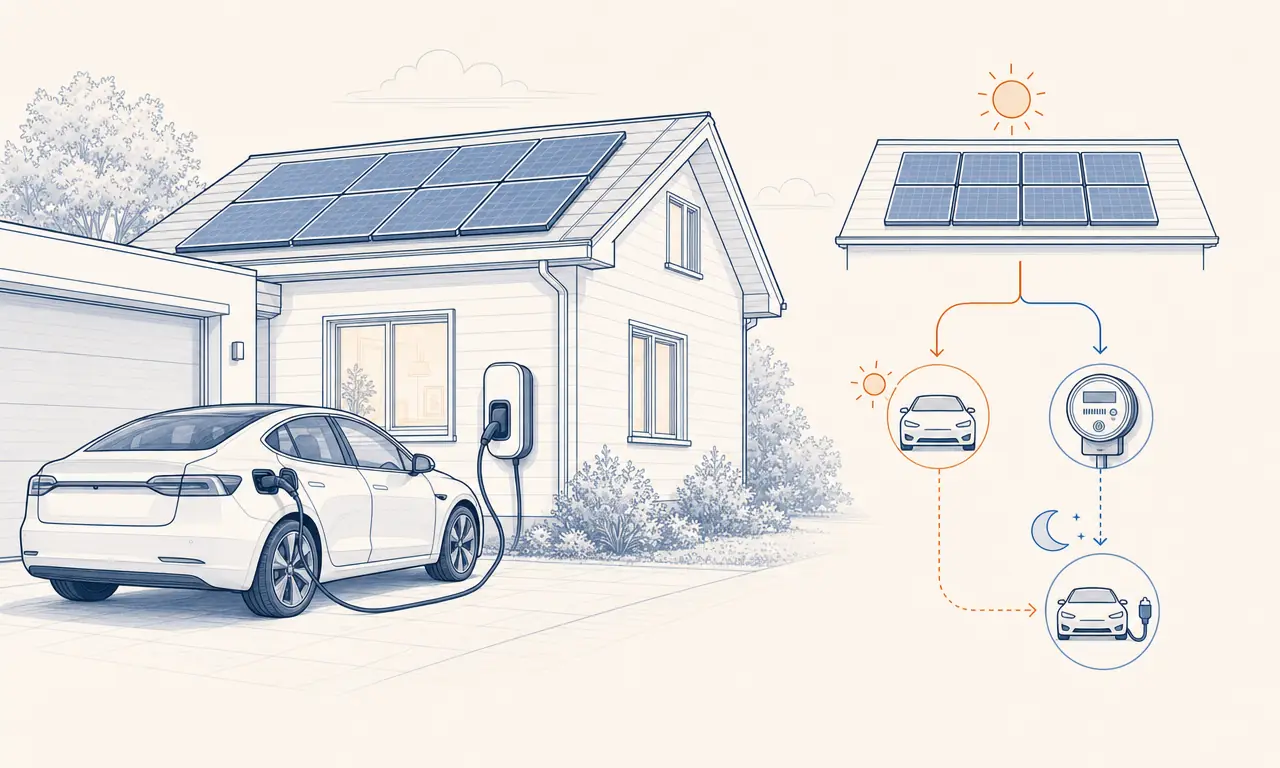
Compare three ways to pair solar with EV charging
The right choice depends on the car's schedule, the home's roof production, and the utility's current export and import rules.
| Strategy | Fits when | Main constraint | Economic input |
|---|---|---|---|
| Charge from live solar | The car is home during the production window and export compensation is weak | Solar output changes with clouds, shade, and other household loads | Value of the retail energy avoided by using solar directly |
| Export solar, charge off-peak | The car is away during the day or the overnight EV rate is attractive | Export credits and overnight prices come from the utility tariff | Export credit compared with the full marginal overnight import price |
| Add a battery | The car charges after sunset, export value is low, or backup power matters | Round-trip losses, battery cost, usable capacity, and service limits | Avoided import value compared with export value and battery costs |
Charge during the day from live solar output
Daytime charging can use the home's solar as it is produced. It works best when the car is parked at home during the strongest production hours and the charger can respond to the home's surplus.
Direct live-solar charging is different from annual solar offset. The array may generate enough energy over a year while the car still imports electricity after sunset, during winter, or when the home is using most of the output.
Export solar by day and charge the car off-peak
This strategy sends excess daytime solar to the grid and charges the EV later during a lower-priced window. It can fit a household where the car is away during the day or the utility offers an EV-specific overnight rate.
The comparison belongs on the utility bill, not in a national rule of thumb. The EIA rate FAQ says it does not publish exact residential peak or off-peak tariffs. The utility tariff supplies the applicable import price, delivery components, seasons, export credit, and EV rider.
For illustration only, 12 cents of export credit versus 8 cents of overnight import cost creates a 4-cent gross spread per kWh before other losses or charges. Those figures are example inputs, not a universal U.S. tariff. Our guides to time-of-use electricity plans and off-peak electricity hours explain the rate questions that affect the comparison.
Store solar in a battery and charge later
A battery can move midday solar into an evening or overnight charging window. It adds flexibility and may provide backup power, but storage is not a prerequisite for solar EV charging.
The DOE solar and storage guidance notes that solar production varies by time of day, weather, season, and obstructions, and that storage is not 100% efficient. The financial comparison should include the value of exporting the solar, the value of avoiding an overnight import, round-trip losses, battery cost and wear, usable capacity, and any backup-power value.
How utility rates change the savings calculation
Solar savings come from the energy flow and the rate that applies to that flow.
Live solar value
= wall kWh served directly × avoided retail import rate

Export and off-peak value
= exported kWh × utility export credit
  − EV wall kWh × overnight import price

Battery value
= battery-delivered kWh × avoided import value
  − export value given up
  − battery losses and ownership costs
Fixed monthly charges usually do not change when the EV's charging time changes. The quote and bill analysis should identify the marginal per-kWh import charge, delivery charges, taxes or riders, export treatment, and any EV-specific tariff.
The DOE homeowner solar guide explains that net-metering and export compensation depend on the state and electric utility. The cost to charge an EV at home guide provides the non-solar baseline for the home's driving load.
2026 incentives: federal credits are date-specific and local programs vary
A new 2026 solar or EV-charger quote should not assume a national rebate.
- Residential solar: The IRS Residential Clean Energy Credit says the 30% credit applies to qualified property installed from 2022 through December 31, 2025. The IRS OBBB FAQ says Section 25D is not allowed for expenditures made after December 31, 2025. Do not include the 30% federal solar credit in a new 2026 project model.
- Home EV charging: The same IRS FAQ lists Section 30C as unavailable for property placed in service after June 30, 2026. A later 2026 charger installation should not be modeled with that federal credit.
- State, local, and utility programs: Programs can exist for solar, storage, chargers, managed charging, or wiring, but eligibility and funding are jurisdiction-specific. The Department of Energy's AFDC state incentives and AFDC utility incentives organize those programs by location. The DOE Home Energy Rebates page says the program is available in select states, territories, and Tribes. The 2026 HEEHR notice changed program guidance for state and territory administrators, so its existence does not establish nationwide solar or EV-charger eligibility.
Our 2026 federal home energy tax credit guide provides filing context for qualifying earlier projects. A current project model should name the state or territory program, the utility, the tariff, and the equipment that the program actually covers.
Electrical work, breakers, service capacity, and permits
Solar generation does not remove the electrical requirements for an EV charger.
- Level 1 charging uses the vehicle cordset or Level 1 equipment, and a suitable dedicated branch circuit may be required.
- Level 2 charging is typically 240 volts and requires a review of the charger, branch circuit, breaker, service and panel capacity, and the home's other continuous loads.
- Load management can be part of the design when the service or panel has limited capacity. A 50-amp breaker is not a universal requirement.
- Outdoor equipment must be rated for outdoor use.
- Local electrical and building codes determine permit, inspection, and site-plan requirements.
- Solar interconnection is a separate utility process from the EV branch-circuit installation.
- The charger and installation should use appropriate safety certification and a qualified electrical contractor.
The AFDC home-charging guidance says home charging installations must comply with local and state codes, permits may be required, and some homes may have insufficient capacity for Level 2. Nothing here is a wiring or DIY guide. A qualified electrical contractor and solar professional should own the circuit, breaker, service-capacity, load-management, permit, equipment-certification, and interconnection decisions.
Our guides to smart electrical panels and EV charger permits cover the planning questions that belong in a professional quote.
Why roof conditions and seasonality change the answer
Annual solar production is an energy total. EV charging is a time-based load.
Solar output changes with:
- roof orientation and tilt
- tree shade and nearby obstructions
- cloud cover, rain, snow, dust, and soiling
- daylight length and winter weather
- inverter, wiring, mismatch, and availability losses
- the home's other loads during the production window
The DOE homeowner solar guide says roof age, shape, slope, and tree cover matter, and that south-facing roofs with a 15-to-40-degree slope often perform well in the northern hemisphere. East- and west-facing roofs can still work. The useful production input is the roof-specific PVWatts result, including its monthly output.
A system can cover an EV's annual wall energy and still need grid electricity in winter. A battery can shift some energy across hours, but it cannot create solar production during a long low-output period. Direct solar charging also depends on the car being home when the panels are producing.
Put these inputs in the solar and charger quote
A decision-ready quote should show:
- annual miles, or monthly miles multiplied by 12
- vehicle efficiency labeled as battery energy or wall-metered energy
- the charging-efficiency assumption and its energy boundary, applied once
- panel wattage, total DC system size, inverter AC capacity, and panel count
- PVWatts location, tilt, azimuth, array type, shading, snow or soiling inputs, system losses, and monthly and annual AC output
- existing solar surplus, inverter limits, interconnection limits, and roof constraints
- charger type, safety certification, circuit and breaker scope, service and panel capacity, and load management
- utility import tariff, export credit, EV-specific rate, delivery charges, and interconnection requirements
- battery usable capacity, round-trip efficiency, warranty, cost, and backup-power scope when storage is included
- permits, inspections, contractor qualifications, and who owns each utility or authority approval
FAQ
How many solar panels do I need to charge an electric car at home?
A rough EV-only sanity check is 6 to 10 modern panels, often 400 to 450 watts each. The reproducible answer is annual wall-metered EV kWh divided by PVWatts AC production per installed DC kW and panel size in kW, rounded up. Mileage, vehicle efficiency, roof production, losses, and seasonality determine the result.
Can one solar panel charge an electric car?
One panel can produce some energy for an EV over time, but it is not a practical everyday home charging system for a typical driver. Everyday charging generally uses a full rooftop array, a grid connection, or both.
Do I need a battery to charge an EV with solar panels?
No. A battery is useful when the car charges after sunset, export compensation is weak, or backup power matters. Direct daytime charging and export-and-off-peak charging can work without one.
Will solar panels charge my EV overnight?
Solar panels do not produce electricity after sunset. Overnight charging comes from the grid or a battery. A solar system can offset the EV's annual energy while the vehicle still uses grid electricity at night.
Is it better to charge an EV during the day or overnight?
The answer depends on when the car is home, how much daytime solar is available, the utility's export credit, and the applicable overnight import rate. Live solar can fit a car that is home during production. Exporting by day and charging off-peak can fit a car that is away during the day.
What electrical work does a home solar EV charger require?
The scope depends on the charger, circuit, service and panel capacity, load management, local permits, and solar interconnection. Level 2 equipment is typically 240 volts. A qualified electrical contractor and solar professional must determine the design and approvals.
Bottom line
Solar panels for electric car charging are sized from labeled wall energy and roof-specific AC production. Use the 6 to 10 panel range as a quick sanity check, then run the annual formula with PVWatts inputs, monthly production, utility rates, and your actual charging schedule. Live solar, export-and-off-peak charging, and batteries solve different timing and rate problems.
For the full project-cost context after the EV load is modeled, start with our solar panel installation cost guide.