Last reviewed: September 23, 2026 (UTC)
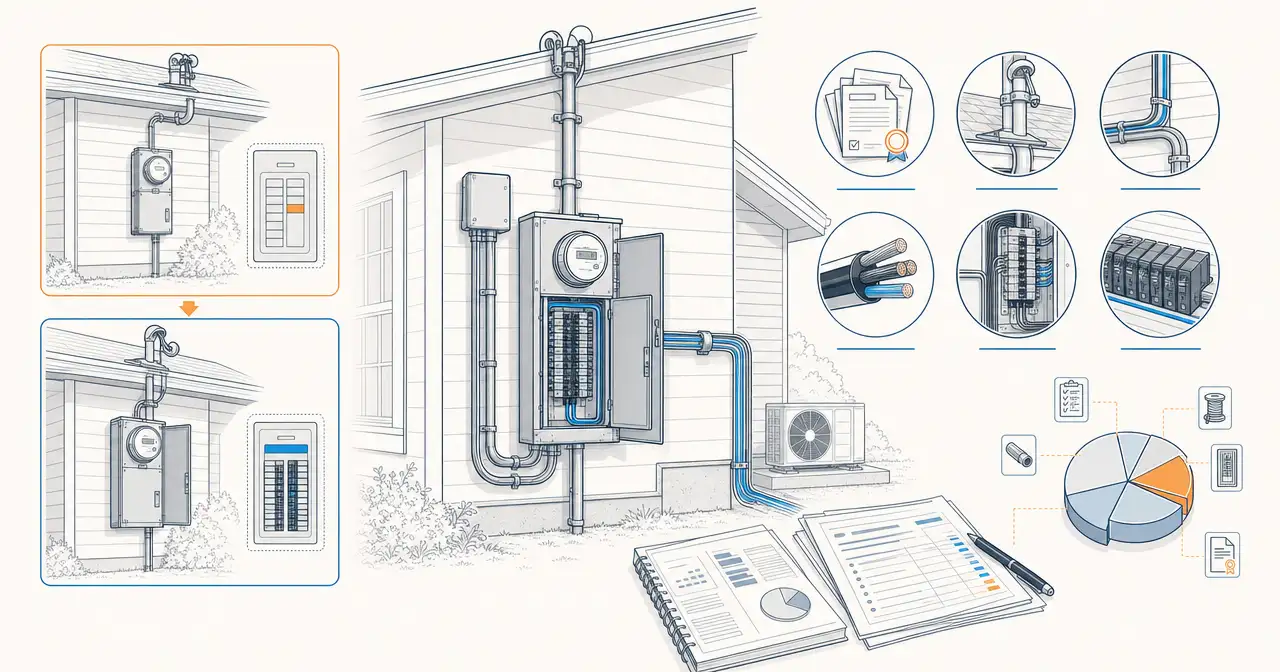
If you are budgeting the cost to upgrade to 200 amp service, start by asking what the quote includes. An electrician may be pricing a panel-side capacity change or a much larger service project. Those scopes have different equipment, utility responsibilities, and price ranges. We separate them, explain the local and site conditions that move the cost, show when 200 amps may not be necessary, and give you a quote-comparison checklist. We also explain how the former 2025 federal panel credit fits into a 2026 budget.
This page is informational, not electrical or tax advice. Use it to build a realistic budget, compare electrician quotes, and separate gross project cost from any incentive assumptions.
Quick answer
The ranges below are scope-dependent planning signals, not universal prices. Local labor rates, permits, code requirements, site access, existing wiring, and utility decisions can move the final quote.
| Project scope | Scope-dependent planning range | What usually moves the quote |
|---|---|---|
| 200-amp panel hardware purchased separately | $250 to $450 | Panel brand, breaker count, and hardware configuration |
| Panel-side labor when existing service stays adequate | $1,000 to $3,000+ | Access, wiring condition, code corrections, and installation complexity |
| Straightforward panel-side upgrade to 200 amps | $2,000 to $4,000 | Panel size, labor, permits, and whether the rest of the service stays adequate |
| 200-amp upgrade that also needs service-side or transformer work | $5,000 to $25,000 | Utility coordination, transformer replacement, underground runs, trenching, and major rewiring |
Three takeaways matter more than the table itself:
- In an installed project, panel hardware is only one part of the price.
- A clean 100-amp or 150-amp to 200-amp upgrade is a very different project from a full service upgrade.
- Some homes can electrify without a full 200-amp upgrade, so do not assume the biggest quote is automatically the right one.
This page is about increasing service capacity to 200 amps, not replacing an old breaker box with a similar-size panel.
What are you actually upgrading when you move to 200 amp service?
Homeowners often use "panel replacement," "panel upgrade," and "service upgrade" as if they mean the same thing.
They do not.
200-amp panel upgrade
A 200-amp panel upgrade usually means replacing the panel with a larger-capacity panel so the house can safely serve more load.
Rewiring America uses about $2,000 to $4,000 as a planning range for a typical panel upgrade, with the final price changing with installation complexity and local market rates. Qmerit separately notes that panel hardware may cost $250 to $450, while panel-upgrade labor may range from about $1,000 to more than $3,000. Those figures describe components of a panel-side project, not a guaranteed installed price.
That is the first important budgeting lesson:
the box alone is a poor proxy for the installed price.
Full service upgrade
Some quotes go beyond the panel and into the home's electrical service.
That can include:
- service entrance work
- meter or main equipment changes
- grounding and bonding updates
- utility coordination
- transformer work
- underground service work
Rewiring America describes a roughly $5,000 to $25,000 planning range when a service upgrade or transformer replacement is required, especially when the service conductors run underground. Local utility requirements, trenching, access, and code corrections determine where a project falls within that range.
If one electrician quotes $2,800 and another quotes $9,500, the first question should be whether they are pricing the same scope at all.
100-amp vs 150-amp to 200-amp service
Searchers often think in terms of the starting panel size: 100 to 200 amp service or 150 to 200 amp service.
That is understandable, but the starting amperage alone does not determine the quote.
The bigger cost drivers are usually:
- whether the existing panel is safe or already degraded
- whether the service entrance and meter setup can support the change cleanly
- whether the job stays on the house side or expands to utility-side work
- whether code corrections, rewiring, or relocation are needed
Qmerit notes that the National Electrical Code recommends a minimum capacity of 100 amps, while many households are upgrading to 200-amp panels as they add higher electrical loads such as EV charging and electrified appliances.
In practice:
- a 100-amp to 200-amp upgrade often happens because the home's existing service is clearly undersized for modern loads
- a 150-amp to 200-amp upgrade may be more about future-proofing, electrification planning, or avoiding a crowded panel
But neither scenario has one universal price. The real split is whether the work is a relatively clean panel-side upgrade or a broader service project.
If the load trigger is an EV charging project, Watt Wallet's EV charger permit guide helps separate normal charger permit steps from the bigger service-capacity question.
If the quote really hinges on whether you need a high-output outlet circuit or a permanently wired install, compare NEMA 14-50 vs. hardwired EV charger before you assume the service upgrade is the only path.
What pushes the cost to upgrade to 200 amp service higher?
1) Labor and installation complexity
For panel-side work, Qmerit estimates labor at $1,000 to over $3,000, with the final quote depending on installation complexity and local market rates.
That range can change based on:
- accessibility of the existing panel
- how much rewiring is needed
- how much cleanup or correction the old setup requires
- whether the panel location itself is awkward or congested
This is why two homes with the same target of 200 amps can get very different quotes.
2) Wiring condition and code corrections
The visible panel may be only part of the real job.
NerdWallet notes that rewiring can add several thousand dollars more to the bill. The actual add-on depends on the amount of work and local labor rates. If the electrician finds outdated conductors, poor grounding, unsafe connections, overloaded circuits, or other code problems, the total can rise quickly.
That is also why a cheap quote is not always the cheaper project. Sometimes it is just a quote that assumes less scope.
3) Service-side and utility work
This is the biggest cost cliff.
If the upgrade also requires:
- service upgrade work
- transformer replacement
- underground service changes
- utility scheduling and reconnection complexity
then the project may move out of the panel-side range and into the much higher $5,000 to $25,000 band Rewiring America describes. That is a conditional planning range for broader service work, not a standard price for every 200-amp upgrade.
4) Permit, inspection, and finish work
Even when the quote stays mostly panel-side, homeowners should still expect additional scope around:
- permits and inspections
- patching or finish repair
- meter or main equipment
- relocation if the old panel location no longer works well
This is one reason a quote that looks cheap at first can grow after the electrician opens the wall or starts coordinating with the utility.
If the quote also changes the main panel or service equipment, pair the pricing check with Watt Wallet's panel upgrade permit guide so the permit and inspection path is explicit before work starts.
Do you actually need 200 amp service?
This is where the planning decision matters most.
It is easy to assume the upgrade is inevitable. Rewiring America adds an important planning nuance:
- if your panel is less than 100 amps, you will likely need an upgrade
- if your panel is 100 to 150 amps, you can often fully electrify without a panel upgrade, though it may require intentional planning
- if your panel is greater than 150 amps, you can usually electrify without an upgrade
That does not mean 200 amps is unnecessary for everyone.
It does mean the right homeowner question is:
Do I need 200 amp service for safety and load capacity, or am I being sold a larger project than my electrification plan actually requires?
If your electrician is recommending a 200-amp upgrade because you plan to add a heat pump, EV charger, induction range, or heat pump water heater, ask them to explain whether the upgrade is truly required or simply the easiest standard recommendation.
How the former 25C panel credit affects net cost
For 200-amp service upgrades, homeowners should be especially careful not to overcount savings. The federal electric-panel provision under Section 25C applied to qualifying products purchased and installed from January 1, 2023, through December 31, 2025. The IRS's 2025 Form 5695 instructions state that the energy efficient home improvement credit does not apply to property placed in service after December 31, 2025.
For a brand-new 2026 panel or service upgrade, treat the former federal panel credit as unavailable in your starting budget under current federal guidance. A qualifying 2025 installation is a separate filing situation.
Under the former 2025 rules, certain panelboards, sub-panelboards, branch circuits, and feeders could qualify for a credit generally framed as 30% of eligible cost up to $600 when the work:
- is installed consistent with the National Electrical Code
- has load capacity of at least 200 amps
- is installed in conjunction with, and enables, qualifying efficiency improvements or qualified energy property
That rule was narrower than "I upgraded to 200 amps, so I get a tax credit." Reaching 200 amps by itself was not enough.
A few practical rules mattered for a qualifying 2025 claim:
- not every 200-amp service upgrade qualifies
- the project generally needs the right connection to qualified energy-improvement work
- the credit was generally claimed through 2025 Form 5695 Part II
- some rebates or subsidies can affect the eligible cost basis
Use Watt Wallet's Electric Panel Tax Credit: Eligibility Guide for the detailed eligibility rules that applied through 2025. If you are filing a qualifying panel-related credit for 2025, pair it with Form 5695 Instructions: How to Claim Home Energy Credits, plus:
- How to Compare Rebates, Tax Credits, and Installer Quotes
- Can You Stack Rebates and Tax Credits?
- Heat Pump Rebates by State
- HEEHRA rebates guide
Those pages help you separate gross electrician cost from any tax-time or rebate savings. State and utility incentives have their own dates and eligibility rules and are separate from the former federal 25C panel credit.
What a good electrician quote for a 200-amp upgrade should include
Ask the electrician to spell out:
- whether the quote is for a panel upgrade only or a broader service upgrade
- whether the meter, service entrance, grounding, bonding, or main disconnect are included
- whether utility coordination is included and whether transformer work is expected
- whether permits and inspections are included
- whether the quote assumes future electrification loads such as a heat pump or EV charger
- whether any rewiring, relocation, or finish work is excluded
- whether the documentation will support any panel-related tax-credit claim you expect to make
That is the fastest way to prevent an apples-to-oranges quote comparison.
How to estimate your real cost before you sign
A simple homeowner workflow works better than chasing one national average.
1) Define the project class
Ask whether the job is:
- a relatively clean panel-side upgrade to 200 amps
- a panel upgrade plus house-side wiring correction
- a full service upgrade involving utility-side scope
2) Clarify the real trigger
Is the upgrade being recommended because:
- the current panel is unsafe or degraded
- the current service is truly undersized
- the panel is overcrowded
- you are planning future electrification loads
- the electrician prefers standardizing on 200 amps even though a lower-cost path may exist
3) Separate gross cost from incentive math
Do not subtract a federal credit unless the project actually qualifies.
4) Compare at least two itemized quotes
If two bids are far apart, compare scope first and price second.
That is the most reliable way to understand whether you are pricing, for example, a $3,000 panel-side upgrade or a $9,000 service project in your local market.
FAQ
How much does it cost to upgrade from 100 amp to 200 amp service?
A straightforward 100-amp to 200-amp upgrade can fit the broad $2,000 to $4,000 planning range when the existing service remains adequate. Local labor, permitting, service conditions, underground utility work, and extensive rewiring can move the final price substantially higher.
How much does it cost to upgrade from 150 amp to 200 amp service?
There is no universal national premium just for starting at 150 amps instead of 100 amps. The real cost drivers are whether the job stays panel-side, whether service equipment also changes, and whether code corrections or utility coordination are needed.
Why are online 200-amp service cost ranges so wide?
Because many pages mix together panel hardware, panel-side labor, full service upgrades, underground work, and rewiring. Those are different scopes with very different costs.
Do I need 200 amp service for a heat pump or EV charger?
Sometimes, but not automatically. Rewiring America notes that many 100- to 150-amp homes can fully electrify without a panel upgrade if the project is planned carefully. The right answer depends on your actual load plan and service configuration.
Can a 200-amp service upgrade claim the federal panel credit?
Only qualifying property installed or placed in service by December 31, 2025 fell within the former Section 25C timing, and it also had to meet the 200-amp, National Electrical Code, and enabled-property requirements. Under current federal guidance, the former panel credit does not apply to a new 2026 installation. State or utility incentives are separate.
What makes a 200-amp service quote jump above $5,000?
The biggest reasons are service-side work, transformer replacement, underground service complications, major rewiring, and broader code-correction scope.
Sources
- Qmerit, panel cost guide
- Rewiring America, panel upgrade pros and cons
- NerdWallet, electrical panel replacement cost
- ENERGY STAR, electric panel credit rules
- IRS, 2025 Form 5695 instructions