Last reviewed: 2026-06-21 (UTC)
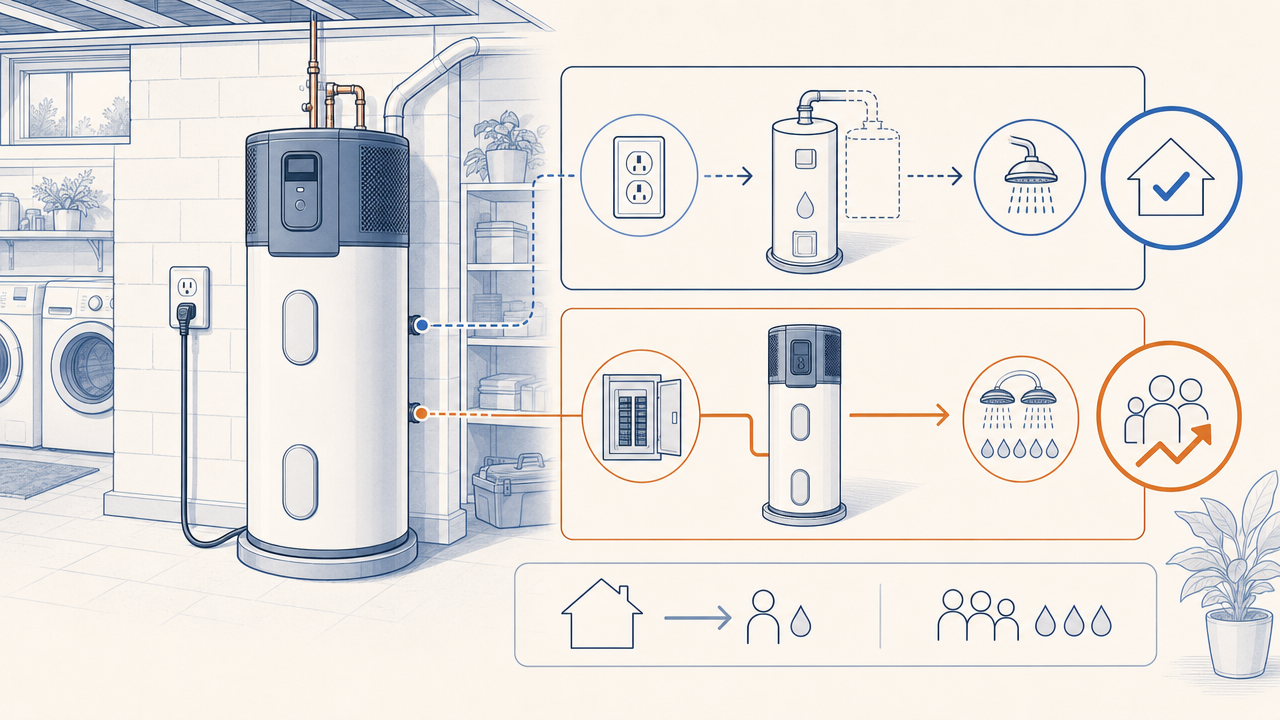
A 120V heat pump water heater can be a smart move when the hard part of the project is adding a new 240V circuit. That is especially true when you are replacing a gas water heater or trying to avoid widening the electrical scope.
It is not automatically the best version of a heat pump water heater, though. The usual tradeoff is slower recovery, so homes with heavier back-to-back hot-water demand may still be better served by a standard 240V model.
That is why this is mostly a fit decision, not just a product search.
120V plug-in models are real and easier to shop than they were a few years ago. Rheem, A.O. Smith, and State Water Heaters all show named 120V models in multiple tank sizes. The practical question is not whether the category exists. It is whether it fits your house better than a standard 240V setup.
Use this guide to pressure-test that decision, then jump to Watt Wallet's deeper install or cost guides if you need more help on room fit or project budget.
Quick answer
| If your situation looks like this | The more likely answer |
|---|---|
| You are replacing a gas water heater, do not have an easy 240V path, and your hot-water use is fairly ordinary | A 120V heat pump water heater may be a very good fit |
| You already know your household pushes hot water hard with long showers, frequent simultaneous use, or tight recovery windows | A standard 240V heat pump water heater is often the safer fit |
| You mainly want to avoid electrical work, but you still have enough room, airflow, and condensate routing for a heat pump water heater | 120V is worth serious consideration |
| You are hoping 120V solves every installation problem in a cramped or poor-fit location | It probably does not |
| You are still deciding between technologies, not just voltage | Start with heat pump water heater vs. tankless water heater |
What a 120V heat pump water heater actually changes
A 120V model mostly changes the electrical side of the job.
Many standard heat pump water heaters still assume a dedicated 240V circuit. If your house does not already have that path, the project can widen into:
- new circuit work
- electrician labor
- panel-capacity questions
- extra permit scope
Focus on Energy says that is exactly why 120V models matter: they can plug into a standard outlet and avoid some electrical-upgrade barriers, though they heat water more slowly.
So the core value of 120V is not better performance. It is a smaller electrical job in the right house.
When a 120V model makes the most sense
1. You are replacing a gas water heater and want to avoid new 240V work
This is where 120V usually makes the biggest difference.
Rheem says its 120V ProTerra Plug-in line is designed for drop-in gas replacement without the need to install a new 240V electric service. Focus on Energy says 120V units are especially useful when they can replace natural gas equipment in homes where space is available and an outlet is already present.
If a standard 240V heat pump water heater would turn your project into a bigger electrical upgrade, 120V can change the conversation from "too much extra scope" to "actually feasible."
2. Your panel or wiring situation is part of the problem
Some homeowners are not blocked by the water heater itself. They are blocked by the ripple effects of adding another 240V load.
That is where 120V can help most. It gives you a way to evaluate heat-pump water heating without assuming that the electrical side of the house also needs a bigger intervention right away.
That does not mean every limited-panel home should default to 120V. It means the voltage question is worth asking early instead of treating 240V as the only serious option.
3. Your hot-water use is ordinary rather than extreme
Focus on Energy's Wisconsin research says 120V heat pump water heaters can provide enough hot water for typical household use.
Its later field-study summary describes the best-fit customer as a household with four or fewer occupants who use an average amount of water. Its earlier phase-one modeling also suggested some 120V units could satisfy four-to-six occupant single-family homes in Wisconsin and handle consecutive hours of 20-gallon hot-water draws.
That does not make 120V a blanket yes for every larger household. It does show the category is more practical than many homeowners assume when usage is ordinary and the rest of the setup fits.
4. The room is already a good general fit for a heat pump water heater
If your best install location is a basement, utility room, or other space that already works well for a heat pump water heater, 120V can be a cleaner simplifier because you are solving one problem instead of many.
If you are still not sure the room works at all, jump to Watt Wallet's heat pump water heater installation guide before you lock in the voltage decision.
The main tradeoffs: recovery speed, tank size, and household demand
A 120V heat pump water heater can reduce electrical scope, but it usually does so by accepting a different performance envelope than a more standard 240V setup.
Slower recovery is real
Focus on Energy says 120V units avoid electrical upgrades, but heat water more slowly.
That is the center of the whole decision. If your current water-heater experience already feels stretched, or your household routinely creates big back-to-back hot-water peaks, slower recovery may matter more than the convenience of using a standard outlet.
Bigger demand does not automatically rule 120V out
Average-use households with four or fewer occupants have the clearest support for 120V. Some larger-demand situations may still work, but those cases lean more on early modeling than field results. In other words, slower recovery is not the same thing as "only works for one person," but it is also not something to treat casually in a high-demand home.
Fit depends on the whole setup:
- household size
- how peaky your hot-water demand is
- tank size
- model design
- what counts as acceptable recovery in your home
Tank size and model design still matter
One reason the category is more credible now is that 120V models are not limited to one tiny tank format.
State Water Heaters currently shows 50-, 66-, and 80-gallon 120V plug-in models on its hybrid line page. A.O. Smith's Lowe's-channel page shows a named 66-gallon 120V plug-in model framed for 3 to 4 person households.
Rheem adds another useful nuance: it distinguishes dedicated and shared circuit versions of its 120V ProTerra line and says the dedicated model delivers the fastest heat-pump tank recovery in that family.
That is why 120V alone does not tell you everything. Tank size and model design still shape how livable the result will be.
Backup elements can help, but they do not erase the tradeoff
A.O. Smith's product page says its 66-gallon 120V model includes backup electric heating elements when the heat pump cannot operate.
That can help with resilience and hot-water availability. It does not mean every 120V unit will feel the same as a strong 240V setup in a high-demand home.
When 240V is still the better choice
A 120V heat pump water heater is not the default winner. A standard 240V model still makes more sense when the household needs more performance headroom and the electrical path is manageable.
1. Your home has heavier or peakier hot-water demand
If your household often stacks long showers, laundry, dishwasher loads, and kitchen use into the same narrow window, faster recovery becomes more valuable.
That does not mean 120V will definitely fail. It does mean the margin for error is smaller, and a standard 240V model may be the safer choice.
2. Adding 240V is not actually a big problem
If the right circuit is already there, or adding it is simple and inexpensive, the whole reason to favor 120V gets weaker.
In that situation, it makes sense to ask whether you would rather keep the broader performance headroom of a more standard 240V setup instead of optimizing around electrical simplicity you do not really need.
3. You are really dealing with a room-fit problem, not a voltage problem
Some homeowners reach for 120V because they hope it turns a marginal location into a good one.
Usually it does not.
If the room is too tight, too cold, too awkward for condensate routing, or poor for service access, the right answer may still be to rethink the location rather than just the voltage.
What 120V does not solve
A 120V heat pump water heater can solve some electrical scope. It does not remove the normal room-fit rules for heat pump water heaters.
The U.S. Department of Energy says these systems generally want locations that stay about 40F to 90F year-round and provide roughly 1,000 cubic feet of surrounding air for standard integrated installs. DOE also notes that heat pump water heaters cool the surrounding air while they run.
So even if 120V solves the circuit question, you still have to think about:
- room size and airflow
- ambient temperature in that space
- condensate drainage
- service access
- whether the location is actually good for a heat pump water heater at all
If those questions are still open in your house, the right next read is Watt Wallet's heat pump water heater installation guide.
How to decide at your house
If you want the shortest practical framework, use these five questions.
1. What are you replacing right now?
If you are replacing gas, 120V deserves a serious look because that is where avoiding a new 240V circuit can matter most.
If you are replacing an existing electric tank and already have an easy electrical path, 240V may still be simpler than people assume.
2. Would a standard 240V install widen the project in a meaningful way?
If the answer is yes, that is the main reason to consider 120V.
If the answer is no, the performance tradeoff may not be worth it.
3. How hard do you push hot water?
A household with ordinary daily use can often view 120V more favorably than a household that regularly creates high-demand peaks.
If you already know recovery is a sensitive issue at your house, treat that as a strong argument for a standard 240V model unless a well-sized 120V option clearly addresses it.
4. Does the room work for a heat pump water heater in the first place?
Voltage is not the only gate.
If the location is marginal for airflow, temperature, condensate, or service access, solve that question before you get too attached to either 120V or 240V.
5. Which deeper question do you really need answered next?
If you need full room, condensate, and install-detail guidance, go to heat pump water heater installation.
If you need to understand what a gas replacement or electrical-scope change does to project budget, go to cost to install a heat pump water heater.
If you are still deciding between water-heating technologies broadly, not just voltage, go to heat pump water heater vs. tankless water heater.
Bottom line
A 120V heat pump water heater is usually best when the electrical side of the project is the real blocker and your home still looks like a good general fit for a heat pump water heater.
That is why 120V is often most compelling for a gas replacement or a panel-constrained home where a standard 240V model would widen the job.
But 120V is not automatically the best answer. The main tradeoff is still slower recovery, which means heavier-demand households or easier-240V homes may still be better served by a standard 240V heat pump water heater.
If you frame the choice as "What voltage gives my house the best balance of electrical scope and hot-water performance?" you are asking the right question.
FAQ
Does a 120V heat pump water heater need a dedicated outlet?
It depends on the model. Some products are built around a standard 120V plug-in approach, but product design still matters. Rheem, for example, distinguishes between dedicated and shared circuit versions of its 120V ProTerra line. Always check the exact installation requirements for the unit you are considering.
Can a 120V heat pump water heater replace a gas water heater?
Often, yes. It is one of the best reasons to look at 120V. Focus on Energy and Rheem both point to gas replacement as a strong fit when the room works and an outlet is already available.
Is a 120V heat pump water heater enough for a family?
Sometimes, yes. Focus on Energy says the ideal customer in its field study is a household with four or fewer occupants who use an average amount of water. Its earlier modeling also suggested some larger-demand scenarios may still work. But "family" is too broad to guarantee a fit. Recovery expectations, tank size, and peak-demand patterns still matter.
What is the difference between a 120V and 240V heat pump water heater?
The biggest practical difference is usually the electrical setup and performance tradeoff. A 120V model can reduce or avoid new 240V electrical work, while a 240V model usually offers a more familiar performance envelope for faster recovery and heavier demand.
Is 120V the same as 110V for a heat pump water heater?
In everyday homeowner language, people often use "110V" and "120V" loosely to mean a standard household outlet. The important step is not the shorthand label. It is checking the exact electrical requirements for the model you are considering.