Last reviewed: 2026-06-05 (UTC)
If you are deciding between a heat pump water heater and a tankless water heater, start with this: a heat pump water heater usually wins when you have a good installation space and care most about efficiency, lower energy use, and electrification. A gas tankless water heater usually wins when space is tight, you already have a good gas setup, and on-demand hot water matters more than maximum efficiency. Electric tankless is often a different project again because the electrical scope can change the quote fast.
For a June 2026 homeowner, one budget rule needs to be explicit up front: do not count on the old federal heat pump water heater tax credit for a brand-new 2026 install unless official guidance changes. The current IRS Energy Efficient Home Improvement Credit page says the credit is allowed for qualifying property placed in service on or after Jan. 1, 2023, and before December 31, 2025. The current ENERGY STAR heat pump water heater tax-credit page says the tax credit is effective for products purchased and installed between January 1, 2023, and December 31, 2025.
That does not automatically make tankless the better choice. It means you should compare these projects with the real 2026 incentive picture, not older headline assumptions.
This page is informational, not plumbing, code, contractor, or tax advice. Use it to pressure-test quotes and ask better questions before you sign.
Quick answer
| Project path | Usually wins when | What adds scope | What to budget around in June 2026 |
|---|---|---|---|
| Heat pump water heater | You have a garage, basement, or utility room that fits it well and you want the lowest energy use. | Room-air fit, condensate or drainage setup, tank footprint, recovery sizing, and any circuit work that comes with the install. | The current IRS and ENERGY STAR pages do not show the old federal 25C credit for a brand-new 2026 install. Budget this path around local rebates and efficiency, then pressure-test the bill outcome against your local electricity and gas rates. |
| Gas tankless | Space is tight, gas is already in the right place, and on-demand hot water is the main priority. | Gas-line sizing, venting path, permit details, recirculation choices, and making sure simultaneous demand matches the unit. | The quote can swing fast if gas and venting work grows. The smaller box does not always mean the cheaper total project. |
| Electric tankless | You are looking at a narrower use case and the electrical capacity is already there. | Dedicated circuits, panel capacity, service size, and flow-rate limits under simultaneous demand. | The appliance price can look simple while the electrical scope becomes the whole project. For many whole-home comparisons, this is the highest-risk path on scope. |
Why "tankless" is not one comparison
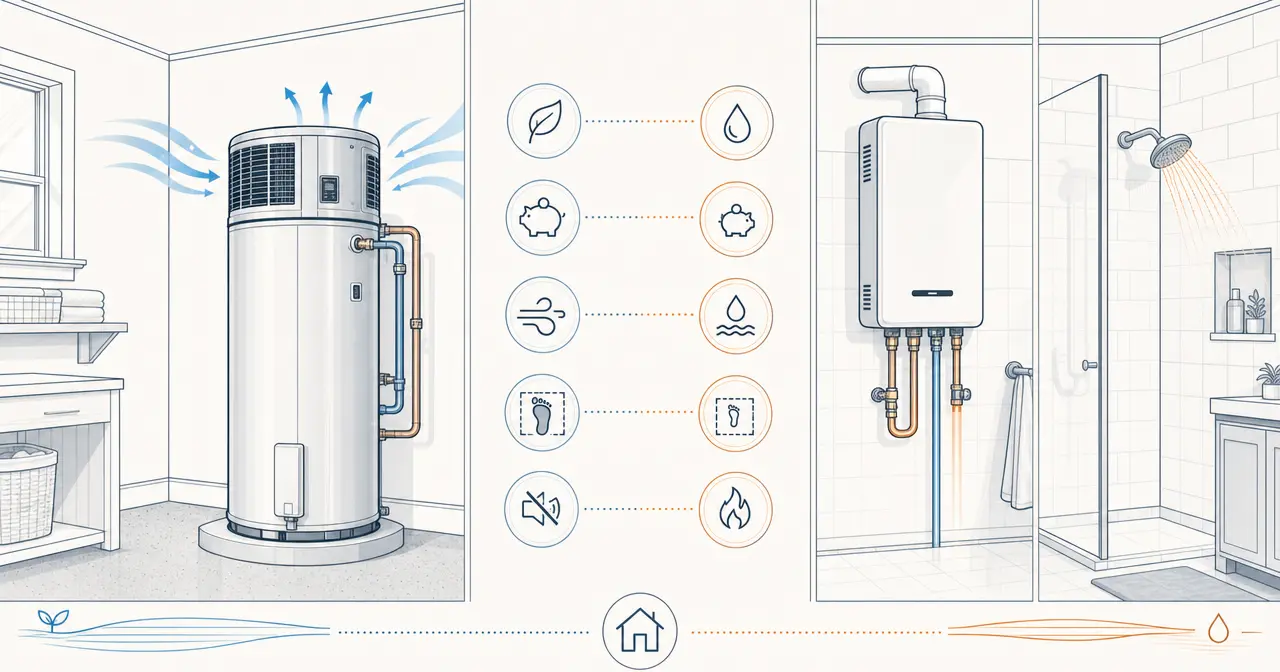
A heat pump water heater and a tankless water heater solve the same problem in different ways.
A heat pump water heater stores hot water in a tank and uses electricity to move heat from the surrounding air into that water. That is why it can be much more efficient than a standard electric tank water heater.
A tankless or demand-type water heater heats water as it passes through the unit, without a storage tank. That is why tankless gets associated with compact size and on-demand hot water.
The problem is that many homeowner comparisons say "tankless" when they really mean gas tankless.
That distinction matters because the project paths are different:
- Heat pump water heater usually wins on efficiency and electrification.
- Gas tankless often wins on compactness and continuous delivery when the gas and venting setup is already favorable.
- Electric tankless may look compact on paper, but the electrical scope can turn it into the most complicated option of the three.
If electric tankless is on your shortlist, treat the electrical question as part of the core comparison, not as a side note. In some homes, that becomes a separate cost to upgrade to 200 amp service guide conversation before you even compare water-heating equipment.
Efficiency and utility bills
On efficiency, the heat pump water heater usually has the clearest edge.
That does not guarantee the lowest utility bill in every home. Local electricity and gas rates, the fuel you are replacing, and your hot-water use pattern can change the bill outcome even when the heat pump path uses less energy overall.
The DOE says heat pump water heaters can be two to three times more energy efficient than conventional electric resistance water heaters.
Tankless water heaters can still be a real efficiency upgrade over a conventional storage tank. The DOE says that for homes using 41 gallons or less of hot water daily, demand water heaters can be 24% to 34% more energy efficient than conventional storage tank water heaters. For homes using much more hot water, the DOE says the advantage narrows to about 8% to 14%.
That means both systems can beat a basic tank water heater, but they do not improve efficiency by the same amount.
The practical read is:
- Heat pump water heater is usually the strongest raw-efficiency option when the home fits it well.
- Gas tankless can still improve efficiency versus a conventional tank, especially by cutting standby losses.
- Electric tankless does not automatically inherit the same real-world case as gas tankless, because flow limits and electrical scope can change the tradeoff.
If your main question is which path usually uses less energy over time, the answer is usually heat pump water heater.
Hot-water delivery and recovery
Tankless makes its best argument on delivery, but the details still matter.
The DOE says tankless systems typically provide hot water at about 2 to 5 gallons per minute, and gas-fired tankless water heaters produce higher flow rates than electric ones.
That is why one sentence can hide three very different homeowner experiences:
- Gas tankless is the strongest version of the "endless hot water" pitch.
- Electric tankless can hit flow-rate limits faster.
- Heat pump water heater behaves more like a familiar tank system, so the question becomes tank size and recovery rather than pure on-demand flow.
A heat pump water heater can feel easier to live with when the household already fits a tank-style pattern. A gas tankless unit can feel better when long showers and repeated back-to-back use matter most. An electric tankless unit needs more caution when multiple hot-water uses overlap.
If one unit cannot keep up with simultaneous demand, the smaller box does not help. That is why simultaneous-demand sizing belongs in the same conversation as equipment choice.
Installation fit and project scope
This is where many quotes stop being apples-to-apples.
Heat pump water heater scope
For a heat pump water heater, the DOE says you generally want:
- a location that stays roughly 40F to 90F year-round
- around 1,000 cubic feet of surrounding air space
- enough tolerance for the fact that the unit cools the space it sits in
That usually makes heat pump water heaters a better fit for garages, basements, and larger utility rooms.
The project scope can change when the house needs:
- a better room location
- condensate or drainage handling
- ducting or airflow adjustments
- a different tank size because of recovery concerns
- electrical work tied to the install
If you need a product-specific walkthrough, Watt Wallet's heat pump water heater installation guide is the next read.
Gas tankless scope
Gas tankless usually looks best when the home already has the right gas and venting conditions.
The project scope can change when the quote picks up:
- gas-line resizing or extension
- venting work or vent-route constraints
- code or permit requirements
- recirculation choices
- unit sizing for simultaneous heavy use
That is why a gas tankless unit can be the best fit in one house and the most annoying quote in the next one.
Electric tankless scope
Electric tankless often gets underestimated because the appliance is compact.
The project scope can change when the house needs:
- dedicated high-amperage circuits
- panel capacity the home does not already have
- service upgrades
- compromises on simultaneous demand because the unit size still has to fit the electrical reality
This is the path where a cheap-looking appliance can turn into the most expensive project once the electrician prices the real scope.
What actually flips the total cost decision?
For a June 2026 homeowner, the heat pump side needs one more time-bound reminder before you compare anything else: the current IRS page says the credit is allowed for qualifying property placed in service on or after Jan. 1, 2023, and before December 31, 2025, and the current ENERGY STAR page says the tax credit is effective for products purchased and installed between January 1, 2023, and December 31, 2025. So for a brand-new heat pump water heater install in 2026, the old federal credit should not be carrying the budget.
After that, these are the variables that usually flip the answer:
| If this is true in your home | Path that often wins | Why |
|---|---|---|
| You already have a good garage, basement, or utility-room location and no major install surprises. | Heat pump water heater | The install is simpler, the efficiency upside stays intact, and local rebates can still improve net cost even without the old federal credit. |
| You already have gas in the right place, venting is straightforward, and space is tight. | Gas tankless | The project avoids the tank footprint and may avoid the room-fit problems that make heat pump installs harder. |
| Electric tankless would trigger big panel or circuit work. | Usually not electric tankless | The appliance can stop being the real cost driver; the electrical scope becomes the project. |
| Your household cares most about heavy simultaneous hot-water use and you do not have a good heat-pump-water-heater location. | Often gas tankless | Correctly sized gas tankless can make more sense than forcing a bad heat pump water heater installation. |
| You are comparing only equipment prices and not the real install scope. | No clear winner yet | This is where homeowners choose the wrong "cheaper" option. |
If a contractor hands you one blended net number, ask them to split the quote into equipment, labor, gas work, venting, electrical work, drainage or condensate handling, permits, and incentive assumptions. Then pressure-test the savings logic with Watt Wallet's guides on how to compare rebates, tax credits, and installer quotes and stacking rebates and tax credits.
If you want to see whether there are still live local heat pump water heater rebates on the table, start with Watt Wallet's heat pump water heater rebate guide before you decide the net-cost answer is already settled.
Which upgrade makes more sense for your home?
Choose a heat pump water heater if:
- you have a garage, basement, or utility room that fits it well
- you want the strongest efficiency outcome
- you are trying to electrify the home
- you want to chase live rebates and lower energy use, not the old federal 2026 tax-credit assumption
- your household is comfortable with a tank-style hot-water setup
Choose gas tankless if:
- your biggest constraint is space
- the home already has a favorable gas and venting path
- you care most about on-demand delivery
- you need a better answer for simultaneous hot-water use than a poorly fitted heat pump water heater would give you
- the quote does not balloon on gas-line or venting work
Choose electric tankless only if:
- the electrical capacity is already there
- your demand profile is modest enough for the unit you are considering
- the project still makes sense after pricing the circuit and panel work honestly
- you are not relying on compact size alone to make the decision
The simplest rule of thumb
If your home is a good fit for a heat pump water heater, that is usually the stronger long-term choice.
If your home is a bad fit for a heat pump water heater but already a good fit for gas tankless, gas tankless becomes much easier to justify.
If your shortlist still includes electric tankless, make sure the electrical quote is in the room before you decide anything.
FAQ
Is a heat pump water heater more efficient than a tankless water heater?
Usually, yes. The DOE says heat pump water heaters can be two to three times more energy efficient than conventional electric resistance water heaters, while tankless systems mainly improve efficiency by reducing standby losses compared with conventional storage tanks.
Is gas tankless the same decision as electric tankless?
No. The DOE says gas-fired tankless water heaters usually provide higher flow rates than electric ones. Gas-line and venting scope also make it a different project from electric tankless, which is more likely to turn into a circuit or panel question.
Can a brand-new heat pump water heater installed in 2026 still use the old federal tax credit?
Under the current official pages reviewed for this article, homeowners should not budget that way. The current IRS page says the credit is allowed for qualifying property placed in service on or after Jan. 1, 2023, and before December 31, 2025. The current ENERGY STAR page says the tax credit is effective for products purchased and installed between January 1, 2023, and December 31, 2025.
What usually flips the cost answer?
The variables that most often change the answer are gas-line and venting scope, panel or circuit work, condensate or drainage handling, room-air fit for a heat pump water heater, recovery tradeoffs, and simultaneous-demand sizing.
Which path is usually easier in a tight mechanical room?
Usually gas tankless, and sometimes electric tankless, because both avoid the large tank and room-air requirement that a heat pump water heater needs.
What should I read next if I am still comparing quotes?
If you still want the current federal cutoff details, start with the IRS Energy Efficient Home Improvement Credit page and the ENERGY STAR heat pump water heater tax-credit page. For the project side, the best next reads are Watt Wallet's guides on heat pump water heater rebate, heat pump water heater installation, and how to compare rebates, tax credits, and installer quotes.
Sources
- DOE: Heat Pump Water Heaters
- DOE: Tankless or Demand-Type Water Heaters
- IRS: Energy Efficient Home Improvement Credit
- ENERGY STAR: Heat Pump Water Heaters Tax Credit
- A. O. Smith: Heat Pump vs Tankless Water Heater
- Clean Energy Connection: Heat Pump Water Heater vs Tankless
- Rheem: Heat Pump vs. Electric Tankless Water Heaters