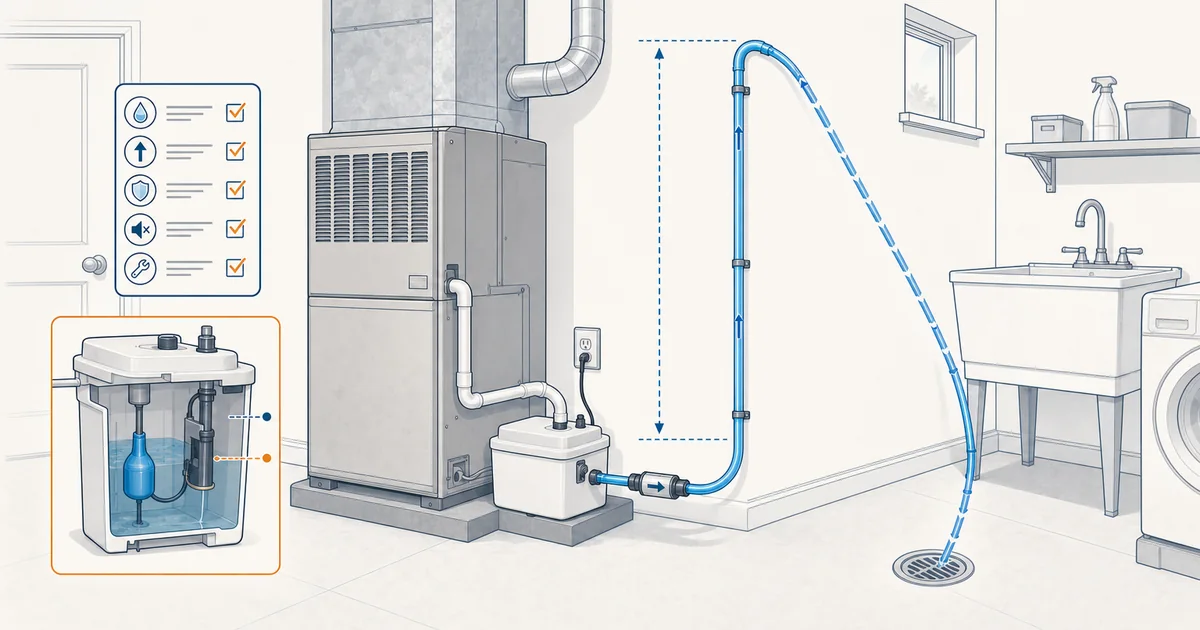
Condensate is easy to ignore until a pump rattles at night, shuts down the furnace, or leaves water beside an air handler. The pump itself is usually inexpensive. Routing, lift, noise, and failure protection decide whether the installation is dependable. We use those details to separate an ordinary HVAC accessory from a leak risk and make every line item in a quote understandable.
What does a condensate pump do?
A condensate pump moves water from equipment to an approved drain or discharge point when gravity cannot do the job. Common sources include:
- a central air conditioner or heat pump in cooling mode
- a high-efficiency condensing furnace or boiler
- a condensing gas water heater
- a dehumidifier
- a heat pump water heater
- an indoor mini-split unit
- some refrigeration equipment
Cooling equipment removes moisture from indoor air as it runs. Climate, humidity, equipment size, runtime, and temperature settings all change the volume. The Department of Energy's condensate potential research shows why cooling systems in hot, humid regions can collect much more water than systems in drier climates.
A typical reservoir pump works automatically. Water drains from the appliance into a small tank. The operating float rises to its on level, starts the motor, and the pump pushes water through a narrow discharge tube. The motor stops when the float falls to its lower off level, which can leave some water in the tank. A discharge check valve holds water in the tube so it does not fall back into the reservoir.
The pump removes water. It does not raise the HVAC system's heating or cooling efficiency.
Do you need a condensate pump?
Cooling coils and evaporators that produce condensate need drainage. Section 307.2 of the 2024 IMC, a model code, includes an exception for coils designed to operate in sensible cooling only and not support condensation. A condensate-producing system needs a pump only when an approved gravity route is unavailable or the equipment design calls for one.
Gravity drainage is the first choice when a continuous downhill route can reach an allowed destination. It uses no electricity, makes no pump noise, and removes one failure point. A gravity drain is an alternative to a pump, rather than a type of condensate pump.
A pump becomes necessary when:
- the appliance sits below the available drain, as often happens in a basement
- the discharge line must rise before it can run downhill
- a gravity route cannot maintain continuous slope to an allowed destination
- a wall-mounted mini-split cannot drain downhill without an impractical visible line
- a heat pump water heater or dehumidifier is far from a suitable drain
- the appliance instructions require pumped disposal for the planned location
An accessible floor drain below the equipment often makes a pump unnecessary. A utility sink above the equipment usually requires one. Distance alone does not settle the question. A long route that remains downhill may still work by gravity, while a short uphill route needs a pump.
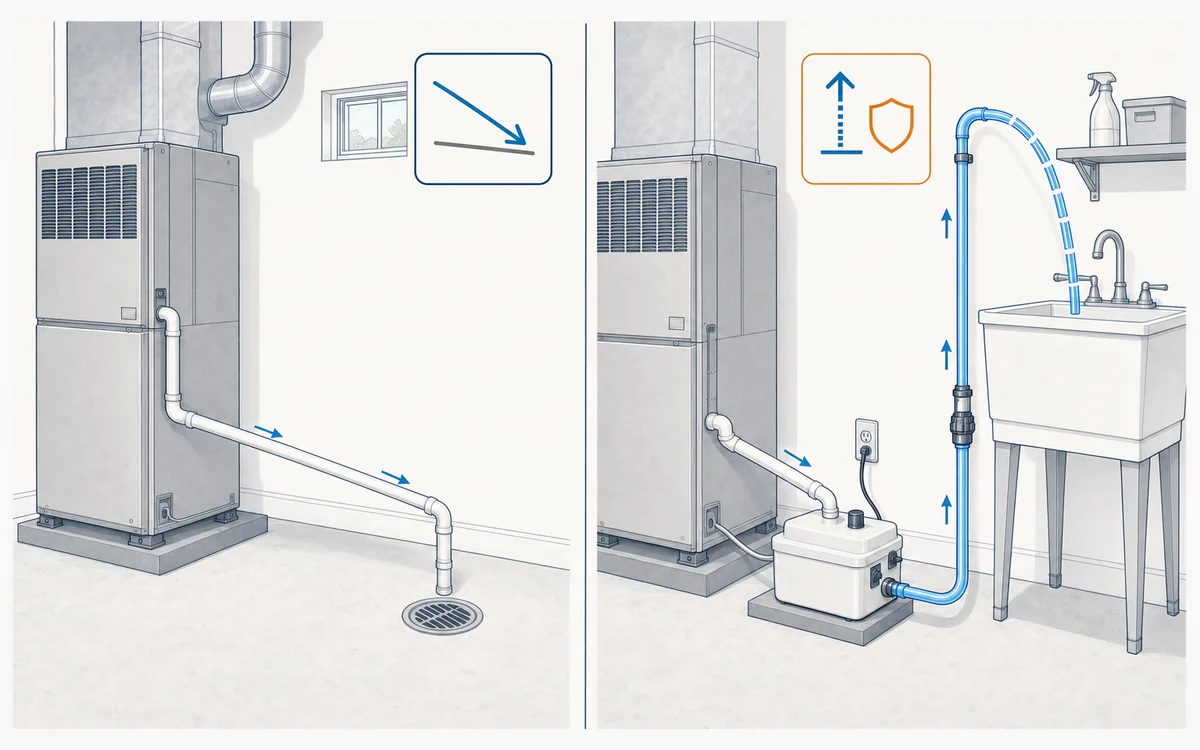
The discharge destination is part of the design. 2024 IMC Section 307.2.1 requires horizontal condensate piping from cooling coils and evaporators to slope toward discharge by at least 1/8 inch per 12 horizontal inches, which is a 1% slope. It also requires an approved place of disposal and prohibits nuisance discharge.
An indoor connection to the building drainage system should remain indirect and open. Section 307.2.1.1 prohibits a direct connection to drain, waste, or vent piping and lists the plumbing fixtures that can receive condensate. Where the 2024 IPC applies, its clear-water waste rule uses an air break or air gap for discharge into the building drainage system. In practical terms, the condensate line ends openly at an allowed receptor such as a floor drain, standpipe, or utility sink instead of being sealed into a waste or vent pipe. Local adoption and amendments determine the enforceable arrangement.
The main condensate pump types
| Pump type | Best fit | Main tradeoffs |
|---|---|---|
| Reservoir or tank pump | Central AC, ducted heat pump, condensing furnace, dehumidifier, or heat pump water heater near the floor | Usually inexpensive and easy to service, but visible and audible during each cycle |
| Mini-split pump | Wall-mounted, ceiling-cassette, or slim-duct indoor units with no gravity route | Compact and easier to conceal, but more expensive, closer to occupied rooms, and sensitive to installation and tubing details |
| Low-profile or shallow-pan pump | Equipment with little clearance below its drain outlet | Fits tight spaces, but has less reservoir volume and still needs service access |
| Neutralizing pump or pump plus neutralizer | Condensing furnace, boiler, or gas water heater with acidic combustion condensate | Raises pH before discharge reaches vulnerable downstream plumbing or septic components, but adds media service. Use a gravity neutralizer when the route permits and add a pump only when lift is needed |
| High-temperature or high-lift pump | An application whose liquid temperature or vertical rise exceeds a standard model's rating | Costs more and must be selected from its performance curve |
When one of these appliances needs pumped drainage, the common choice is an automatic reservoir pump with a high-water safety circuit, a discharge check valve, and ample flow at the actual lift. Our heat pump water heater installation guide explains how drainage fits into the wider room, electrical, and plumbing plan.
A mini-split pump belongs in the plan only when the indoor unit lacks a sound gravity route. If the overall system choice is still open, compare ductless and ducted heat pumps before optimizing a pump around one layout.
Steam-system condensate return pumps are a different equipment class. They handle hot condensate in a boiler loop and are not interchangeable with a small residential HVAC reservoir pump.
How to size and choose a condensate pump
The best pump is the model that moves the required flow at the real installation head, handles the liquid, and fails safely. Horsepower and maximum flow alone do not answer that question.
1. Flow at the actual lift
Pump capacity is usually shown in gallons per hour. The headline number is often measured with almost no vertical rise. Capacity falls as the pump pushes water higher.
The 115-volt Little Giant VCMA-20ULS provides a useful example. Its published curve shows 80 gallons per hour at 1 foot of head, 70 at 5 feet, 48 at 10 feet, and zero at its 20-foot shutoff point. A "20-foot pump" cannot deliver useful flow at 20 feet. That number marks the point where flow stops.
Start with the appliance's documented or calculated peak condensate inflow. Then use pump capacity at the installation's total dynamic head and apply the selected model's duty rule. The guidance varies by pump and reservoir. Beckett's small-pump sizing guidance uses 2 to 3 times the condensing rate for smaller collection tanks and says 1.5 to 2 times can suit larger tanks. The Little Giant EC-1-DV manual limits that mini pump to a 50% duty cycle and a three-minute maximum on cycle, so its flow at the required head must be at least twice the condensate inflow. These examples show why there is no universal multiplier. The appliance and pump instructions control the final margin.
2. Vertical lift and the whole discharge route
Static lift is the vertical distance from the pump to the highest point in the discharge line. Horizontal tubing, fittings, narrow diameter, and backpressure add friction. The model's performance curve should still show comfortable capacity after all of that is considered.
Avoid treating horizontal distance as vertical lift. They affect the pump differently. The quote should show:
- vertical rise to the line's highest point
- total tubing length and inside diameter
- number of restrictive fittings
- pump capacity at that operating point
- maximum recommended lift, rather than only shutoff lift
3. Voltage and power
Residential reservoir pumps commonly use 115/120 volts, while 230/240-volt versions and hardwired mini pumps are also sold. The power source must be constant, grounded, correctly rated, and within the installation rules for the chosen model. A pump connected to power that disappears with the HVAC blower cannot finish a cycle after the equipment stops.
4. Traps and two different check-valve jobs
The appliance drain and pump discharge have separate requirements. 2024 IMC Section 307.2.4 requires a condensate drain trap when the equipment or appliance manufacturer requires one. The next model-code section, 307.2.4.1, requires ductless mini-split equipment that produces condensate to have either an inline check valve in the drain line or a trap.
That mini-split drain-line check valve is separate from a reservoir pump's discharge check valve. The pump discharge valve sits at the outlet and keeps the lifted water column from draining back into the tank. It does not replace an appliance trap required by the manufacturer or the mini-split drain-line component required by the adopted model code.
5. Liquid temperature and chemistry
Cooling condensate is different from combustion condensate. Condensing furnaces, boilers, and gas water heaters can produce acidic liquid that attacks vulnerable materials. The Department of Energy's condensing boiler guidance describes the acidity and notes that some jurisdictions require neutralization before disposal. Condensate from an air conditioner, heat pump, dehumidifier, or heat pump water heater forms from indoor air and does not need treatment as acidic combustion condensate.
The pump, tubing, fittings, and destination all need to suit the appliance. Where equipment instructions, adopted code, or vulnerable downstream plumbing or septic components call for neutralization, a maintained neutralizer raises the pH before disposal. A gravity-fed neutralizer keeps the simpler drainage route intact. A neutralizing pump belongs in the design only when the treated condensate also needs lift.
6. Safety switch and listing
Choose a listed pump intended for the application and a model with an independent high-water safety circuit. The operating float turns the pump on and off. The safety switch acts when water keeps rising because the pump, check valve, or discharge line has failed.
The switch is useful only when it is connected to something. It can stop the source appliance, trigger an alarm, or do both, depending on the controls and local requirements.
The overflow details that prevent water damage
We treat the high-water interlock as standard scope, even where code does not expressly require it. Where adopted, 2024 IMC Section 307.3 applies to any condensate pump located in an uninhabitable space such as an attic or crawl space. The pump must be connected to the appliance or equipment it serves so a pump failure prevents that equipment from operating, and the pump must follow its installation instructions. Finished rooms also justify strong protection because a small reservoir can overflow onto flooring, drywall, or stored belongings.
Three details matter:
- The interlock must stop every source served by the pump. If an AC, furnace, and dehumidifier share one pump, shutting down only the AC still leaves other sources running.
- The pump switch does not cover every upstream clog. A blocked appliance drain may overflow its pan before water reaches the pump. Drain-pan switches, secondary drains, or leak sensors may still belong in the system.
- The protection needs a clear failure signal. An appliance shutdown, local alarm, or monitored leak sensor should make the problem visible. Unused safety-switch leads provide no protection.
The contractor's handoff should include operation of the pump and the high-water response under controlled commissioning. Bypassing the interlock to restore cooling or heat defeats the feature designed to stop an overflow.
Condensate pump cost
The pump is often the smallest part of the bill. Access, tubing route, electrical work, controls, neutralization, and service-call pricing create the wider range.
| Project | Equipment-only planning range | Installed planning range |
|---|---|---|
| Standard reservoir pump with safety switch | $55 to $150 | $200 to $600 for an accessible, like-for-like replacement |
| Mini-split condensate pump | $135 to $350 | $400 to $1,250+ when the pump or tubing is concealed |
| Neutralizing, high-lift, or high-temperature pump | $180 to $500 | $375 to $1,400+ depending on routing, controls, and treatment |
These are Watt Wallet illustrative U.S. planning estimates as of August 2026, rather than reported national averages. Our equipment inputs are current listed prices before tax and shipping, rounded to useful planning figures. Representative reservoir pump listings run from about $56 to $151. An EC-1 mini pump is listed at $134.88, while current mini-pump listings include in-stock models near $342. Current specialty inputs include a $185 neutralizing pump and a high-temperature, high-lift model listed near $500 in the high-lift range.
For installed figures, our reproducible planning method adds $100 to $200 for mobilization and the first on-site hour, $75 to $150 for each additional hour, and $20 to $100 for ordinary tubing, fittings, and consumables. We allow one to two hours for an accessible reservoir replacement and two to five hours for a mini or specialty pump. The ranges exclude tax, permits, a new electrical circuit, wall repair, after-hours premiums, and long concealed routing. A written quote should replace each allowance with the pump model, materials, labor, and routing price for the job.
When a pump appears inside a full replacement proposal, our heat pump installation cost guide helps separate small accessories from the main system and electrical scope.
Noise, placement, and service access
Reservoir pumps normally run in short bursts. Their motor and water movement can be obvious in a quiet basement or utility closet. Mini pumps can sit near bedrooms and living areas, so noise deserves more weight even when the published decibel number looks low.
Good placement keeps the tank level, below the appliance outlet, away from freezing conditions, and open to service. It also keeps tubing from transmitting vibration into sheet metal, framing, or a wall cavity. A pump hidden behind permanent finishes may look tidy on installation day and turn a small maintenance job into demolition later.
Noise ratings are most useful when models were measured under comparable conditions. Mounting, line contact, air in the tubing, a clogged inlet, and a failing motor can dominate the real sound. Continuous humming, grinding, or rapid repeated cycles are service signals, rather than ordinary operation.
Maintenance and signs of failure
There is no dependable universal lifespan for a condensate pump. Water quality, sludge, runtime, temperature, lift, installation, and maintenance vary too much. Keep the pump accessible so it can be serviced and replaced without opening finished surfaces.
At annual HVAC service, the pump scope should include:
- removing dirt and sludge from the reservoir with the cleaner allowed by the pump manual
- clearing the inlet, outlet, and discharge check valve
- confirming a complete start-and-stop cycle with no leaks or drain-back
- confirming the high-water switch shuts down or alarms as designed
- examining tubing for kinks, sagging, hardening, and loose connections
- servicing neutralizer media when the system has one
- addressing any route exposed to freezing
Use only the cleaning method allowed by the pump instructions. Chemical tablets, solvents, and drain treatments belong in the system only when the equipment and pump instructions allow them.
Arrange service promptly for water around the tank, a full reservoir, a motor that runs continuously, repeated rapid cycling, new grinding or buzzing, a tripped safety shutdown, or tubing that leaks. Standing water around energized equipment is an electrical hazard.
What a complete HVAC quote should say
A one-line allowance for "condensate pump" leaves the expensive questions unanswered. We want these items in writing:
- appliance or appliances feeding the pump
- exact pump model and application rating
- condensate chemistry and temperature assumptions
- expected peak inflow, pump capacity at actual head, and applicable duty limit
- vertical rise, tubing size, total route, and restrictive fittings
- approved discharge destination and an indirect, open termination with the required air gap or air break, rather than a direct drain, waste, or vent connection
- any manufacturer-required appliance trap and, for a condensate-producing mini-split, its drain-line inline check valve or trap
- the separate pump discharge check valve
- voltage and power connection
- noise and vibration plan for occupied areas
- overflow interlock wiring, every appliance it stops, and any alarm or pan protection
- neutralizer type and future media service, when applicable
- access for cleaning and replacement
- commissioning and homeowner handoff
- equipment, labor, and routing costs shown separately
If a contractor is pricing a wider HVAC project, use our questions to ask an HVAC contractor to compare sizing, scope, permits, commissioning, warranties, and payment terms across bids.
For an HVAC replacement or upgrade, take the pump checklist into the site visit and use our contractor questions to turn the proposed drainage route, safety controls, and final price into a scope you can compare.