Last reviewed: September 21, 2026 (UTC)
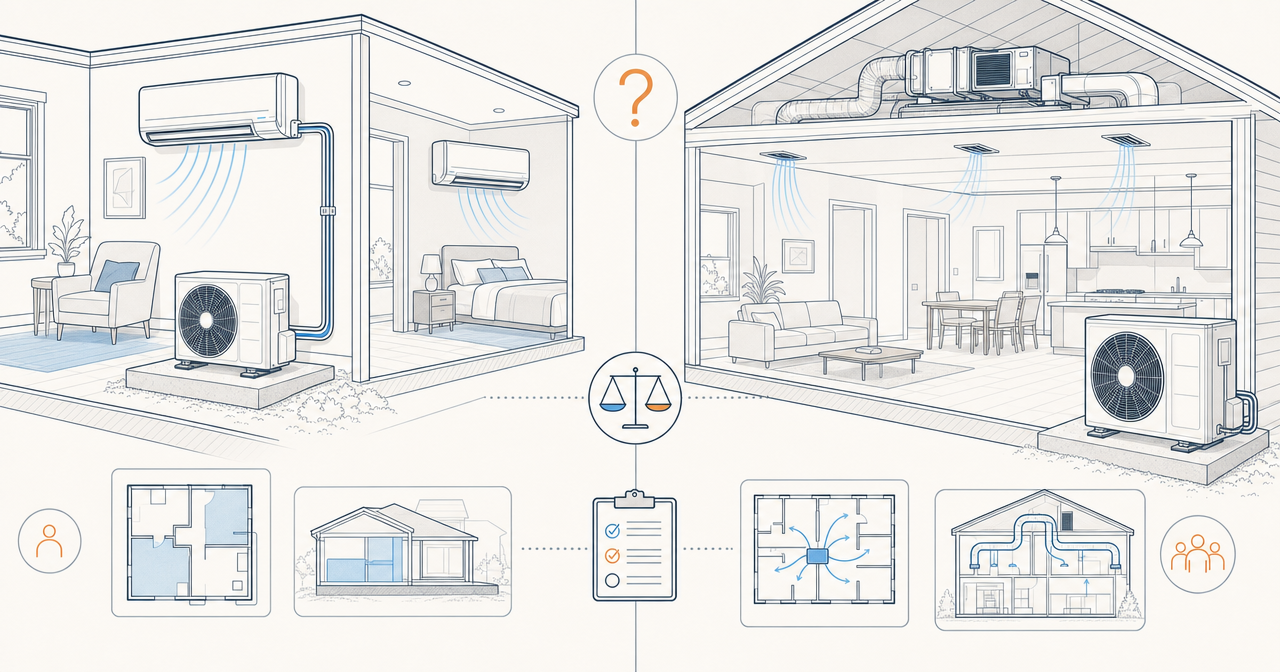
Quick answer: use this decision matrix
| Decision point | Ductless mini-split | Ducted heat pump |
|---|---|---|
| Ductwork | Does not need distribution ducts. Refrigerant lines connect the outdoor unit to indoor heads. | Uses supply and return ducts through a central air handler. Existing ducts may work if they are properly sized, sealed, and accessible. |
| Zones | Each indoor head can serve a separate zone with its own control. | One central thermostat is typical. Zoning requires dampers, multiple air handlers, or separate equipment and careful airflow design. |
| Whole-home coverage | Possible with a multi-zone design, enough heads, and a layout that lets each head reach its assigned rooms. | Natural fit for whole-home coverage when the duct system reaches the rooms and can move the required airflow. |
| Visibility | Indoor heads, line-set covers, and condensate routes remain visible unless you choose floor or ceiling units and concealed routing. | Most indoor equipment stays in an attic, basement, closet, or mechanical room. Registers and returns remain visible. |
| Filtration and ventilation | Each head has a small filter for recirculated room air. Whole-home filtration and outdoor-air ventilation usually need separate equipment. | A central return makes filter access and higher-efficiency filtration easier to plan. Ducts still do not provide fresh-air ventilation by themselves. |
| Maintenance and noise | Clean each head's filter and condensate path. A fan in the room can be audible even when it is quiet. | Maintain the central filter, blower, coil, condensate system, and ducts. Supply or return airflow can create noise if the duct design is poor. |
| Efficiency | Avoids duct losses and can condition only occupied zones. Efficiency still depends on the exact equipment, head placement, and installation. | A well-sealed, well-insulated duct system can perform well. Duct leakage and ducts in hot attics or crawlspaces reduce delivered efficiency. |
| Cost | Often the simpler project for one room or a home without ducts. Multiple heads, long line sets, and complex routing raise the price. | Often the simpler whole-home project when usable ducts are already in place. New ductwork can change the cost calculation. |
| Installation scope | Outdoor unit, indoor head or heads, refrigerant lines, controls, condensate drainage, electrical work, permits, and commissioning. | Outdoor unit, indoor air handler, duct assessment or modification, thermostat, condensate drainage, electrical work, permits, and commissioning. |
We frame the comparison this way: a mini-split is usually a ductless heat pump, and the useful choice is ductless versus ducted. The better fit depends on the house and the project scope.
What the terms mean
A mini-split is usually a ductless heat pump
A ductless mini-split uses an outdoor compressor and one or more indoor air handlers, often called heads. Refrigerant lines, electrical wiring, and a condensate drain connect the equipment. The indoor head moves conditioned air directly into the room it serves.
ENERGY STAR's ductless heat pump guidance describes mini-splits as a fit for homes or sections of homes without ductwork, additions, outbuildings, and rooms with persistent hot or cold spots. A single-zone system has one outdoor unit and one indoor head. A multi-zone system uses one outdoor unit with several heads, although the allowable combination depends on the manufacturer.
The word mini-split can also describe cooling-only equipment. If winter heating, low-temperature performance, or an incentive matters, use the exact model numbers and matched indoor and outdoor equipment in the comparison.
A ducted heat pump is the central-air version of the same basic technology
A ducted air-source heat pump moves heat between the outdoor air and an indoor coil, then distributes that heating or cooling through supply registers. An air handler and return ductwork complete the air path. In many homes, it can replace a central air conditioner, a furnace, or both, making it relevant to replacing a central furnace and air conditioner.
ENERGY STAR's air-source heat pump guidance describes existing ductwork as a possible drop-in path when the ducts are suitable. A heat pump often moves more air at a lower supply temperature than a gas furnace, so the old ducts still need an airflow and condition assessment.
There is also a middle option. A ducted mini-split can hide the indoor air handler and serve several nearby rooms through a short duct run. It can work well where a wall head is undesirable and a full central duct retrofit would be excessive. Ask for the exact system configuration rather than assuming every mini-split is wall-mounted.
Where each system fits best
Choose ductless when the home has no usable ducts
Mini-splits make sense in older homes with radiators or baseboards, additions, finished attics, garages, workshops, sunrooms, and other spaces where running ductwork would require major access work. They also work well when the project is limited to one floor or one persistent comfort problem.
The installation can be relatively focused. A single zone still needs an outdoor unit, a suitable indoor location, line-set routing, a condensate solution, electrical work, and startup. The scope is smaller than a whole-house duct retrofit, though the exact layout determines the price.
Choose ducted when good ducts already reach the whole home
A ducted heat pump usually fits a home that already has a central air handler, supply registers, and return paths in reasonable condition. It keeps one central thermostat and distributes air through a familiar system. It also keeps indoor wall space clear of multiple heads.
Existing ducts are an asset only when they can support the new equipment. A contractor should inspect leakage, insulation, supply and return sizing, airflow, and access. Ducts in an unconditioned attic or crawlspace deserve extra scrutiny because their losses affect both comfort and operating cost.
Use a hybrid layout when the house has mixed needs
Some homes are best served by a ducted heat pump in the main living areas plus one or two mini-splits in an addition, upper floor, finished basement, or room the existing ducts miss. This avoids rebuilding a distribution system that works in most of the house while giving the problem area its own zone.
A hybrid quote should identify which rooms each system is expected to heat and cool, whether the old system stays as backup, and how the controls prevent the systems from fighting each other. Compare the complete layout rather than judging the equipment labels separately.
Comfort, filtration, maintenance, and noise
Zoning is a real advantage, with limits
Each ductless head can respond to the temperature in its own zone. That helps when bedrooms, offices, and sun-facing rooms have different schedules. It can also keep an unused area from receiving the same conditioning as the occupied part of the home.
Zoning works only when the head placement matches the room layout. A head in a hallway does not automatically condition closed bedrooms. A multi-zone system also does not mean every room needs a separate head. The contractor should map the zones, account for door positions and room loads, and explain how air will move when interior doors are closed.
Ducted systems can use dampers or multiple systems for zoning, though those designs require airflow controls and balanced supply and return paths. A single central thermostat remains the simplest ducted arrangement.
Filtration and ventilation are separate questions
A ducted system gives you a central return and a single filter location, which makes filter access and filtration upgrades easier to plan. The filter still needs to match the air handler's airflow capability. As DOE filter guidance explains, a higher-MERV filter can restrict airflow when the system is not designed for it.
Ductless heads typically use washable or replaceable filters at each indoor unit. They filter recirculated air near the head, and each head needs attention. A ductless mini-split is not a whole-house fresh-air ventilator. A ducted heat pump also needs a separate outdoor-air ventilation strategy if the home requires mechanical ventilation. An ERV, HRV, or dedicated ventilation system may be part of that plan.
Maintenance follows the distribution system
Both systems need clean outdoor coils, clear condensate drainage, clean filters, and professional service. Ductless systems add several indoor filters, fan wheels, coils, and condensate pans to the maintenance list. A multi-zone system can multiply the cleaning work.
Ducted systems concentrate service at the air handler, but the duct system matters. Dirt, leaks, crushed flex duct, undersized returns, or inaccessible filters can reduce airflow and comfort. ENERGY STAR recommends checking filters regularly and using professional pre-season service. The manufacturer's maintenance instructions control the actual schedule.
Noise depends on equipment, fan speed, mounting, and air-path design. A ductless head places a fan in the room, so its low-speed sound is part of the living space. A ducted system moves fan and airflow noise to the air handler, registers, and returns. Poorly sized ducts can make a ducted system louder than the equipment rating suggests.
Cost: compare the complete project
Published prices mix one-room jobs, whole-home designs, regional labor, and different incentive assumptions. Use the figures below as US planning benchmarks, not as a promise from a contractor. The amounts are generally before incentives unless the row says otherwise. Electrical service work, permit fees, major building repairs, and unusual access can sit outside the comparison.
| Project scope | Current planning figure | What the figure assumes |
|---|---|---|
| Single-zone ductless mini-split | About $3,000 to $8,000 installed | One outdoor unit, one indoor head, ordinary wall access, and a manageable line-set route. Higher equipment tiers, long lines, difficult condensate routing, and labor rates push the quote upward. |
| Two- to four-zone ductless system | About $8,000 to $20,000 or more | One multi-zone outdoor unit, two to four indoor heads, normal controls, and standard routing. Each head adds equipment, line-set, drainage, and labor scope. |
| Whole-home ductless system | About $15,000 to $26,000 or more | Enough heads and outdoor capacity to cover the home's rooms and loads. EnergySage's 2026 marketplace comparison reports an average of $25,957 before incentives for whole-home ductless systems. |
| Ducted heat pump using existing ducts | About $14,500 average in 2026 marketplace data | A central ducted replacement with usable ducts. EnergySage reports an average of $14,529 before incentives for ducted systems; a simple replacement can fall below that, while cold-climate equipment, duct repairs, access, or electrical work can raise it. |
| Ducted heat pump with new or major ductwork | Add about $2,000 to more than $10,000 | A small new-construction duct layout sits near the low end. A full-home retrofit, wall and ceiling access, insulation, air sealing, and repairs can move beyond the high end. |
| Electrical scope | Quote as its own line item | A branch circuit, disconnect, conduit, wire, grounding, or controls may be enough. A service or panel upgrade belongs in the quote only when the electrical assessment shows it is needed. |
| Permits and inspections | Jurisdiction-specific | A mechanical, electrical, building, or other permit may apply. Fee, plan-review, inspection, and contractor-handling rules vary by city, county, and state. |
| Incentives | Subtract only confirmed savings | State and utility programs may apply. The federal Energy Efficient Home Improvement Credit under Section 25C is not available for qualifying property placed in service after December 31, 2025 under current IRS guidance. |
The national figures come from different project mixes, so they should not be read as a head-to-head guarantee. EnergySage's mini-split cost guide reports a few thousand dollars per zone, up to around $8,000, while its comparison page reports new ductwork from about $2,000 to more than $10,000. That explains why a one-head mini-split can be less expensive than a ducted retrofit while a five-head whole-home design costs more than a ducted replacement using sound existing ducts. Its 2026 ducted-versus-ductless cost comparison is a useful benchmark because it identifies the project types behind the averages.
For a more detailed project budget, use our Heat Pump Installation Cost guide. If the quote includes panel or service work, compare that scope with Cost to Upgrade to 200 Amp Service.
Do not let a contractor blend gross price, rebate, tax credit, and financing into one attractive net number. Start with Heat Pump Rebates by State, then use our guide to compare rebates, tax credits, and installer quotes. Program eligibility depends on the exact equipment, installation date, home, income rules where applicable, contractor requirements, and local program budget.
Efficiency and comfort: the equipment label is only part of the answer
Both systems use the heat-pump cycle. An air-source heat pump transfers heat rather than creating it with combustion or electric resistance. ENERGY STAR says a certified air-source heat pump can deliver up to three times more heat energy to a home than the electrical energy it consumes. The delivered result depends on outdoor temperature, building load, equipment match, airflow, duct condition, controls, and installation quality.
Ductless avoids duct losses
Conditioning air at the room avoids losses from long, leaky, or poorly insulated ducts. That advantage is largest when ducts run through hot attics, crawlspaces, garages, or other unconditioned spaces. Ductless zoning can also reduce energy use when a household intentionally conditions only occupied rooms.
The advantage is smaller when ducts are inside the conditioned envelope, well sealed, insulated, and sized for the heat pump's airflow. A ductless system can lose its expected savings through poor head placement, oversized zones, unnecessary heads, or low-temperature performance that does not match the load.
Compare the equipment's rated combination and performance data. SEER2 and HSPF2 numbers are useful, yet they do not show the entire delivered performance of a particular installation. Ask for the matched indoor and outdoor model numbers and the AHRI reference when the contractor provides one.
Ducted can provide steadier whole-home air movement
Supply registers and return paths distribute air through the house, which can feel more even in an open or well-designed layout. The central system can also make it easier to coordinate filtration, ventilation, and whole-home humidity equipment.
The system still needs enough airflow. A heat pump's lower supply temperature can require more air movement than a furnace at the same nominal capacity. An undersized return, restrictive filter, or leaky supply system can produce cold rooms, high fan noise, poor dehumidification, and higher bills.
Sizing affects both options
Do not choose a mini-split head or central heat pump from square footage alone. ENERGY STAR recommends a Manual J load calculation based on the home's insulation, windows, air leakage, orientation, and design temperatures. Ductless projects need room-by-room or zone loads. Ducted projects need whole-home loads plus duct and airflow evaluation.
Oversizing can cause short cycling and weak humidity control. Undersizing can increase backup heat, reduce comfort, or leave rooms below the target temperature. A contractor who cannot explain the load calculation cannot explain why the proposed equipment is the right size.
Cold climates and equipment-specific caveats
Many modern mini-splits and ducted heat pumps work in cold weather. The category name tells you little about how a particular model performs at your winter design temperature.
For a cold-climate project, ask for:
- heating capacity and efficiency at the outdoor design temperature for your location,
- capacity at 5°F or the lowest temperature used in the equipment's published data,
- the exact matched indoor and outdoor equipment,
- defrost behavior and condensate management,
- the backup or supplemental heat plan,
- outdoor-unit clearance above snow and protection from roof runoff,
- and the control strategy for any dual-fuel system.
ENERGY STAR's current cold-climate criteria require qualifying split systems to demonstrate low-temperature performance, including a coefficient of performance of at least 1.75 at 5°F and at least 70% of 47°F heating capacity at 5°F. Those criteria apply to qualifying products, not every mini-split or heat pump sold. A standard model and a cold-climate model can have very different capacity curves.
In a mild climate, a single-zone mini-split may cover a room with little backup heat. In a cold climate, whole-home coverage may call for more heads, a ducted system, a dual-fuel arrangement, electric resistance backup, envelope improvements, or a combination. A cold-climate system also needs a design that handles defrost water, snow, and low outdoor temperatures.
For the winter-performance details behind that choice, start with Do heat pumps work in cold weather? alongside the equipment data in the quote.
What a complete quote should include
Use a licensed and insured contractor who understands the equipment type and local requirements. State and local licensing rules vary. Refrigerant work also has a federal requirement: the EPA's Section 608 guidance says a technician who connects or disconnects refrigerant lines or adds or removes refrigerant from a mini-split must hold Section 608 certification.
Ask the contractor to document these items:
- Load calculation and equipment selection. The quote should show the Manual J or equivalent load method, the zones it covers, the design temperatures, and why the selected equipment matches those loads.
- Duct assessment, if applicable. Include supply and return sizing, leakage, insulation, airflow, filter pressure, and any repairs or modifications. A ducted heat pump quote that assumes perfect existing ducts is incomplete.
- Exact equipment. List indoor and outdoor model numbers, matched combinations, efficiency ratings, cold-weather capacity, controls, and warranty terms.
- Physical installation. Spell out the outdoor pad or stand, wall brackets, line-set lengths and covers, wall penetrations, condensate routing, air handler location, registers, returns, access repairs, and cleanup.
- Electrical work. Identify the circuit, disconnect, wire, conduit, grounding, controls, panel work, and service work. A service upgrade should follow an electrical load assessment rather than a sales shortcut.
- Permits and inspections. State which permits are required in the project jurisdiction, who pulls each one, and whether inspection fees are included. Our mini-split installation permit guide covers why a wall-mounted system is not automatically permit-free.
- Commissioning and handoff. Require startup testing, refrigerant-charge verification, airflow measurements for ducted systems, temperature and control checks, condensate drainage, defrost or backup-heat operation where relevant, model and serial records, manuals, and warranty registration.
ENERGY STAR's quality-installation guidance specifically calls out proper sizing, airflow, refrigerant charge, and duct evaluation. Use our HVAC contractor question checklist while you compare bids.
How to choose: a clear decision path
1. Decide what the system must cover
If the project is one room, an addition, a garage, or a comfort problem, start with a ductless design. If the project is the entire home, continue to the duct question before choosing the equipment.
2. Inspect the duct path
If usable ducts already reach the whole home, ask for a ducted heat pump quote that includes duct testing and airflow work. If the home has no ducts or the existing system cannot reach the rooms, ask for a ductless mini-split design and zone plan and a separate duct-retrofit comparison when both are feasible.
3. Match zone count to household behavior
Choose ductless when room-by-room control matters and you will use it. Choose ducted when one coordinated thermostat and even distribution matter more. A hybrid system can handle a house where both priorities exist.
4. Test climate and load assumptions
In a cold climate, compare capacity at the local design temperature and confirm the backup plan. In a humid climate, ask how the chosen equipment will manage latent load and how ventilation will work. In every climate, insist on a load calculation instead of a square-foot rule.
5. Compare the quote scope line by line
The lower equipment price may omit ducts, electrical work, permits, condensate drainage, wall repairs, controls, commissioning, or incentives that have not been confirmed. Compare the same coverage, zone count, performance assumptions, and included work before deciding which system costs less.
The usual fit is:
- One room or no ducts: ductless mini-split.
- Whole home with good existing ducts: ducted heat pump.
- Whole home without ducts: compare a multi-zone ductless plan with the cost and disruption of new ductwork.
- Mixed layout or one problem area: hybrid ducted and ductless design.
FAQ
Is a mini-split a heat pump?
Usually. A ductless mini-split heat pump is one type of air-source heat pump. Some mini-splits provide cooling only, so the exact equipment determines whether it also provides heating.
Is a mini-split cheaper than a ducted heat pump?
A single-zone mini-split often costs less than a whole-home ducted retrofit because it serves less space and avoids new ducts. A multi-zone or whole-home mini-split can cost more than a ducted heat pump using good existing ducts. Compare coverage and included scope.
Can a mini-split heat a whole house?
Yes, when the system has enough capacity, the zones and head locations match the room loads, and the home allows air to move between spaces. Whole-home ductless designs often need several heads, careful controls, and a plan for rooms with closed doors.
Do mini-splits work in cold weather?
Many do. Select a model for the local design temperature, review its published capacity at low outdoor temperatures, and document backup heat or a dual-fuel strategy where the load requires it. A standard cooling-focused mini-split is not the same as a cold-climate heat pump.
Can you combine a mini-split with a ducted heat pump?
Yes. A ducted system can serve the main house while a mini-split handles an addition, finished basement, upper floor, or room with weak duct performance. The quote should identify each system's coverage and control sequence.
Which system is quieter?
Neither wins in every home. A ductless head puts a fan in the room, while a ducted system puts blower and airflow noise at the air handler, returns, and registers. Compare manufacturer sound data with the proposed fan speed, head location, duct design, and mounting surface.
Do both systems need ventilation equipment?
Usually, yes if the home needs mechanical outdoor-air ventilation. A ductless head recirculates room air, and a ducted heat pump's distribution ducts do not automatically bring in fresh air. An ERV, HRV, or dedicated ventilation system may be needed separately.
Do both qualify for rebates or tax credits?
They may qualify for state, utility, or local incentives when the equipment and project meet that program's rules. For a 2026 installation, do not assume the federal Section 25C heat-pump credit is available. The IRS says the credit does not apply to qualifying property placed in service after December 31, 2025. Confirm the current program, equipment list, timing, and contractor requirements before subtracting any incentive from a quote.
If you are ready to compare bids, start with our 12 questions to ask an HVAC contractor and carry the completed scope into every quote request.