Last reviewed: September 14, 2026 (UTC)
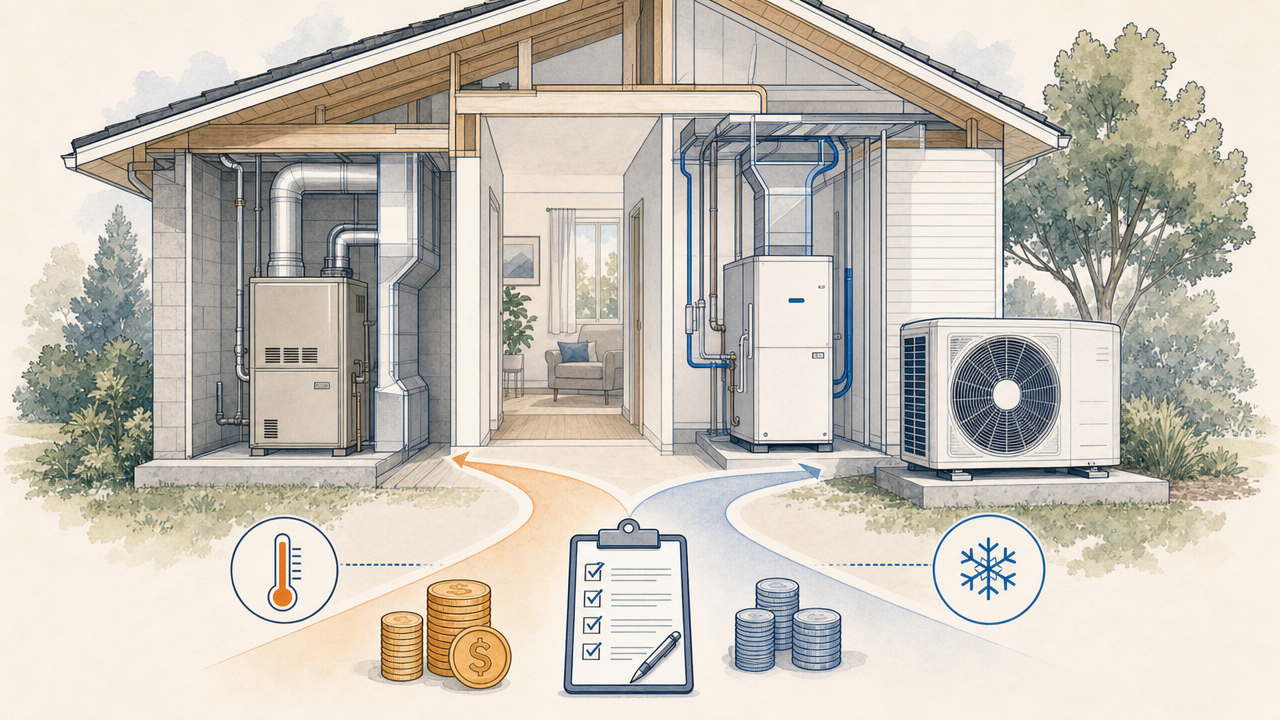
Here, heat pump means a ducted air-source system that can heat and cool through existing forced-air distribution when the ducts are suitable. A furnace-only replacement supplies heat. A furnace plus central AC replacement supplies heat and cooling as two separate systems. All-electric means the furnace is removed and any backup heat is electric. Dual fuel keeps or adds a gas furnace alongside the heat pump.
Scoped price benchmarks for replacing a furnace with a heat pump
The table uses gross U.S. contract-price planning bands before rebates. It assumes an ordinary single-family forced-air home with reasonable equipment access. The bands are deliberately broad because labor rates, house size, equipment tier, permits, and existing conditions vary. They are planning ranges, not quotes for a particular home.
| System path | Gross contract-price planning band | Common add-ons | Later rebates or credits |
|---|---|---|---|
| Heat pump, straightforward ducted conversion | $10,000–$18,000 | Duct sealing or balancing, a new 240-volt circuit, condensate work, outdoor pad, line-set changes, permit, or gas-line closure | State or utility heat-pump rebates may reduce net cost. The federal 25C heat-pump credit does not apply to property placed in service after December 31, 2025. |
| Furnace only | $4,000–$10,000 | Venting or chimney work, gas-line changes, duct repairs, thermostat, permit, or removal of old equipment | A local high-efficiency furnace offer may exist. Do not count the expired federal heat-pump credit. |
| Furnace plus central AC | $9,000–$19,000 | Duct corrections, refrigerant line, electrical work, condensate drainage, thermostat, permit, or removal | State and utility HVAC offers vary by equipment and territory. A furnace-plus-AC project does not qualify for the federal heat-pump credit simply because it provides cooling. |
| All-electric conversion | $12,000–$28,000 | Cold-climate equipment, electric resistance backup, panel or service work, weatherization, duct corrections, condensate protection, and permits | An active state, utility, or Home Energy Rebates pathway may apply when income, location, equipment, and timing rules are met. There is no 2026 federal 25C heat-pump credit. |
| Dual fuel, new furnace plus heat pump | $11,000–$28,000 | Furnace and heat-pump controls, gas venting, gas-line work, a new circuit, duct corrections, cold-climate equipment, and permits | Some programs accept dual-fuel systems and others do not. Treat the program decision as separate from the contractor’s price. No federal 25C heat-pump credit applies to post-2025 placed-in-service property. |
The ranges overlap on purpose. A simple heat-pump conversion can cost less than an all-electric retrofit with electric backup. A dual-fuel system that keeps a healthy existing furnace can cost less than the new-furnace dual-fuel row.
Price-method note: These are Watt Wallet planning bands, not a national homeowner quote. We synthesized the NEEP market assessment, the NESCAUM cost study, the California TECH cost study, the federal DOE duct guide, and the NYSERDA electrical guide. The regional studies show how scope changes price; they do not set a price for your address.
The live savings side belongs in a separate worksheet. Watt Wallet’s heat pump rebates by state guide organizes state and utility paths without folding them into the gross equipment price.
The cost swings behind the table
Duct corrections: roughly $500 to $3,500 for modest work
A furnace and a heat pump both move air, so existing ducts can often stay. That does not make them automatically suitable. A heat pump may need different airflow, and old furnace systems can have undersized returns, leaks, crushed flex duct, poor balance, or insulation gaps.
For budgeting, allow roughly $500–$3,500 for spot sealing, balancing, minor repairs, or a return-side correction. That is a Watt Wallet planning allowance for modest work. If the duct system needs broad replacement, the federal duct retrofit guide reports national replacement averages of $1,450–$8,000, with complex projects exceeding $12,000. The NESCAUM cost study found an average ductwork add-on of about $4,500 in its Northeast and Mid-Atlantic analysis.
A complete duct scope identifies whether the system will be reused, sealed and balanced, modified, or replaced. It also separates duct labor from the heat-pump equipment so two bids can be compared fairly.
Electrical work: from a new circuit to a service upgrade
The outdoor unit commonly needs a dedicated 240-volt circuit. An indoor air handler with electric resistance backup can add another electrical load. The work may involve a breaker, disconnect, conductors, conduit, panel space, or a service-capacity solution.
Use these as separate planning allowances:
- New circuit, disconnect, and breaker: roughly $500–$2,000 when the panel and service can support the work.
- Basic panel work: roughly $1,000–$3,000 for a straightforward panel-related upgrade.
- Service, meter, relocation, or underground work: roughly $3,000–$20,000 or more, depending on the utility connection and site conditions.
The NYSERDA electrical guide lists local-cost examples for circuits, panels, service wiring, and related work. A heat pump does not automatically require a 200-amp panel. A licensed electrician determines whether the issue is capacity, breaker space, wiring condition, or a combination of those constraints under the jurisdiction’s adopted code.
Cold-climate equipment and backup heat: roughly $1,500 to $5,000 above a simple conversion
Cold-climate equipment can retain more capacity at low outdoor temperatures than a standard model. It may also cost more. An all-electric design can add electric resistance heat in the air handler, controls, wiring, breakers, snow or condensate measures, and more careful sizing.
For planning, a $1,500–$5,000 allowance above a straightforward conversion is reasonable for the cold-climate equipment, backup-heat, and related scope. It is an allowance, not a published national average. The correct choice depends on the home’s design temperature, heat loss, equipment capacity at that temperature, and the number of hours backup heat is expected to run.
A cold-climate system can work in a cold region. The design still needs to state what the selected model delivers at the local design temperature and what happens when the outdoor temperature falls below that point. Watt Wallet’s cold-climate heat pump guide explains the performance and backup questions in more detail.
Dual fuel: often several thousand dollars above heat pump only
A new dual-fuel system adds a gas furnace, compatible indoor equipment, controls, venting, combustion safety work, and gas-side installation to the heat-pump scope. A reasonable planning allowance is $3,000–$10,000 above a straightforward heat-pump conversion when a new furnace is required. Keeping a suitable existing furnace can reduce that incremental work.
The comparison baseline matters more than the label. The California TECH cost study found that, in its aggregated sample, replacing a gas furnace with an all-electric heat pump cost about $11,080 more than a like-for-like furnace replacement. A heat pump paired with a new furnace cost about $10,574 more, while a heat pump using the existing furnace cost about $5,868 more. In homes already replacing a gas furnace and central AC, the average increments were much smaller: about $2,087 for all-electric, $1,283 for a new-furnace dual-fuel system, and $3,896 less when the existing furnace was retained. The existing-furnace result came from only two observations, and the study is regional, so use those figures to understand the baseline effect rather than as a local quote.
The replacement workflow, from load calculation to commissioning
Replacing a furnace with a heat pump is a coordinated HVAC, electrical, and sometimes gas project. A complete installation follows this sequence.
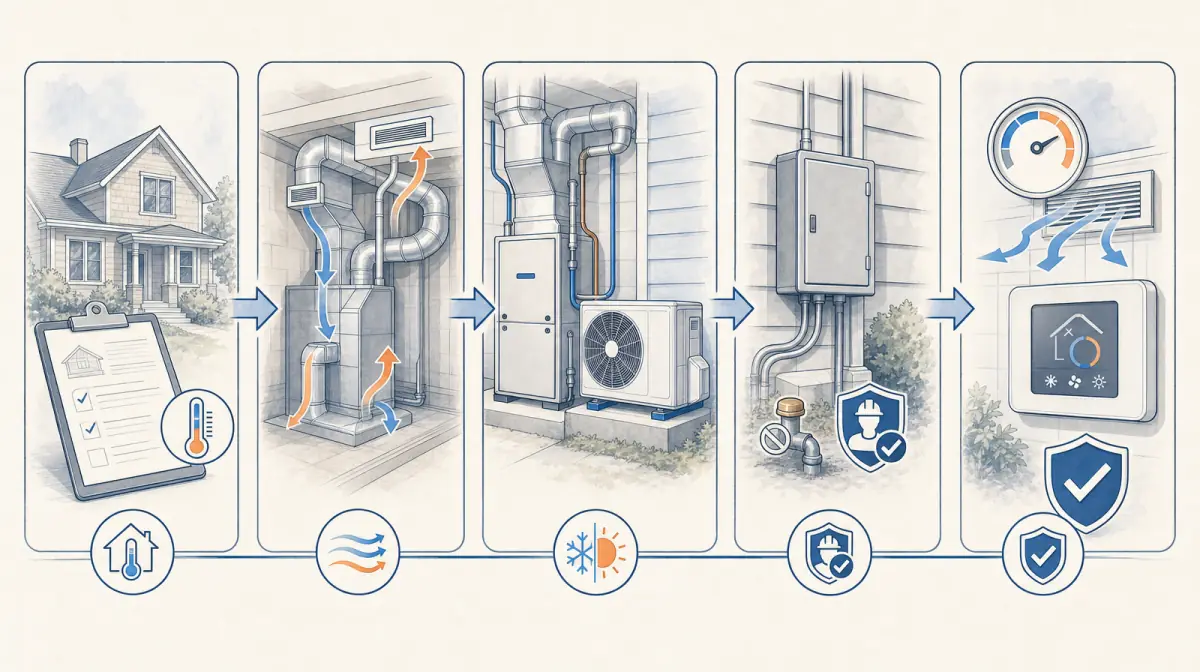
Simplified workflow, not installation instructions.
1. Site assessment and load calculation
The installer documents the home’s floor area, insulation, windows, air leakage, duct losses, design temperatures, and existing comfort problems. A Manual J or equivalent load calculation determines the heating and cooling loads. The equipment is selected from those loads, rather than from the old furnace’s nameplate or a square-foot rule.
The DOE sizing guidance explains why heating and cooling loads come first. Heat-pump capacity changes with outdoor temperature, so the proposal should show capacity at the local design temperature and a low-temperature point relevant to the climate.
2. Duct assessment and corrections
The HVAC contractor evaluates supply and return capacity, static pressure, airflow, leakage, balance, insulation, filter pressure drop, and the condition of accessible runs. The result determines whether the ducts are reused, sealed, balanced, resized, or replaced.
The duct decision also affects equipment sizing. A leaky or restricted system can make a correctly selected heat pump perform poorly. If the house has rooms with chronic comfort problems, those issues belong in the design scope before equipment is ordered.
3. Indoor and outdoor equipment selection
A ducted split system usually includes an outdoor heat-pump unit, an indoor coil or air handler, a matched blower, controls, thermostat, refrigerant line set, condensate management, and an outdoor pad or stand. The proposal should identify the exact model numbers and matched indoor-outdoor combination.
An all-electric design may include electric resistance backup. A dual-fuel design includes a furnace and controls that choose between the heat pump and gas heat. The switchover can be based on outdoor temperature, equipment capacity, or operating economics. That setting belongs in the commissioning plan.
4. Electrical work, permits, and gas work
The electrician completes the applicable load and circuit work, installs listed overcurrent protection and disconnects, and coordinates with the HVAC contractor. Permit and inspection requirements vary by city, county, state, and utility. HVAC, electrical, and gas permits can be separate even when one company coordinates the job.
For a full-electric conversion, a licensed HVAC, plumbing, or gas professional closes the furnace’s gas connection. Depending on the jurisdiction and the planned future use of the line, the work can involve isolation, purging, capping, removal, a gas-utility service change, and inspection. Local fuel-gas code controls the method. Homeowners should never open, disconnect, or cap a gas line themselves.
If the furnace remains for dual fuel, the gas line and venting stay part of the combustion-safety scope. The installer still needs to confirm furnace condition, venting, combustion air, condensate handling, and control compatibility.
5. Commissioning and handoff
Commissioning turns an installed system into a working system. The installer records airflow, static pressure, refrigerant charge, temperature response, defrost operation, backup-heat operation, thermostat controls, condensate drainage, and heating and cooling modes. The ENERGY STAR quality-installation guidance identifies equipment sizing, airflow, refrigerant charge, and duct evaluation as core quality items.
The closeout package should include model numbers, warranty terms, permit information, operating instructions, filter requirements, maintenance intervals, and the final incentive documents. A system that has been installed without commissioning data is harder to evaluate when comfort or energy bills miss expectations.
How rebates and tax credits affect the 2026 price
Keep three numbers separate:
- Gross contract price: the amount in the signed installation contract.
- Point-of-sale rebate: a discount applied by a utility, state program, contractor, or administrator before or at payment.
- Later recovery: a rebate paid after paperwork or a tax benefit claimed for a qualifying tax year.
The federal Energy Efficient Home Improvement Credit, commonly called 25C, is the main source of the old heat-pump tax-credit assumption. The current IRS credit page says qualifying property had to be placed in service on or after January 1, 2023, and before December 31, 2025. For a system placed in service after December 31, 2025, do not include the federal heat-pump credit in a 2026 budget. A qualifying 2025 installation follows the rules for its own tax year.
The old up to $2,000 heat-pump credit and up to $600 electrical-component credit should not appear as automatic savings in a new 2026 quote. A tax credit also belongs to a tax return rather than the installer’s invoice, and the credit was nonrefundable under the prior rules.
State and utility rebates are a separate, potentially active category. The DOE says states, territories, and Tribes administer Home Energy Rebates and set local eligibility. ENERGY STAR’s current HEAR table lists a maximum of $8,000 for an eligible space-heating and cooling heat pump, $4,000 for an eligible electric load service-center upgrade, and $2,500 for eligible wiring, subject to income limits, state implementation, product rules, and cost caps. Those are program maximums, not a national payment.
A program may require a participating contractor, pre-approval, income documentation, a qualifying model, a whole-home fuel switch, or completion by a deadline. Watt Wallet’s guides on stacking rebates and tax credits and comparing rebates, tax credits, and quotes cover the paperwork and timing side of the decision.
Operating cost: heat-pump efficiency does not guarantee a lower bill
ENERGY STAR says an air-source heat pump can deliver up to three times more heat energy to a home than the electrical energy it consumes. That efficiency advantage is real. The bill comparison still depends on the heat pump’s seasonal COP, the gas furnace’s AFUE, local electricity and gas prices, the home’s heat loss, and backup-heat use.
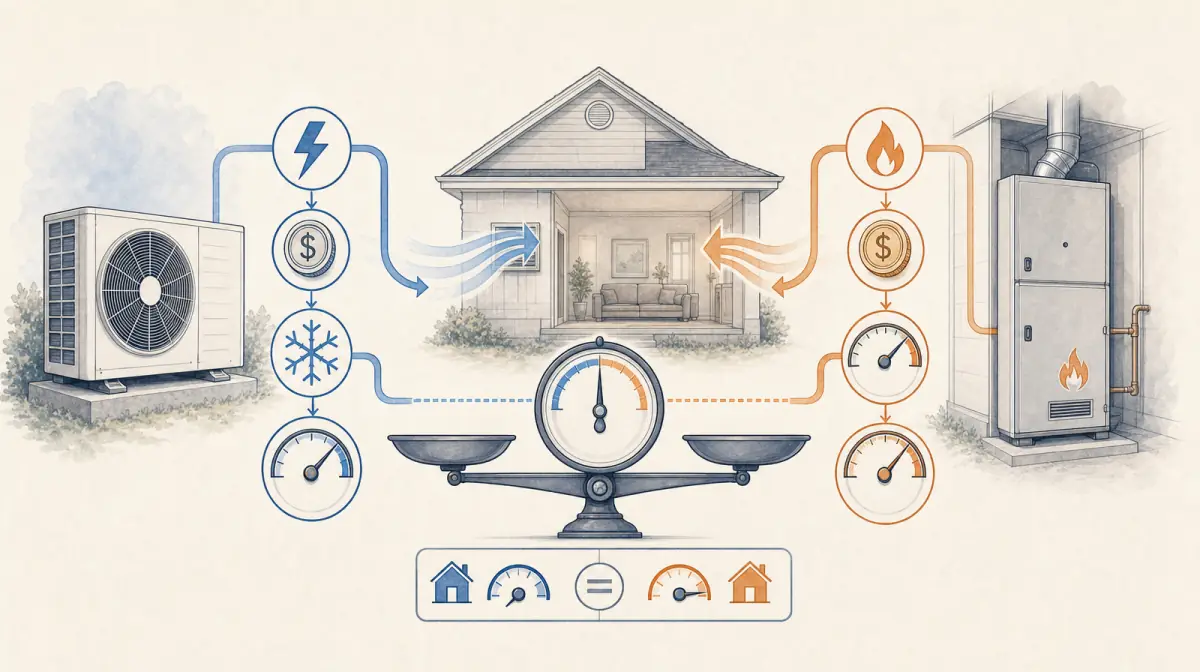
Illustrative comparison, not a utility-bill forecast.
A simple comparison uses delivered heat in dollars per million British thermal units:
Heat pump delivered-heat cost = electricity price per kWh × 293.1 ÷ seasonal COP
Gas delivered-heat cost = gas price per therm × 10 ÷ AFUE
For example, at $0.16 per kWh and a seasonal COP of 2.5, heat-pump heat costs about $18.76 per delivered MMBtu. At $1.50 per therm and 95% AFUE, gas heat costs about $15.79 per delivered MMBtu. At the same electric rate and a seasonal COP of 3.0, heat-pump heat falls to about $15.63 per delivered MMBtu.
That example is deliberately generic. Fixed utility charges, demand charges, fuel-delivery fees, cooling costs, and the amount of electric backup can change the annual result. The ENERGY STAR heat-pump guidance and NREL field study support the efficiency and cold-climate performance context, while local rates determine the household economics.
Climate fit and honest disadvantages
A heat pump is a strong fit when
- the home needs both heating and cooling, or the existing AC is near replacement;
- the ducts can deliver the selected system’s required airflow;
- the electrical service can support the outdoor unit and any backup heat;
- the home’s insulation and air sealing are adequate for the design load;
- the local utility offers a useful heat-pump rate or rebate; and
- the selected model retains enough capacity at the local design temperature.
Cold weather alone does not rule out a heat pump. Cold-climate systems can heat below freezing, and DOE-funded field work has monitored centrally ducted systems in IECC Climate Zones 5 and 6. Capacity and COP fall as outdoor temperatures fall, so the design must account for those conditions.
The tradeoffs belong in the decision
- Higher first cost: Replacing a furnace alone is usually cheaper than installing a complete heat-pump system. The gap narrows when the AC also needs replacement. Compare the cost and fit of a heat pump versus an air conditioner before treating the combined project as a furnace-only decision.
- Electrical demand: Electric backup heat can create a large short-term load and a high bill when it runs often.
- Different comfort pattern: Heat-pump supply air can feel less hot than furnace air. Longer, steadier cycles are normal for a well-designed system.
- Outdoor equipment: The system needs an outdoor unit, clearance, drainage, defrost management, and protection from site conditions.
- Power dependence: An all-electric heat pump needs electricity. Dual fuel still needs electricity for the controls and blower, so retaining a gas furnace does not guarantee heat during an outage without a suitable backup-power plan.
- Gas-system decisions: A full conversion removes combustion equipment and gas use for space heating. Dual fuel keeps more equipment, more controls, and more maintenance in the home.
When keeping the furnace for dual fuel is reasonable
Dual fuel is reasonable when the existing furnace is safe, serviceable, compatible, and has useful life left. It can provide a practical bridge in a cold climate, especially when electric resistance backup would require a larger service or when the local electricity-to-gas price relationship makes gas cheaper during the coldest hours.
Retaining the furnace often makes sense when:
- the furnace is relatively new and has a sound heat exchanger;
- the home already has a compatible indoor coil, blower, venting, and gas connection;
- the coldest design hours are better covered by gas heat than by oversized electric backup;
- a panel or service upgrade would otherwise become a major part of the project;
- the homeowner wants a staged move toward electrification; or
- the local rebate accepts dual fuel and the program rules fit the system.
A new furnace is usually the better path when the existing unit is near the end of its life, has combustion or heat-exchanger concerns, lacks compatible controls, or would require expensive corrective work. Keeping a failing furnace simply to call the project dual fuel creates a second replacement problem.
The controls need a documented switchover strategy. The least-cost temperature may differ from the temperature that protects capacity, comfort, emissions, or electric peak demand. An installer can use the equipment’s performance data and local energy prices to set that control point.
What an itemized quote should contain
A useful proposal separates the decisions that are often hidden inside one total:
- system path: heat pump only, all-electric with backup heat, or dual fuel;
- Manual J or equivalent load calculation and design-temperature capacity;
- exact indoor and outdoor model numbers and matched-system information;
- equipment, labor, removal, freight, and warranty;
- duct reuse, sealing, balancing, modification, or replacement;
- electrical circuit, breaker, disconnect, panel, service, or load-management work;
- gas disconnection, capping, venting, or furnace-retention scope;
- thermostat, controls, backup heat, switchover, condensate, pad, and line-set work;
- permits, inspections, commissioning, and closeout documents; and
- gross contract price followed by each rebate assumption and its payment timing.
Watt Wallet’s quote-comparison guide is useful when two bids use different assumptions for rebates or add-ons.
FAQ
Do existing furnace ducts always need to be replaced?
No. Suitable ducts can often be reused. The installer’s airflow, static-pressure, leakage, balance, and condition assessment determines whether the right scope is reuse, correction, or replacement.
Does replacing a gas furnace with a heat pump always require a panel upgrade?
No. A new circuit may fit within the existing service. A licensed electrician determines whether capacity, breaker space, wiring condition, or local code requires additional work.
Can a heat pump work below freezing?
Yes. A properly selected cold-climate system can operate below freezing. Its capacity and COP change with outdoor temperature, and the design may include electric or gas backup for the coldest conditions.
Is dual fuel always cheaper to operate?
No. The lower-cost source changes with outdoor temperature, equipment performance, and electricity and gas rates. Dual fuel gives the controls two heating choices; it does not guarantee lower annual bills.
Does the federal heat-pump tax credit apply to a 2026 installation?
No. The federal 25C home-improvement credit ended for qualifying property placed in service after December 31, 2025. State and utility rebates may still be active under separate rules.
Bottom line
The cost of replacing a furnace with a heat pump depends on the comparison you are making. A straightforward ducted conversion with reusable ducts and adequate electrical service is a different project from a cold-climate all-electric retrofit, a duct rebuild, or a new dual-fuel system.
Start with the gross contract scope. Keep duct, electrical, backup heat, gas work, permits, and later incentives in separate lines. Then use Watt Wallet’s heat pump rebates by state guide to map the active programs that fit your address before signing the installation contract.