Last reviewed: September 30, 2026
How much does it cost to rewire a mobile home?
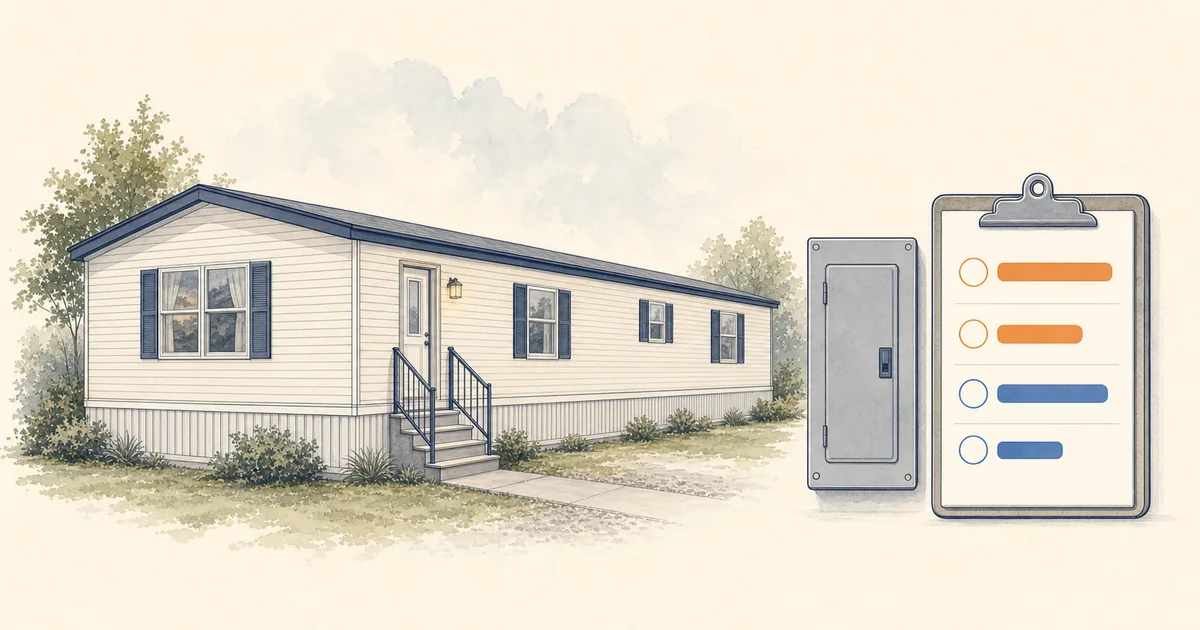
A full rewire can reach five figures, including for a single-wide. As one local price example, Jackson Electric, serving San Jose and Chico, California, advertises $8,000 to $18,000 for a single-wide rewire. It separately advertises $2,400 to $4,800 for a mobile-home panel upgrade, depending on service size and meter-base location.
These are one contractor's advertised prices. They are not a national average, a double-wide estimate, or documented homeowner invoices. The rewire range does not specify whether panel work is included, so adding the two ranges could count the same work twice.
A targeted repair is a different purchase from a full rewire. The useful budget starts with the electrician's diagnosis and separates four amounts:
- Interior circuits and devices: the wiring, outlets, switches, boxes, lights, and appliance connections being replaced.
- Panel and supply equipment: any panel, feeder, disconnect, meter, or service work.
- Access and restoration: opening and closing walls, ceilings, the belly barrier, insulation, and skirting.
- Permits and project logistics: applications, inspections, coordination, and any accommodation needed during outages.
Our house-rewiring cost guide explains a defined whole-house benchmark. It should not become a manufactured-home price per square foot: the access, supply arrangement, and alteration rules can be different.
Define the repair before pricing a full rewire
“Rewire” needs a written definition. A failed outlet, flickering lights, or a circuit that stops working does not establish that every cable in the home needs replacement.
The assessment should identify the affected circuits, wiring materials, damaged insulation or connections, earlier alterations, panel condition, and capacity for existing and planned appliances. It should explain why the proposed work is localized or home-wide.
- Targeted repair: The diagnosed defect and each connection, device, or cable section being repaired.
- Partial rewire: The circuits being replaced and the circuits and equipment remaining in service.
- Whole-home branch-circuit rewire: Every circuit being replaced, new or reused devices and fixtures, and any retained wiring.
- Panel or service project: The equipment and supply changes, separately from the interior circuit work.
Aluminum wiring does not settle the scope by itself
The Consumer Product Safety Commission's aluminum-wiring guidance recognizes complete replacement with copper and specific professional permanent-repair alternatives for applicable aluminum branch-circuit connections. A repair proposal needs to cover all affected connections, rather than just the outlets that have shown symptoms.
That guidance has a narrower scope than “all aluminum wire.” It does not apply to larger-gauge service-entrance, dryer, or range wiring. The electrician should identify the actual wiring and appropriate remedy. A home's age alone does not establish its wiring material or the need for a complete rewire.
Warning signs need attention before budget shopping
Hot outlet or switch plates, burning-plastic smells, flickering lights, and dead circuits warrant prompt assessment by a qualified electrician. The commission also warns that failing aluminum connections can overheat without obvious prior symptoms. Stop using affected equipment and contact an electrician promptly.
For smoke or fire, leave the home and call 911 from outside. Do not open a panel or handle damaged wiring. Avoid powering major appliances through extension cords or overloading outlets while waiting for repairs, consistent with federal fire-safety guidance.
Separate interior wiring from the home's power supply
The panel inside a manufactured home distributes electricity to its circuits. The feeder supplies that panel from upstream equipment. Service equipment, a disconnect, and meter equipment can belong to another part of the job.
A proposal for “full rewiring” may stop at the indoor panel. Another may include work outside the home, utility coordination, and supply corrections. Those proposals are not equivalent.
- Interior branch circuits: Circuit and device counts, appliance connections, retained equipment, and required protective devices.
- Home distribution panel: Replacement or retained enclosure, breakers, circuit labels, location, and usable breaker spaces.
- Feeder and service equipment: The exact equipment being replaced, supply rating, grounding and bonding corrections, meter work, and any trenching.
- Multi-section connections: Assessment and any required work on electrical connections between home sections.
Power-supply arrangements vary. An exterior pedestal is not a universal requirement for every manufactured home. Federal power-supply standards allow qualifying service equipment in or on the home. Those construction standards do not, by themselves, define the rules for a local retrofit.
A double-wide also deserves an explicit connection scope. Federal installation standards address electrical crossover connections between sections with wiring. The quote should state whether those connections are being assessed, retained, or replaced. Doubling a single-wide price misses that distinction and assumes identical access and circuit counts.
A rewire does not automatically require 200 amps
Replacing interior wiring and increasing supply capacity answer different needs. Future electric heating, water heating, cooking, or vehicle charging belongs in the electrician's capacity assessment. The conclusion should explain whether the existing supply can support the planned loads and whether any upgrade is required.
Extra breaker spaces alone do not increase the supply capacity. A larger panel alone also does not replace the feeder or utility equipment. Keep optional future-load provisions separate from work required to correct the existing system.
Access and restoration can change the finished cost
Square footage cannot show how an electrician will reach the cable routes. A smaller home with inaccessible cavities and finished surfaces can require substantial opening and restoration work.
The quote should describe the intended access through walls, ceilings, floor cavities, or underneath the home. It should also state the expected finish after those areas are closed. “Electrical work complete” can leave a very different result from “home restored and ready to occupy.”
Include the belly barrier, insulation, and skirting
The underfloor belly contains insulation and utilities behind a bottom barrier. It is part of the home's enclosure, not simply an empty crawlspace.
The Department of Energy's manufactured-home belly job aid addresses sound barrier closure, continuous insulation, and reinstalling removed skirting after insulation work. For a rewiring quote, the practical implication is to assign restoration of any of those layers disturbed for electrical access. This does not mean every rewire must use an underfloor route.
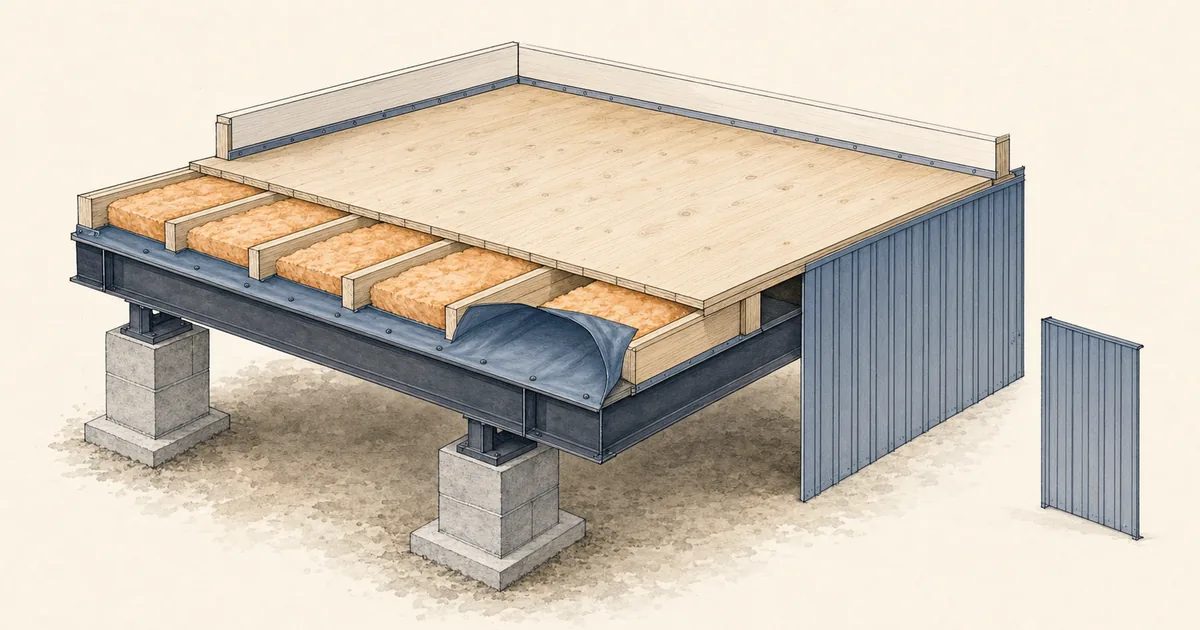
Simplified layout, not wiring instructions.
A complete restoration scope names who replaces insulation, closes the bottom barrier durably, reinstalls skirting, patches interior openings, and handles texture and paint. Existing water damage or other concealed defects need a separate price and approval process if discovered.
Manufactured-home permits have their own scope
Older mobile homes, manufactured homes built to U.S. Department of Housing and Urban Development (HUD) standards, and modular homes are not interchangeable construction categories. Certification labels, the data plate, and manufacturer records help the contractor establish the home's category and original specifications. HUD's homeowner resources explain certification and the role of manufacturer manuals.
The proposal should name the authority responsible for alterations to the home and any separate authority responsible for outside electrical work. It should include required plans, permit fees, inspections, and associated restoration approvals.
For example:
- Washington distinguishes electrical work inside the home from outside work in its manufactured-home permit guidance. Added circuits and main-panel replacement appear among alterations requiring permits; some like-for-like replacements have exceptions.
- California's alteration guidelines list different documentation requirements for branch circuits, electrical-system changes, panels, and meter bases. Wall alterations can add their own requirements. Its alteration permit table does not require the same plans or load calculation for every electrical job.
These are state examples. The contractor's permitted design must follow the requirements that apply to your property.
Permit fees are not rewiring prices
Washington's manufactured-home fee schedule, effective July 1, 2026, lists $148.50 for each added or modified 120-volt circuit, with a maximum charge of two circuits, and $148.50 for replacing the main panel or permanent transfer equipment.
Those are state permit and inspection fees. They exclude electrical labor and materials, and other fees can apply. The authority determines the applicable fee combination; the two-circuit maximum is not a whole-project cost cap.
In a park, assign ownership and outage coordination
The home, park, and utility can have different responsibilities for supply equipment. A quote should identify the equipment owner, who authorizes work, who pays each charge, and who arranges disconnection and reconnection. Shared supply work may also require coordination affecting neighboring homes.
California's park-conversion program illustrates why those boundaries matter. Its utility-program cost rules distinguish covered reconnection work from damaged or noncompliant resident-owned facilities that may need owner-funded correction. Participation does not promise a free indoor rewire.
The contract should include expected outage windows, rooms or appliances unavailable during work, inspection hold points, and any need to leave the home. Electrical crew time, permit review, utility scheduling, and restoration are separate parts of the project calendar. A universal “three-day rewire” promise cannot account for them.
Compare quotes on the finished job
Select an electrician qualified for the work and experienced with manufactured-home alterations. The Federal Trade Commission recommends multiple written estimates that describe the work, materials, timing, and price. Give bidders the same home information and requested scope.
A comparable proposal should include:
- Home and circuit inventory: home category, size, number of sections, circuits, devices, and appliance connections.
- Retained equipment: wiring, fixtures, boxes, panels, feeders, and crossovers that remain.
- Separately identified supply work: panel, feeder, disconnect, meter, grounding, bonding, and utility work, with no duplicate charges.
- Access and restoration: planned openings, insulation and belly closure, skirting, patching, paint, cleanup, and the responsible trade.
- Permits and closeout: permit holder, authorities, inspections, correction responsibility, final approval, circuit labels, and warranty.
- Price changes: allowances, unit prices or labor rates for concealed conditions, and written authorization before extra work starts.
- Occupancy plan: outage coordination, usable areas of the home, and dates for electrical completion and restoration.
For a simple illustration, suppose one proposal is $9,000 with restoration excluded and a separate restoration quote is $2,000. Another proposal is $10,500 including the same electrical work and restoration. In that hypothetical comparison, the totals are $11,000 and $10,500, provided permits, equipment, and finish standards match.
Keep lodging and other household expenses outside the contractor total, then include them in your cash budget. Do not subtract an expected reimbursement until the applicable program has approved the project and payment terms.
Reduce cost by reducing duplicated work
Coordinate rewiring with planned wall, floor, or insulation work before finishes return. Set outlet locations and future appliance plans early. Give the crew clear access to approved work areas, and separate optional additions from the required repair scope.
Savings should come from fewer repeat visits and a clearer scope. Omitting restoration, permits, or identified safety corrections simply moves an expense or leaves work unfinished.
Choose a complete scope before choosing a price
The local $8,000 to $18,000 single-wide example shows how large a full rewire can be. It cannot price every mobile or manufactured home. The decision rests on the diagnosed circuit work, supply-equipment boundary, access and restoration, and the approvals needed for that specific home.
Choose a proposal that accounts for the finished job and states how concealed discoveries change the price. If panel or supply work is part of it, use our panel replacement cost guide to separate that equipment purchase from a larger service upgrade.