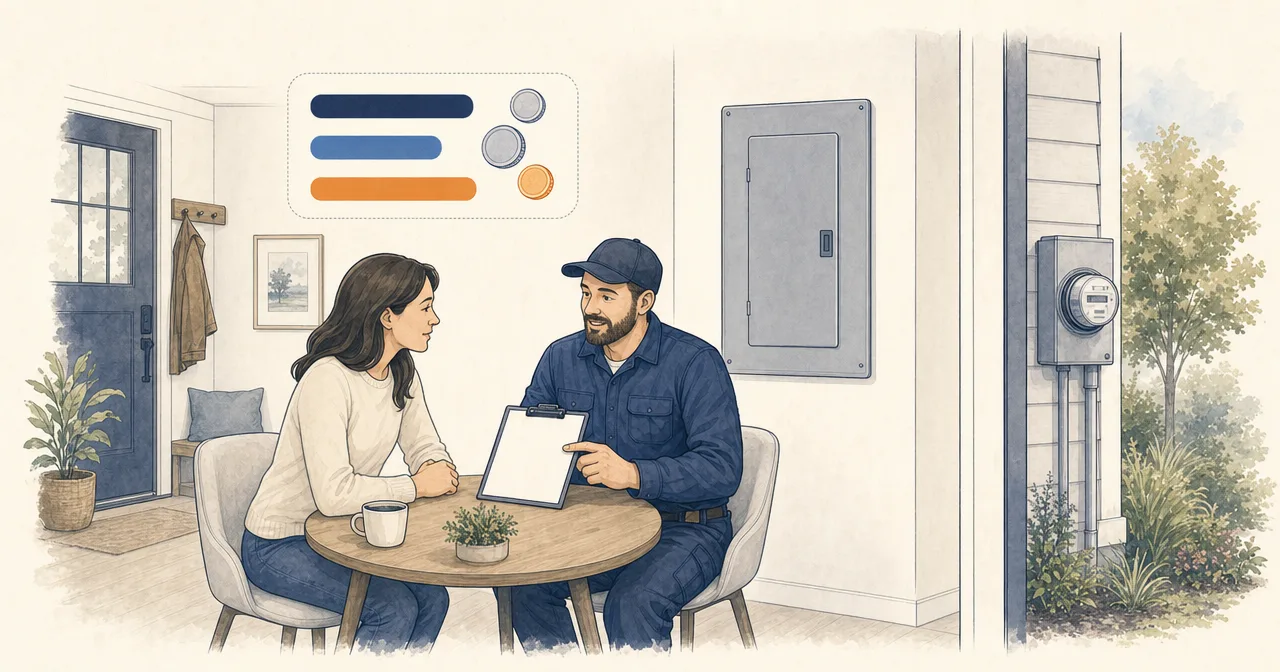
Electrical inspection cost is easy to misread because homeowners use the same phrase for several different visits. A general home inspection, an electrician's dedicated review, an installer assessment, and a permit final inspection answer different questions and carry different fees. We separate those scopes so you can budget the right visit before buying a home, correcting a safety concern, or planning an EV charger, heat pump, induction range, or other large electric load.
Last reviewed: September 23, 2026 (UTC)
This guide is informational, not electrical, code, or contractor advice. Electrical inspection and service work can expose people to serious shock and fire hazards. Use a licensed electrician for the private inspection and follow your local authority having jurisdiction (AHJ) for permits and final approval.
Electrical inspection cost at a glance
For a U.S. homeowner, plan on roughly $100 to $500 for a dedicated electrician inspection, with the final price tied to the scope below. A focused panel or service review sits toward the lower end. A written whole-home review, multiple panels, difficult access, or additional testing moves toward the upper end or above it.
| Visit or scope | Planning range or fee treatment | What the visit is for |
|---|---|---|
| Focused electrician review | About $100 to $200 | A limited look at the panel, service equipment, or a specific concern, with the exact components named in advance. |
| Dedicated whole-home electrical inspection | About $250 to $500 | A broader review of accessible electrical equipment, representative devices, visible wiring, safety concerns, and a written report. |
| Complex or expanded inspection | Often above $500 | Multiple panels, detached buildings, a large or difficult-to-access home, urgent scheduling, thermal imaging, or a deeper report can add time and fees. |
| General home inspection | Usually part of the whole-home inspection price | A visual electrical review included in a broader property inspection. A standalone electrician report usually costs extra. |
| Installer assessment | Often free, bundled, or credited | A project-specific visit used to design and price the install. The installer decides how much electrical assessment is included. |
| Permit or final inspection | Local permit and inspection fee | An AHJ's review of permitted new work. It is not a private pre-project condition report. |
Current market guides show why a single average is misleading. Angi's 2026 cost guide reports $75 to $500 overall, with standard inspections around $100 to $200 and full-home electrical inspections around $250 to $400. HomeAdvisor's 2026 guide lists a $100 to $400 normal range and about $150 on average. Thumbtack's 2026 data covers panel and fuse-box inspections and reports $217 to $663, with most people around $389. Treat these figures as planning ranges, not quotes. The different datasets use different scopes, so require the visit's components, report, exclusions, and add-ons in writing. The fee for the inspection is separate from the cost of correcting a hazard, replacing a panel, adding a circuit, or upgrading service.
One official example shows why permit fees belong in their own category. Tennessee's current electrical guidance lists final inspection fees from $35 to $90 for service sizes up to 1,000 amps, plus other permit, rough-in, reinspection, or service-release charges. That schedule is a Tennessee example, not a national estimate. Your AHJ sets the applicable fee and inspection sequence. The state guidance also requires a final inspection after the electrical installation is complete. Tennessee's permit page explains that public process.
What a dedicated electrical inspection covers
A dedicated electrical inspection is a paid review commissioned by the homeowner. Its purpose is to document the condition and visible risks of the home's electrical system, answer a defined question, and identify follow-up work. The exact scope belongs in the quote. Some electricians provide a short panel and service review. Others visit the whole home, inspect representative outlets and devices, review accessible wiring, and provide photographs and priorities.
The report may discuss:
- the service rating shown on the equipment and the main disconnect;
- the exterior meter and visible service entrance;
- the panel enclosure, breakers, spaces, labels, corrosion, damage, and signs of overheating;
- grounding and bonding observations;
- visible wiring methods and clues about older or altered work;
- representative receptacles, switches, lighting, GFCI and AFCI protection, where the agreed scope allows;
- dedicated circuits and equipment that matter to the proposed project; and
- hazards, limitations, and recommended next steps.
The report is a condition assessment. It does not automatically include a formal service load calculation, an engineering design, concealed-wiring investigation, repair estimate, permit application, or code certification. Ask for each item explicitly when it affects your project.
The InterNACHI electrical inspection standard lists service equipment, the meter and base, panels, overcurrent devices, grounding and bonding, representative devices, and GFCI and AFCI observations within a general home inspection scope. It also says a standard inspection is not required to determine system capacity, future conditions, code compliance, or repair costs. That distinction matters when you are deciding whether the house can support a new high-load appliance.
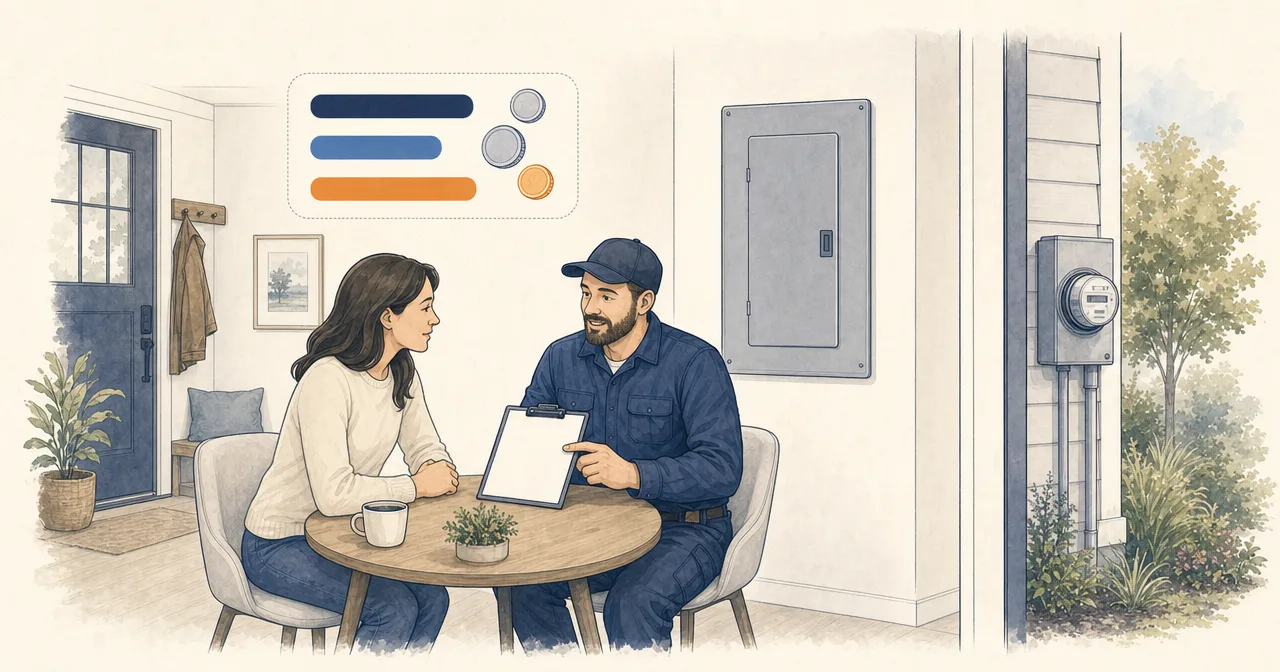
The electrician evaluates the equipment and prepares the report. The homeowner supplies project information and receives the findings. The homeowner does not open the panel or perform the inspection.
Dedicated electrician inspection versus the other visits
The word inspection can describe a private condition review or an approval step after work. Treat the four services below as separate line items when you compare quotes.
| Service | Main question it answers | What it usually does not answer |
|---|---|---|
| Dedicated electrician inspection | What visible electrical conditions, hazards, and project constraints should a homeowner understand before choosing repairs or electrification work? | It may not include a load calculation, engineering, concealed wiring, repairs, or permit handling unless the quote says so. |
| General home inspection | What readily accessible, visually observable conditions across the property should a buyer know about at the time of inspection? | It generally does not establish future capacity, suitability for a planned EV charger or heat pump, correction methods, or repair cost. |
| Installer assessment | Can this install fit the existing equipment, route, and proposed design, and what should the installer price? | It is not necessarily an independent baseline report, and it may focus on the installer's chosen solution rather than every reasonable option. |
| Permit or final inspection | Does permitted new work appear to match the adopted code, approved documents, and local inspection requirements? | It is not a survey of every old condition in the house and usually occurs after installation, not when you are comparing options. |
General home inspection
Standards from the American Society of Home Inspectors describe a home inspection as a review of readily accessible, visually observable installed systems at the time of inspection. The standard calls for a written report and recommendations or further evaluation, while excluding exhaustive testing, concealed conditions, and the methods or costs of corrections.
That scope can be enough for a broad purchase decision when the electrical system is ordinary, the report has no material findings, and you are not planning an immediate high-load change. It is a starting point when the report flags an old panel, amateur alterations, aluminum branch wiring, missing protection, ungrounded receptacles, damaged equipment, or limited access. A dedicated electrician can then answer the narrower safety, repair, or capacity question.
Installer assessment
An installer visit is often the fastest way to get a project quote. The installer may read the panel rating, count spaces, inspect the route to the equipment, ask for nameplates, and perform or arrange a load calculation. That visit is valuable when the installer states what was evaluated and includes the result in the proposal.
Treat it as project design rather than a universal electrical report. If two installers recommend different panel or service work, the useful next step is a written comparison of the existing service rating, current and planned loads, calculation method, circuit assumptions, and reasons for each recommendation. A separate electrician inspection can be worth the fee when the disagreement involves a safety issue or a large upgrade.
Permit or final inspection
The AHJ's inspection belongs to the permit process. It may include a rough inspection before wiring is concealed and a final inspection after devices, panel work, or equipment are complete. The inspector reviews the permitted work under the code and local process that apply to that project. The inspection fee may be paid through the permit, bundled by the contractor, or listed separately.
Do not treat a final approval as a private inspection of the entire home. It generally focuses on the new work. Put the permit number, inspection responsibility, correction visits, and final approval record in the installer quote. Watt Wallet's electrical panel permit guide covers the separate permit questions that arise when an electrification quote includes panel work.
When a dedicated inspection is worth paying for before electrification
A dedicated inspection is most useful when it can change the project decision. Consider one before accepting an electrification quote when:
- The service history is unknown. You do not know whether the panel, meter, service entrance, or branch circuits were replaced, permitted, or altered over time.
- The home is older or has visible modifications. Fuses, obsolete equipment, corrosion, damaged enclosures, mixed wiring methods, missing labels, or previous additions deserve a professional scope review.
- Several large loads are coming. An EV charger, heat pump, electric resistance backup, induction range, heat-pump water heater, dryer, pool equipment, solar, battery, or workshop can change the service question when planned together.
- The panel has room, but capacity is uncertain. Open breaker spaces show physical room. They do not prove that the service can support the planned load.
- A general inspection raised an electrical concern. Pay for the specialist who can evaluate the flagged condition and separate urgent safety work from optional modernization.
- Installer recommendations conflict. A second written evaluation can be less expensive than approving a panel or service upgrade that the home's load does not require, or delaying a repair that it does require.
- You are buying a home for immediate electrification. The general inspection may describe the existing condition without answering whether your selected equipment, circuit, and service plan fit.
You may not need a separate private inspection when the installer already provides a clear condition review, a written load calculation, the proposed circuit and service assumptions, and an itemized scope from a qualified professional. Ask whether those deliverables are included before paying twice for similar work. A permit final inspection still remains a separate approval step when the project requires a permit.
For panel and service decisions, use Watt Wallet's electrical panel upgrade guide to separate a same-size replacement, a capacity upgrade, a service change, and load management. For an EV charger, the EV charger permit guide helps keep the charger circuit, permit, and utility questions together.
What raises the electrical inspection cost
The price moves with the time and responsibility in the scope, not simply the square footage on a listing.
| Cost driver | Why it changes the quote |
|---|---|
| Home size, age, and layout | More rooms, older additions, finished areas, and longer travel between equipment increase the time needed to reach representative components. |
| Number and location of panels | A main panel, subpanel, detached garage, workshop, or outbuilding can create separate access and documentation needs. |
| Accessibility and safety | Stored items, locked areas, crawl spaces, height, weather, or unsafe equipment can limit the inspection or require more preparation. |
| Report depth | A short findings list costs less time than a photographed report with circuit notes, priorities, limitations, and project recommendations. |
| Additional testing or imaging | Thermal imaging, circuit tracing, or other tools may be useful for a specific question. They are add-ons, not proof that concealed wiring is safe. |
| Urgency and travel | Same-day scheduling, remote locations, or a return visit can add fees. |
| Project coordination | A load calculation, utility question, permit support, or design review belongs in its own line so you know whether it is included. |
Ask the electrician to price repairs and upgrades separately from the inspection. A low inspection fee can be reasonable when the visit is narrow. It can also leave you with a second paid visit when the quote never defined the report, access, or project question.
What the report should answer before an electrification quote
Use the report to make competing project quotes comparable. It should answer the questions below, or clearly mark them as outside the agreed scope.
| Report question | Why it matters |
|---|---|
| What service rating and main disconnect are visible? | The rating is a starting point for load planning. It does not by itself prove that a new appliance fits. |
| What panel equipment is present and in what condition? | Brand, model, age clues, corrosion, damage, breaker compatibility, labels, and available spaces can change the repair or replacement path. |
| What is visible at the meter and service entrance? | Damage, water intrusion, conductor condition, or utility-side questions may need a utility or service professional rather than an indoor panel quote. |
| What grounding, bonding, wiring, and protection concerns were observed? | Safety corrections can take priority over convenience upgrades. GFCI and AFCI observations should identify what was actually included and tested. |
| Which circuits and large loads were considered? | A useful electrification quote needs the existing equipment list, proposed equipment nameplates, voltage, breaker assumptions, and future loads that the homeowner has disclosed. |
| Was a formal load calculation completed? | A general inspection may not include one. The quote should identify the calculation method, loads included, proposed service rating, and who is responsible for the design. |
| Which findings are urgent, recommended, or optional? | This separates a safety repair from a panel replacement chosen for space, convenience, or future planning. |
| What was inaccessible or outside the scope? | A report should identify concealed wiring, locked areas, detached buildings, non-energized circuits, and equipment the professional did not evaluate. |
| What follow-up belongs in a separate quote? | Repairs, rewiring, panel work, service changes, engineering, permits, and utility work should not hide inside an inspection fee. |
An inspection report can support a project decision without promising that the final installation will be code-compliant. The installer, designer, permit applicant, AHJ, utility, and other responsible professionals each have a defined role in the final work.
How to compare electrical inspection quotes
Require each quote to state:
- the professional's license or registration information and the person who will perform the visit;
- the property areas, panels, outbuildings, meter or service equipment, and representative devices included;
- whether the visit is visual, functional, thermal, or another defined testing scope;
- whether the panel cover, dead front, or any other enclosure will be opened, and the safety conditions that control that decision;
- whether a written report, photographs, priorities, and limitations are included;
- whether a service load calculation, project design review, or utility coordination is included or excluded;
- the price of travel, thermal imaging, circuit tracing, additional panels, urgent scheduling, and reinspection;
- the expected report delivery time; and
- the fact that repairs, upgrades, permits, and final inspections are separate costs unless listed in detail.
Give the electrician the equipment information for the project, including the model or nameplate data when available. Ask the installer to use the same load list in the project quote. That simple handoff makes it easier to see whether a proposed panel or service change responds to a documented condition or only to an assumption.
Safety boundaries for homeowners
Homeowners can gather safe background information, describe symptoms, clear ordinary access to rooms, and share prior permits or reports. That preparation does not turn into an electrical inspection.
Do not remove a panel cover, reach into an enclosure, touch conductors, test live equipment, trace circuits, or decide that wiring is safe because a breaker is off. Service equipment can remain energized. A consumer checklist can help you describe a concern to a professional, but it cannot certify a system or replace the required inspection.
The CPSC's home electrical safety guidance treats arcing, sparks, overheating, buzzing, sizzling, and burning odors as warning signs that need a qualified response. If you see smoke, flames, or active arcing, move people away and call emergency services from a safe location. If a panel, outlet, or electrical equipment is hot, wet, damaged, or making unusual noise, keep clear and contact a licensed electrician or the utility when service-side equipment may be involved.
FAQ
Is $150 a reasonable electrical inspection cost?
It can be a reasonable planning number for a focused or standard visit. A dedicated whole-home report, multiple panels, difficult access, or additional testing can move the cost toward $250 to $500 or higher. The scope and report deliverables matter more than a single national average.
Is a general home inspection enough?
It can be enough for a broad purchase screen when the electrical portion has no material findings and you do not have an immediate high-load project. Get a dedicated electrician's review when you need a load, service, repair, or safety decision that the general report does not answer.
Should I get an electrical inspection before buying a home?
The general inspection is the normal first screen. A separate electrician is worth considering when the home is older, the service history is unclear, the general report flags electrical problems, or you plan an EV charger, heat pump, induction range, or other large load soon after closing.
Does an electrical inspection include repairs?
Usually no. The inspection identifies conditions and recommended next steps. Repairs, rewiring, panel replacement, service upgrades, permits, utility work, and final inspections should appear as separate scope and price lines. The same electrician may offer both services, which still makes the separation useful.
How long does a dedicated electrical inspection take?
A focused visit may take about an hour or two. A whole-home review can take longer when the property has multiple panels, outbuildings, limited access, or a detailed report requirement. The written quote should state the expected visit and report timing.
Can I perform my own electrical inspection and have it approved?
Do not perform the inspection yourself. You can provide project information and describe visible symptoms, while a licensed electrician handles the private evaluation. A permit or final inspection is performed under the local AHJ's process and is separate from a homeowner's review.
Bottom line
Budget about $100 to $500 for a dedicated electrician inspection, then match the price to the question you need answered. A general home inspection is a broad visual screen. An installer assessment supports a project quote. A permit final inspection approves permitted new work. None of those should be quietly substituted for another.
If an EV charger, heat pump, induction range, or service upgrade is driving the question, start with Watt Wallet's electrical panel upgrade guide, then bring the documented load and report questions to a licensed electrician.