Last reviewed: September 23, 2026 (UTC)
An electrical project is not finished when the new panel, outlet, charger, or appliance turns on. The closeout needs a local inspection result showing that permitted work was approved and a handoff record showing what you received. We separate what a homeowner can see from what belongs to an electrician or inspector, then walk through correction notes, safety red flags, and final-payment paperwork. Local rules and status labels vary, so the authority having jurisdiction, usually the building or electrical department, controls the final answer.
Final electrical inspection checklist at a glance
| Closeout step | Homeowner action | Record to keep |
|---|---|---|
| Permit scope | Match the permit number, address, permit holder, and described work to the project. | Issued permit and approved plans, when supplied. |
| Finished work | Walk every new device, fixture, panel, disconnect, and piece of equipment included in the scope. | Photos and written notes for anything incomplete or changed. |
| Visible safety | Look for installed cover plates, a closed panel, readable labels, clear access, and normal operation. | Photos of labels and finished work. |
| Professional checks | Ask the electrician or inspector which tests and code checks apply. Do not open equipment or perform trade testing. | Startup, testing, or inspection record supplied for the project. |
| Permit result | Read each inspection result, correction note, and reinspection entry. | Inspection history or official review report. |
| Final status | Confirm the local record uses its equivalent of final, approved, or closed. | Saved permit-status page or closure record. |
| Final payment | Compare the final invoice with the signed scope, changes, open items, and documents promised. | Itemized invoice, warranties, model records, and written punch list. |
What a final electrical inspection does
A final electrical inspection is a permit closeout inspection after the permitted electrical work is complete. The inspector compares the finished installation with the approved scope and the code requirements adopted by that jurisdiction. It is one point in the permit process, not a universal national checklist.
The 2024 IRC administration chapter describes final inspection as happening after permitted work is complete and before occupancy. It also describes written inspection findings and official approval records. The model code only becomes enforceable through local adoption, and local amendments can change the sequence or the required inspection names. The ICC code adoption resources explain why the code edition and local rules matter.
A final electrical inspection is also different from an independent home inspection. The permit inspection is an authority's review of permitted work against adopted requirements. A home inspection is a broader condition review for a buyer or owner. A passed permit inspection does not diagnose every unsafe condition in older wiring that was outside the permitted scope, and it does not settle a dispute about incomplete contract work.
Some projects have more than one final step. Portland’s residential inspection guide lists final electrical, final plumbing, final mechanical, final building, and final permit inspections as separate steps for certain residential projects. Its inspection process says the permit is not officially closed until the final permit step is approved. Treat that as a local example, not a national sequence.
The homeowner view and the professional view
The useful boundary is simple: you can document what is visible, accessible, and included in the handoff. The electrician or inspector must establish whether the installation meets code and whether concealed or energized parts are safe.
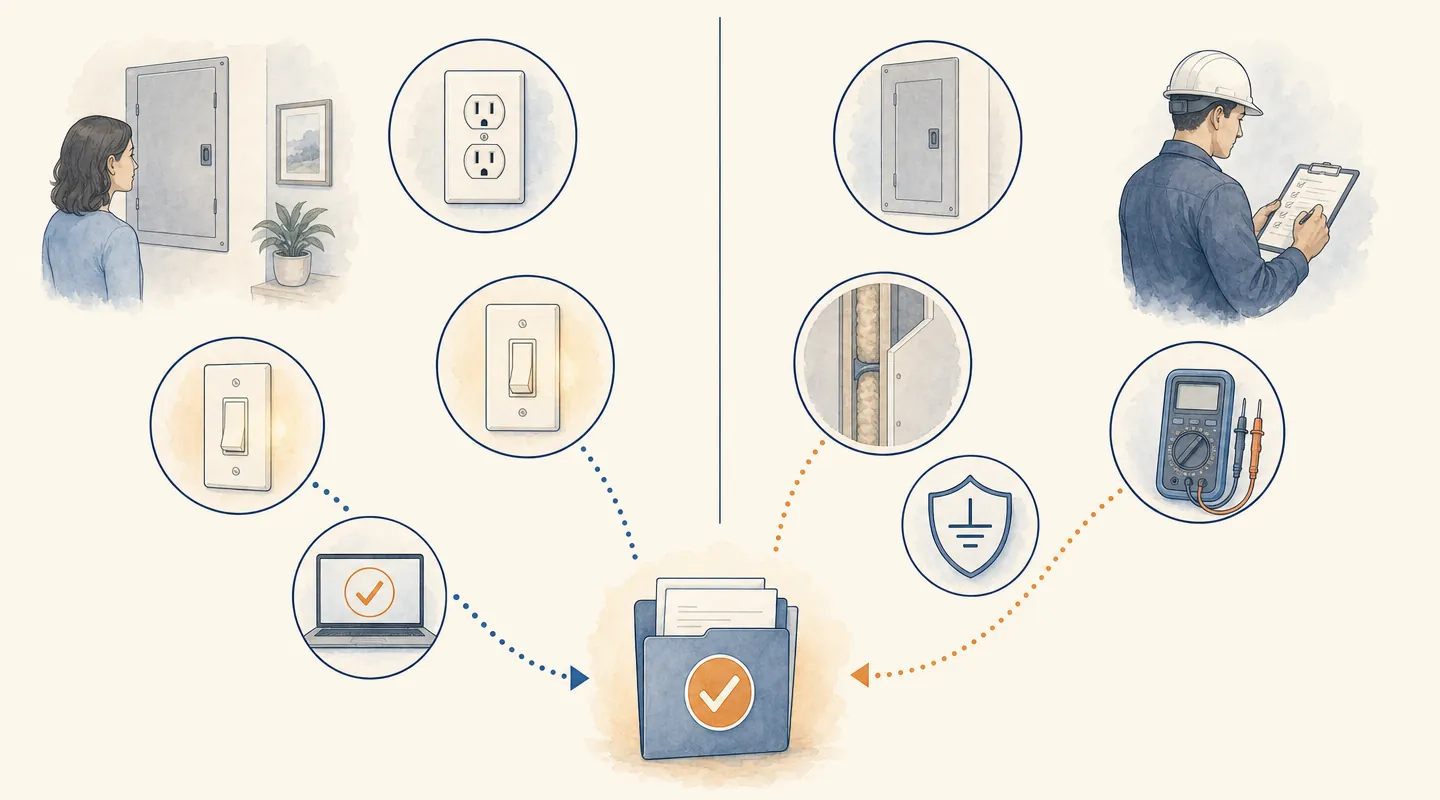
Simplified layout, not wiring instructions.
Homeowner-visible final electrical inspection checklist
Use the signed proposal, change orders, permit description, and equipment list as your walk-through documents. Walk the finished work without removing panel covers, opening junction boxes, or touching wiring.
1. Match the finished work to the written scope
Start with the parts that changed. Depending on the project, that may include a service panel, subpanel, feeder, new circuit, electric vehicle (EV) charger, heat-pump water heater, heating, ventilation, and air-conditioning (HVAC) disconnect, switches, receptacles, lighting, or appliance connection.
- The installed equipment and device locations match the signed scope or an approved change.
- Every promised device, cover, fixture, disconnect, and control is present.
- No box, opening, conduit end, or penetration is left unfinished or inaccessible.
- Any work that changed after the quote has a written explanation and price adjustment or change order.
If the project expanded into panel or service work, Watt Wallet’s electrical panel permit guide explains why that scope commonly brings permit and inspection steps with it.
2. Look at the finished devices and covers
From a safe standing position, look at each new switch, receptacle, fixture, and cover plate.
- Devices are mounted straight, secure, and flush with the finished surface.
- Cover plates are installed, uncracked, and free of gaps that expose the box.
- Outdoor devices have the covers and weather protection included in the scope.
- Fixtures, fans, and controls are complete rather than temporarily supported.
- The work area is free of loose parts, cut wire, packaging, and construction debris.
A finished appearance is not proof of code compliance. It is a fast way to identify work that is visibly incomplete before the crew leaves.
3. See that the panel and labels are ready for handoff
You can document the outside of the panel and the circuit directory without opening the enclosure.
- The panel door and cover are in place and close normally.
- The circuit directory is readable and describes the actual rooms or equipment served.
- Required labels, disconnect markings, and equipment identification are present where the project calls for them.
- The area in front of the panel and disconnects is clear enough for the electrician and inspector to work safely.
- The panel, meter equipment, or disconnect is not hidden behind stored items, new trim, or a locked door the inspector cannot access.
Do not remove the panel cover to look at breaker connections, bus bars, neutrals, grounds, or conductor sizes. Those are professional checks.
4. Operate normal homeowner controls
With the electrician present, operate the switches, lights, controls, and equipment included in the scope. The goal is to identify a missing function or an unusual condition, not to diagnose the installation.
- Lights turn on and off from the intended controls.
- Receptacles serve the intended equipment without loose plugs, unusual warmth, sparks, or noise.
- New equipment starts and stops in the expected way after the installer explains its normal sequence.
- A charger, heat-pump water heater, or other dedicated load responds as promised; the electrician demonstrates any disconnect operation.
- Required protective-device demonstrations are performed by the electrician when they belong to the scope. You can observe the result without opening the panel or using trade test equipment.
Record the room, device, setting, and symptom if something behaves differently from the written scope. A symptom is useful handoff information; it is not a diagnosis.
5. Photograph the handoff
Take photos of the closed panel, circuit directory, equipment nameplates, finished devices, and visible routes before tools and temporary labels disappear. Keep the photos with the permit record and invoice. They help future service professionals understand what changed and give you a dated record of the finish condition.
What the electrician or inspector must handle
Some of the most important final-inspection work is invisible from the room. A homeowner should request the result or record, rather than reproduce the procedure.
| Professional-only work | Why it stays professional |
|---|---|
| Concealed wiring, box fill, cable support, conductor protection, and inaccessible connections | These conditions may be behind walls, ceilings, or equipment and can require code judgment or opening finished work. |
| Conductor sizing and overcurrent protection | The relationship between the wire, breaker, equipment, and installation method is not established by a visual walk-through. |
| Grounding and bonding | Service and equipment grounding paths require inspection of connections and continuity that a homeowner should not access. |
| Terminations, torque, and enclosure condition | An electrician uses the applicable manufacturer and code requirements for energized equipment and connections. |
| Ground-fault circuit-interrupter (GFCI), arc-fault circuit-interrupter (AFCI), polarity, continuity, voltage, and other required tests | The applicable tests depend on the project, equipment, code edition, and local inspection practice. |
| Load calculations, service capacity, and utility coordination | A larger load or service change can affect the panel, service equipment, meter, and utility approval. |
| Code compliance and approved-scope decisions | The AHJ decides whether the work meets the adopted requirements and whether a revision is needed. |
Rough or cover inspections may handle wiring before it is concealed. A final inspection usually focuses on completed devices, equipment, access, labels, and required final tests. If a required earlier inspection was skipped, the authority may require access to concealed work before the permit can close.
How to verify the permit and inspection record
The permit record is the closeout evidence. A contractor’s statement that the inspection “went fine” does not tell you whether the result was approved, whether corrections remain open, or whether the permit itself is closed.
- Start with the permit number. Match the permit to the property address, permit holder, contractor, and described electrical scope. If the contractor gives you several numbers, list each electrical, service, combination, or related trade permit that applies.
- Read the required inspection types. The local portal or permit card may list rough, cover, service, feeder, final electrical, or a final permit step. Seattle says most of its electrical permits require cover, service, and final inspections, while Portland uses its own inspection codes and sequence. These are local examples of why the permit record matters.
- Read the result for each inspection. Distinguish a passed or approved result from a scheduled appointment, an inspection request, a partial result, a failed result, or an entry that says the inspector could not access the work.
- Read every correction note. Note the location, deficiency, responsible party, and required next action. A later pass should be tied to the correction or reinspection entry that resolved the issue.
- Find the final permit status. The local equivalent may be
Final,Closed,Approved, or another label. Portland’s status guide definesFinalas approval of all final inspections. Do not treat that label as universal, and do not treatIssuedorUnder Inspectionas closed. - Save the record. Download the inspection history or review report, save the status page as a PDF, and keep it with the invoice, photos, and warranty records. If the portal shows inspector notes, save those too.
Seattle’s electrical inspection page tells homeowners where to find inspection results and notes in its permit portal. Portland’s permit status guide shows how a local system separates permit status from individual activity entries. Use your own permitting authority’s portal and terminology for the project record.
How to handle correction notes
A correction note is a written closeout task. Treat it as a trackable item, not as an informal comment that disappears when the electrician leaves.
For each note, keep four pieces of information:
- the exact wording or a clear copy of the official note;
- the location and equipment involved;
- the correction the electrician says was made; and
- the date and result of the reinspection or updated review.
If the installed work differs from the approved plans, the authority may require a revision rather than a field fix. Portland says plan changes can go through another review and inspection process. Keep the approved revision with the permit record.
Do not let a correction be covered or concealed again until the authority has authorized the next step. The IRC inspection provisions describe approval before work moves past an inspection point, although the local department controls how that rule is administered.
A complete correction trail should end with an updated result that says the relevant inspection passed or was approved. If the portal still shows an open correction, a pending reinspection, or an unclear status, keep the item on the written punch list and name the person responsible for closing it.
What to collect before final payment
Final payment should follow the written contract and applicable local rules. There is no national payment schedule that turns a passed inspection into proof that every contract item is complete. Keep the permit closeout and the contractor handoff together.
| Document | What it should show |
|---|---|
| Issued permit and approved plans | Permit number, property, scope, permit holder, and the work approved for installation. |
| Inspection history | Required inspection types, dates, results, inspector notes, and correction entries. |
| Final or closed status | The local record’s equivalent of a completed permit, with any related final permit step included. |
| Correction and reinspection record | Each correction resolved and the authority’s updated approval. |
| Itemized final invoice | Labor, equipment, electrical work, permits, utility charges, credits, taxes, and balance due. |
| Signed scope and change orders | The agreed work, approved additions, substitutions, and price changes. |
| Equipment records | Make, model, serial number, manuals, warranty terms, and registration information. |
| Panel and circuit records | Final circuit directory, equipment labels, disconnect information, and service documentation when applicable. |
| Photos and visible handoff notes | Finished devices, closed equipment, labels, model plates, and any agreed punch-list item. |
If the work involves an electrical panel replacement, keep the panel record separate from the broader price question. Watt Wallet’s panel replacement cost guide can help you organize panel, labor, service, and permit lines. If the project changes service capacity, our 200-amp service cost guide covers the larger scope that can sit behind a simple “panel upgrade” label.
When a document, inspection, registration, or repair is still open, put the status, owner, due date, and payment treatment in writing before the final payment step. Follow the contract rather than inventing an arbitrary holdback, and do not sign a completion statement that conflicts with the open punch list.
Safety red flags that stop the walkthrough
Safety concerns outrank the paperwork. Do not open a panel, remove a cover, touch a conductor, or troubleshoot an energized device to investigate a warning sign.
| Red flag | Safe response |
|---|---|
| Smoke, active arcing, fire, or a strong burning smell | Leave the area and call emergency services. Do not re-enter until responders say it is safe. |
| Shock or tingling from a device, appliance, switch, or metal surface | Stop touching it. Move people away and call a licensed electrician. If it can be done without contact with the hazard, stop using the affected circuit or device. |
| Hot, discolored, melted, buzzing, sparking, or flickering outlet or switch | Stop using the affected device or circuit if safe and arrange an electrician’s assessment. Do not remove the plate or panel cover. |
| Repeated breaker trips or a breaker that will not reset normally | Leave the circuit off and call an electrician. Do not install a larger breaker or repeatedly reset it. |
| Missing panel cover, exposed wiring, open box, or damaged insulation | Keep clear of the area and contact the electrician. Treat the work as unfinished and unsafe to use. |
| A permit record that is missing, still open, or inconsistent with the work | Pause the closeout conversation, keep the status in writing, and request the responsible contractor’s plan for inspection or correction. |
The U.S. Consumer Product Safety Commission (CPSC) home electrical safety checklist identifies warm or improperly operating outlets and switches as warning signs that need an electrician’s attention. Its home wiring hazards guide also explains why damaged cords, exposed wires, and overheating conditions can create shock or fire risks.
Frequently asked questions
What does a final electrical inspection consist of?
It usually covers the completed electrical scope, installed devices and cover plates, panel and equipment access, circuit identification, required protective devices, grounding and bonding, and the tests or code reviews that apply to the project. The exact checklist depends on the jurisdiction, adopted code edition, permit type, and scope. A homeowner can document visible completion and normal operation; the electrician and inspector handle concealed-work review, energized testing, and code decisions.
Is an electrical final inspection the same as a final permit inspection?
Not always. Some jurisdictions use a final electrical inspection as the trade approval and a separate final permit or building inspection to close the overall permit. Portland is one example of a local process with separate final trade inspections and a final permit step. Your local portal may use different names or combine them.
What happens if the final electrical inspection fails?
The inspection record should identify the correction, incomplete work, access problem, or code issue. The responsible professional corrects the work, and the authority records a reinspection or updated result. Keep the original note and the later approval together. A failed final is a closeout delay, not permission to conceal the work or treat the permit as closed.
How do I verify that an electrical inspection passed?
Use the permit number to open the local permitting record. Read the inspection history, find the final electrical result, read the correction notes, and identify the local equivalent of final, approved, or closed. Save the result. A scheduled inspection or contractor message is not the same record as an approved result.
Can a homeowner do the final electrical inspection?
A homeowner can perform the visible walk-through and assemble the paperwork. The authority’s inspector or an approved inspection professional determines whether permitted work meets the applicable requirements. Owner-permit rules vary, and a homeowner should never open energized equipment or substitute a personal walk-through for the required inspection.
Does every electrical project need a final inspection?
No single national rule covers every project. A small like-for-like repair may follow a different local path from a new circuit, panel replacement, service upgrade, EV charger, remodel, or equipment installation. The permit description and local authority determine which inspections apply. Watt Wallet’s electrical panel permit guide covers the common permit path for panel and service work.
What should I have before I pay the electrician in full?
Have the applicable permit and inspection record, correction and reinspection history, final or closed status, itemized invoice, signed changes, equipment and warranty records, final labels or circuit directory, and a written list of any remaining work. If electrical work is part of a larger HVAC project, Watt Wallet’s HVAC contractor questions can help you carry permit and handoff requirements into that scope. For a mini-split project, use the mini-split permit guide as a companion to the electrical closeout.
Save this checklist with your permit folder and use it at the final walkthrough before you release the last payment.