Last reviewed: October 30, 2026 (UTC)
What is an AFCI breaker?
An arc-fault circuit-interrupter (AFCI) breaker is a circuit breaker that detects electrical patterns associated with hazardous arcing and interrupts power when its detection criteria are met. It combines that arc-fault function with the overload and short-circuit protection expected of a household branch-circuit breaker.
Its purpose is to reduce the chance that an arc ignites nearby material. An arc is an electrical discharge across a gap. Damaged insulation, a broken conductor, or a deteriorated connection can create conditions for dangerous arcing. The U.S. Consumer Product Safety Commission (CPSC) explains in its AFCI safety guidance that ordinary fuses and breakers may not respond to early arcing conditions.
A branch circuit supplies lights, receptacles, or equipment after its final overcurrent protective device, usually a breaker. An AFCI breaker protects its connected branch circuit; one AFCI does not automatically protect every circuit in the house.
At Watt Wallet, we separate circuit protection from electrical capacity when planning upgrades. Our electrical panel guide explains that broader equipment picture. Adding arc-fault protection does not increase the amount of power a circuit or service can safely supply.
AFCI breaker vs. regular breaker
A regular circuit breaker responds to excess current. An overload occurs when the connected loads demand more current than the circuit is intended to carry. A short circuit creates an unintended low-resistance path that can allow a much larger current to flow.
An arcing fault can behave differently. Its current may stay below the level needed to operate ordinary overcurrent protection, or arrive in intermittent bursts. An AFCI adds electronic detection of arc-related electrical characteristics.
| Protection function | Regular household breaker | AFCI circuit breaker |
|---|---|---|
| Overload protection | Yes | Yes |
| Short-circuit protection | Yes | Yes |
| Detection of hazardous arc signatures | No dedicated AFCI function | Yes, within the device's listed capabilities |
| Personnel ground-fault protection | No | Only when also marked for personnel ground-fault protection |
This explains why “the breaker never tripped” does not establish that a damaged cord or connection is safe. It also explains why a trip from an AFCI breaker does not, by itself, prove that an arc occurred. Its ordinary overcurrent protection can operate too.
Series and parallel arcs
Two terms describe where an unwanted arc occurs:
- Series arc: the arc bridges a gap along one conductor or connection, in the normal path supplying a load. A partly broken cord conductor is one possible example. The connected load limits the current, so the hazard need not look like an overload.
- Parallel arc: the arc crosses between different electrical paths, such as an energized conductor and neutral or ground, after insulation is damaged. The event can be intermittent even when substantial current is available.
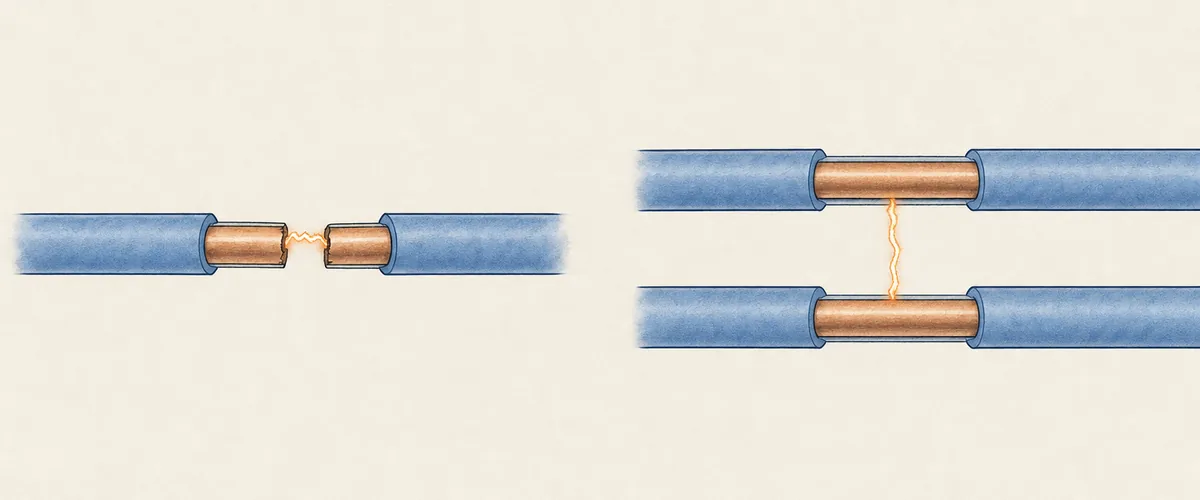
Simplified layout, not wiring instructions.
UL's arc-fault research report, page 6, explains these differences and why a conventional breaker may not interrupt some arcing conditions. AFCI detection concerns the electrical behavior of the fault. It does not sense smoke or inspect a cord for damage.
The labels that matter
Combination-type AFCI means arc-fault protection covering series and parallel arcing. “Combination” does not mean that ground-fault shock protection is included.
A ground-fault circuit interrupter (GFCI) detects current escaping its intended return path and helps protect people against electric shock. A dual-function AFCI/GFCI breaker combines arc-fault protection with personnel GFCI protection. Our AFCI vs. GFCI guide explains that distinction in more detail.
The ampere number, button color, and presence of a button are insufficient to identify all of a device's functions. Different product families use different markings and controls. A GFCI breaker can also have a TEST button.
Visible labels, installation records, and the exact model's documentation are the useful starting points. Some identifying information is hidden behind the panel's protective cover. Do not remove that cover to find it. When the panel is dry, intact, safely accessible, and free of warning signs, a photo of markings already visible at its normal operating face can help an electrician identify the device. Missing information can remain unknown until the professional visit.
How routine AFCI testing works
Routine testing exercises the device's protective operation. For push-to-test AFCIs, the built-in TEST control introduces a simulated arc signal intended to operate the detection circuitry and trip mechanism. UL describes that function in its circuit-breaker marking guide.
There is no single control sequence for every AFCI. Some current designs use handle operation and internal-test status indications rather than the push-button sequence used by other models. Reset movements, indicator meanings, and preparation requirements also vary.
The Electrical Safety Foundation International recommends monthly AFCI testing. The exact model's instructions govern its routine procedure and expected response. A licensed electrician can identify the model and demonstrate its normal homeowner operation without exposing energized parts.
Routine care has several practical limits:
- Power interruption is intentional. A routine test can shut off everything on that branch circuit. Medical equipment and other essential loads need an appropriate continuity plan before a planned interruption.
- Safe access comes first. Wet equipment, damage, unusual sounds, burning odors, or exposed electrical parts rule out normal homeowner operation. Keep away and obtain qualified help.
- A failed prescribed test needs service. Stop using the affected circuit and arrange an electrician's evaluation. Do not keep cycling the device or improvise a different test.
- A plug-in indicator is different. It is not a universal substitute for the AFCI's own prescribed test. UL's AFCI indicator guidance explains that an external indicator can fail to trip a functioning AFCI.
Three observations that answer different questions
A label, a successful test, and a trip are three different pieces of information. Treating any one of them as a complete circuit assessment can lead to the wrong repair.
| Observation | What it tells you | What it does not establish |
|---|---|---|
| The device is identified as an AFCI | It has a specified arc-fault protection function | That it also provides personnel GFCI protection or protects other circuits |
| The model's prescribed routine test succeeds | The device produces the expected test response | That all wiring, connections, and appliances are sound |
| The breaker trips during everyday use | A protective function has interrupted the circuit | Which function operated, where the problem is, or whether the breaker needs replacement |
A successful routine test does not make a visibly damaged cord safe to use.
When an electrician should assess the circuit
Professional assessment is warranted for repeated or unexplained trips, failure to reset, a failed prescribed test, or a model-specific indication that protection is compromised. These are reasons for diagnosis before choosing a replacement breaker.
Other warning signs include burning odors, scorch marks, unusual buzzing or sizzling, flickering lights, sparks, damaged insulation, and suspected overheating. The CPSC identifies these in its home wiring warnings. Do not touch equipment to judge its temperature, recreate a fault, or approach wet electrical equipment.
For smoke, flame, or suspected fire, follow your fire escape plan and call 911 from safety. Our conservative advice for active arcing is also to keep away and call 911 from safety. Suspected electric shock or injury requires emergency medical help first. Do not touch someone still in contact with an electrical source. The CDC's electrical shock guidance explains that touching the person can pass current through you.
For a non-emergency visit, share observations already available. Repeated or unexplained trips should remain off pending qualified evaluation. Our AFCI breaker tripping guide covers those situations and the limits on any ordinary reset.
Do not bypass AFCI protection, substitute a regular breaker to stop trips, or increase the amperage. Installation, replacement, and circuit diagnosis belong to a qualified licensed electrician. Panel interiors can remain energized even with the main breaker off.
Adding or replacing AFCI protection
Older homes with conventional breakers can benefit from added arc-fault protection. The CPSC recommends qualified installation because the work involves the electrical panel. AFCI protection also exists in receptacle form, but a receptacle is not automatically equivalent to a breaker for every circuit arrangement.
Requirements depend on the locally adopted electrical code and project scope. A licensed electrician and the local electrical authority establish the project's requirements.
Selecting equipment is also more involved than matching the ampere number. The panel's approved breaker types, circuit design, voltage, and device ratings matter. Physical fit alone does not establish compatibility. A new breaker also cannot repair a damaged cable or failing appliance.
A useful written scope distinguishes repairing a fault, adding protection, and increasing capacity.
For an upgrade or inspection finding, have a licensed electrician document the affected circuit and the required repair or protection before approving the work.