Last reviewed: October 27, 2026 (Pacific Time)
Stop first for fire, shock, or electrical warning signs
Smoke, fire, or active arcing
For smoke, flame, or a suspected developing fire, follow your building's fire escape plan and call 911 from safety. Do not delay to reset the breaker or investigate. Once outside, stay outside. The U.S. Fire Administration's fire escape guidance addresses escaping a fire and situations where an exit is blocked or someone is trapped.
At Watt Wallet, our conservative emergency advice for active arcing, even without visible fire, is to keep away, not touch the equipment or reset the breaker, and call 911 from safety. Do not approach suspect equipment, investigate, or try to stop the arcing yourself.
Suspected electric shock or injury
If someone may have received an electric shock, call 911 or emergency medical help. Do not touch a person who is still in contact with the electrical source. Follow the emergency dispatcher's instructions. An electrician's service call does not replace medical help, even if the breaker has tripped or the person describes only a tingling sensation. This follows the CDC's electrical shock guidance.
Equipment warning signs without a fire or injury
A burning odor, sparks, unusual buzzing or crackling, heat, scorch marks, damaged cords, or exposed electrical parts call for stopping use and urgent qualified electrical help. Leave an already-tripped circuit off. Do not reset it, touch suspect equipment, or feel outlets and breakers to judge their temperature. These are among the CPSC's home wiring warnings.
For water at electrical equipment, keep away. Do not operate wet equipment or enter standing water to reach a switch. Wet equipment needs a qualified electrician's inspection before power is restored; drying alone is insufficient. The CDC's water exposure precautions explain these limits.
Repeated trips, failure to reset, or a failed manufacturer-prescribed test also mean stop re-energizing the affected circuit and arrange an electrician's evaluation. You do not need another trip to justify calling.
Why an AFCI breaker can trip
AFCI means arc-fault circuit interrupter. Arcing is an electrical discharge across a gap, such as at a damaged connection. An AFCI detects electrical characteristics associated with dangerous arcing. Its purpose is to reduce arcing-related fire risk, as the CPSC's AFCI safety guidance explains.
An AFCI circuit breaker also provides overload and short-circuit protection. Schneider's combination-type AFCI breakers detect series and parallel arcs. Its QO, QOB, and HOM dual-function AFCI/GFCI breakers add GFCI, or ground-fault circuit interrupter, protection against ground-fault shock hazards.
That gives a tripping breaker several possible explanations:
- Arcing or damaged equipment. A damaged cable, loose connection, worn cord, or fault inside an appliance can require repair.
- Overload or short circuit. Excess current can operate the breaker's ordinary overcurrent protection, even without an arc-fault detection event.
- Wiring or installation problems. Incorrect connections or a neutral arrangement that does not suit the breaker can cause trips. The neutral is a circuit's normal return conductor; diagnosing it is professional work.
- Ground-fault conditions. A dual-function breaker may interrupt leakage current rather than an arc. Some AFCI models also have ground-related detection that is different from personnel GFCI protection.
- Device interaction or a breaker problem. Some appliance electrical signatures can be misinterpreted by AFCI electronics. A breaker fault is also possible. The trip alone establishes neither cause, and the possibility of an interaction does not establish that a trip is harmless.
Schneider's QO/QOB breaker instructions distinguish their ground-related detection from personnel GFCI protection and exclude shared-neutral use for that breaker family. These product limits are reasons to leave neutral evaluation to an electrician.
The handle's tripped position does not identify which protection function operated. Our AFCI vs. GFCI guide explains the labels, including why “combination AFCI” does not mean AFCI plus GFCI.
What you can safely do without troubleshooting wiring
Preserve what you already observed
Record the circumstances of trips that already happened. Do not repeatedly start an appliance, operate a switch, or reset a breaker to recreate the problem.
If the panel is dry, intact, safely accessible, and free of warning signs, you can read labels and the circuit directory at its normal operating face. Keep the screwed protective cover installed. Do not expose wiring to find a hidden model number. A safely taken photo of visible labels or an already-visible indicator is enough for the initial call.
Our electrical panel guide explains these exterior observations. Panel interiors can remain energized even with the main breaker off, so turning off the main does not make cover removal a homeowner task.
Stop using a suspect appliance
Ordinary unplugging is limited to accessible, dry, undamaged cord-and-plug equipment. Do not handle something hot, sparking, wet, scorched, or otherwise suspect. Keep an appliance associated with trips out of service for professional evaluation.
Do not move it to another outlet to see whether it works there. Different protection and circuit conditions can change the result without establishing that the appliance is safe.
Limit any ordinary reset
Our advice is at most one ordinary reset for a single apparent-overload trip, only after safely reducing the obvious excess load and with no warning signs. Repeated or unexplained trips stay off for a qualified electrician's diagnosis.
Reduce that load first, using only normal switching off or unplugging of accessible, dry, undamaged cord-and-plug equipment. If this requires troubleshooting or handling suspect equipment, leave the circuit off for qualified help. The CPSC's reset safety guidance places correction of the overload before resetting.
That limited reset depends on safe access and the exact model's normal operating instructions. Those instructions may require moving the handle fully OFF before ON. Do not force a handle, hold it on, or press and hold TEST as an improvised reset procedure.
If the breaker will not reset or trips again, leave it off and arrange service. A reset that holds does not certify the wiring or equipment as safe.
What common trip patterns mean
The pattern helps an electrician choose an investigation. It does not identify a repair by itself.
It trips immediately or will not reset
An immediate trip can involve a short circuit, wiring or connected-equipment fault, an installation issue, or the breaker itself. Some devices also prevent resetting when their protection is compromised, including the reset lockout described in Leviton's AFCI instruction sheet.
Report whether the handle would not latch or it latched and then tripped. Do not force it or continue cycling it. The circuit needs diagnosis before another attempt to restore power.
It trips with “nothing plugged in”
Unplugging accessible appliances does not necessarily unload a circuit. Ceiling lights, fans, hardwired equipment, and appliances at hidden receptacles may still be connected. A circuit directory can also be incomplete or inaccurate.
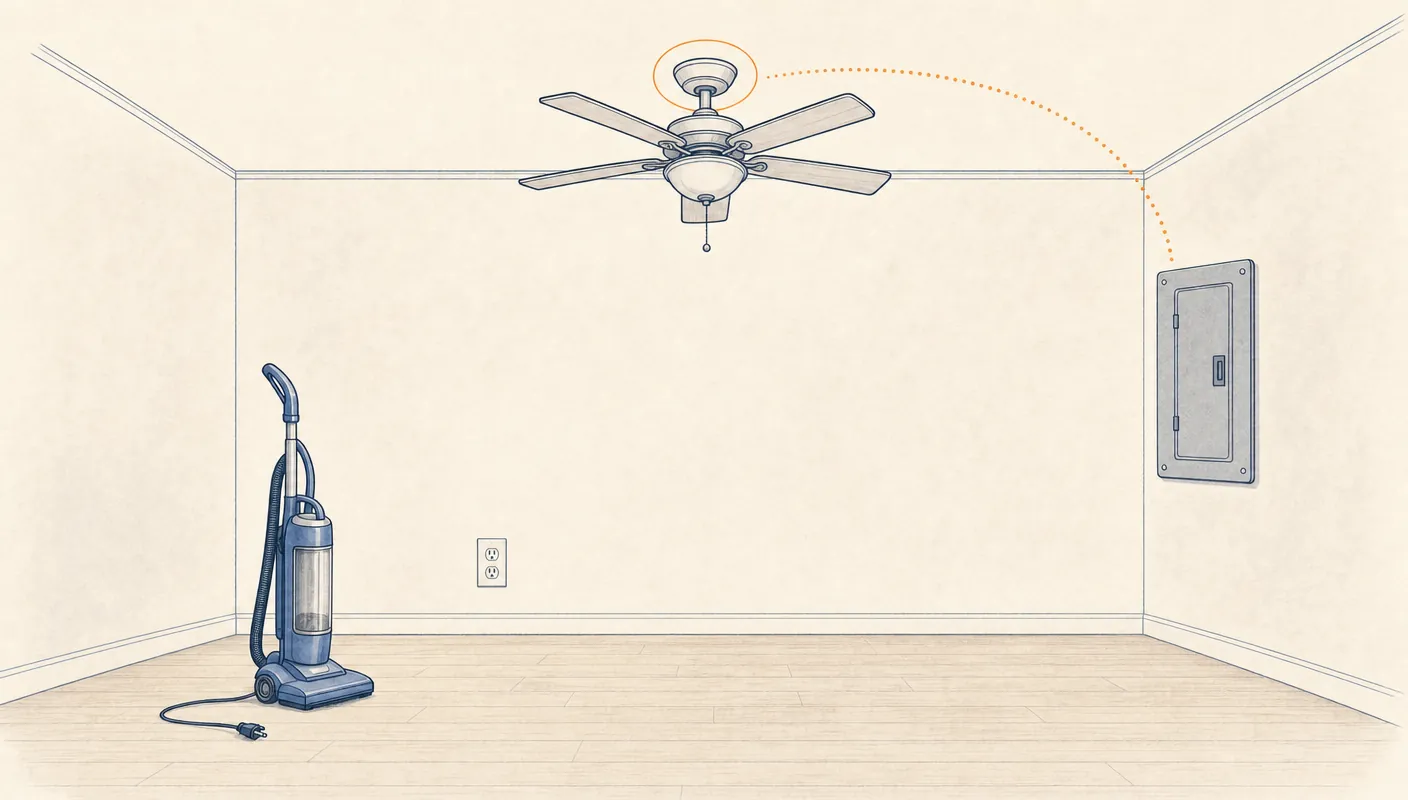
Simplified layout, not wiring instructions.
A trip under those circumstances leaves several possibilities, including fixed equipment, wiring, installation, and breaker problems. It does not prove there is an arc inside a wall or that the breaker is defective.
Tell the electrician exactly what was unplugged and what remains unknown. Leave fixed equipment connected for professional investigation; do not disconnect fixtures or open outlet boxes.
It trips when a vacuum, treadmill, or other appliance starts
The appliance, cord, receptacle connection, circuit loading, or an electrical-signature interaction may be involved. “The vacuum started just before the trip” is an observation. “The vacuum is harmless and the breaker is oversensitive” is a diagnosis that the observation cannot support.
Keep the suspect appliance out of service. A qualified electrician can coordinate with the breaker manufacturer or qualified appliance service when needed. Buying a new breaker or a surge protector first can leave the actual fault unresolved.
It trips after several devices run, or apparently at random
Several large loads running together raise an overload question. The CPSC lists frequent breaker resets among home wiring warning signs. Delayed trips can also involve equipment or connections whose condition changes during use.
For a seemingly random trip, record time and activity rather than assuming nothing was running. Automatic equipment may cycle without someone switching it on. Note any relationship to lighting, weather, or other devices, but do not create a repeat event to confirm the relationship.
It began after electrical work, a new appliance, or water exposure
Include the change in the service request: a fixture or dimmer replacement, remodel, panel work, new appliance, leak, or storm. A new breaker can reveal an existing circuit issue, have an installation problem, or interact with connected equipment. “It is new” does not rule out any of those categories.
If more than one breaker tripped, report which ones and whether they operated together. That may change the scope of the electrician's investigation. It does not establish that every breaker needs replacement.
Indicator lights are model-specific clues
A visible light or blink pattern can help the electrician, but there is no universal AFCI color, flash-count, or timing chart. Meanings differ by product family and revision. On some models, no illuminated indicator can accompany an overload or short circuit; Schneider's QO/QOB instruction bulletin is one example. Darkness is not a safety clearance.
Record an indication only when it is already safely visible. Do not reset solely to retrieve it, clear stored fault information, or use another brand's chart.
An ordinary trip that happens immediately or several seconds after resetting is also different from a controlled manufacturer diagnostic sequence. Some professional procedures deliberately use the TEST button and measured timing on specified devices, as in Schneider's Time Saver Diagnostics. Timing an everyday trip does not produce the same diagnostic result.
Routine manufacturer-prescribed testing and fault diagnosis have different purposes. If a prescribed test has failed, stop using the affected circuit and arrange qualified service. Even a successful device test does not establish that concealed wiring and connected appliances are sound.
Give the electrician observations, unknowns, and actions
A useful service request includes:
- Device and circuit: visible breaker brand, model or markings, amperage, circuit-directory description, and affected rooms.
- Event: date, time, whether the trip was immediate or delayed, and one breaker or several.
- Equipment: what was operating or had just started, with appliance make and model when available.
- Changes and warning signs: recent work, new equipment, water exposure, odors, sounds, visible damage, or flickering.
- Unknowns: hidden receptacles, hardwired loads, incomplete labels, or an indicator you could not safely read.
- Actions already taken: what was safely unplugged, any ordinary reset already attempted, and whether the circuit remains off.
For example, a homeowner's message might say:
The breaker labeled “bedroom” tripped when the vacuum started on Tuesday evening. I left the vacuum out of service, but I do not know whether the ceiling fan is on that circuit. The breaker is still off, and I have not tried to recreate the trip.
That message preserves a lead without declaring the appliance or wiring responsible. If there was suspected shock or injury, emergency medical help comes first; this service request is for the equipment afterward.
The electrician's evaluation may include identifying the protection that operated, mapping the circuit, assessing loads and connections, evaluating neutral arrangements, and reviewing the breaker's condition and listed compatibility. These are professional diagnostic tasks, not a homeowner sequence.
A quote should distinguish diagnostic time, the proposed repair, and any further investigation. A general condition inspection is a different scope from locating an intermittent AFCI fault. Neither automatically includes concealed wiring investigation or repairs.
Keep the protection until the cause is resolved
Do not bypass AFCI protection, substitute a standard or GFCI-only breaker to silence trips, increase the amperage, or choose another breaker just because it physically fits. The appropriate device depends on the panel's listing, circuit design, and locally adopted requirements. A qualified electrician must establish the cause and suitable remedy.
Repeated AFCI trips alone do not establish that you need a larger electrical service, panel replacement, or whole-house rewiring. Those projects need their own evidence. The immediate job is diagnosing the affected circuit while keeping its required protection intact.
For recurring trips, arrange a licensed electrician's diagnostic visit and bring your trip record. Our electrical inspection cost guide helps you distinguish service scopes and budget for the evaluation before committing to broader work.