
AFCI and GFCI devices often appear in the same electrical conversation, so their labels are easy to mix up. The protection starts with two different failure patterns: unwanted arcing can create heat and fire, while current that leaves its intended path can injure a person. We explain the difference in plain language, show how breakers and receptacles fit in, and outline the safety and code questions to take to an electrician.
Last reviewed: 2026-09-24 (UTC)
AFCI vs. GFCI at a glance
AFCI means arc-fault circuit interrupter. GFCI means ground-fault circuit interrupter. GFI is a common shortened name for GFCI.
| Protection | Main risk it addresses | What it detects | What it does not replace |
|---|---|---|---|
| AFCI | Fire caused by qualifying unintended arcing | Electrical characteristics associated with dangerous series or parallel arcs | GFCI protection, sound wiring, smoke alarms, or correctly sized overcurrent protection |
| GFCI | Severe shock or electrocution from leakage current | An imbalance between current leaving and returning on the intended path | AFCI protection, sound wiring, or every form of shock and overload protection |
The short answer is simple: AFCI protection addresses arc-fault fire risk. GFCI protection addresses ground-fault shock risk. They are not interchangeable. A circuit may need both functions, either through separate listed devices or through a listed dual-function AFCI/GFCI device. The exact choice depends on the circuit, equipment, adopted electrical code, and local authority having jurisdiction.
Start with the fault, not the device shape
The words arc fault and ground fault describe different electrical conditions. They can occur in the same general system, and one physical fault can involve more than one hazard, but AFCI and GFCI electronics look for different signals.
What is an arc fault?
An arc fault is unwanted electrical arcing. A damaged conductor, loose connection, crushed cord, or stressed device can create an arc that produces heat near combustible material.
A series arc interrupts the intended path in series with a load. A parallel arc creates an unintended path between conductors of different potential, such as line-to-line, line-to-neutral, or line-to-ground. An ordinary overcurrent breaker responds to sustained overloads and short circuits. A lower-current or intermittent arc can be a different condition, which is why AFCIs use electronic detection to recognize characteristics associated with hazardous arcing and interrupt the circuit.
The U.S. Consumer Product Safety Commission's AFCI fact sheet describes AFCIs as enhanced protection against fires that result from arcing and sparking. An AFCI reduces a defined fire hazard when it is correctly listed, installed, and working. It does not guarantee that every electrical fire will be prevented or prove that concealed wiring is in good condition.
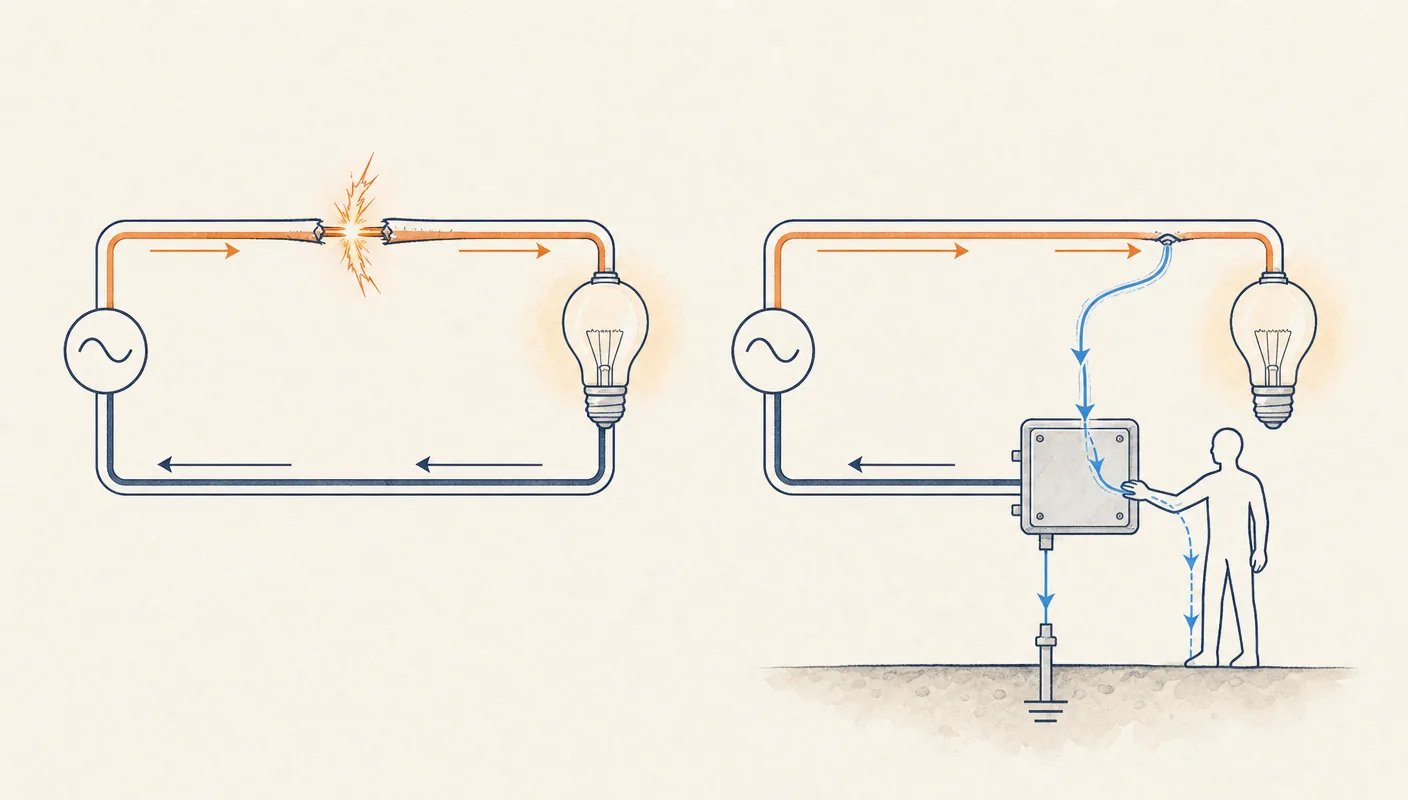
Simplified layout, not wiring instructions.
What is a ground fault?
A ground fault occurs when current leaves its intended circuit path and finds another path to ground. That path can include a metal enclosure, wet surface, damaged equipment, or a person. The hazard is severe shock or electrocution.
A GFCI continuously compares the current leaving on the circuit's conductors with the current returning. If the amounts do not match closely, the difference indicates that some current is taking another path, and the device interrupts the circuit quickly. A Class A GFCI is the common personnel-protection category discussed for household shock protection.
The CPSC's GFCI fact sheet explains that GFCI protection is designed to interrupt leakage before it becomes a lethal shock. It is not a general-purpose overload device, and it does not protect against every contact scenario. OSHA's electrical safety guidance also notes that GFCI protection does not address line-to-line contact hazards, such as touching two energized conductors or an energized conductor and neutral at the same time.
What an AFCI protects against
An AFCI's job is to reduce the chance that dangerous arcing will ignite surrounding material. It analyzes electrical behavior associated with an arc fault and opens the circuit when its detection criteria are met. UL Solutions' AFCI overview describes AFCIs as devices that de-energize a circuit when an arc fault is detected.
That protection is useful for faults that may not look like a conventional short circuit. Examples include:
- a loose termination that arcs when a load operates
- damaged insulation in a cord or concealed cable
- a conductor pinched by a fastener
- an unwanted connection between conductors that creates parallel arcing
These examples are reasons to take a trip seriously. They are not a homeowner diagnosis list. Flicker, heat, odor, buzzing, or visible damage can point to a broader wiring or equipment problem that needs professional inspection.
The word combination creates a common trap. A combination-type AFCI generally refers to an AFCI designed to recognize both series and parallel arc conditions. It does not mean that the device also provides GFCI shock protection. The protection label and listing must say what the device does.
What a GFCI protects against
A GFCI's job is to reduce shock risk when current leaks away from its normal route. That is why GFCI protection is commonly associated with places where people and electricity can come into contact with water, grounded surfaces, or outdoor conditions.
Common examples where GFCI questions arise include:
- bathroom and kitchen receptacles
- outdoor receptacles and equipment
- garages, unfinished areas, laundry areas, and utility spaces
- countertop receptacles and other locations with likely water exposure
These are general safety patterns, not a complete room-by-room legal list. The circuit type, equipment, voltage, distance from water, adopted code, and local amendments can change the answer.
A GFCI can reduce some fire risk when it interrupts a ground fault, but that secondary benefit does not make it an AFCI. It does not inspect wiring for arc signatures, and it does not replace overcurrent protection. A GFCI receptacle, for example, is not the same thing as an ordinary breaker that protects against overloads.
Why AFCI and GFCI are not interchangeable
The two devices can both interrupt power, but interruption alone does not tell you which hazard the device detects.
- A standard AFCI is not Class A personnel GFCI protection.
- A GFCI does not provide AFCI arc protection.
- An ordinary breaker does not automatically provide either function.
- A dual-function device can provide both, when the exact listed product and installation are appropriate.
Some faults can involve both arcing and a path to ground. That overlap does not make the sensing functions identical. The right question is whether the circuit has the required arc-fault function, ground-fault function, or both, and whether the device is listed and compatible for that use.
Do not identify the function from a button color, handle position, or general appearance. Read the device label and model information. If the device has tripped repeatedly, give that information to a qualified electrician rather than replacing it with a different type.
When both protection functions may be used
A circuit can face both hidden fire risk and shock exposure. A kitchen, laundry or utility area, garage, outdoor installation, or special equipment circuit may raise both AFCI and GFCI questions, depending on the adopted rules and the circuit design.
Both functions may be provided in a few high-level ways:
- An AFCI device and a separate GFCI device can provide their respective functions.
- A listed dual-function AFCI/GFCI device can combine combination-type AFCI protection with Class A GFCI protection.
- Some equipment has its own listed protection or special requirements, which can change how the overall design is evaluated.
The word dual-function is the useful distinction here. It means the device combines AFCI and GFCI protection. It is different from combination AFCI, which describes the arc-fault capability and does not, by itself, promise GFCI protection.
EV chargers, heat pumps, and other electronically controlled equipment can also create equipment-specific protection and nuisance-trip questions. Watt Wallet's NEMA 14-50 vs. hardwired EV charger guide explains why an EV connection decision needs its own circuit and code review.
Breaker, receptacle, combination AFCI, and dual-function device
These terms describe two different things: the physical form of a device and the protection functions built into it.
| Term | High-level meaning | Important limit |
|---|---|---|
| Breaker | A device installed at the electrical panel that can interrupt a branch circuit. The breaker may be AFCI, GFCI, dual-function, or a conventional overcurrent breaker. | The word “breaker” alone does not identify the protection function or the exact portion of the circuit covered. |
| Receptacle | An outlet device that may include GFCI or AFCI protection and often has TEST and RESET controls. | Coverage of the receptacle and any downstream load depends on the listed device and circuit arrangement. |
| Combination AFCI | An AFCI capability that generally covers series and parallel arcing. | “Combination” does not mean AFCI plus GFCI. |
| Dual-function AFCI/GFCI | A listed device that combines combination-type arc-fault protection and Class A ground-fault protection. | Compatibility, ratings, indicators, and installation requirements are model-specific. |
The form does not change the hazard being addressed. A breaker versus receptacle question is an implementation decision about coverage, reset location, compatibility, hardwired loads, access, and cost. It is separate from the basic AFCI-versus-GFCI comparison. Our electrical panel guide explains the panel's role and the limits of reading a panel from the outside. A licensed electrician should evaluate the exact circuit before selecting or replacing a device.
Where each type is commonly used
The National Electrical Code is a model code, not one unchanged nationwide answer. The NFPA 70 page identifies the NEC as a benchmark for electrical design, installation, and inspection. States, counties, and cities adopt editions on different schedules, and local governments can amend them. The NFPA NEC enforcement maps are a useful starting point for adoption research, not a substitute for the local rule.
As a high-level pattern, the model-code discussion often looks like this:
| Situation | Protection question that commonly comes up |
|---|---|
| Many dwelling living, sleeping, working, and circulation areas | Does the branch circuit fall under the locally adopted AFCI provisions, including any exceptions? |
| Receptacles or equipment exposed to water, dampness, outdoors, or grounded surfaces | Does the circuit or outlet need GFCI protection under the locally adopted provisions? |
| A circuit with both hidden wiring exposure and shock exposure | Are both functions required, or is a listed dual-function solution appropriate? |
| A fixed appliance, EV charger, heat pump, pool system, or other special equipment | Do the product instructions, equipment rules, and local code add requirements? |
The answer for a particular address can turn on the adopted NEC edition, local amendments, permit date, occupancy, existing-versus-new work, circuit details, and the equipment involved. A room name alone cannot establish compliance. For a code or permit decision, ask the local authority having jurisdiction or electrical inspector, and have a licensed electrician evaluate the installation.
Testing, repeated trips, and red flags
Use the device's built-in TEST function only according to the exact manufacturer's instructions for that model. A test verifies the device's intended interruption function. It does not certify the wiring, concealed connections, connected equipment, or the entire circuit. Do not use a generic tester or an indicator light from another product as a universal diagnostic.
If the device does not respond as its instructions describe, will not reset, or trips again without an obvious safe explanation, stop using the affected outlet or equipment and arrange professional evaluation. Do not swap an AFCI for a GFCI, bypass the protection, or keep resetting it to restore power.
Repeated trips can come from a real arc or ground fault, moisture, overload, short circuit, connected-load behavior, wiring or neutral problems, or a device fault. Product-specific LEDs and trip categories can help an electrician understand the last event, but they are not a general homeowner diagnosis system.
The CPSC's home wiring guidance treats heat, odors, unusual sounds, flicker, sparks, damaged insulation, and shocks as electrical warning signs.
Stop using the affected equipment or circuit and arrange an inspection for:
- repeated unexplained trips
- flickering or dimming lights
- a warm, hot, scorched, or discolored outlet, switch, plug, or breaker
- buzzing, sizzling, crackling, sparks, or an electrical burning odor
- loose plugs, damaged cords, frayed insulation, or exposed wiring
- water or moisture around electrical equipment
- any shock or tingling sensation
Smoke, flame, or active arcing is an emergency. Leave the area, call emergency services when appropriate, and do not investigate inside a panel or service enclosure.
No-live-panel boundary: Do not remove a panel cover, handle exposed conductors, install or replace a breaker or receptacle, move wires, diagnose a shared neutral, perform continuity or insulation tests, defeat a trip, or treat “turn off the main” as a safe DIY procedure. Panel interiors can contain energized parts even when a branch breaker or main disconnect is off. Use a qualified electrician for installation and diagnosis.
AFCI vs. GFCI FAQ
Is GFI the same as GFCI?
Yes. GFI is a common shortened name for ground-fault circuit interrupter. The device's label, listing, and instructions matter more than which abbreviation appears in a conversation.
Can an AFCI and GFCI protect the same circuit?
Sometimes. A circuit may need both functions when local rules, the location, and the equipment create both fire and shock hazards. The functions can be provided by separate listed devices or a listed dual-function AFCI/GFCI device. A licensed electrician must confirm the arrangement.
Is a combination AFCI the same as a dual-function AFCI/GFCI?
No. Combination AFCI refers to arc-fault coverage, generally including series and parallel arcs. Dual-function AFCI/GFCI adds Class A ground-fault protection. The words are not interchangeable.
Does a GFCI protect against electrical fires?
A GFCI can interrupt some ground faults and may reduce the severity of a fire caused by that fault. Its primary purpose is personnel shock protection. It does not replace AFCI protection for dangerous arcing or ordinary overcurrent protection.
What should I do when an AFCI or GFCI keeps tripping?
Stop treating the trip as a reset inconvenience. Disconnecting or stopping use of the affected equipment may be appropriate when it can be done without touching damaged or wet electrical parts, but repeated trips need professional evaluation. Heat, odor, sound, sparks, water, visible damage, shock, or tingling raise the urgency. Smoke, flame, and active arcing require emergency action.
If you are planning panel work, an EV charger, or a remodel, start with Watt Wallet's electrical panel guide, then bring this AFCI/GFCI distinction and the device's label or trip history to a licensed electrician before any installation or replacement.