
A paid invoice can feel like the end of a home project. A notice from a subcontractor or supplier can make it feel unfinished again. The difference between a warning, a recorded lien, and a lawsuit matters, especially before a sale or refinance. We explain how the payment chain, project records, and claimant-specific releases fit together, and where state law changes the answer. This is general homeowner education, not legal advice.
Last reviewed: September 29, 2026 (America/Los_Angeles)
Quick answer
| Question | Practical answer |
|---|---|
| Can a contractor put a lien on my house? | Often, if the contractor performed qualifying work under state law and says an amount remains unpaid. |
| Can a subcontractor or supplier put a lien on my house? | Potentially. Some states protect lower-tier participants even when the homeowner paid the general contractor. |
| Is a preliminary notice the same as a lien? | Usually no. It is often an early warning or rights-preserving notice. The label and effect depend on state law. |
| Does a recorded lien mean I will lose my home? | No. It creates a property and title problem, and some states allow foreclosure if the claim is valid and remains unresolved. |
| What protects me best? | A written scope, complete payment records, a list of project participants, and releases signed by the claimants they cover. |
California's Contractors State License Board describes mechanics liens as claims that contractors, subcontractors, laborers, and material suppliers may make when they are not paid. Its homeowner lien guide also explains the risks of double payment, a cloud on title, refinancing problems, and possible foreclosure. Those are useful national warning signs, while the legal test still comes from the state where the property sits.
What a mechanics lien does
A mechanics lien, also called a construction lien or contractor lien, is a legal claim against real property improved by the claimant's labor, services, or materials. The claim is generally recorded in the county land records where the home is located.
Think of the process as three separate events:
- A potential claim or notice. A subcontractor or supplier may send a preliminary notice, notice to owner, notice of intent, or another state-specific document. It may identify the participant and preserve a right to claim later. It usually is not the recorded lien itself.
- A recorded claim. The claimant files a lien instrument in the land records. That filing can appear in a title search and make a sale, refinance, or new loan harder to close.
- Enforcement. If the dispute remains unresolved, the claimant may need to take another legal step, often a foreclosure lawsuit, within a state-specific deadline. Recording alone does not decide that the claimed amount is valid.
Recording a lien is not a court judgment or an immediate order to leave your home. It can still create immediate practical pressure because a buyer, lender, or title company may require the claim to be released, paid, bonded, or resolved before moving forward. The California CSLB guide describes a lien as a property claim that can affect borrowing, refinancing, and selling.
Who can claim a lien on a house?
The payment chain matters. The person you hired is not always the only person whose unpaid bill can affect the property.
| Potential claimant | How they connect to the project | Why homeowners should track them |
|---|---|---|
| General or direct contractor | Has the contract with you and may claim when the contract balance is unpaid. | Your invoice and payment records address the direct contract, including approved change orders. |
| Subcontractor | Is hired by the general contractor or another contractor to perform part of the work, such as plumbing, roofing, HVAC, or electrical work. | A subcontractor may have statutory lien rights even without a contract directly with you. |
| Laborer or worker | Performs qualifying labor on the improvement. | Eligibility and notice requirements differ by state and by the worker's relationship to the contractor. |
| Material supplier | Delivers equipment or building materials used for the project. | A supplier may claim when the contractor does not pay for materials, subject to state limits and required notices. |
Some states also give lien rights to other project participants. A supplier who sold to another supplier, for example, may be treated differently from one that delivered materials to the job. Do not assume a claimant qualifies or does not qualify based only on their job title.
Why paying the general contractor may not end the risk
Your payment usually satisfies an obligation under your contract with the general contractor. It does not, by itself, prove that every subcontractor, worker, or supplier received the money intended for their part of the job.
That creates the homeowner's most confusing lien scenario: you pay the general contractor in full, then a lower-tier participant says the contractor never paid them. The Illinois Attorney General's home repair guide warns that a lien can arise from unpaid subcontractor or supplier bills even after the homeowner fully paid the contractor. Florida's construction-lien statute also expressly addresses claims by unpaid contractors, subcontractors, and material suppliers after an owner has made payment in full. See the Florida statute for that state's rules.
For an energy project, the same chain can include an HVAC installer, an electrician, an equipment distributor, and a general contractor. Before you compare bids, our questions for HVAC contractors can help you get the scope, permits, change orders, payment terms, and closeout documents into writing. For a larger electrical scope, our house rewiring cost guide shows why branch wiring, panel work, service capacity, and restoration should appear as separate lines.
Build a payment record before you pay
Good records do not guarantee that a lien claim is impossible. They give you a clear project history and help a lawyer, title professional, or court compare the claim with what was agreed, delivered, and paid.
Keep one project file with:
- the signed contract, property address, scope of work, payment schedule, and warranty terms;
- every signed change order, including the price, date, and person who approved it;
- invoices that identify the work, equipment, materials, and payment period;
- payment proof, such as cleared checks, bank or card records, ACH confirmations, receipts, and payment dates;
- the names and contact details of subcontractors, laborers, and material suppliers when the contractor provides them;
- every preliminary notice, notice to owner, notice of intent, invoice, demand, or other project letter;
- claimant-specific waivers or releases, including the amount, property, work, and date they cover;
- permits, inspection approvals, delivery records, and dated project photographs; and
- notes of calls, site meetings, promises, defects, missed work, and unresolved change-order disputes.
For a heat pump, panel, water heater, EV charger, or other home-energy job, keep incentive paperwork in the same project file while treating it as a separate question from lien rights. Our guide to rebates and installer quotes can help you keep the gross price, contractor discount, and conditional program savings separate.
Do not rely on a verbal assurance that “everyone has been paid.” Ask for the document or payment evidence that supports the statement, and keep your own proof of every payment you make.
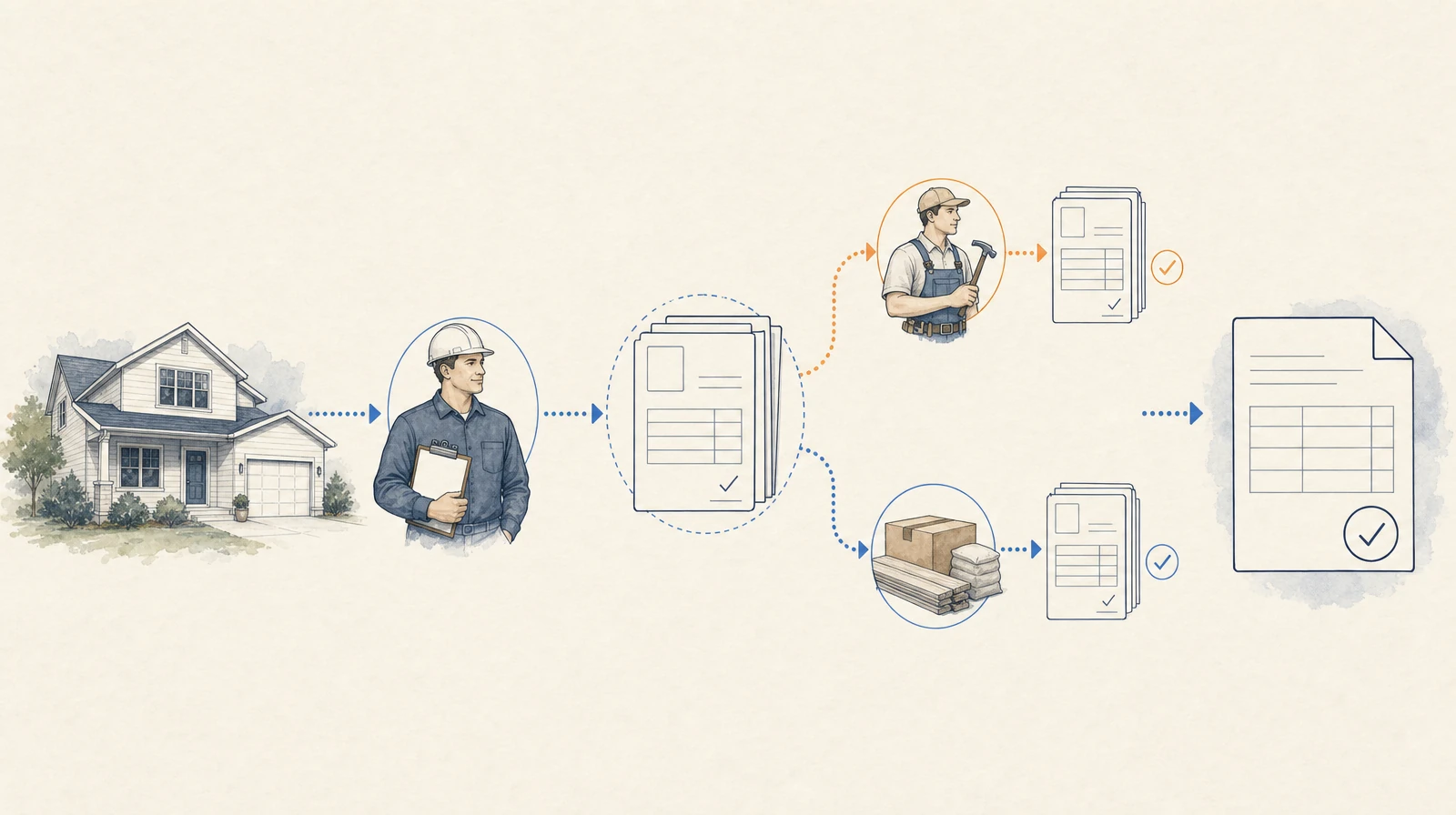
Simplified payment chain, not a legal workflow. Papers and check marks illustrate project records, not proof that every claimant is paid or title is clear.
Conditional and unconditional lien releases
A lien waiver or release is a claimant's statement about its right to claim the property. The document only works within its stated scope, date, amount, project, and legal requirements. A release from the general contractor does not automatically release a subcontractor or supplier.
The terms below describe common concepts. They are not a nationwide form or payment instruction.
| Release type | Common meaning | What to check |
|---|---|---|
| Conditional progress release | The claimant agrees to release covered rights when the described progress payment is actually received or clears. | The payment condition, covered work and dates, amount, and claimant's signature. |
| Unconditional progress release | The claimant states that covered progress rights are released without the same payment condition. | Whether the payment has cleared, the exact period released, and any exclusions or retainage. |
| Conditional final release | The claimant agrees to release covered final-payment rights once the stated payment condition occurs. | Whether “final” covers the whole project or only the listed work, amount, and payment evidence. |
| Unconditional final release | The claimant states that the covered final rights are released without a remaining payment condition. | The actual claimant's signature, the property and project, the covered amount, and any reserved rights. |
California's official waiver guidance describes separate conditional and unconditional forms for progress and final payments. It says the claimant must sign and deliver the release, and it cautions that paying the direct contractor does not establish that other claimants were paid. California's homeowner guidance describes a sequence of obtaining a conditional release before payment, making the payment, and then obtaining an unconditional release from each claimant after payment.
Other states use different forms and effects. Florida, for example, says a lien right cannot be waived in advance and provides statutory progress- and final-payment forms in its waiver statute. Use a state-appropriate form or professional review instead of copying a generic online waiver. A release should come from the person or business whose rights you need released.
State law changes the answer
There is no national contractor-lien deadline, notice form, waiver, or payment sequence. The property state's law can control:
- which contractors, subcontractors, laborers, suppliers, or other participants qualify;
- whether an early preliminary notice or notice to owner is required;
- what the notice must say and who must receive it;
- when a claim must be recorded and when a foreclosure action must begin;
- whether a notice of completion shortens a filing window;
- whether owner payment, a joint check, an escrow arrangement, a bond, or a statutory reserve affects exposure; and
- what language a waiver, release, bills-paid affidavit, or final-payment affidavit must contain.
Official state examples show why a generic online answer can mislead:
| State example | What it illustrates |
|---|---|
| California | The CSLB homeowner brochure describes preliminary notices for many subcontractors and suppliers, separate recording and enforcement deadlines, and statutory conditional and unconditional releases. It also explains that a Notice of Completion can shorten some filing windows. |
| Florida | Chapter 713 requires many non-labor lienors to serve a Notice to Owner as a condition of recording a claim and says the notice itself is not a lien. The chapter also addresses proper payments and a contractor's final-payment affidavit. |
| Texas | Texas Property Code Chapter 53 has residential rules involving subcontractor and supplier lists, disbursement statements, a final bills-paid affidavit, homestead contracts, and a reserve framework. Those rules do not become a national instruction for homeowners elsewhere. |
These are examples of variation, not a shortcut for deciding what applies to your project. A deadline from a different state can cause you to miss the deadline that controls your house.
What to do when a notice or recorded lien appears
Treat every notice as time-sensitive, then identify exactly what you received.
| What arrived | What it generally means | Practical next step |
|---|---|---|
| Preliminary notice, Notice to Owner, or notice of intent | A participant is identifying a potential claim or warning that it may record one. In many states, this is not the recorded lien. | Save every page and envelope, record the date received, identify the claimant and work, compare it with your project file, and ask for state-specific advice if a response or payment deadline is stated. |
| Recorded claim of lien | An instrument has been filed in the property records and may cloud title. | Get the official recorded copy from the county recorder, clerk, or title professional. Note the claimant, amount, legal description, recording date, work period, and any attached proof of service. Contact a local construction or real-estate attorney promptly. |
| Foreclosure complaint or other court papers | The dispute has moved into a formal legal proceeding or response deadline. | Treat the response date as urgent. Send the complete project file to a local attorney and follow the court instructions. |
Do not ignore an invalid-looking filing. A claim can still interfere with title while you wait for someone else to remove it. Do not automatically pay the claimant a second time, sign a release, or withhold the entire remaining contract balance based on a generic internet rule. The right response may depend on the contract, the notice, the claimant's status, the amount actually owed, and your state's payment and lien procedures.
If you are selling or refinancing, tell the title company, lender, or closing attorney that a lien issue exists. They can explain what their closing process requires. They cannot replace state-specific legal advice about whether the claim is valid or how to challenge it.
When to seek local legal help
Consider prompt advice from a construction or real-estate attorney licensed where the property is located when:
- a lien has already been recorded;
- a notice gives you a response, payment, or lawsuit deadline;
- a sale, refinance, construction loan, or home-equity loan is pending;
- the contractor has stopped responding, closed the business, or filed bankruptcy;
- the amount is large, several claimants are involved, or the project is financed;
- the work is incomplete, defective, unauthorized, or tied to a disputed change order;
- a claimant's name, amount, property description, or work dates appear wrong; or
- you received a foreclosure complaint, court summons, or request to sign a settlement or release.
Bring the contract, change orders, invoices, proof of payment, notices, releases, photos, permits, and the official recorded lien if one exists. A complete file lets the lawyer focus on the state-law requirements and the facts of your project instead of reconstructing the payment history.
FAQ
Can a subcontractor put a lien on my house if I paid the contractor?
Potentially. Some states give qualifying subcontractors or suppliers lien rights against the improved property even when the owner paid the general contractor. Other rules may limit or defeat a claim when required notices, payment protections, or releases are missing. Your payment record matters, but it is not a universal answer.
Can a contractor file a lien for unfinished or disputed work?
A dispute does not automatically prevent a claim. The claimant's eligibility, the work actually performed, the amount claimed, the contract and change orders, and the state's filing rules all matter. Preserve photos, inspection reports, messages, and the part of the invoice you dispute. Seek local advice before signing a settlement or changing the payment plan.
Is a preliminary notice a lien?
Usually no. A preliminary notice or Notice to Owner often alerts you that a subcontractor or supplier is on the project and may preserve rights if payment fails. It can still matter because it may trigger recordkeeping or payment procedures. Read the document's title and state-specific instructions rather than treating every notice as the same.
Can a contractor put a lien on my house without a written contract?
The absence of a written contract does not answer the lien question by itself. State law may recognize claims based on other evidence of authorized work, delivered materials, or an agreement. It can also impose special rules for residential, homestead, licensed, or unlicensed work. A local lawyer can assess the documents and the law that applies.
How long does a contractor have to file a lien?
There is no single U.S. deadline. The clock may depend on the type of claimant, the last labor or delivery date, project completion, a notice of completion, the property type, and whether the claimant must later file a foreclosure action. Do not rely on a deadline from another state or a generic form site.
Can I sell or refinance with a recorded contractor lien?
Sometimes a transaction can proceed through a release, payment, bond, court process, or another title-company solution. An unresolved lien can delay or block the transaction because the buyer or lender may require clear or insurable title. Ask the title professional what is required and get legal advice about the underlying claim.
The safest homeowner workflow is simple: define the work, identify who is being paid, keep proof of every payment, and collect claimant-specific releases that match the work and payment. Before you approve an HVAC or other home-energy quote, use our contractor question checklist to make the scope, change orders, permits, and payment terms clear from the start.