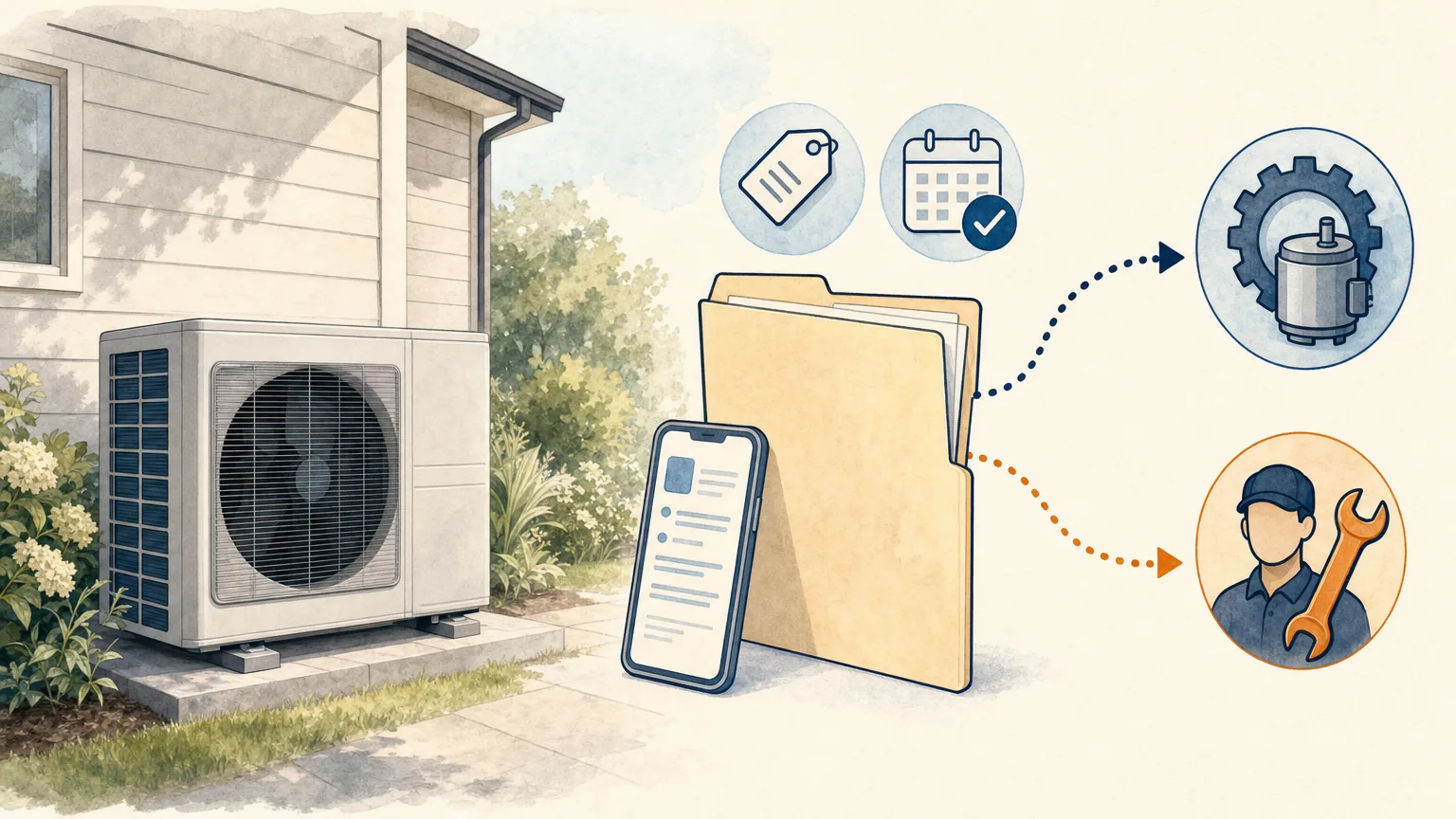
An HVAC warranty can cover a failed compressor, coil, furnace component, or control and still leave you paying for diagnosis and labor. The phrase “10-year warranty” describes one term in one written agreement, not every cost of a repair. We show you how to separate the promises, find four records, register or look up coverage, transfer it at a home sale, and build a claim file without doing trade work.
Last reviewed: September 29, 2026 (UTC)
HVAC warranty: start with parts versus labor
If a contractor or seller says an HVAC system has a 10-year warranty, ask two questions first: Which component has that term, and who pays the labor? A manufacturer limited warranty often addresses a defective part. Diagnosis, the service call, removal, installation, shipping, access, permits, and refrigerant work can belong to a different agreement or to you.
Trane’s current base and registered examples describe parts coverage without labor. Carrier’s current Consumer Choice program shows another possible structure: eligible homeowners can choose a longer parts-only term or a shorter term that includes labor. Those examples explain why an air conditioner warranty, heat pump warranty, furnace warranty, or mini-split warranty has to be read line by line. The FTC warranty guidance also tells buyers to check who pays for labor and shipping.
Use this coverage map before you compare a quote or authorize a repair:
| Cost or promise | Agreement that may control it | What to confirm in writing |
|---|---|---|
| Defective compressor, coil, motor, board, heat exchanger, or other listed component | Manufacturer limited warranty | The covered component, defect standard, term, registration status, owner, and installation location |
| Diagnosis, dispatch, or service call | Installer terms, service plan, home-warranty contract, or homeowner | Whether diagnosis, travel, and the first visit are included |
| Removal and installation labor | Installer labor or workmanship promise, dealer plan, or extended coverage | Labor term, limits, authorized process, and transfer rules |
| Refrigerant, leak search, recovery, or recharge | The exact manufacturer or service agreement | Whether refrigerant and leak-related work are excluded or separately priced |
| Freight, shipping, access, disposal, permits, and taxes | The certificate, contract, and installation scope | The line-item estimate and any caps or allowances |
| Maintenance, inspections, and tune-ups | Product certificate or separate maintenance plan | Required tasks, acceptable proof, provider, and frequency |
| Repair or replacement under a home warranty or service contract | A separate paid provider | Service fee, payout cap, waiting period, exclusions, network, and cancellation terms |
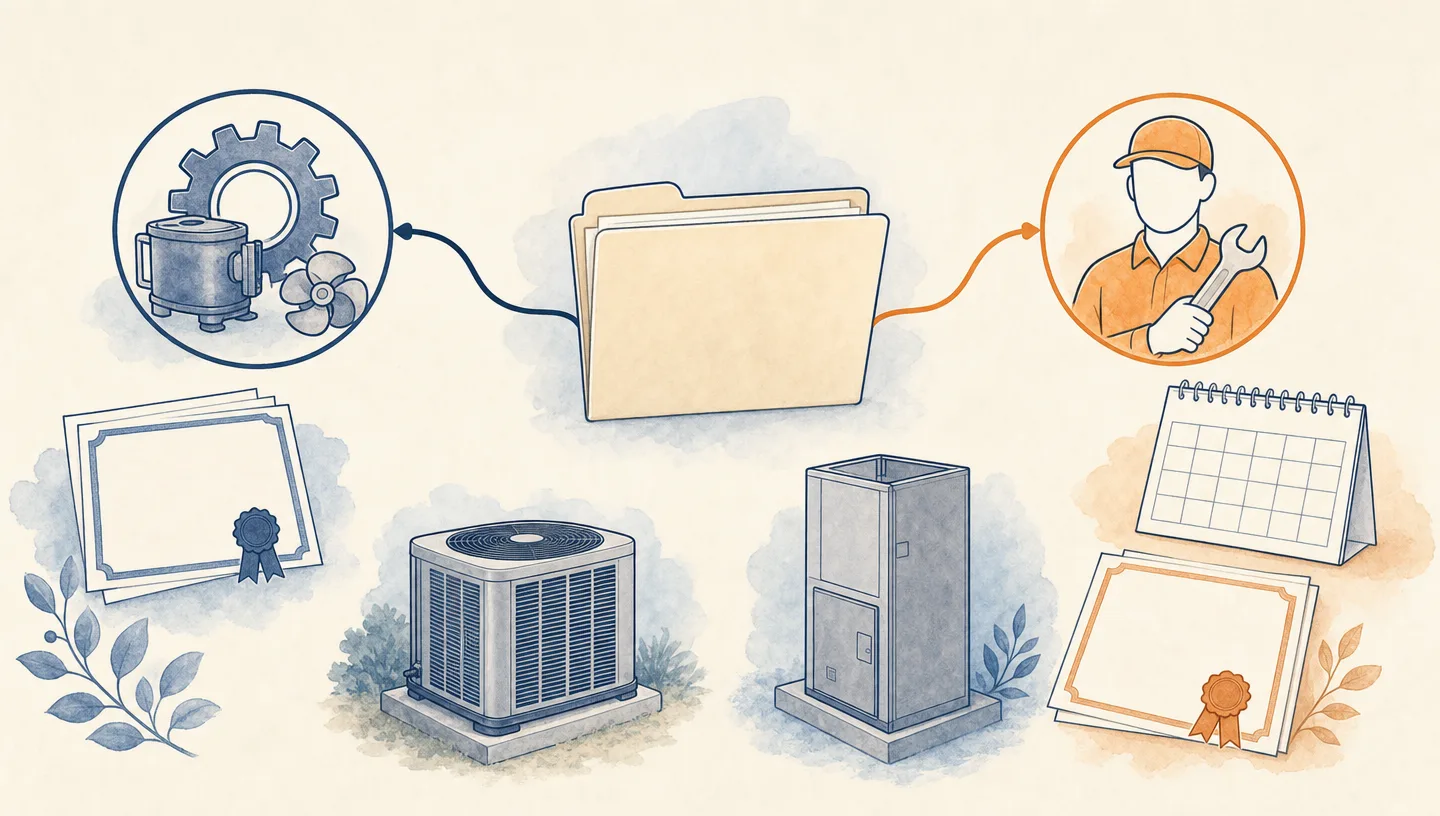
When comparing a new project, our HVAC contractor questions guide helps you ask for the manufacturer warranty, labor promise, service path, and scope before you compare totals.
Five different promises people call an HVAC warranty
These names often appear together in a sales conversation. They are different promises, from different parties, with different claim paths.
| Coverage type | What it is meant to do | What it does not automatically promise |
|---|---|---|
| Manufacturer limited warranty | Covers eligible defects in the listed equipment or components for the stated term. | Free diagnosis, labor, refrigerant, shipping, or a whole-system replacement. |
| Installer labor or workmanship promise | Covers the installer’s stated labor or corrections for workmanship issues during its stated period. | The manufacturer’s part, a lifetime term, transfer to a buyer, or service after the installer closes. |
| Maintenance plan | Provides scheduled visits, inspections, tune-ups, priority service, discounts, or other listed services. | A defect remedy. It may have a separate fee and may not pay for a failed component. |
| Extended warranty or service agreement | Adds time, labor, accessories, refrigerant, or other coverage when the plan says it does. | The same benefits as the base warranty. Read the start date, overlap, exclusions, and claim administrator. |
| Home warranty or home service contract | Covers specified repair or replacement events under a separate contract, often after a service fee. | Manufacturer warranty benefits, unlimited payouts, any contractor you choose, or coverage for pre-existing or excluded conditions. |
For a newly built home, collect the builder’s workmanship or systems warranty as a separate record. The FTC’s new-home guidance explains that builder coverage and a paid home service contract are different arrangements, and a builder warranty can overlap with equipment coverage.
Find these four records before you need one
Put the records in one digital folder and one backup location. A photo of a nameplate is useful, but the written terms and registration record carry the coverage details.
1. The model-specific manufacturer certificate
Find the certificate for every separately covered piece: outdoor unit, indoor coil, air handler, furnace, controls, and accessories. Record each model and serial number, the installation address, the component covered, the term, the start-date rule, exclusions, claim channel, and transfer language. A certificate for one outdoor unit does not prove that the indoor coil or thermostat has the same coverage.
2. The final invoice and installer labor promise
Keep the signed scope, paid invoice, change orders, installation and startup dates, and the contractor’s labor or workmanship terms. Ask the installer to state whether the promise covers diagnosis, travel, labor to replace a manufacturer-covered part, refrigerant, workmanship corrections, and a transfer to a later homeowner. If a promise was made verbally, ask for it in writing. The FTC recommends keeping written warranty terms and receipts.
3. The registration and lookup record
Save the confirmation email, certificate PDF, screenshot, warranty lookup result, and the date of registration. The record should show the owner, address, dealer, equipment, and coverage choice. If the installer says it registered the system, ask for the confirmation instead of assuming the registration happened.
4. Any paid service or extended-coverage contract
Keep the full maintenance plan, extended warranty, home-warranty contract, or service agreement, including the contract number and claim administrator. Highlight the service fee, waiting period, annual limits, per-repair cap, network rules, pre-existing-condition language, cancellation terms, and transfer rules. A plan summary or sales page is not a substitute for the contract.
Register and look up HVAC warranty coverage
Use this workflow for a new installation, a home purchase, or an older system with missing paperwork:
- Identify every component. Use accessible labels, the invoice, and the installation file. Do not remove a panel just to photograph a serial number.
- Find the official manufacturer route. Use the brand’s registration or warranty-lookup page, not a form from an unrelated lead site. Have the model and serial numbers, installation address, owner name, dealer, and installation or closing date ready.
- Read the result, not just the headline term. Save the certificate and write down the covered parts, labor benefit, start date, expiration date, claim contact, and transfer instruction.
- Match the record to the quote. If a salesperson promised 10 years, confirm whether that means parts, a named component, the original owner only, or an option selected during registration.
- Save proof. Keep the confirmation with the invoice, labor promise, permits, startup or commissioning record, and any service contract.
Current brand examples show why terms vary
The following are examples from current U.S. homeowner pages. They are useful for knowing what to look for, not for predicting coverage on a different model. The exact certificate, installation date, dealer program, owner, and state control the result.
| Brand example | What the current homeowner terms show | What not to assume |
|---|---|---|
| Trane warranty terms | Its base limited warranty is typically five years and parts-only when a product is not registered or is registered after 60 days. Registered limited coverage is typically 10 years and still parts-only when registration is completed within 60 days. An optional extended warranty may add labor. | Do not treat a Trane term as universal. The Trane base certificate applies to listed products and has its own exclusions and claim conditions. |
| Carrier’s program | For eligible equipment installed in an existing home through a participating dealer, Carrier’s Consumer Choice Warranty currently offers a 10-year parts-only option or a 5-year parts plus 3-year labor option when selected within 90 days. | New residential construction, nonparticipating dealers, product tiers, and state rules can change eligibility. Late registration can lead to standard parts-only coverage under the program terms. |
| Goodman warranty rules | Goodman describes enhanced terms for qualified registered purchases, while its model certificate controls the exact benefit. Its current state notice lists California, Florida, and Georgia as jurisdictions where coverage cannot be conditioned on registration for named installation dates, and Florida, Georgia, and Texas as states with listed transfer requirements for named installation dates. | Do not turn those examples into a national registration or transfer rule. |
| Lennox warranty choices | Lennox presents its basic limited warranty as requiring no registration, while terms vary by product tier. For eligible Merit and Elite products, current extended choices can include 10 years of parts-only coverage or 7 years of parts plus 3 years of labor. A 60-day registration window applies to specified extended benefits outside jurisdictions that prohibit registration conditions. | A basic Lennox term, an extended program, and a dealer’s service agreement are separate records. |
The pattern is clear: registering may extend parts coverage, select a labor option, or document the owner without changing the basic warranty. In some jurisdictions, the written terms preserve coverage even when registration cannot be used as a condition. Save the lookup result either way.
Transfer coverage when a home is sold
Start with the equipment’s installed location. A manufacturer warranty usually attaches to the serial number and the original installation address. It does not automatically follow the homeowner to a new house. An installer’s labor promise may have a different owner, deadline, or no transfer path at all.
Before closing:
- Pull the current warranty certificate and record the remaining term for each component.
- Check whether the manufacturer allows transfer, whether the transfer must happen after closing, and whether there is a fee or form.
- Use the closing date and installation address the certificate requires. A new-construction certificate may use the home closing date rather than the crew’s installation date.
- Submit the transfer through the manufacturer or plan administrator, then save the updated certificate and fee receipt.
- Give the buyer the model and serial list, manufacturer certificate, registration record, installer labor promise, service contract, maintenance records, permits, and claim contact.
Trane currently describes a registered-warranty transfer completed within 90 days of sale and lists a one-time $99 fee on its homeowner page. Goodman’s current notice lists transfer requirements for named units in Florida, Georgia, and Texas. These are brand and jurisdiction examples. They do not replace the exact certificate or state rule, and they do not transfer an installer’s separate labor promise automatically.
Prepare an HVAC warranty claim without doing trade work
The goal is to give the right party enough information to decide coverage before chargeable work begins.
Make a safe record of the problem
Safety comes before photos or warranty paperwork. Only when it is safe to remain nearby, write down the date, thermostat setting or display, whether the system is heating or cooling, the symptom, outdoor conditions, and any visible error message. Photograph accessible labels, visible water or ice, and the thermostat screen. Do not open an electrical panel or equipment cabinet.
Smoke or suspected fire: If you see smoke or flames, notice a burning smell or sparking, or otherwise suspect a fire, alert others and leave the building immediately. Call 911 or your local emergency number from outside and away from the building, following the U.S. Fire Administration’s guidance. Do not stay to inspect equipment, take photos, or fight the fire.
Suspected gas leak: If you smell gas or suspect a leak, leave the home immediately. Do not operate switches or electronics, including lights or a phone, while inside. From outside and away from the building, contact your local gas utility or emergency services, following the CPSC’s gas-leak guidance.
Wet electrical equipment: If electrical equipment is wet, or water is in or near it, do not touch or approach it or try to switch it off. Keep away from the area and contact your electric utility or a qualified professional from a safe location. The CPSC’s wet-appliance guidance recommends professional or utility evaluation before use.
Dangerous indoor temperature: Move to a safely heated or cooled location. Contact emergency services if anyone is in immediate danger.
For a non-emergency heating or cooling problem, arrange service with a qualified HVAC professional after everyone is safe.
Ask for a written diagnosis and itemized estimate
Ask a qualified HVAC professional to describe the failed component and separate the expected charges into:
- covered part or part credit
- diagnosis, dispatch, and travel
- removal and installation labor
- refrigerant, recovery, recharge, or leak-related work
- shipping or freight
- access, permits, disposal, and taxes
Ask the technician to identify which agreement may pay each line. Do not approve chargeable work based only on a verbal statement that “the warranty covers it.”
Start the claim through the stated channel
Use the manufacturer’s official claim path, the installing dealer, or the service-contract administrator named in your records. Keep the claim number, written diagnosis, estimate, photos, correspondence, approval or denial, and final invoice together. Some certificates require a dealer or licensed service provider to submit the claim, while others direct the homeowner to customer support.
If the installer is unavailable, contact the manufacturer or participating dealer with the model, serial, address, and certificate. That can help with a parts claim. It does not recreate a labor promise from a contractor that is no longer serving the home.
If a claim is denied, request the reason in writing and match it to the certificate or contract section. You can then ask the manufacturer, seller or installer, state consumer-protection office, or a qualified lawyer what next step fits your situation.
Post-install closeout: make the warranty file once
Use this homeowner-safe checklist before the installation folder disappears:
- Record the equipment: Photograph accessible nameplates and list every model and serial number for the outdoor unit, indoor unit, coil, furnace, controls, and accessories. Do not remove panels for a photo.
- Fix the dates: Have the invoice identify the installation or startup date and note any separate closing date used for a new home.
- Collect the promises: Save the manufacturer certificate, installer labor or workmanship terms, extended-coverage contract, maintenance plan, manuals, and claim contacts.
- Register promptly when the terms call for it: Use the official route, confirm the owner, address, dealer, and components, then save the PDF or confirmation screen.
- Keep completion records: Add the permit or inspection closeout, startup or commissioning record, AHRI match or certificate if supplied, final paid invoice, and change orders.
- Record maintenance expectations: Keep the filter size and homeowner-safe maintenance notes. Write down what proof the certificate requests and who may perform required service.
- Create a claim note: Add space for the failure date, symptoms, diagnosis, claim number, covered part, labor, refrigerant, shipping, and final resolution.
- Prepare for a sale: Keep the transfer form, fee receipt, updated certificate, and a buyer handoff copy with the home records.
If the project is a heat pump, keep these documents with the system handoff records described in our guide to heat pump ownership. When you are comparing an installation quote, compare warranty coverage as a separate line from equipment, labor, permits, and incentives.
Common exclusions and misunderstandings
An exclusion belongs to the specific certificate or contract. These are the lines worth looking for:
- Labor and diagnosis: A parts warranty may supply the component while leaving diagnosis, removal, reinstallation, and technician time to the homeowner or another agreement. Trane’s current base certificate is one clear example.
- Refrigerant and leak work: A certificate may exclude refrigerant, recovery, recharge, leak searches, or related materials. Never assume a covered coil means every refrigerant charge is covered.
- Installation-related damage: Improper installation, operation, maintenance, modification, misuse, or a mismatch can affect a claim when the written terms connect the condition to the failure. A manufacturer can deny damage caused by service or parts without making every unrelated warranty right disappear.
- Shipping, access, permits, and disposal: These costs can sit outside the covered part even when the replacement component is supplied without charge.
- Ducts, wiring, controls, accessories, and property work: A warranty for a named HVAC component does not automatically cover every connected part of the home or every line in an installation quote.
- Normal service versus defect: A maintenance visit or an expected consumable is different from a component defect. A home service contract may use different definitions and caps.
- Repair versus replacement: The certificate may promise a part, a suitable substitute, a credit, or another limited remedy. It may not promise a new system or reimbursement for every consequence of a failure.
Read the whole certificate before describing a claim as “covered.” The eCFR’s prohibited-tying rule generally limits a warrantor’s ability to condition coverage on a named brand of part or service when that part or service is not provided free. The rule still allows a warrantor to address damage caused by a part or service, so a separate installer process and the manufacturer’s defect terms both matter.
2026 caveats outside warranty coverage
Warranty coverage, refrigerant rules, and tax credits answer different questions. Keep them separate in your project file.
State and manufacturer rules can change. Goodman’s current state notice and Lennox’s current warranty page show 2026 treatment for Georgia units installed on or after January 1, 2026, alongside other state-specific registration or transfer rules. Those pages are examples, not a complete state survey. Use the exact model certificate and the applicable state rule for a live claim or home sale.
Refrigerant transition does not decide a warranty claim. For new residential and light-commercial air-conditioning and heat-pump systems, EPA’s Technology Transitions rule restricts use of regulated hydrofluorocarbons (HFCs) or blends containing them when their global warming potential (GWP) is 700 or greater. The same threshold applies to new variable refrigerant flow (VRF) systems, which follow a separate compliance schedule.
EPA’s May 2026 final rule, effective July 27, 2026, removed the installation deadline for eligible non-VRF residential and light-commercial systems when all specified components were manufactured in the United States or imported into the United States before January 1, 2025. This pre-2025-component exception does not cover VRF systems. Under EPA’s separate VRF rule, new VRF systems using a regulated HFC or a blend containing one with a GWP of 700 or greater may be installed before January 1, 2027, if all specified components were manufactured in the United States or imported into the United States before January 1, 2026. The separate rule also permits installation before January 1, 2028, for projects with an approved building permit issued before October 5, 2023 that specifies use of the restricted HFC or blend in the VRF system, provided all specified components were manufactured in the United States or imported into the United States before January 1, 2026. For a project-specific eligibility question, consult the 2026 final rule and a qualified HVAC professional. EPA separately says R-410A components can continue to be sold for servicing existing systems, while R-32 and R-454B equipment must be designed for those refrigerants under its refrigerant use conditions. None of these refrigerant rules determines whether a certificate pays for refrigerant, leak work, recovery, or a replacement component.
Tax credits are separate. The IRS says the federal Section 25C Energy Efficient Home Improvement Credit is not allowed for property placed in service after December 31, 2025. A warranty page cannot establish tax eligibility. Keep any incentive or tax question separate from the coverage file and use the current IRS 25C guidance or Watt Wallet’s heat-pump tax-credit guide for that topic.
HVAC warranty FAQs
Does an HVAC warranty cover labor?
Many manufacturer limited warranties cover eligible parts and leave labor, diagnosis, travel, removal, installation, shipping, or refrigerant to another agreement or the homeowner. Some dealer programs and extended plans include labor for a stated period. Read the labor line separately from the parts term.
What does a 10-year HVAC warranty mean?
It can mean 10 years on a specific component or parts category, often after registration. It does not automatically mean 10 years of free service, labor, refrigerant, or whole-system replacement. Use the certificate and registration result to identify the exact promise.
Should I register my HVAC warranty?
Register promptly when the manufacturer’s terms make registration part of an enhanced term or coverage choice. Some basic warranties do not require registration, and some states limit registration conditions. Save the confirmation even when registration does not change the legal coverage.
Can I use another contractor for a warranty repair?
Federal warranty rules generally limit a written warranty from requiring a named brand of part or service when that item is not supplied free. A warrantor can still address damage caused by a particular part or service, and an installer’s labor promise can have its own claim process. Ask who will diagnose the failure, who submits the claim, and which work is chargeable before service begins.
Does an HVAC warranty transfer when a home is sold?
Sometimes. The manufacturer warranty may stay with the equipment at the original address if the owner completes a stated transfer process. A deadline, fee, or updated certificate may apply. The installer’s labor or workmanship promise may not transfer automatically. Check both documents before closing.
Does a home warranty cover HVAC?
A home warranty is generally a separate service contract that may cover listed HVAC breakdowns after a service fee, subject to waiting periods, caps, exclusions, network rules, and pre-existing-condition terms. It can overlap with a manufacturer warranty or exclude the same event. Compare the contract with the equipment certificate before paying for duplicate coverage.
What records should I keep for an HVAC warranty claim?
Keep model and serial numbers, the paid invoice, installation and closing dates, manufacturer certificate, registration proof, installer labor promise, service or extended-coverage contract, startup or commissioning record, permits, maintenance records, claim number, diagnosis, photos, estimates, approvals, denials, and final invoices.
Consumer information, not legal advice.
Warranty rights, implied warranties, installation contracts, service-contract rules, and remedies depend on the written terms and state law. Under eCFR Part 700, household air conditioners and furnaces are separate consumer products even when attached to real property. That boundary does not make wiring, ducts, installation workmanship, or every service promise part of a manufacturer warranty. For a dispute, start with the manufacturer and seller or installer, then use your state consumer-protection office or a qualified lawyer.
Before you sign an HVAC quote or authorize a warranty repair, save the four records in one project folder and use our HVAC contractor questions guide to ask who pays each line item. If an existing furnace is failing, check the remaining warranty before comparing repair and replacement scopes.