Last reviewed: 2026-08-12 (UTC)
A home heat pump can replace both heating and air conditioning, but choosing one takes more than picking a brand or matching the old furnace size. Ducts, floor plan, winter temperatures, electrical capacity, and local energy prices all change the right system. We’ll show you how the main types differ, what a realistic project costs, which numbers matter on a quote, and how to tell whether a heat pump could lower your bills.
What is a home heat pump?
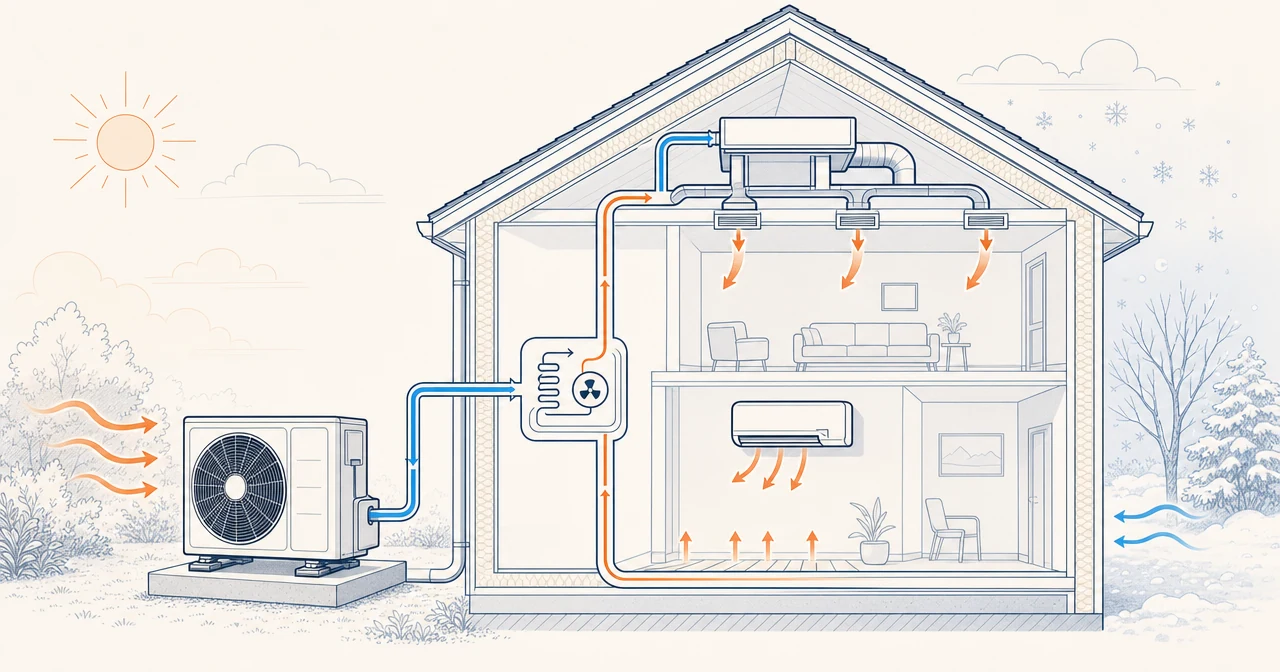
A heat pump is an electric HVAC system that moves heat instead of making it with a flame or electric resistance. In winter, it collects heat from outside and moves it indoors. In summer, the refrigerant cycle reverses and moves indoor heat outside, so the same equipment works as an air conditioner.
That transfer makes a heat pump much more efficient than electric baseboards or an electric furnace. The Department of Energy says today’s systems can use about 65% less electricity for heating than electric resistance equipment. Savings against gas, oil, or propane depend on fuel prices, climate, and the exact system.
Two terms cause avoidable confusion:
- A mini-split is not automatically a heat pump. “Mini-split” describes the split-system configuration, usually with one outdoor unit and one or more compact indoor units. Many residential mini-splits are reversible heat pumps that heat and cool, but cooling-only models also exist. Confirm that the exact model provides heating if that is part of the plan.
- A heat pump water heater is a different appliance. It heats domestic water. The systems here heat and cool living space.
Choose the system around the house
For most U.S. homes, an air-source heat pump is the practical starting point. It can distribute conditioned air through existing ducts, short duct runs, or room units. Geothermal systems use buried loops and can be highly efficient, but the site work makes them a separate, larger project.
Start with the home’s distribution system and layout:
| What the house has | Likely path | What can change the answer |
|---|---|---|
| Sound, well-sized forced-air ducts | Ducted air-source heat pump | Leakage, undersized returns, ducts in an attic or crawlspace, and cold-weather capacity |
| No ducts and an open plan | Single-zone or multi-zone ductless mini-split | Closed bedrooms, indoor-unit placement, condensate routing, and the number of outdoor units |
| No ducts and many small rooms | Ductless units plus transfer-air planning, or compact ducted zones | A wall unit in the hallway rarely conditions bedrooms well behind closed doors |
| A usable gas furnace and central AC ducts | Ducted heat pump with the furnace retained for dual fuel | Fuel prices, furnace age, control settings, and the switchover temperature |
| Boiler, radiators, or electric baseboards | Ductless or compact ducted heat pump | Reusing hydronic distribution usually requires a different air-to-water project |
| One addition or hard-to-condition area | Single-zone mini-split | Whether the goal is targeted comfort or eventual whole-home coverage |
| Suitable land and a long ownership horizon | Ground-source heat pump | Drilling or trenching, geology, loop design, and upfront cost |
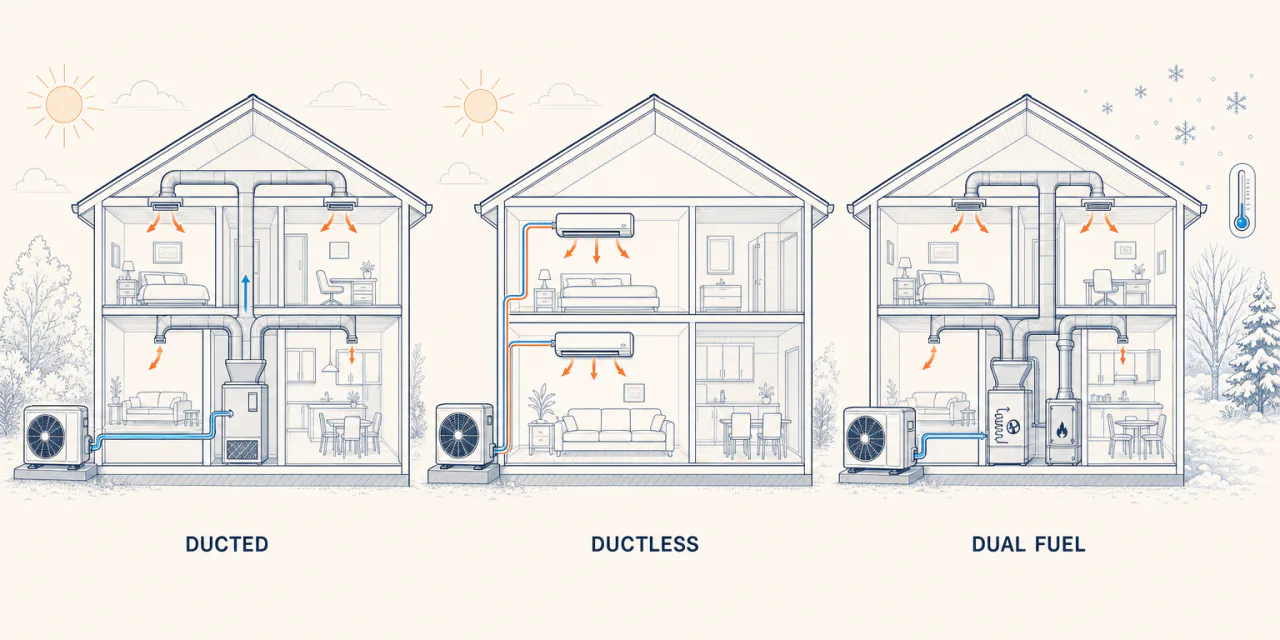
A central ducted system feels familiar and keeps indoor equipment out of living areas. A ductless system avoids major duct construction and gives each zone its own control. It also puts an indoor unit in every served zone. Our ducted versus ductless guide goes deeper on that tradeoff.
Once ductless is the likely path, our ductless installation guide shows what a professional project should include from planning through commissioning.
A dual-fuel system is useful when a heat pump can cover most hours but a gas or propane furnace remains economical or desirable during the coldest weather. “Backup” should still be a designed operating mode. The quote must state which system runs at each temperature and whether the changeover is based on available heat, operating cost, or both.
Run five fit checks before comparing brands
A brand list cannot tell you whether a system fits your home. We use five checks first.
1. Calculate the home’s heating and cooling loads
Square footage and the old equipment label are poor sizing methods. A room-by-room Manual J calculation accounts for local design temperatures, insulation, air leakage, windows, orientation, occupancy, and duct losses. Manual S then matches equipment performance to those loads, while Manual D covers duct design. ACCA explains the roles of these residential design standards.
Have the calculation completed after any planned air sealing, insulation, or window work. Reducing the load first may allow smaller equipment and simpler backup heat. Ask for the calculation report, its indoor and outdoor design temperatures, and its assumptions. A contractor saying “three tons should be plenty” has not shown the work.
2. Inspect ducts and room-to-room airflow
Existing ducts are an asset only when they can deliver the required airflow without excessive leakage or static pressure. A furnace can mask poor distribution with short blasts of very hot air. Heat pumps usually deliver gentler heat for longer periods, which can expose cold rooms, small returns, crushed flex duct, and losses through unconditioned space.
For a ducted quote, require an inspection, duct-leakage findings, and an airflow plan. For a ductless quote, mark each indoor unit on a floor plan and follow the actual path of air with doors open and closed. Adding heads after installation is a costly way to solve a layout mistake.
3. Match low-temperature output to the winter load
“Works down to -15°F” is an operating limit, not proof that the unit can heat your house at that temperature. As outdoor air gets colder, an air-source heat pump’s capacity and coefficient of performance, or COP, change. Compare the exact indoor-outdoor equipment combination at your local winter design temperature.
A cold-climate quote should show:
- the home’s heating load at the design temperature;
- the model’s maximum heating capacity and COP near that temperature;
- its minimum output in mild weather, which affects cycling and comfort;
- the thermal balance point, where the house needs more heat than the pump can supply; and
- the backup type, capacity, and control setting.
The NEEP product list publishes model-level cold-weather data, which is more useful than a product-family brochure. Our cold-climate heat pump guide explains how to read those numbers and plan backup heat.
4. Scope the electrical work
A panel upgrade is not automatic. The answer depends on service capacity, existing loads, the heat pump circuit, and any electric resistance backup. A small ductless system and a whole-home air handler with large heat strips create very different electrical loads.
The quote should identify breaker sizes, new circuits, disconnects, surge protection, panel work, and who completes the electrical permit. If backup strips are proposed, ask for their kilowatt rating and which thermostat conditions activate them. Unplanned strip heat can erase expected bill savings.
5. Compare the new system with the equipment it replaces
The best financial cases often begin with electric resistance, heating oil, or propane, or with a furnace and air conditioner that both need replacement. A newer gas furnace in a market with cheap gas needs closer math. A targeted mini-split can also be sensible when the goal is adding cooling or reducing use of an expensive existing system rather than removing it.
If the current system is baseboards, wall heaters, or an electric furnace, our electric heat versus heat pump comparison covers the room-by-room keep-or-replace decision and the bill math behind it.
Home age alone is not a disqualifier. An older home can use a heat pump when the load, distribution, electrical scope, and backup plan are designed together. Weatherization improves comfort and may reduce equipment size, but it does not have to turn the house into a new build first.
What heat pumps for homes cost
Installed price follows project scope. A single wall unit, a multi-zone ductless layout, and a whole-home ducted replacement should never share one planning number.
Rewiring America’s March 2024 analysis of public installation data reported the modeled national ranges below. They are 20th-to-80th-percentile total installed costs, including equipment and installation, before incentives:
| Project | Planning range | What commonly moves the quote |
|---|---|---|
| Single-zone ductless heat pump | $5,400 to $8,500 | Line-set length, electrical work, wall construction, drain routing, and equipment tier |
| Whole-home air-source system, 1,500 to 2,500 sq. ft. | $17,000 to $23,000 | Capacity, climate, ducts, electrical readiness, labor, and backup heat |
| Whole-home air-source system, 2,500 to 5,500 sq. ft. | $22,500 to $28,000 | Multiple systems or zones, higher capacity, duct changes, and project complexity |
These are budgeting ranges, not price guarantees. A simple replacement can land lower, while new ducts, panel work, asbestos remediation, difficult access, or several indoor zones can push a project higher. Our heat pump installation cost guide separates equipment, installation, and hidden scope in more detail.
Keep gross price, rebates, financing, and operating cost on separate lines. For a 2026 installation, the old federal Energy Efficient Home Improvement Credit is no longer part of the budget. IRS guidance says the credit cannot be claimed for property placed in service after December 31, 2025. State, utility, and income-qualified programs may still reduce the cost.
Will a heat pump lower your energy bills?
A heat pump almost always uses less electricity than resistance heat to deliver the same amount of warmth. Comparisons with gas are local because electricity and gas prices vary, and air-source heat pump efficiency falls as the outdoor temperature drops.
You can make a first-pass comparison with two formulas. Use the variable supply-and-delivery price from each bill:
- Heat pump cost per million Btu delivered: electricity price per kWh × 293 ÷ seasonal COP
- Gas furnace cost per million Btu delivered: gas price per therm × 10 ÷ furnace efficiency
For example, at $0.17 per kWh and a seasonal COP of 3, heat costs about $16.60 per million Btu. At $1.50 per therm and 90% furnace efficiency, gas costs about $16.67 per million Btu. They are nearly even before fixed gas charges, maintenance, cooling value, and backup heat.
Do not use the best COP on a sales sheet for this calculation. Use a realistic seasonal estimate or an estimate built from model performance across your weather. Then run a cold-month case that includes resistance backup or a dual-fuel changeover. Our heat pump electricity cost guide walks through consumption and rate scenarios.
Your current bills are useful evidence. You can estimate the heat the house needed from twelve months of fuel use, furnace efficiency, and local weather data. That check often catches a proposal based on an oversized old furnace or a generic square-foot rule.
Are heat pumps worth it?
Heat pumps are especially compelling when they replace electric resistance, oil, or propane, add air conditioning the home lacks, or replace both a furnace and central AC near the end of their lives. They can also solve one difficult zone without rebuilding a whole distribution system.
The decision needs closer scrutiny when the home has a newer gas system, low gas prices and high electric rates, major duct reconstruction, or an electrical upgrade driven mainly by large backup strips. In those cases, a partial-home or dual-fuel design may deliver more value than immediate whole-home conversion.
The main disadvantages are upfront cost and sensitivity to design and installation. Some ductless layouts also require several visible indoor units. All standard heat pumps need electricity, so outage planning must account for the compressor, blower, and any backup heat.
Know what normal operation and maintenance look like
Heat pumps run differently from furnaces. Long, steady cycles are often normal, while backup-heat settings, defrost behavior, and basic upkeep can have a large effect on comfort and bills.
AUX and emergency heat mean different things
On a system with backup heat, auxiliary heat is the supplemental source that the controls call automatically. It may run when the heat pump cannot meet the load alone, during some defrost cycles, or while recovering from a large thermostat setback. Depending on the design, that backup may be electric resistance strips or a furnace that takes over in a dual-fuel system. Brief AUX operation during severe cold or defrost can be normal. Long AUX runs in mild weather can point to a control, sizing, airflow, or equipment problem, and resistance strips can raise electricity use quickly.
Where the thermostat offers it, Emergency Heat is a manual mode that normally locks out the heat-pump compressor and heats with the backup source alone. Use it when the heat pump has failed or a service technician directs you to. It is not a faster setting for routine warmups.
Frost, steam, and defrost cycles
An air-source heat pump’s outdoor coil can collect frost in cold, damp weather. The system periodically reverses the refrigerant cycle to warm the coil and melt that frost. The outdoor fan may stop, the sound may change, auxiliary heat may come on, and steam or water may appear around the unit. Those are signs of normal defrost behavior. A coil that stays encased in ice, a fan striking ice, or repeated defrost without useful indoor heat needs service. Do not chip ice from the coil, and keep the meltwater path away from walkways and the unit’s base.
Keep airflow, coils, and drainage clear
- Filters: Check them monthly during heavy heating and cooling use. Clean reusable filters or replace disposable ones according to the equipment manual.
- Outdoor unit: Remove leaves, grass, drifting snow, and other debris without blocking the manufacturer’s required clearances. Do not wrap or cover an operating unit in winter.
- Coils: Keep the visible outdoor coil free of debris. Have a technician inspect and clean indoor and outdoor coils as needed rather than bending fins or spraying electrical components.
- Condensate: Check the drain and any condensate pump during cooling and dehumidification. Standing water, an overflow switch that trips, or water around an indoor unit needs prompt attention.
ENERGY STAR recommends annual pre-season service that includes coil, condensate, controls, electrical, airflow, and refrigerant checks.
Choose the installer before chasing the highest rating
SEER2 measures seasonal cooling efficiency. HSPF2 measures seasonal heating efficiency. Those ratings help compare equipment, but they do not show whether a model retains enough capacity on your coldest design day, modulates low enough during mild weather, or works with the home’s ducts.
We compare proposals in this order:
- Load and distribution: room-by-room Manual J, duct or zone plan, and ventilation assumptions.
- Exact matched system: outdoor model, every indoor model, and the AHRI reference for the combination.
- Performance at design conditions: heating capacity, COP, minimum output, HSPF2, and SEER2.
- Backup and controls: heat-strip size or furnace changeover, lockout settings, and thermostat logic.
- Installation and commissioning: airflow, static pressure, refrigerant charge, condensate drainage, controls, and measured startup results.
- Service: labor and parts warranties, local parts access, and who handles a winter no-heat call.
This order matters. Building America’s quality-installation guide summarizes an NREL model that examined incorrect airflow and refrigerant charge in central air conditioners and air-source heat pumps in U.S. single-family detached homes. The model estimated those faults increased energy use by about 9% over a no-fault baseline and added about $2.5 billion to annual utility bills. The guide calls for refrigerant, airflow, duct-leakage, static-pressure, controls, and performance checks.
A complete quote should also state permit responsibility, outdoor-unit location and clearances, snow or flood protection, defrost drainage, sound placement, line-set routing, wall and ceiling repairs, equipment removal, and the gross price before incentives. Get the same answers from each bidder so the totals describe comparable work. For a ductless project, our mini-split permit guide explains the approval and inspection questions to settle before work starts. Use our contractor question checklist to run the rest of those conversations.
Home heat pump FAQs
Is it normal for a heat pump to run all night in winter?
Yes. Variable-speed heat pumps are designed to run for long periods at low output, which can improve temperature consistency and efficiency. Long runtime becomes a problem when the home cannot hold its setpoint, emergency heat runs without a clear reason, the outdoor unit stays encased in ice, or the system repeatedly starts and stops after a few minutes.
Do heat pumps control humidity all year?
A heat pump removes moisture while it runs in cooling mode, much like a central air conditioner. Sizing and setup determine the result. An oversized system may satisfy the thermostat before removing enough moisture, while low minimum capacity, longer cooling cycles, correct airflow, and suitable controls improve summer dehumidification.
Spring and fall are harder. During a humid shoulder season, a home can need moisture removal with little or no cooling. The heat pump may barely run, and heating mode does not dehumidify indoor air. A dry mode still cools the space, so it cannot solve every low-load condition. The Department of Energy notes that moisture loads can remain even when a home's cooling load is low. Dedicated dehumidification may be needed when indoor humidity stays high.
Basements have another limitation. They are already cool, often have their own moisture sources, and may exchange little air with the rooms served by the heat pump. An upstairs ductless head should not be expected to dry basement air. Even a basement zone can reach its temperature setpoint before removing enough moisture. Fix leaks, seepage, drainage, and other water sources first. If basement humidity still stays high, use a basement or whole-home dehumidifier that actually serves that space. The EPA recommends keeping indoor relative humidity below 60%, ideally 30% to 50%.
How long does a home heat pump last?
The Department of Energy uses a 15-year average life in its federal purchasing analysis. Actual life depends on climate, runtime, installation quality, maintenance, and exposure of the outdoor unit. Labor coverage and local service capacity deserve as much attention as the headline parts warranty.
What commissioning results should the installer leave behind?
Ask for the final control settings and measured startup results, not only a statement that the system works. For a ducted system, that includes airflow and static pressure. Every project should document the manufacturer-approved refrigerant-charge check, condensate drainage, thermostat operation, backup-heat lockouts, and a heating and cooling mode test. Keep the model and serial numbers, AHRI reference, warranties, and commissioning record together so a future technician has a baseline.
Choose the next guide for your project
The right next step depends on which part of the decision is still open:
| If you need to... | Use this guide |
|---|---|
| Check low-temperature capacity and backup planning | Cold-climate heat pumps |
| Decide what to replace in an electric-heated home | Electric heat versus heat pump |
| Understand the scope of a professional ductless project | Ductless mini-split installation |
| Settle permit responsibility before ductless work starts | Mini-split permit guide |
| Compare a heat pump with replacing a gas furnace | Gas-furnace replacement guide |
| Spread the project cost over time | Heat pump financing |
| Understand the federal credit cutoff for a 2026 installation | Federal tax credit guide |
| Compare gross prices, rebates, and contractor offers consistently | Incentive and quote comparison |
Take the next step with real numbers
Bring a year of energy bills, a floor plan, and photos of the ducts, panel, and existing equipment to three qualified installers. Before the quotes become final, use our state rebate guide to find live programs that can change the net cost.