Last reviewed: September 23, 2026 (UTC)
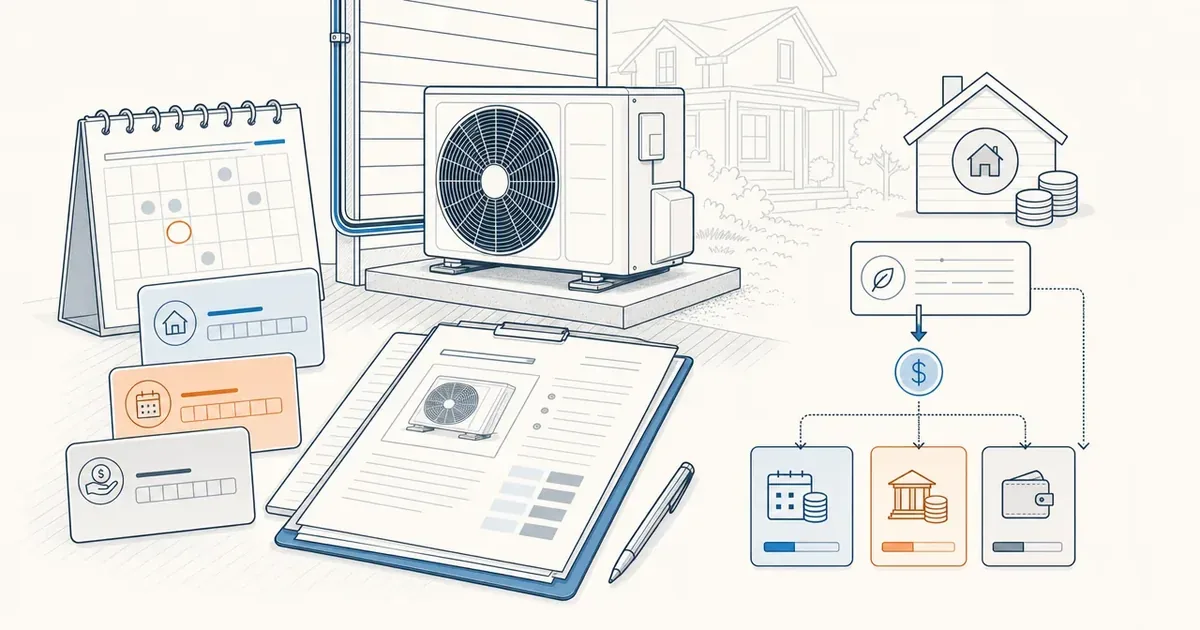
Heat pump financing is a price-and-timing decision. Start with the full installed quote, subtract only incentives that will reduce the invoice, then compare the remaining balance across five routes. Local utility or state financing deserves a place beside the contractor offer because terms can include approved-contractor rules, on-bill repayment, or project caps. Watt Wallet does not issue loans. We help you locate rebate and program pages, then use the worksheet here to compare monthly payment with total repayment.
Quick comparison: five heat pump financing routes
| Route | Security and rate | Term and fees to ask about | Contractor or eligibility limits | Timing | Usually fits when |
|---|---|---|---|---|---|
| Contractor or dealer financing | Often no mortgage collateral, but the agreement controls. May be fixed-rate, promotional, or deferred-interest credit. | Promo end date, post-promo APR, dealer fee, origination fee, prepayment terms | Often tied to the installing dealer and approved credit | Fastest when bundled with the quote | The system has failed or you value one application and one project contract |
| Personal or home-improvement loan | Often unsecured and fixed-rate, though products vary | APR, origination fee, term, late fee, prepayment terms | Usually lets you choose the contractor; lender rules still apply | Apply separately, often before signing the install contract | You want to compare installers without using their financing partner |
| Home equity loan | Secured by the home; often a fixed-rate lump sum | Closing costs, recording fees, fixed term, prepayment rules | Usually independent of the contractor | Underwriting and closing can take longer | The scope is stable and you want one predictable payment |
| HELOC | Secured by the home; usually a variable rate and revolving balance | Draw period, repayment period, rate cap, annual or closing fees | Usually independent of the contractor | Useful when costs arrive in stages | Ductwork, electrical work, or other scope may change |
| Utility, state, or clean-energy program | May be unsecured, on-bill, or otherwise secured. Rate structure varies by program | Loan cap, program fee, rebate timing, transfer terms, rate reset rules | Service area, utility account, income, equipment, and approved-contractor rules may apply | Application and program approval can affect the install date | A local program offers terms that compete with ordinary lending |
The table is a screening tool. The signed loan agreement and the complete installation quote control the real cost.
If you are still choosing between a ductless mini-split and a ducted system, use our mini split vs. heat pump guide before you compare financing offers.
1. Contractor or dealer financing
Dealer financing is convenient because the application appears inside the installation sale. That can matter when a furnace or air conditioner has failed and waiting for a separate loan would leave the home without reliable heating or cooling.
The financing product can take several forms. A dealer may arrange a closed-end loan, a credit-card-style account, a fixed promotional APR, or a deferred-interest offer. Those labels matter. The CFPB's deferred-interest guidance (reviewed September 23, 2026) explains that interest can be charged back to the original purchase date when a balance remains after the promotion. A minimum payment may also be too small to clear the balance before the deadline.
Ask for these numbers on the same page as the equipment quote:
- cash price for the full installed scope
- financed price, including any dealer or lender fee
- APR, whether it is fixed, promotional, or deferred-interest
- exact promotional end date and the APR afterward
- monthly payment required to clear the balance before that date
- prepayment rules, late fees, and any lien or fixture filing
- who receives a rebate and when it reduces the balance
An offer that shows a small payment over a long term can be easier to approve and more expensive to repay. Keep the financing decision separate from the quality of the heat-pump quote. The FTC's home-improvement guidance (reviewed September 23, 2026) recommends multiple written estimates and warns against pressure to use a contractor's preferred lender without comparing terms.
2. Personal or home-improvement loans
A personal installment loan gives you a lump sum and a set repayment schedule. The CFPB personal-loan explainer (reviewed September 23, 2026) says lenders commonly consider credit history, income, debts, loan amount, and term. Rates can be fixed or adjustable, and fees vary.
This route separates the lender from the contractor. You can ask two or three installers for the same scope, then use a bank, credit union, or other lender for the amount that remains after confirmed rebates and your down payment. The loan is often unsecured, so the home is not pledged as collateral. That convenience can come with a higher APR or a shorter term than a home-secured product.
Use the loan's APR and total of payments for the comparison, rather than the advertised monthly payment. A five-year loan may cost less interest than a 10-year loan at the same APR, while the monthly payment will be higher. An origination fee can also change the amount you actually receive or the principal you repay.
This option is usually easier to compare when the project scope is clear and you do not want a mortgage-related lien. It may be less useful when the contractor needs to draw funds in stages or when the final scope is still moving.
3. Home equity loan
A home equity loan gives you a lump sum secured by the equity in your home. The CFPB's home-equity guidance (reviewed September 23, 2026) describes the usual fixed-rate structure and warns that failure to repay can put the home at risk of foreclosure. Upfront fees and closing costs can matter as much as the stated rate on a smaller heat-pump project.
The predictable payment can fit a planned installation with a stable scope. It also means borrowing the full approved amount at once, even if the contractor's final invoice changes. Compare the cash price, amount borrowed, rate, closing costs, term, and total scheduled payments against an unsecured offer.
Home equity is not free project cash. The loan adds another payment beside the first mortgage, and a lower rate does not remove the collateral risk. Keep any future energy savings out of the repayment calculation until the equipment, installation quality, fuel prices, and usage assumptions are documented separately.
4. HELOC
A HELOC is a revolving line secured by the home. You draw funds as needed, repay them, and may draw again up to the approved limit. The CFPB's HELOC comparison (last reviewed August 28, 2026) explains that HELOCs usually have adjustable rates and payments that change with the outstanding balance.
That draw structure can fit a heat-pump project that includes uncertain add-ons, such as duct changes, electrical work, permits, or air sealing. It can also prevent you from paying interest on the unused portion of a line. The trade-off is an adjustable payment and home-secured debt. Record the index, margin, rate cap, draw period, repayment period, minimum draw, annual fee, and closing costs in the worksheet.
Do not treat a HELOC's initial payment as a permanent quote. A rate change or the end of the draw period can change the payment. A home-equity loan is easier to model when the project amount is known; a HELOC is more flexible when the amount is not.
5. Utility, state, and clean-energy programs
Local financing is the route most likely to be missed because it may sit on a utility, state energy office, green-bank, or community-choice website instead of the contractor's quote. It can be a traditional loan, an on-bill product, an income-qualified offer, or a program that combines a rebate with a participating contractor.
The DOE Home Energy Rebates page (retrieved September 23, 2026) says Home Energy Rebates are available in select states and directs households to their state or territory energy office for status and eligibility. The federal page is a program overview, not a nationwide approval or financing directory.
Current state pages show how different the structures can be:
| Official program illustration | What the page shows |
|---|---|
| NYS Clean Heat financing | Its On-Bill Recovery Loan says monthly payments may not exceed estimated average monthly energy-cost savings. Its Smart Energy Loan is repaid through regular payments. Retrieved September 23, 2026. |
| Efficiency Maine Home Energy Loans | The page lists a one-year 0% option with a $500 origination fee, a five-year 5.99% option, and a 10-year 7.99% option. It also lists a $25,000 maximum for several options and requires an Efficiency Maine Residential Registered Vendor. Terms retrieved September 23, 2026. |
| NYSERDA residential financing | New York's page describes on-bill and traditional loan paths, participating-utility rules, and rates that can change. Retrieved September 23, 2026. |
These are dated illustrations, not quotes or endorsements. Program rates, caps, contractor lists, and funding can change.
A state and ZIP workflow
Use the same sequence for every address:
- Record the location and project. Save the ZIP code, state, electric and fuel utilities, homeowner or renter status, equipment type, and whether the project includes a panel, ducts, insulation, or a heat-pump water heater.
- Start with the state energy office. Use the DOE status page and the state office's current program list. Note whether the money is a rebate, a loan, or both.
- Run the ZIP search. The ENERGY STAR Rebate Finder asks for a ZIP code and returns local offers for eligible products. Retrieved September 23, 2026.
- Match the utility account. Open the utility or cooperative page and record service-area limits, income rules, eligible equipment, application deadlines, point-of-sale treatment, and whether payment is added to the utility bill.
- Match the contractor. Record whether the program requires a participating or registered installer, whether the contractor applies for the rebate, and when the lender or program pays the contractor.
- Put only documented money in the worksheet. Treat an incentive as upfront only when the written quote or program approval shows that it reduces the invoice. Put later payments in a separate row with an expected timing and a status.
Watt Wallet's heat pump rebates by state guide is a useful starting point for state pages. Our Energize CT program guide, TECH Clean California guide, NYSERDA heat-pump guide, and Maine heat-pump guide show why the state and utility match matters.
Payment and total-repayment worksheet
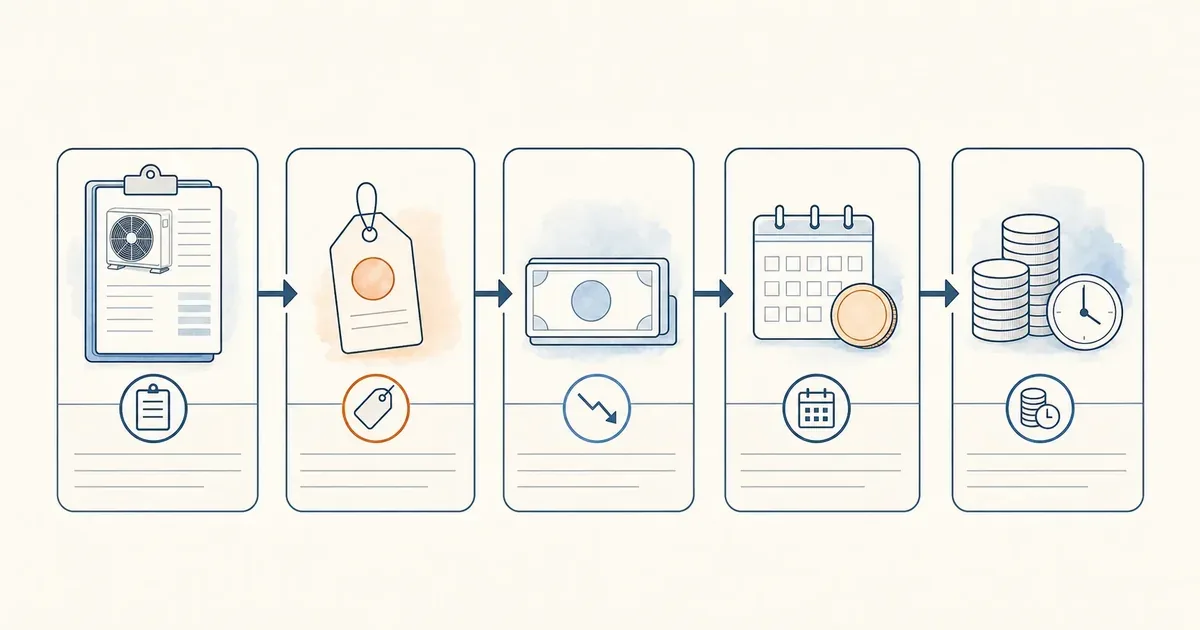
Monthly payment is only one line in the financing decision. Fill in the same fields for every offer, including the dealer's financing and any local program. The visual below follows the calculation from the installed quote to the amount financed and the total repaid.
| Worksheet line | Your offer | Clearly illustrative example |
|---|---|---|
| Full installed cash price | $_____ | $18,000 |
| Upfront rebate shown on the invoice | $_____ | -$2,000 |
| Down payment | $_____ | -$1,000 |
| Amount financed before fees | $_____ | $15,000 |
| Fees rolled into the balance | $_____ | $300 |
| Starting principal | $_____ | $15,300 |
| APR and rate type | _____ | 8.99% fixed |
| Term | _____ | 60 months |
| Promotional end date | _____ | None |
| Collateral or filing | _____ | Unsecured, per offer |
| Estimated monthly payment | $_____ | About $317.53 |
| Total of scheduled payments | $_____ | About $19,051.72 |
| Upfront cash paid | $_____ | $1,000 |
| Later rebate or tax item, with timing | $_____ | $0 federal 25C for a new 2026 install; local program pending |
| Total project outlay, including financing | $_____ | About $20,051.72 |
The example works like this: $18,000 - $2,000 - $1,000 + $300 = $15,300 financed. At an illustrative 8.99% fixed APR over 60 months, the estimated payment is about $317.53 and the scheduled payments total about $19,051.72. Add the $1,000 down payment for about $20,051.72 paid over time. The example includes about $300 in fees and about $3,751.72 in interest on the $15,300 principal. Actual lender calculations, payment dates, and fees can differ.
For a promotional offer, calculate the amount needed to clear the balance before the end date. A $10,000 balance over 12 months requires $833.33 per month before fees if the product uses equal payments and no interest. A deferred-interest product can show no interest during the promotion and then apply interest back to the purchase date if the balance remains. The CFPB's promotional-interest guidance (reviewed September 23, 2026) explains why the minimum payment is not a reliable payoff plan.
Rebates and the 2026 tax-credit status
Separate money that lowers the invoice today from money that might arrive later. A point-of-sale rebate can reduce the principal before interest accrues. A rebate paid after installation may arrive after the loan starts, so record its timing rather than subtracting it from today's payment.
For a new 2026 installation, do not put the former federal 25C heat-pump credit into the worksheet as a current benefit. The IRS energy-credit guidance (retrieved September 23, 2026) says qualifying improvements had to be placed in service by December 31, 2025. The 2025 Form 5695 instructions (retrieved September 23, 2026) say energy-efficient home-improvement credits do not apply to property placed in service after December 31, 2025.
That means the former $2,000 annual heat-pump credit is historical for this guide's 2026 financing examples. A system placed in service during 2025 belongs to the 2025 tax-year rules and the applicable IRS form instructions. The IRS says the credit is claimed for the tax year when the property is installed, and it also explains that some subsidies and rebates reduce qualified expenses. Keep the invoice and equipment information with the project records, and use current IRS instructions for any filing question.
State, utility, and installer-offered incentives may affect a 2026 quote, but each has its own eligibility and timing. Our guide to stacking rebates and tax credits explains why two incentives should not be combined in the worksheet until their rules and payment timing are clear.
What a comparable offer should show
We treat two offers as comparable only when they describe the same installed scope and disclose the same financing fields. Use this short list when a contractor or lender gives you a payment first:
- Scope: equipment model or class, labor, removal, permits, electrical work, duct changes, controls, and any required insulation or air sealing
- Price: cash price, financed price, down payment, rebate deduction, and amount actually financed
- Rate: fixed, variable, promotional, or deferred-interest APR, plus the end date and post-promo rate
- Repayment: term, required payment, total scheduled payments, late fees, and prepayment rules
- Security: unsecured status, home collateral, lien, UCC or fixture filing, and any transfer rule if the home is sold
- Eligibility: credit, income, utility service area, equipment efficiency, approved contractor, and application deadlines
- Assumptions: estimated energy savings, future rebates, or tax benefits shown separately from guaranteed price reductions
For quote quality, use our questions to ask an HVAC contractor guide. If the quote depends on lower electricity costs, compare the assumption with our heat pump electricity cost guide. If the project replaces a furnace, our gas furnace replacement cost guide helps separate equipment scope from the payment decision.
Which route usually fits the situation?
- Urgent replacement: Put the dealer offer beside a fast personal loan. Convenience has value, but compare the post-promo APR and the full installed price before signing.
- Planned, stable project: Compare a personal loan with a home equity loan. The first avoids home collateral; the second may offer a different rate and term but adds secured-debt risk and closing costs.
- Uncertain or phased scope: A HELOC or a program that allows staged draws can match the work sequence. Model the rate change and the repayment-period payment, not only the first draw.
- Strong local program: Put the utility or state option at the top of the comparison sheet. Contractor and service-area rules determine whether the program can fund the whole quote.
- Large expected rebate: Reduce the financed amount only when the incentive is documented as an invoice credit or approved payment. A later rebate can be used in a separate payoff scenario, subject to the loan's prepayment terms.
FAQ
Can you combine heat pump financing with rebates?
Often, yes. The financing method usually does not decide rebate eligibility. Equipment, installer, property, utility, income, and timing rules do. An upfront rebate can reduce the amount financed; a later rebate does not erase interest that accrues before the payment arrives.
What credit score do you need for heat pump financing?
There is no universal score. Lenders and programs use different credit, income, debt, and property rules. As one dated example, Efficiency Maine's loan table (retrieved September 23, 2026) lists minimum average FICO scores of 620 for its standard home-energy-loan underwriting and 580 for its income-based option, with different debt-to-income limits. Those are program rules, not a promise about another lender or state.
Is 0% financing the same as deferred interest?
No. An equal-payment 0% APR offer and a deferred-interest promotion can have different contracts. Deferred interest can be charged back to the original purchase date if the balance is not cleared in time. Record the end date and the payoff amount required each month.
Are there government or utility loans for heat pumps?
Some states, utilities, cooperatives, and clean-energy administrators offer loans or on-bill products. The DOE program page (retrieved September 23, 2026) says its rebates are available in select states, and state programs set their own loan terms and contractor rules. A federal rebate overview does not mean a loan is available in every ZIP code.
How does project size change the amount financed?
Every eligible line item changes the principal, and a larger scope can reach a program cap or require another loan product. Ask for separate prices for the heat pump, electrical work, duct changes, permits, and other measures. Then run the worksheet with the confirmed rebate and fee treatment for each scope.
Is the federal heat-pump tax credit available for a 2026 installation?
The IRS pages retrieved September 23, 2026 state that the Energy Efficient Home Improvement Credit applied through December 31, 2025. This guide does not count the former 25C heat-pump credit as a current benefit for a new 2026 installation.
Bottom line
Start with the full installed price, then subtract only the incentive that is documented to reduce that price. Compare the remaining principal across a contractor offer, an unsecured loan, a home equity loan, a HELOC, and any utility or state program available at the property. Read the rate type, fees, security, contractor rules, and total repayment together.
When you are ready to identify local programs, start with our heat pump rebates by state guide, then bring the confirmed terms into the worksheet before choosing how much to borrow.