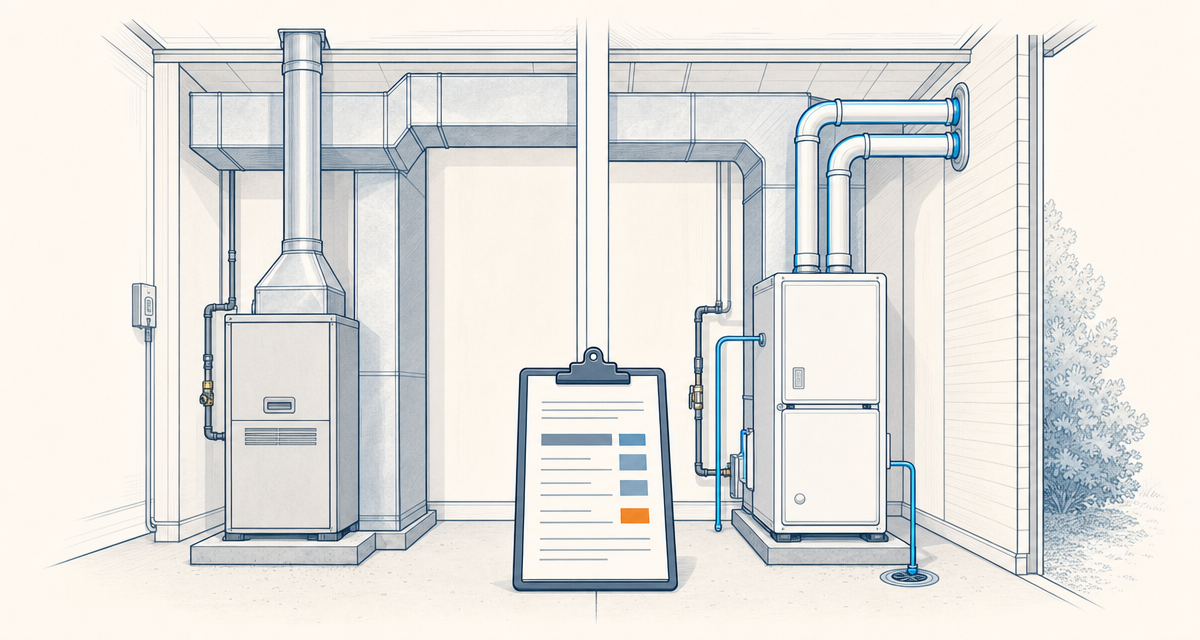
Use an itemized contractor quote to decide what a furnace replacement will cost in your home, and use modeled 2023 values as a benchmark.
The National Renewable Energy Laboratory (NREL) lists one defined gas-furnace retrofit in its 2023 Reference data at $3,561 low, $3,861 mid, and $4,526 high in 2023 dollars. That entry uses an 80,000-Btu/h, or British thermal units per hour, gas unit rated at 90% annual fuel utilization efficiency (AFUE), a measure of seasonal fuel-to-heat efficiency. It is a modeled reference value, not a national price range or a quote for your home.
This is general cost and planning information, not tax, electrical, building-code, or safety advice. A licensed heating, ventilation, and air conditioning (HVAC) contractor and your local permitting authority should confirm the requirements for your home.
Furnace replacement cost benchmarks from NREL
Treat an installed cost as the equipment plus the stated work to remove, connect, start up, and test it. The exact scope varies by home.
The NREL Building Technologies Baseline dataset labels the following as Typical Retrofit Installed Cost ($2023) for its 2023 Reference entries. Its low, mid, and high columns are shown exactly as modeled. Here, kBtu/h means thousands of Btu/h.
| NREL 2023 Reference furnace | Low | Mid | High |
|---|---|---|---|
| Gas-fired furnace, 80 kBtu/h, 90 AFUE. | $3,561. | $3,861. | $4,526. |
| Electric resistance furnace, 68 kBtu/h, 100 AFUE. | $3,002. | $3,198. | $3,394. |
| Oil-fired furnace, 105 kBtu/h, 85 AFUE. | $4,723. | $5,350. | $5,976. |
The figures give an independently published benchmark for three defined retrofit specifications in 2023 dollars. They do not set a universal installed-price range, a current dollar budget, or a price for a different capacity, efficiency rating, location, or installation scope.
NREL lists prevailing local wages, drive time, code requirements, access, existing venting, electrical or gas connections, duct condition, and whether heating and cooling are handled together among its cost-variation considerations. An itemized contractor quote is still needed to price those conditions in your home.
Price a new outdoor air conditioner and its indoor coil, the part of a central air conditioner that sits near the furnace, as separate work. Major duct replacement, an electrical-panel upgrade, hazardous-material work, or wall repair also needs its own line in the proposal.
Compare quotes before comparing totals
A scope is the exact work included in a price. An allowance is a placeholder amount for work that remains uncertain. A change order is a written addition or change to the contract.
Compare totals only after every proposal identifies the same work.
| Quote section | What it should state |
|---|---|
| Furnace equipment. | Exact model number, fuel, efficiency rating, and heating capacity in Btu/h. |
| Removal and installation. | Removal and disposal, a filter holder, duct-connection pieces, a platform or stand, and cabinet changes. |
| Gas, venting, and drains. | Gas-line work, shutoff, vent material and route, where any vents end outside, and any drain or pump for water produced by the furnace. |
| Ducts and cooling. | Duct changes, sealing, airflow adjustments, and whether the indoor coil or outdoor air conditioner stays. |
| Electrical and controls. | Circuit work, thermostat, a switch that turns the unit off if its drain backs up, and optional accessories. |
| Permits and completion. | Permit fees, inspection coordination, start-up, required tests, warranty terms, and exclusions. |
| Open costs. | The trigger, amount, and approval process for every allowance or change order. |
Sort each proposal into four columns: equipment, required installation, optional upgrades, and possible price changes. This makes omissions and different scopes easier to spot. Our HVAC contractor questions help you request the missing details before choosing a bidder.
What can change a furnace quote
A replacement can need more work than a direct equipment swap. Ask for a separate line item when any of these conditions apply.
A condensing furnace captures additional heat from its exhaust and produces condensate, water that needs a route for disposal. The selected model determines whether a high-efficiency gas furnace uses this design.
| Condition | What the proposal should identify |
|---|---|
| A high-efficiency gas furnace. | Whether the selected design needs dedicated exhaust venting, a combustion-air pipe, which brings outdoor air to the furnace for combustion, and, for a condensing furnace, a way to manage the water it produces, plus any wall or roof work. |
| The furnace and water heater use the same chimney. | Whether the replacement changes the water-heater vent or chimney, based on the appliances, existing vent, code, and selected furnace design. |
| An attic, crawlspace, or tight closet. | Extra access labor, a platform, or equipment relocation. |
| A duct problem or poor air movement. | The ducts involved, the problem found, and the correction included. |
| An aging air conditioner or indoor coil. | Separate prices for the furnace, indoor coil, outdoor unit, connecting lines, ducts, and controls. |
| A switch from gas to electric heat or a heat pump. | Required circuits, the home's available electrical capacity, and any panel work. A heat pump moves heat to provide both heating and cooling. |
ENERGY STAR says typical duct systems lose about 20% to 30% of the air moving through them to leaks, holes, and poor connections. The proposal should identify the air-movement problem, the ducts involved, and the work included to correct it.
Why a high-efficiency gas furnace can cost more to install
AFUE describes how efficiently a gas furnace turns fuel into heat over a heating season. It does not describe the condition of the duct system or the work included in a quote.
Depending on the furnace design and the home, a condensing-furnace installation may need dedicated venting and condensate management. An installation designed to draw combustion air directly from outdoors uses a combustion-air pipe.
The Department of Energy's furnace cost analysis accounts for furnace venting, combustion-air intake when the design draws air from outdoors, condensate handling, and possible water-heater vent changes. Those are potential scope items, not automatic work on every condensing-furnace replacement.
Some older setups use one chimney for a non-condensing furnace and a natural-draft gas water heater. If a condensing furnace replaces the older furnace, the water heater may become the only appliance on the existing chimney. This is sometimes called an orphaned water heater. Whether it needs a new connector, a resized vent, or a chimney liner depends on the water heater, chimney, local requirements, and replacement design.
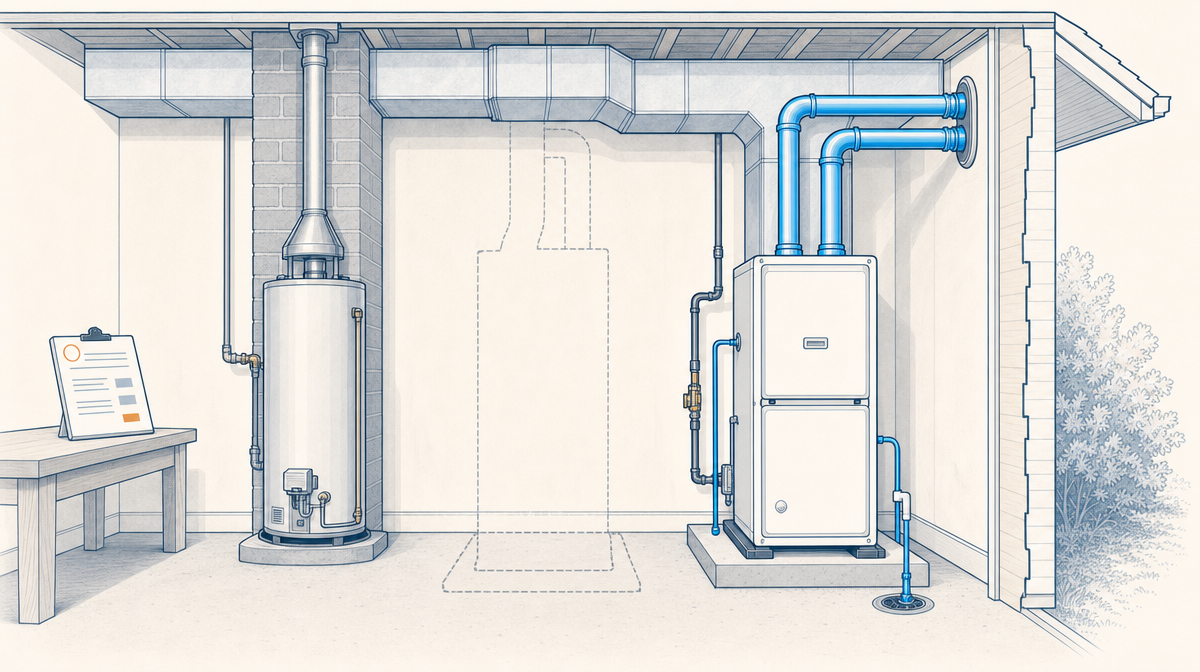
This illustration shows one possible scope, not every installation. The quote should state whether dedicated venting and condensate management are needed, and whether the water heater or chimney needs changes.
Ask the contractor to identify the furnace vent route, the condensate drain or pump, and the effect on any water heater that shares the existing chimney before you sign.
Size the furnace for your home before comparing price
Furnace capacity is shown in Btu/h. It describes how much heat the furnace can deliver each hour. The right capacity depends on the home's heat loss in local winter conditions.
A Manual J load calculation estimates the heating and cooling a particular home needs. It uses the local climate, insulation, windows, air leakage, and floor area. The Manual J standard is a nationally recognized method for residential HVAC sizing.
Ask each contractor for the load-calculation result, the proposed furnace's heat output, and any duct work needed to support it. Those details are more useful than a square-foot rule of thumb.
The equipment label can show two capacity numbers. Input is the fuel the furnace uses each hour. Output is the heat it can deliver. For example, an 80,000-Btu/h gas furnace at 80% AFUE delivers about 64,000 Btu/h. At 95% AFUE, it delivers about 76,000 Btu/h. Compare output rather than the larger input number.
Repair, replace, or price a larger project
Age matters, though it cannot settle the decision alone. ENERGY STAR's replacement guidance identifies a furnace older than 15 years, frequent repairs, rising energy bills, and uneven comfort as reasons to consider replacement or a wider HVAC improvement.
Compare a documented repair and a replacement when:
- A major part has failed or the same repair keeps returning.
- Rooms remain uncomfortable or energy bills are rising.
- The outdoor air conditioner or indoor coil is also near the end of its useful life.
When replacement follows a diagnosis, request the diagnosis, repair option, remaining warranty, and full replacement scope in writing.
When to compare a furnace, air conditioner, and heat pump
In a split central-air system, the furnace shares an indoor cabinet and blower with the air conditioner. When the indoor coil or outdoor unit needs replacement, price the work as a larger HVAC project.
Dual fuel means a heat pump paired with a furnace. The heat pump provides heating and cooling, while the furnace supplies heat when the system calls for it.
| Project | When it fits | Price these items separately |
|---|---|---|
| Furnace only. | The air conditioner and indoor coil are working and compatible. | Furnace, venting, drainage, ducts, permits, and electrical work. |
| Furnace plus air conditioner. | The indoor coil or outdoor cooling unit also needs replacement. | Furnace, indoor coil, outdoor unit, connecting lines, ducts, and controls. |
| Heat pump plus furnace, or dual fuel. | Cooling equipment is due and you are considering an electric heating upgrade. | Heat-pump equipment, furnace, electrical work, ducts, backup heat, and incentives. |
When the air conditioner needs replacement, include a heat-pump alternative if the home's climate, fuel costs, and electrical scope make it a practical option. Our gas-to-heat-pump comparison separates the cost of a conversion from a furnace-only replacement. Electrical upgrades need their own line, and our electrical panel cost guide helps frame that part of the project.
Keep incentives outside the contract price
An incentive is a rebate, discount, or tax-related benefit that can reduce your final cost when your project meets the program's rules. Keep it separate from the contractor's installed price.
Placed in service means installed and ready to use. The former federal Energy Efficient Home Improvement Credit applied to qualifying property placed in service through December 31, 2025. A furnace placed in service in 2026 does not qualify for that former credit. The IRS credit guidance explains the former timing and equipment rules.
Utility and state incentives vary by program, equipment, location, and application timing. List the program name, equipment requirements, application timing, and expected amount separately from the contract price. For a heat-pump alternative, our state rebate guide helps you find the applicable program path.
Frequently asked questions about furnace replacement cost
How much does a new furnace cost for a 2,000-square-foot house?
NREL's 2023 Reference gas-furnace entry is for an 80-kBtu/h, 90-AFUE retrofit, not a 2,000-square-foot home. It reports $3,561 low, $3,861 mid, and $4,526 high in 2023 dollars. A 2,000-square-foot house can need different equipment because a load calculation, ducts, venting, equipment location, and local labor affect the scope.
Does a 95% furnace cost more to install than an 80% furnace?
It can when the selected 95% model is condensing and the home needs different venting or condensate management. The actual scope depends on the equipment, the home, any shared chimney or water heater, and local requirements. Ask for each change as a separate line item.
Should I replace the air conditioner with the furnace?
Price the furnace and air conditioner together when the indoor coil or outdoor unit is also due for replacement. Include a heat-pump alternative when the home's climate, fuel costs, and electrical scope make a heat-pump system practical.
Before you sign
Set your decision on a scope that reflects your home, then sort every proposal into equipment, required installation, optional upgrades, and possible price changes. Use our HVAC contractor questions to ask for those details before signing a contract.