Last reviewed: 2026-09-29 (UTC)
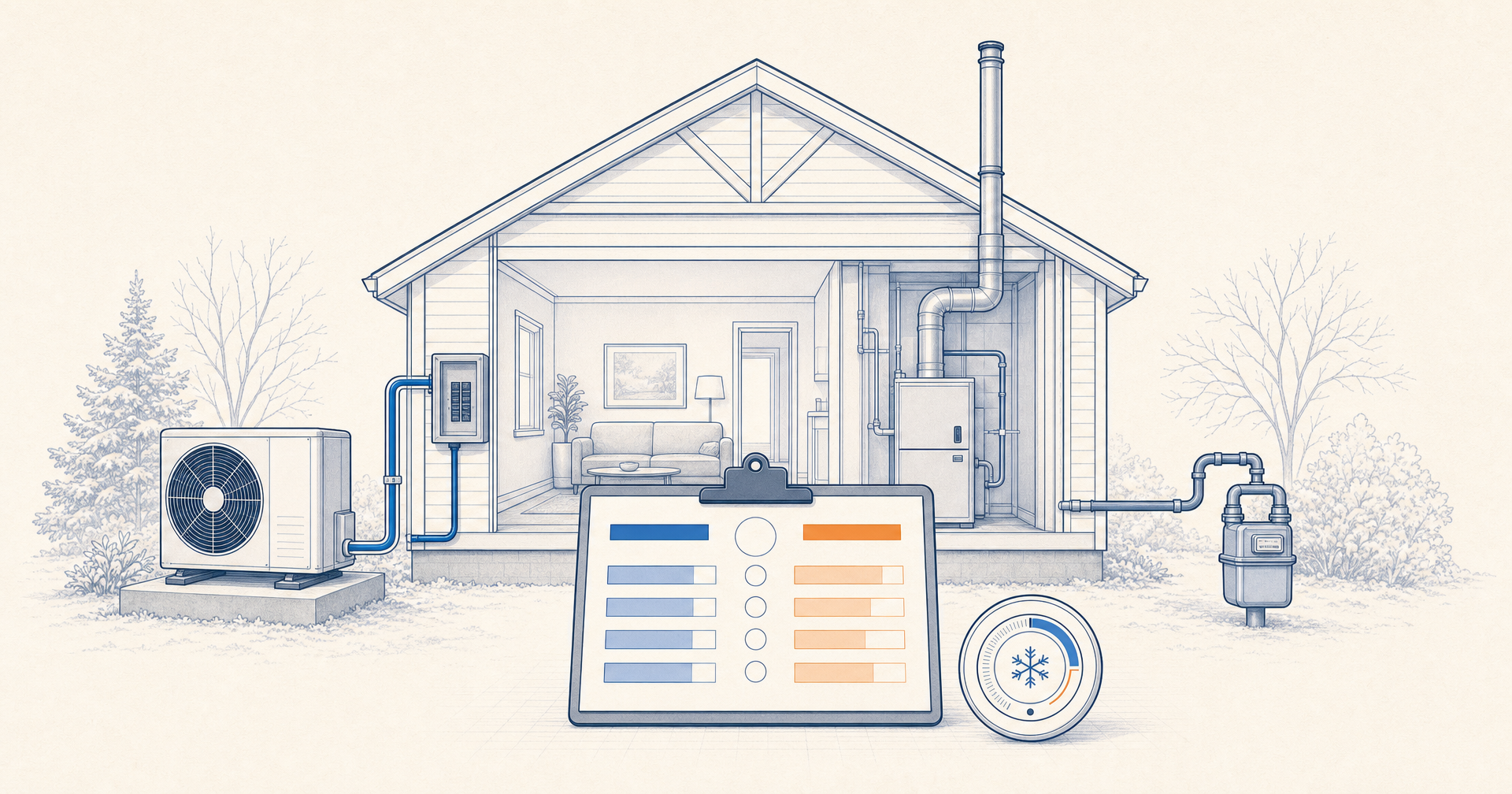
Use this comparison to choose the replacement scope that fits your climate, utility rates, comfort needs, and house infrastructure.
When both systems are due for replacement, price a heat pump if the home supports electrical work and the model covers local winter load. A gas furnace is simpler when only the furnace needs replacement and the air conditioner remains viable. In some homes, a dual-fuel system deserves a third quote.
Important: This is general information, not HVAC, electrical, code, tax, or financial advice. A qualified contractor and the official program source should make the final equipment, safety, permit, and incentive determinations.
Heat pump vs. furnace at a glance
| If your situation looks like this | The path to price first | Why |
|---|---|---|
| Your gas furnace and central air conditioner both need replacement, and your ducts are usable. | An all-electric heat pump. | One system can provide heating and cooling, so the fair alternative is a furnace plus a new air conditioner, not a furnace alone. |
| Only the gas furnace has failed, while the air conditioner has useful life remaining. | A gas furnace, then a heat-pump conversion quote if cooling replacement is near. | A furnace-only project has a smaller immediate scope. Replacing a working air conditioner changes the comparison. |
| Winter temperatures are severe, electricity is costly, or the home needs another source for the coldest hours. | A heat pump plus gas furnace, also called dual fuel. | The system can use the heat pump during suitable conditions and the furnace when the agreed switchover point is reached. |
| You have an electric-resistance furnace. | A heat pump. | A resistance furnace makes heat directly from electricity. A heat pump moves heat, which can greatly reduce electricity use for the same heating job. |
Most searches for furnace vs. heat pump, heat pump vs. gas furnace, or gas furnace vs. heat pump mean a gas furnace. An electric furnace is a different comparison.
Heat pump vs. electric furnace
An electric furnace uses resistance elements rather than gas combustion. In its Energy Saver guide, the U.S. Department of Energy (DOE) estimates that heat pumps can use about 50% less electricity for heating than electric furnaces or electric baseboard heaters. Actual use depends on the model, winter weather, backup heat, and the home.
Compare the full replacement scope before comparing prices
Furnace vs. heat pump cost becomes misleading when the quotes solve different problems. A gas furnace makes heat only. When cooling is also due for replacement, a heat pump's direct competitor is a furnace plus a central air conditioner.
| Quote path | Equipment scope | House-side scope that can move the price |
|---|---|---|
| Furnace only | Gas furnace, reusing the existing air conditioner when it has useful life. | Gas piping, venting, drain work, blower compatibility, permits, and any duct repairs. |
| Furnace plus air conditioner | Gas furnace and new central AC. | The furnace items above, plus outdoor equipment, refrigerant lines, electrical work for AC, and controls. |
| All-electric heat pump | Outdoor heat pump with a matched indoor air handler or coil, plus any electric backup heat. | Branch circuit, disconnect, electrical capacity, ducts, condensate, outdoor location, permits, and controls. |
| Dual fuel | Heat pump paired with a gas furnace. | Both gas and electrical scope, matched controls, switchover settings, and a clear responsibility for system integration. |
An itemized quote should separate equipment from duct, electrical, gas, permit, and incentive assumptions. A low total that omits line-set work, a new circuit, airflow corrections, or old-equipment removal is not a lower-cost version of the same project.
For a gas-to-electric replacement budget, use our gas-furnace conversion guide to separate the HVAC equipment from the duct and electrical scope.
Heat pump vs. gas furnace operating cost: compare delivered heat
Nameplate efficiency alone cannot answer whether a heat pump or gas furnace costs less to run. The useful question is the cost of one million British thermal units (Btu), or one MMBtu, of heat delivered into the home.
- Coefficient of performance, or COP, is heat delivered divided by electricity used at a stated condition. A COP of 2.5 means the heat pump delivers 2.5 units of heat for each unit of electricity it consumes.
- Annual fuel utilization efficiency, or AFUE, is the share of furnace fuel that becomes usable heat over a typical year. A 95% AFUE furnace turns 95% of its fuel energy into delivered heat.
The U.S. Energy Information Administration (EIA) converts one kilowatt-hour (kWh) to 3,412 Btu and one therm to 100,000 Btu. Its conversion factors support the delivered-heat formulas below.
| System | Cost for one MMBtu of delivered heat |
|---|---|
| Heat pump | 293 × electricity price ($/kWh) ÷ seasonal COP |
| Gas furnace | 10 × gas price ($/therm) ÷ AFUE |
For a rate snapshot, EIA reported a nationwide residential electricity average of 18.34 cents per kilowatt-hour in June 2026 and a residential natural-gas price of $24.09 per thousand cubic feet for the same month. June electricity data and the natural-gas price series provide those figures. Using EIA's sample heat content of 1,036 Btu per cubic foot, that gas price is about $2.33 per therm.
| Example using those June 2026 national figures | Delivered heat cost |
|---|---|
| 95% AFUE gas furnace | About $24.48 per MMBtu. |
| Heat pump at seasonal COP 2.2 | About $24.43 per MMBtu. |
| Heat pump at seasonal COP 2.5 | About $21.50 per MMBtu. |
The near tie at a COP of 2.2 shows why fuel labels do not settle the decision. These figures are a rate snapshot, not a winter-bill forecast. Your result changes with delivered rates and fixed charges, heating load, outdoor temperatures, the model's COP at those temperatures, and any electric-resistance backup heat.
Put the all-in electricity and gas rates from the relevant heating bills into the two formulas, then ask the contractor to state the heating-season COP assumption and backup-heat use behind any savings claim. For broader household-bill planning, our heat-pump electricity guide separates average-month math from winter peaks.
Cold-weather performance is a model-and-house decision
A heat pump operating at a low temperature is different from a heat pump carrying your home's full heating load at that temperature.
ENERGY STAR's Cold Climate designation gives a useful first screen. To qualify, a system must reach a COP of at least 1.75 at 5°F and retain at least 70% of its 47°F heating capacity at 5°F. See the cold-climate criteria. Those thresholds describe product performance. They do not prove that a particular model can heat a particular house without backup.
For a whole-home replacement, the quote needs to state:
- The local winter design temperature, meaning the outdoor temperature used to size the heating system.
- The home's calculated heating load at that temperature.
- The selected system's capacity and COP at that temperature, using the exact indoor and outdoor equipment pairing.
- Whether electric-resistance heat or the gas furnace supplies any shortfall, and the temperature or control logic that starts it.
A cold-climate heat pump can be a fully electric option in a cold region when its capacity covers the home's design-temperature load. If capacity falls short or local rates favor gas during the coldest hours, a dual-fuel design can be a better-fit quote. ENERGY STAR's buying guidance describes dual fuel as a heat pump paired with a gas or oil furnace, so either source can heat the home.
Comfort deserves the same attention as capacity. A gas furnace produces hotter-feeling air at the register. A heat pump commonly runs longer with lower-temperature supply air to hold a steady room temperature. Neither experience is automatically better. The useful comfort measure is whether rooms maintain the chosen setpoint without excessive noise, drafts, humidity problems, or auxiliary-heat surprises.
Electrical and gas infrastructure can decide the project
The equipment decision turns into an infrastructure decision when electrical or gas scope changes.
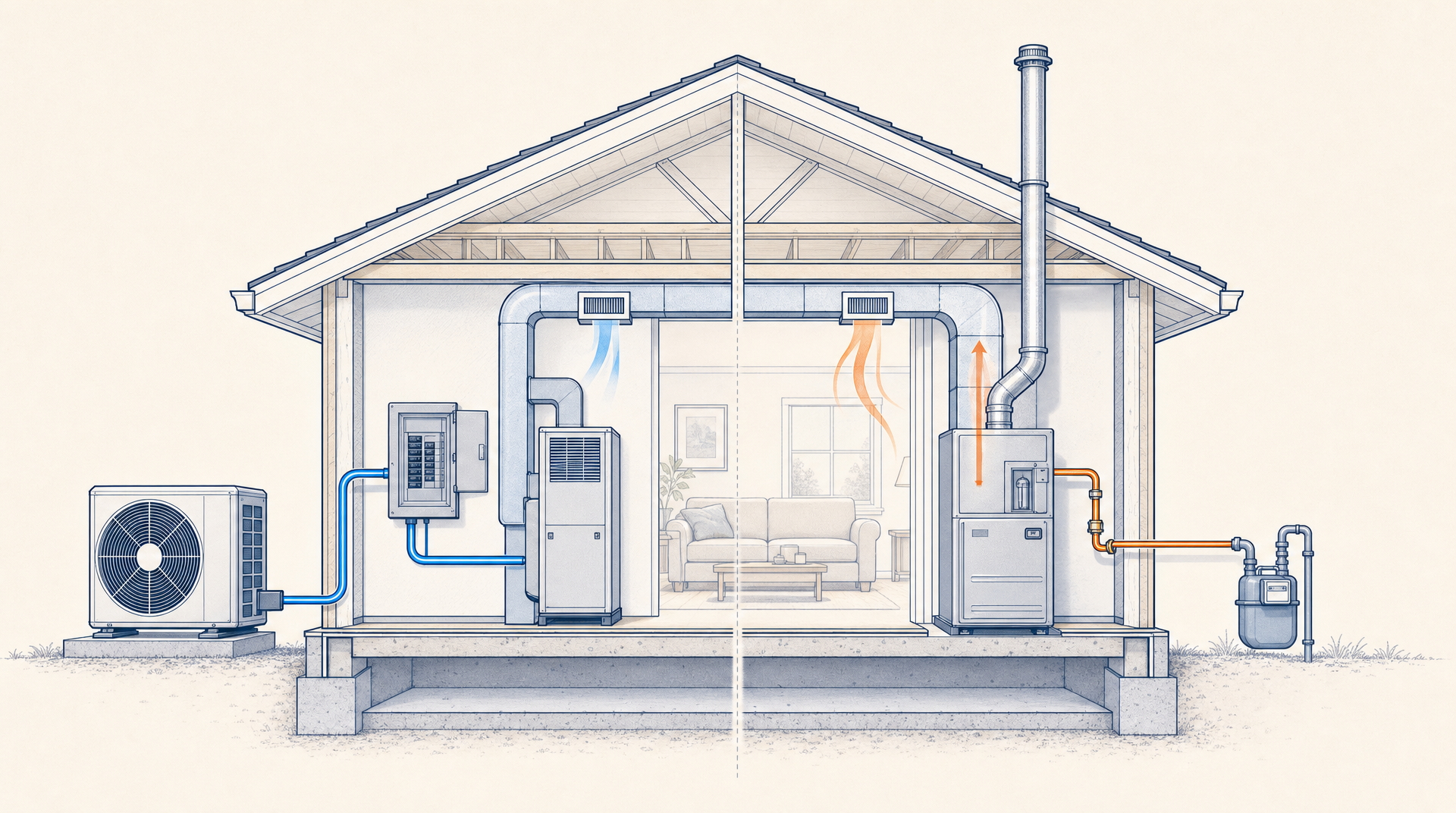
An all-electric heat pump needs a correctly sized circuit, disconnect, and enough electrical capacity for the matched equipment and any backup heat. When the service has spare capacity, scope can be limited to a new branch circuit. A crowded panel, limited service capacity, or competing future loads such as EV charging and electric cooking can expand it. A heat pump alone does not prove that a 200-amp upgrade is necessary.
A gas furnace needs gas piping, combustion venting, and safe burner operation. It also uses electricity for controls and the blower, and it still needs a separate air conditioner for cooling. If other gas appliances remain, replacing the furnace does not by itself end gas service or its fixed utility charges.
Have the electrical scope described separately from the HVAC scope. Our electrical panel replacement guide explains the difference between a breaker-space issue, a panel replacement, and a larger service upgrade.
Maintenance and lifespan: plan around condition, not a generic deadline
Both choices need routine filter care and professional service. ENERGY STAR recommends annual pre-season service and monthly filter inspection, cleaning, or replacement as needed for central air conditioners, furnaces, and heat pumps. Its maintenance guidance also calls for electrical, airflow, controls, drain, and combustion-related service where applicable.
The ownership pattern differs:
- A heat pump has outdoor and indoor components that serve heating and cooling, so its condition matters all year.
- A furnace serves the heating side. The air conditioner remains a separate equipment and maintenance decision.
- Duct leakage and poor airflow can weaken any forced-air system. For heat pumps, the National Institute of Standards and Technology (NIST) identifies duct leakage, refrigerant faults, oversizing, and low indoor airflow as significant energy-use risks in a commissioning-fault study.
Avoid treating a broad lifespan estimate as a replacement rule. ENERGY STAR says a professional evaluation is worth considering when a heat pump or air conditioner is more than 10 years old or a furnace is more than 15 years old, especially when repairs or utility bills are rising. Its replacement guidance frames age as one signal alongside condition and comfort.
Incentives can change net cost, but they do not make the system fit
Keep the gross contractor price, point-of-sale rebates, tax-time savings, and financing in separate lines. A confirmed point-of-sale rebate reduces the amount due to the installer. A tax credit, when one exists, affects tax filing later. Financing changes payment timing and interest, not the installed scope.
For a heat pump first placed in service in 2026, meaning installed and ready to use that year, do not include the former federal Energy Efficient Home Improvement Credit in a contractor's net-price promise. The IRS credit guidance says qualifying property had to be placed in service on or after January 1, 2023; the 2025 Form 5695 instructions confirm the credit ran through December 31, 2025, including that final day. Qualifying heat pumps had a credit limit of $2,000.
State, territory, Tribal, utility, and local programs can still matter. The Home Owner Managing Energy Savings (HOMES) program has a modeled path based on projected whole-home energy savings.
For an eligible single-family household below 80% of area median income, DOE's program rules set the standard rebate at the lesser of $8,000 or 80% of project cost. That tier requires projected energy savings of at least 35%.
That $8,000 figure is not a universal HOMES cap. An administering state or territory can request a higher limit for that income group, subject to DOE approval. Projects based on measured savings after installation use a different rebate calculation.
DOE's Home Energy Rebates page separately lists up to $14,000 across eligible upgrades through the High-Efficiency Electric Home Rebate (HEEHR) program and directs homeowners to state and territory offices for program status. Under DOE's May 2026 rules, the standard state and territory HEEHR path for HVAC replacements covers upgrades from existing electric equipment, rather than gas-to-electric swaps. Neither headline figure is a promised amount for an individual project.
Use our heat-pump rebates by state guide to reach relevant official program pages, then keep any confirmed rebate separate from the gross installed price in each quote.
What every replacement quote should make clear
Ask every contractor for the same details. A clear answer turns a sales total into a comparison you can use.
- The complete alternative. State whether the comparison is furnace only, furnace plus AC, all-electric heat pump, or dual fuel.
- The sizing basis. A Manual J load calculation estimates the heating and cooling the home needs. ENERGY STAR describes it as the tool contractors use to size a system for the home, and the Manual J standard explains its residential load-calculation role.
- The exact equipment pairing. Include indoor and outdoor model numbers, heating capacity at the design temperature, efficiency ratings, and warranty terms.
- The backup strategy. State electric-strip capacity or gas-furnace switchover settings, plus the expected conditions for operation.
- The house-side scope. Separate duct repairs, electrical circuit and panel work, gas and vent work, condensate management, outdoor pad or stand, permits, inspections, and old-equipment removal.
- The money assumptions. Show the gross contract price, each confirmed point-of-sale rebate, any tax-time assumption, financing terms, and operating-cost inputs on separate lines.
- The startup record. Include airflow, refrigerant procedure, controls, and any commissioning measurements the installer will document.
Frequently asked questions about heat pumps vs. furnaces
Is a heat pump cheaper to run than a gas furnace?
Sometimes. A heat pump's COP, local electricity price, natural-gas price, heating demand, and backup-heat use decide the answer. The delivered-heat formula above is more reliable than a national rule of thumb.
Can a heat pump replace a gas furnace in a cold climate?
Yes, when the selected cold-climate equipment has enough capacity at the local design temperature and the home is sized correctly. A dual-fuel system remains a valid choice when the capacity, rate, or comfort case favors retaining gas backup.
Is a heat pump better than an electric furnace?
For whole-home heating energy use, a heat pump is commonly the stronger option because it moves heat instead of making it directly with resistance elements. The selected system still needs enough cold-weather capacity, appropriate ducts, and an electrical scope that fits the home.
Why can a heat-pump bill be higher than expected?
Electric-resistance backup heat, high winter electricity rates, a leaky home, airflow problems, poor commissioning, and an oversized or poorly selected system can all raise use. A bill comparison needs the actual operating assumptions, not the equipment label alone.
Make the decision on the whole project
Choose a heat pump when it is a well-sized heating-and-cooling replacement with credible cold-weather performance, workable electrical scope, and operating-cost inputs that fit your rates. Keep or replace a gas furnace when its narrower scope is genuinely the project you need. Price dual fuel when the house or local economics make a second heating path useful.
Before you sign, use Watt Wallet's quote-comparison questions to turn every proposal into the same equipment, scope, and price categories.