Published: August 14, 2026
A heat pump and central air conditioner can look identical beside the house, yet choosing between them changes the home's winter heating plan. Cooling bills, installed cost, backup heat, and an existing furnace all affect the result. A sound decision compares like-for-like equipment, then applies your climate, utility rates, and contractor scope.
Heat pump vs. air conditioner: the short answer
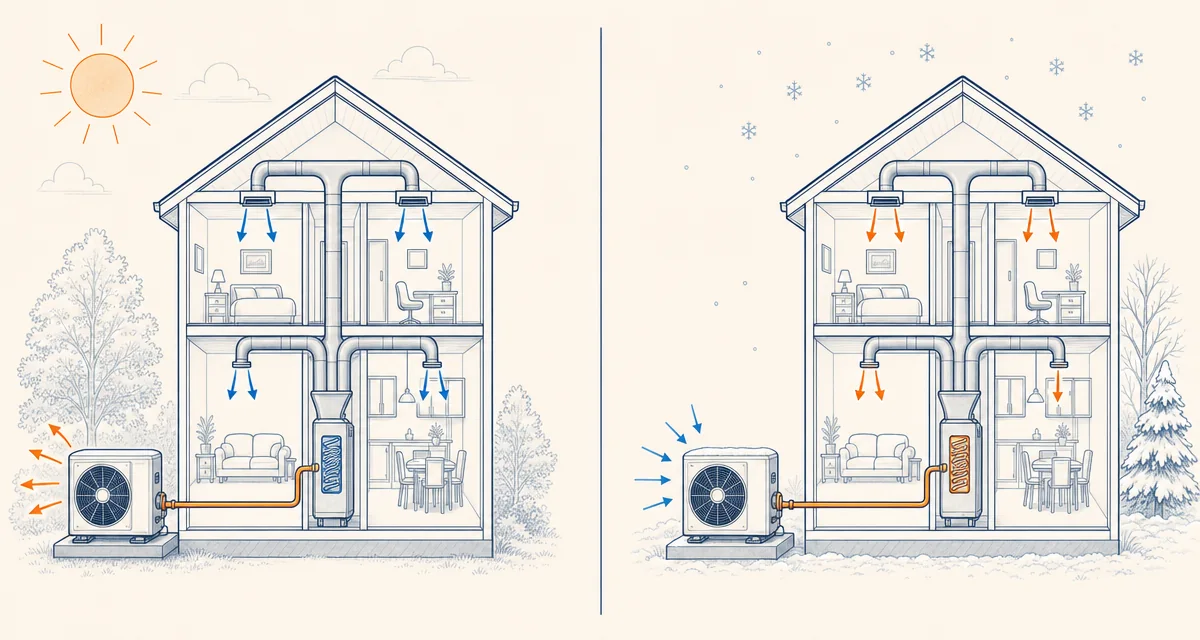
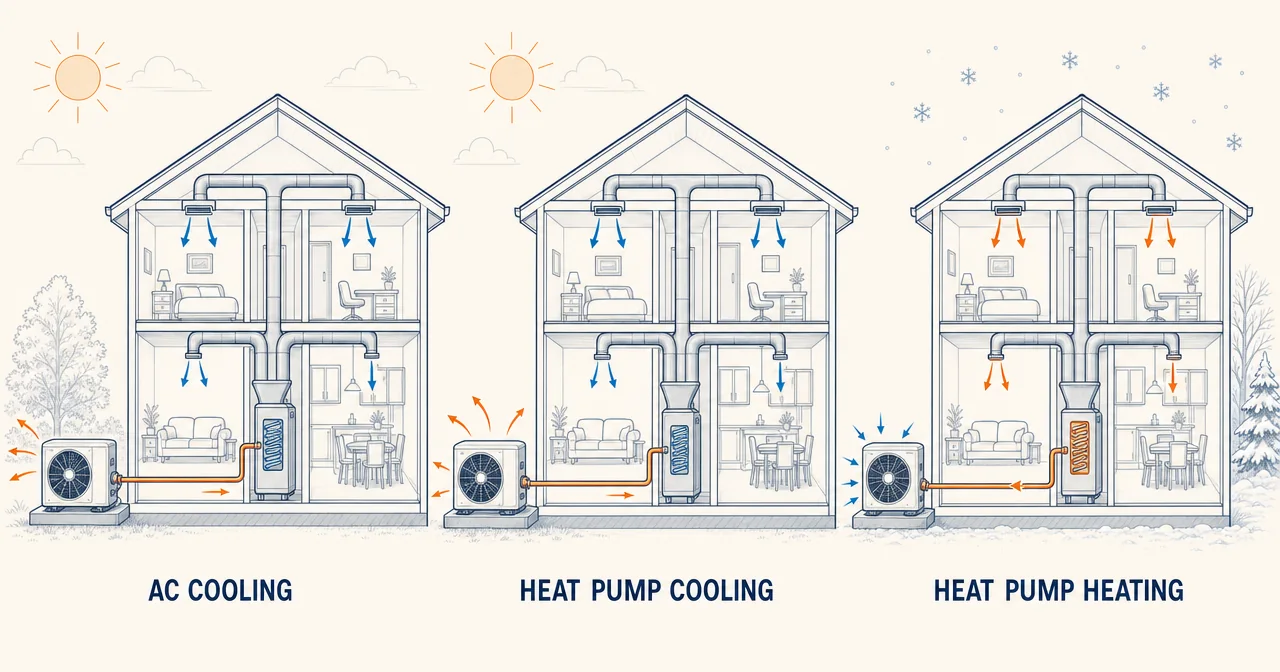
A central air-source heat pump is an air conditioner that can reverse its refrigerant cycle. Both systems cool and dehumidify the same way. At the same certified capacity and SEER2 rating, their cooling energy use is effectively the same. The heat pump can also heat the house, while an air conditioner needs a furnace or another separate heat source.
Our default choice is a heat pump when the heating capability has real value. That includes homes replacing electric resistance, oil, or propane heat, homes that need both heating and cooling equipment, and projects intended to remove onsite combustion. A straight air conditioner is often the lower-cost choice when a reliable, relatively new furnace will remain and the homeowner only needs cooling.
| Feature | Heat pump | Air conditioner |
|---|---|---|
| Cooling and dehumidification | Yes | Yes |
| Space heating | Yes | No |
| Cooling ratings | SEER2 and EER2 | SEER2 and EER2 |
| Heating ratings | HSPF2, COP, and low-temperature capacity | None |
| Separate heat source | Optional if designed for all-electric operation; furnace can provide dual-fuel backup | Required for winter heating |
| Typical like-for-like upfront cost | Usually higher than AC-only | Usually lower than heat-pump-only |
The condition of the equipment already in the home changes the best starting point:
| Your situation | Strongest starting point | Why |
|---|---|---|
| Air conditioner and furnace both need replacement | Heat pump sized for the home, with a defined backup plan if needed | One system can cover cooling and most or all heating |
| Air conditioner failed, newer gas furnace still works | Compare a straight AC with a heat pump using the furnace for dual fuel | The heat pump adds optional electric heating without discarding a useful furnace |
| Electric baseboard or electric furnace, oil, or propane heat | Heat pump | The project can add cooling while displacing some or all use of the existing heater |
| No usable ducts | Ductless heat pump | Adding central AC ducts solely for cooling can turn this into a much larger project |
| Cooling-only building in a climate with almost no heating demand | Air conditioner | Reversible heating may have little practical value |
A cold winter does not settle the decision by itself. Cold-climate heat pumps can serve cold regions, provided the exact model's low-temperature output matches the home's heating load. A gas furnace can also stay in the system as dual-fuel backup.
Compare whole systems, not two outdoor boxes
The outdoor cabinets hide most of the decision. A typical split-system air conditioner includes an outdoor compressor and coil, an indoor coil, and a blower that is often inside a furnace. The AC handles cooling. The furnace or another appliance handles heating.
An all-electric ducted heat pump uses a reversible outdoor unit and an indoor air handler. It may include electric resistance strips for supplemental or emergency heat. A dual-fuel system pairs the heat pump with a gas or propane furnace, using the heat pump during selected outdoor conditions and the furnace at a planned changeover point.
In cooling mode, either system absorbs heat and moisture at the indoor coil and releases that heat outdoors. In heating mode, a heat pump changes refrigerant flow so the outdoor coil collects heat and the indoor coil releases it. The Department of Energy's heat-pump systems explanation describes how a heat pump moves heat in each direction.
Central air-source equipment is the direct replacement choice in most quotes. “Mini-split” describes a system layout, usually without central ducts. Many mini-splits are reversible heat pumps, and cooling-only models also exist. Our ducted versus ductless guide covers that separate layout decision.
Cooling performance is a tie when the ratings match
Heat pumps have no built-in cooling-efficiency advantage over air conditioners. Compare the exact systems on these five items:
- certified cooling capacity at the relevant outdoor temperature;
- SEER2 for seasonal cooling efficiency;
- EER2 for rated-condition cooling efficiency;
- compressor type, such as single-stage, two-stage, or variable-speed; and
- the indoor coil or air handler included in the certified match.
A variable-speed heat pump may be quieter, hold temperatures more steadily, and remove humidity better than a basic single-stage AC. Those gains come from modulation, sizing, airflow, and controls. Variable-speed air conditioners can provide the same cooling benefits.
The indoor and outdoor model numbers matter together. AHRI certifies split systems as matched combinations, and its matched-system guidance recommends getting the AHRI reference number or certificate from the installer. That document gives the capacity and efficiency of the proposed combination. A high rating for an outdoor unit alone does not establish the installed system's rating.
Sizing affects both choices. Oversized cooling equipment may satisfy the thermostat before removing enough moisture, while undersized equipment may miss the setpoint during design weather. Require a Manual J calculation based on the home's insulation, leakage, windows, orientation, ducts, and local design temperatures. ACCA describes Manual J as the residential load standard. Manual S then uses those loads to select equipment with the needed heating, sensible cooling, and latent cooling capacity. A square-footage rule does neither job.
Heating capacity and local energy prices decide the heat-pump value
SEER2 answers the summer question. A heat-pump quote also needs HSPF2, low-temperature capacity, and coefficient of performance, or COP.
- HSPF2 is a seasonal heating-efficiency rating. It helps compare models, but it does not show output on the coldest night.
- Heating capacity shows how many Btu per hour the system can deliver at a stated outdoor temperature.
- COP divides delivered heat by electrical energy used at a stated condition. A COP of 3 means the system delivers three units of heat for each unit of electricity consumed.
Ask for the heat pump's maximum output and COP near the winter design temperature used in the Manual J report. “Operates down to -15°F” only identifies an operating boundary. It does not show that the unit can meet the house load there.
Two low-ambient parts of the ENERGY STAR cold-climate criteria are a COP of at least 1.75 at 5°F and at least 70% of the unit's 47°F heating capacity retained at 5°F. Those thresholds are only part of the designation. Product-type SEER2 and HSPF2 thresholds and a controls verification procedure also apply. The label is a useful filter, while the final design still needs model-level performance at the home's design condition. Our cold-climate heat pump guide explains how to compare that output with the load.
There are three valid backup paths:
- No installed backup: Suitable when the heat pump can meet the design load and local requirements allow it.
- Electric resistance backup: Simple to integrate with an air handler, but large heat strips can raise peak demand, operating cost, breaker size, and service requirements.
- Dual fuel: A furnace takes over below a capacity-based or cost-based changeover temperature. The controls and setpoint belong in the written scope.
Heat pumps also operate differently in winter. They often run longer and deliver lower-temperature air than a furnace. During cold, damp weather, the outdoor coil may defrost, producing water or visible steam. Outdoor-unit placement needs clearance from snow and a safe route for defrost water.
Installation cost depends on the bundle and equipment tier
Air conditioners usually cost less than comparable heat pumps when both are quoted as cooling replacements. Heat pump installation cost varies with equipment tier and project scope, so the premium varies much more than a national average suggests.
A 2026 Midwest pricing study analyzed 271 preliminary bids and final project invoices from Michigan, Illinois, and Minnesota. The data covered ducted retrofit projects from 2022 through 2025:
| Retrofit bundle | Sample | Mean bid/invoice cost | Bid/invoice cost range |
|---|---|---|---|
| Central AC only | 18 | $6,400 | $4,500 to $10,800 |
| Air-source heat pump only, connected to existing heating equipment | 84 | $9,800 | $5,600 to $16,500 |
| Central AC plus furnace | 14 | $13,500 | $9,100 to $18,700 |
| Heat pump plus furnace for dual fuel | 125 | $17,300 | $8,600 to $35,500 |
| All-electric heat-pump system | 30 | $17,900 | $10,900 to $30,000 |
Treat these figures as descriptive records, rather than a market price list. The records form an availability sample drawn from utility and cooperative programs, CEE staff and personal networks, and home-energy-audit recipients. It was not a random or representative sample of the Midwest or the United States. Several subgroups were small, including 18 AC-only records and 14 AC-plus-furnace records. Small AC samples may affect the observed means and narrower ranges.
The study retained necessary duct and electrical work, combined records from several years without inflation adjustment, and included different equipment mixes in each category. Its Illinois data also included 31 ASHP-only invoices from a pilot of coil-only variable-speed products that may cost less than traditional matched variable-speed systems. These scope, timing, and sample differences limit comparisons between rows.
The study's compressor comparisons apply only to its ASHP-only and AC-only samples. Among those records, 15 single-stage ASHP records averaged $8,000 and 14 single-stage AC records averaged $6,400, a $1,600 difference. The variable-speed means were $10,500 across 57 ASHP-only records and $10,800 for the sole variable-speed AC-only record. One AC observation cannot establish a general variable-speed price relationship. Compressor type was also unavailable for some records.
That equipment-tier issue matters in real quotes. Comparing a variable-speed cold-climate heat pump with a minimum-efficiency single-stage AC measures several upgrades at once. Ask each bidder for parallel options with the same capacity, compressor class, cooling efficiency, duct scope, electrical scope, thermostat, commissioning, and warranty.
Compare the gross installed prices before subtracting incentives. For equipment placed in service after December 31, 2025, the old federal Energy Efficient Home Improvement Credit is no longer available. The 2025 IRS instructions state that the credit cannot be claimed for property placed in service after that date. State, local, and utility rebates may still change the net cost, and eligibility can depend on the exact matched system, contractor, income, or approval timing.
Which system costs less to run?
For cooling, compare SEER2 and the same local electricity rate. A 16-SEER2 heat pump and a certified 16-SEER2 air conditioner need the same amount of electricity to remove the same seasonal cooling load under the rating procedure.
For heating, efficiency alone does not determine the cheaper fuel. Use the charges that change with consumption on each utility bill:
Heat-pump cost per million Btu delivered = electricity price in dollars per kWh × 293.07 kWh/MMBtu ÷ COP
Gas-furnace cost per million Btu delivered = gas price in dollars per therm × 10 therms/MMBtu ÷ AFUE as a decimal
EIA's current 2025 estimates put the U.S. average residential electricity price at 17.30 cents per kWh and residential natural gas at $15.34 per thousand cubic feet, or Mcf. EIA reports an average 2025 heat content of 1,037 Btu per cubic foot, so 1 Mcf equals 10.37 therms. The gas-price conversion is $15.34 ÷ 10.37 = $1.4793 per therm before rounding, or about $1.48. These current retail estimates are benchmarks, rather than the marginal rates on a specific utility bill.
| Heat source | Performance and price assumption | Cost per million Btu delivered |
|---|---|---|
| Heat pump | COP 2.0 | $25.35 |
| Heat pump | COP 3.0 | $16.90 |
| Heat pump | COP 4.0 | $12.68 |
| 95% AFUE gas furnace | About $1.48 per therm, calculated with unrounded $1.4793 | $15.57 |
| Electric resistance | COP 1.0 | $50.70 |
At those national benchmark rates, a heat pump needs a COP of about 3.26 to beat the 95% furnace on variable energy cost. The screen excludes furnace blower electricity, fixed charges, equipment, and maintenance. Real results differ because electricity and gas rates vary widely, heat-pump COP changes with outdoor temperature, and backup heat may run. Use a seasonal case and a cold-month case instead of one best-condition COP.
Fixed gas charges count only when removing the furnace or last other gas appliance lets the household close the gas account. Time-of-use electricity calls for the rate during heating hours or an interval-weighted average. Our heat pump electricity cost guide walks through the bill math in more detail.
Maintenance, comfort, and service are model-level questions
Air conditioners and heat pumps share filters, indoor and outdoor coils, blowers, refrigerant circuits, condensate drains, and electrical components. The basic cooling maintenance is the same. A heat pump also uses its outdoor equipment during winter and adds a reversing valve, defrost operation, and heating controls.
That extra seasonal use can add operating hours, but it does not support a universal lifespan penalty. Climate, run hours, sizing, installation quality, salt exposure, maintenance, and repair support create too much variation for a dependable “heat pumps last X years less” rule. Compare parts and labor warranties, local service capacity, and the price of major controls for the exact models.
ENERGY STAR recommends pre-season checkups for cooling in spring and heating in fall. An AC-and-furnace home still has two seasonal functions to maintain. An all-electric heat pump consolidates those functions in one refrigerant system.
Noise and humidity also belong at the model level. Compare published sound ratings at equivalent operating conditions, minimum compressor capacity, blower setup, and outdoor-unit placement. Reversibility by itself does not make a system quieter or better at dehumidifying.
Use this five-part test on contractor quotes
- Define what is being replaced. Record the age and condition of the AC, furnace, boiler, or resistance heat. A heat-pump premium has a different value when the heating system is also near replacement.
- Require the load and selection reports. Get Manual J and Manual S, including the design temperatures and the selected equipment's capacity at those conditions. Weatherization planned before installation should appear in the load assumptions.
- Compare certified systems. Require outdoor and indoor model numbers, the AHRI reference, SEER2, EER2, HSPF2, and compressor type. For a cold climate, add capacity and COP near the winter design temperature.
- Write down the winter sequence. Identify backup type and size, panel impact, thermostat, thermal balance point, and any dual-fuel changeover temperature.
- Normalize scope and price. Separate equipment, ducts, electrical work, permits, controls, commissioning, warranties, gross price, and each incentive. Our HVAC contractor checklist gives you the questions for that review.
Heat pump vs. air conditioner FAQ
Are heat pumps better than air conditioners?
Heat pumps are usually the better fit when their heating function can replace costly resistance, oil, or propane heat, or when both heating and cooling equipment need replacement. An air conditioner can be the better buy when a sound furnace will remain and the home only needs cooling.
Do heat pumps cool as well as air conditioners?
Yes. A heat pump and air conditioner with the same certified capacity, SEER2, EER2, compressor class, and matched indoor equipment should provide equivalent cooling. Sizing, airflow, and installation quality can create larger differences than reversibility.
Does a heat pump cost more upfront than an air conditioner?
Usually, when the comparison is a heat-pump-only replacement against a like-for-like AC-only replacement. The difference depends on equipment tier and project scope. Comparing an AC plus a new furnace with a heat pump is a different bundle and can change the result.
Do I need a furnace with a heat pump?
No. A properly selected heat pump can work as an all-electric system, with or without electric resistance backup. A furnace remains useful in a dual-fuel design when its capacity or operating cost makes it the planned backup at lower temperatures.
How long do heat pumps and air conditioners last?
There is no dependable universal lifespan figure or fixed gap between them. A heat pump may run in more seasons, while climate, sizing, installation, maintenance, corrosion exposure, and repair support all affect service life. Compare the exact models' warranties and local parts support.
Choose the heat pump when its heating capability solves a real need, the low-temperature design works, and the full cost comparison holds up. Choose the air conditioner when cooling is the only missing service and a sound heating system will remain. Before signing either quote, start with our heat pump rebate guide to find live programs without counting an expired federal credit.