Published: August 11, 2026
An old breaker panel can look quiet for decades and still fail during the one overload when protection matters. That is the concern with legacy Federal Pacific Electric Stab-Lok equipment. The name often surfaces during a home inspection, insurance review, or estimate for an EV charger or heat pump. The right plan identifies the equipment without exposing live parts, handles the safety risk first, then decides whether the house also needs more electrical capacity.
A confirmed FPE Stab-Lok panel belongs on the replacement list
At Watt Wallet, we treat a confirmed residential Federal Pacific Electric, or FPE, Stab-Lok panel as a safety replacement first. We would not add an EV charger, heat pump, resistance backup heat circuit, or other major load to it.
Schedule a licensed electrician to identify the exact equipment and quote either a complete panel replacement or a listed retrofit interior that replaces the old breakers and bus assembly. Do not remove the screwed-on dead-front cover, pull a breaker, or try to test tripping yourself.
The response becomes more urgent when the electrical system shows active warning signs:
| What you notice | What to do |
|---|---|
| Smoke, flames, active arcing, or sparks | Leave the home and call 911. Never use water on an electrical fire. |
| A burning odor, sizzling, crackling, buzzing, unusual heat, or scorch marks | Keep away from the panel and call the fire department or an emergency electrician. Do not touch the panel to see if it feels hot. |
| Frequent trips, dimming, or flickering without an active fire sign | Stop using the affected large loads and arrange a prompt electrical evaluation. |
| A confirmed FPE Stab-Lok label with no symptoms | Pause plans for new circuits and schedule replacement. A quiet panel has not proved that its breakers will trip correctly. |
Massachusetts fire-safety guidance places arcs, sparks, buzzing, and burning odors among the signs that warrant an immediate fire department call.
What a Federal Pacific Stab-Lok panel is
Federal Pacific Electric sold residential load centers and circuit breakers under the Stab-Lok name for decades. Many remain in houses built or rewired from the 1950s through the 1980s.
The safety concern centers on legacy Stab-Lok residential panels and breakers. It does not automatically apply to every industrial or medium-voltage product that has carried a Federal Pacific name. If the label says Federal Pacific but the product type is unclear, a licensed electrician should identify it before anyone chooses a remedy.
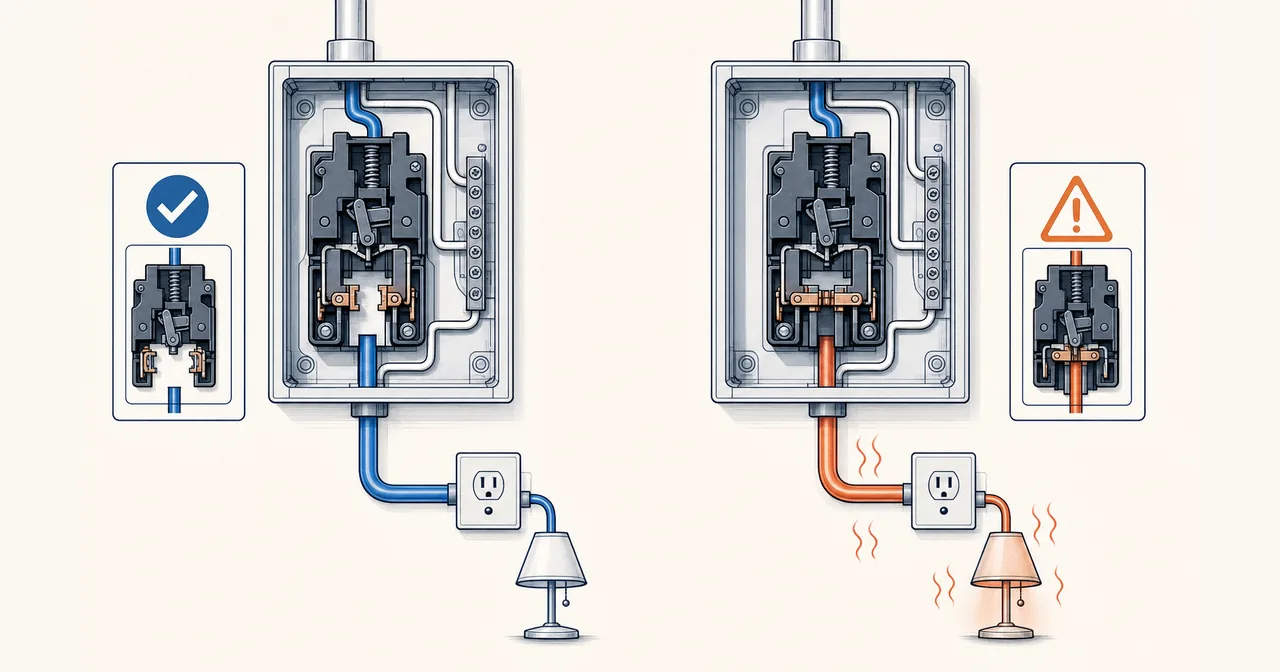
A branch-circuit breaker has one basic safety job. It must open the circuit when current rises above safe limits. A breaker that stays closed can let an overload continue heating wiring or equipment.
The U.S. Consumer Product Safety Commission confirmed that tested FPE breakers failed certain UL calibration requirements. Results varied widely with the breaker and test setup. In CPSC-sponsored testing of 122 two-pole breakers at 135% of rated current, 125 of 244 individual-pole trials did not trip (51%), while 31 of 122 both-pole tests did not trip (25%). The results appear in a CPSC-hosted technical report. A later IEEE study of several residential breaker lines found failure rates near 50% in the worst-performing lines, with some multipole samples never opening at any applied current.
Those percentages do not predict the condition of one breaker in one house. They show a repeated protective-device reliability problem. That distinction matters because the common claim that "one in three breakers fails" hides major differences among single-pole, double-pole, used, new, and differently tested samples.
How to identify a Federal Pacific panel safely
Identification starts with labels that are visible without removing internal covers.
- Look at the panel door and directory. Common markings include “Federal Pacific Electric,” “Federal Pacific,” or “FPE.”
- Open only the normal hinged outer door, and only when there are no heat, odor, sound, smoke, or arcing warnings. Look for “Stab-Lok” on the interior label or near the breaker area.
- Treat colored handles as a clue. Many Stab-Lok breakers have red or orange handle tips, but color and shape changed across models and production years. Handle color alone cannot confirm the brand.
- Photograph the label and breaker face from a normal standing position. Keep hands, tools, and the camera outside the panel opening.
- Have an electrician confirm the model. Missing labels, painted covers, replacement breakers, and altered interiors can make a visual guess unreliable.
The panel's dead front is the metal cover held by screws around the breakers. It shields energized parts that can remain live even when a main breaker is switched off. Leave that cover in place.
Why a normal-looking panel does not get a clean bill of health
An electrician can spot corrosion, scorching, loose connections, damaged insulation, and overheated bus components. A normal appearance still cannot demonstrate the current at which every breaker will trip.
North Carolina's Home Inspector Licensure Board tells inspectors that FPE Stab-Lok reliability has been questioned because of documented breaker and busbar failures. Its recommended inspection language says latent defects require work beyond the scope of a home inspection and calls for evaluation by a licensed electrical contractor.
Moving a breaker handle also proves very little. The toggle can click while the internal trip mechanism remains unreliable. Proper calibration testing requires specialized equipment and controlled current on each pole. Testing every old breaker usually costs more than removing the obsolete system, and it still leaves the old bus and connections in service.
The history of uneventful use offers little reassurance. Most breakers spend their lives closed and are rarely asked to interrupt a serious overload. A failure to trip becomes visible only when the protective function is needed.
There was no Federal Pacific panel recall
The CPSC opened an investigation in 1980 after FPE's parent company reported that many breakers did not fully comply with UL requirements. The agency closed the investigation in 1983. It lacked enough data to connect the calibration failures to a serious consumer-injury risk and estimated that a full investigation would cost several million dollars.
That closure was never a safety clearance. The CPSC later added a prominent note explaining that it closed the case without a safety determination or accepting the manufacturer's position.
The CPSC did not issue a recall, so its investigation created no recall-driven replacement deadline. “Illegal” is also the wrong nationwide test. Electrical code adoption and rules for alterations are local, and insurance underwriting can create a separate practical deadline. The absence of a recall should never be used as proof that an installed Stab-Lok panel is dependable.
A breaker swap is different from a real panel remedy
Compatible replacement breakers can still be found. Availability does not make a one-breaker swap equivalent to replacing the affected system.
| Option | What stays in service | When it fits |
|---|---|---|
| Replace one Stab-Lok breaker | The old enclosure, bus, connections, and every other breaker | A limited repair does not resolve the panel-wide concern. It should not be presented as a long-term safety remedy. |
| Install a listed retrofit interior | The sound metal cabinet may stay; the bus, breakers, trim, and internal assembly are replaced | Useful when removing an embedded cabinet would cause major wall work or in some multifamily installations. The exact kit, enclosure, inspector, and insurer must all accept the design. |
| Replace the complete panel | A new enclosure, bus, breakers, and cover replace the FPE load center | The usual single-family remedy, especially when the enclosure is damaged, the panel needs relocation, or no suitable retrofit exists. |
| Upgrade the electrical service | The panel is replaced and service conductors, meter equipment, or utility-side work may also change | Appropriate when a load calculation, equipment condition, or utility requirement shows that the house needs more capacity. |
Panel replacement typically requires a local electrical permit. The licensed contractor normally handles it and coordinates a utility disconnect when needed, although owner-permit rules vary by jurisdiction. Our panel permit guide explains the usual permit, inspection, and service-reconnection sequence.
What Federal Pacific panel replacement costs
The FPE label does not create one national price. Scope creates the price.
| Project scope | Broad planning range | Main cost drivers |
|---|---|---|
| Like-for-like panel replacement | About $518 to $2,190 | Breaker count, labor, wiring condition, permit, and code corrections |
| Straightforward upgrade, often to 200 amps | About $2,000 to $4,000 | Larger equipment, service conductors, grounding and bonding, meter work |
| Service or utility-heavy project | About $5,000 to $25,000 | Underground service, relocation, trenching, transformer work, and utility coordination |
These broad bands align with 2026 panel-replacement data and published panel and service estimates. Local labor and utility scope can move them sharply.
An FPE project can land above the low end because the new work may trigger grounding, bonding, surge protection, AFCI or GFCI protection, exterior disconnect, meter, or clearance requirements under the locally adopted code. Wall repair and panel relocation can add more.
Ask each electrician to separate these items in writing:
- complete panel replacement versus retrofit interior;
- existing and proposed service amperage;
- panel spaces and included breakers;
- grounding, bonding, and service-entrance corrections;
- meter and utility work;
- permit, inspection, disconnect, and reconnect fees;
- wall repair or relocation; and
- circuit labeling and final documentation.
New panel work placed in service in 2026 does not qualify for the federal Energy Efficient Home Improvement Credit. The IRS says Section 25C is unavailable for property placed in service after December 31, 2025. A qualifying 2025 project may still be claimed on a 2025 return filed in 2026. Our panel tax credit guide separates those two timelines.
Treat safety and electrification capacity as two decisions
Replacing an FPE Stab-Lok panel does not automatically mean buying 200-amp service. The old protective equipment needs a remedy. The correct service size depends on a code load calculation and the home's actual project plan.
Give the electrician a list of planned equipment and likely loads for the next several years:
- EV charging, including the charging current you actually need;
- the heat pump outdoor unit and any electric auxiliary heat;
- a heat pump water heater;
- an induction range or electric dryer;
- a hot tub, workshop, or accessory dwelling unit; and
- solar, battery storage, or backup-power equipment.
Then compare three scopes:
- Safe replacement at the current service size. This can work when the load calculation shows enough capacity. Choose a modern panel with enough spaces for planned circuits.
- Safe replacement plus managed loads. Dynamic EV load management can reduce charging when the rest of the house is busy. It can help a 100-amp or 150-amp service support useful charging. It cannot correct the breaker and bus concerns inside an FPE panel. Our EV load management guide explains where that approach fits.
- Panel and service upgrade together. This is the right scope when calculated demand, service condition, utility rules, or near-term projects exceed the existing service.
Empty breaker spaces do not prove that the service has electrical headroom. A panel with no open spaces may gain circuit space through a subpanel, while a panel with empty slots can still be at its calculated limit. Ask for the load calculation behind the recommendation.
Heat-pump planning needs the same discipline. The required circuit depends on the selected outdoor unit, indoor equipment, and resistance backup heat. Have the HVAC contractor and electrician coordinate equipment specifications before either one sizes the electrical scope.
Buying or selling a home with an FPE panel
An FPE panel does not automatically prevent a home sale, but it can affect the inspection response, negotiations, insurance, and closing schedule. A general home inspection is not a universal pass-or-fail test. An inspector may flag the panel and refer it to an electrician, while a permit inspector evaluates new work under the locally adopted code.
As a buyer, get an electrician's itemized replacement quote during the inspection period. Ask the insurance agent whether the carrier will bind coverage before replacement and what proof it needs after the work. Base any seller credit or repair request on the quoted scope, including permits and service work. A few replacement breakers are not the same deliverable as a new panel or listed interior retrofit.
As a seller, a permitted replacement can remove a recurring point of friction. Keep the paid invoice, electrician's license information, panel make and model, before-and-after photos, permit number, and final inspection record. Those documents help the buyer, future electrician, and insurer understand exactly what changed.
Build one plan for the old panel and the next major load
Resolve the Stab-Lok safety issue, size the replacement from a real load calculation, and finish with a closed permit and clear documentation. Before requesting bids, use our electrical panel replacement cost guide to build a quote-ready budget and compare the same scope across electricians.