Published: August 11, 2026
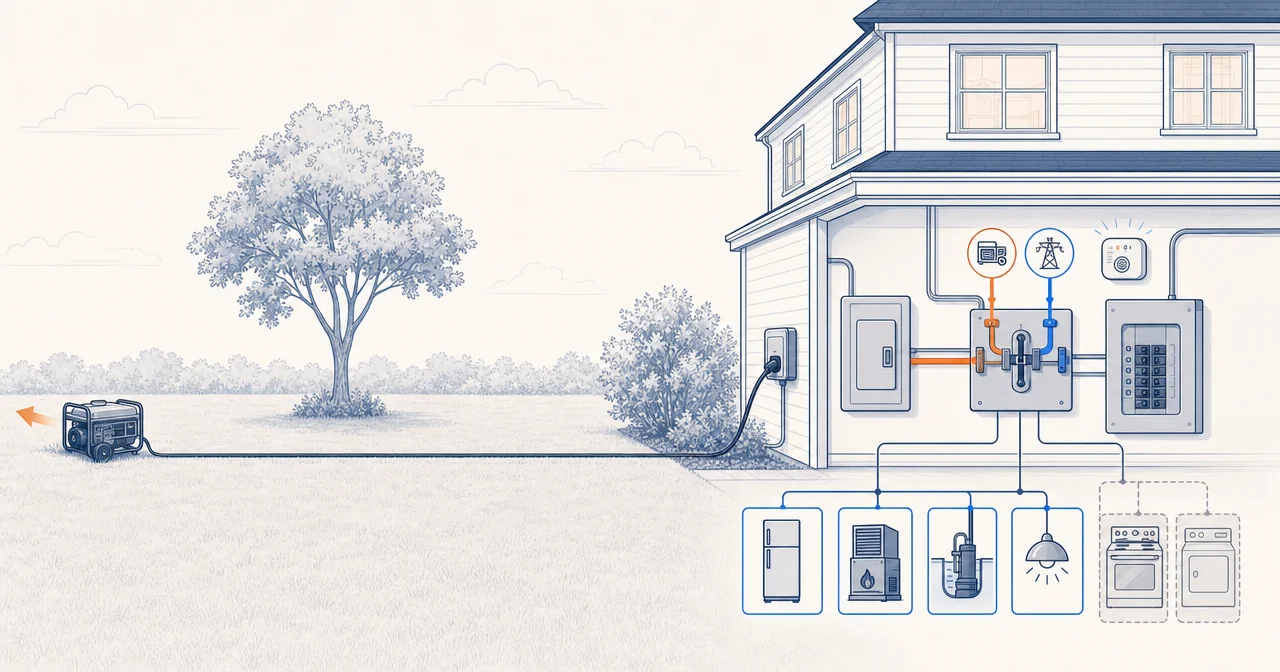
A transfer switch turns a portable or standby generator into useful home backup. The switch is only one part of the job. The generator output, critical loads, panel layout, neutral configuration, inlet location, and local permit rules all have to agree. We show how to plan that system, what a professional installation includes, how much to budget, and how to spot a quote that leaves out important work.
The short answer: treat installation as a panel-level project
A generator transfer switch installation connects a second power source to permanent household wiring. It belongs with a licensed electrician, an electrical permit where required, and a final inspection. Switching off the main breaker does not necessarily de-energize the utility conductors and lugs ahead of it.
For a portable generator and a short, fixed list of essential loads, we usually favor a selected-circuit manual transfer switch. It makes outage operation clear and limits which circuits can reach the generator. A panel-specific interlock is often a better fit when the household wants access to any panel circuit and can manage loads carefully. A permanently installed standby generator normally uses an automatic transfer switch, often with load shedding.
The safe design starts with the loads and generator. Buying a switch first can leave you with the wrong voltage, too few usable circuit positions, an incompatible neutral arrangement, or an inlet in an unsafe generator location.
What a transfer switch does, and what it does not do
Ordinary residential transfer equipment is open-transition, also called break-before-make. It disconnects the backed-up loads from utility power before connecting them to generator power, so the two sources do not overlap during the transfer. That isolation prevents generator electricity from backfeeding through the utility transformer onto lines that crews may believe are dead. Oregon's generator connection guidance requires transfer equipment or another approved safety device for a connection to a home panel and treats the work as permitted electrical work.
Closed-transition equipment is the narrow exception. It synchronizes the sources and briefly parallels them during a make-before-break transfer. This is an engineered arrangement that requires explicit utility approval and added protection, rather than a portable-generator shortcut. PG&E's distribution interconnection handbook prefers open transition and sets utility review, protection, and operating requirements for closed transition.
A selected-circuit switch routes only named branch circuits, such as refrigeration, a furnace blower, a sump pump, a well pump, lights, or communications. CPSC staff describes this arrangement as a practical way to serve hardwired loads that cannot simply plug into a generator. The CPSC transfer-switch memo also shows why portable-generator capacity usually limits backup to part of a home.
A transfer switch does not:
- increase generator output;
- make a portable generator start automatically;
- regulate voltage, frequency, or waveform;
- make every panel circuit safe to run at once; or
- solve carbon monoxide, fuel-storage, or weather-exposure risks.
Choose the transfer method that fits the operator
The equipment choice changes both installation scope and what someone must do during an outage.
| Setup | Best fit | Main advantage | Main constraint |
|---|---|---|---|
| Selected-circuit manual transfer switch | Portable generator, fixed essential-load list | Simple, repeatable operation with fewer overload choices | Only wired circuits are available; 240-volt and shared-neutral circuits can consume paired positions |
| Panel-specific generator interlock plus inlet | Portable generator, flexible circuit access | Any compatible panel circuit can be used within generator limits | The operator must turn large loads off and manage the panel; the kit must be approved for that exact panel |
| Whole-panel manual transfer equipment | Larger portable generator or a home needing whole-panel access | Keeps every panel circuit available for manual selection | Service-side equipment and wiring raise cost; the generator still cannot carry all loads automatically |
| Open-transition automatic transfer switch | Permanently installed standby generator | Starts and transfers without someone being home | Higher project cost, generator controls, fuel work, and possible load shedding |
A meter-mounted transfer device is another option in some utility territories. It depends on utility approval and program availability, so it cannot be treated as a universal substitute.
A transfer switch with six or ten circuit positions does not promise enough power to run six or ten loads simultaneously. Circuit count describes routing. Generator running watts, motor-starting demand, voltage, and load balance decide what can operate.
Build the load list before sizing the switch
A useful load plan records each appliance or system, its voltage, its running demand, and any brief motor-starting demand. The electrician also maps each load to its actual breaker and identifies 240-volt circuits and multiwire branch circuits that share a neutral.
Here is a hypothetical worksheet showing the method. These values are examples only. Actual nameplates and manufacturer data belong in the project calculation.
| Intended backup load | Voltage | Example running watts | Example additional starting watts |
|---|---|---|---|
| Refrigerator | 120 V | 400 | 800 |
| Furnace blower | 120 V | 700 | 1,000 |
| Sump pump | 120 V | 800 | 1,200 |
| Well pump | 240 V | 1,000 | 2,000 |
| Lights, router, and selected outlets | 120 V | 300 | 0 |
| Total | 3,200 | 2,000 largest single addition |
A first-pass target would be 3,200 running watts plus 2,000 watts for the largest single start, or 5,200 watts. Real motors can start together, voltage can sag, and fuel type can change generator output. The final design may need more headroom or staged loads.
Three details prevent common sizing mistakes:
- The generator's continuous rating is the working limit. Starting or surge watts last briefly. A large number on the generator housing may be the surge rating.
- The outlet and breaker can limit output below the generator headline. A 30-amp, 120/240-volt circuit has a theoretical 7,200-volt-ampere ceiling, and a 50-amp circuit has a 12,000-volt-ampere ceiling. A lower generator running rating or output-breaker rating becomes the real limit.
- A 120/240-volt generator has two 120-volt legs. Several 120-volt circuits placed on one leg can overload that side even while total household watts appear acceptable. The initial circuit assignment should balance expected loads.
A 120-volt-only generator requires transfer equipment designed for that source. An improvised adapter that energizes both panel legs cannot supply 240-volt loads and can create unsafe current on shared neutrals.
The generator's neutral can change the equipment design
Portable generators use either a floating neutral or a neutral bonded to the frame. Transfer equipment may leave the neutral continuous or switch it along with the hot conductors. Those choices determine whether the generator is treated as a separately derived system and where neutral-to-ground bonding belongs.
This is also why a jobsite generator with GFCI-protected receptacles may trip when connected through some transfer switches. The problem can be a mismatch between the generator bond and the transfer design, rather than excessive household load.
The complete design records:
- generator make and model;
- 120-volt or 120/240-volt output;
- running watts and output-breaker rating;
- receptacle configuration;
- floating or bonded neutral;
- whether the transfer equipment switches the neutral; and
- the required grounding and bonding arrangement.
Removing a factory neutral bond without manufacturer authorization is not a homeowner fix. A switched-neutral transfer device or a different approved system may be the correct answer. A separate ground rod also cannot replace transfer equipment. OSHA's portable-generator grounding guidance distinguishes direct cord-and-plug use from a generator connected to a structure and assigns structural connections to qualified installers.
What professional installation includes
A good project follows a system sequence rather than a generic wiring tutorial.
- Site and equipment survey. The electrician documents the service, panel model, main rating, available spaces, existing breaker types, generator specifications, proposed operating location, and desired loads.
- Load and transfer design. The plan sets the backed-up circuits, starting-load allowance, generator feeder size, switch type, neutral treatment, overcurrent protection, enclosure rating, and load-management rules.
- Permit package. Depending on the jurisdiction, this can include the equipment data, load schedule, one-line diagram, inlet location, and contractor information. Placer County's residential checklist requires permanent listed transfer equipment and enough capacity for the loads intended to operate together.
- Planned outage and installation. The electrician coordinates any utility disconnect, mounts the transfer equipment and outdoor inlet, installs the approved wiring method, integrates the selected circuits or service conductors, and completes grounding and bonding.
- Labels, inspection, and commissioning. Every source, inlet, breaker, and backed-up circuit is labeled. The inspector closes the permit. The electrician then runs the system under representative loads, demonstrates transfer in both directions, and leaves a written operating sequence.
A straightforward portable-generator setup often fits into a half day or full day once the permit is ready. A service-rated manual switch or automatic transfer switch can require a longer outage, utility coordination, several trades, and multiple inspections.
Generator transfer switch installation cost
Current 2026 Angi cost data puts installed manual transfer switches at $400 to $1,300 and installed automatic transfer switches at $600 to $2,500. The 2026 transfer-switch cost data reflects customer project costs and separates simple installations from more complex electrical work.
The wider figures below are rough quote-screening bands, not nationwide averages. They allow for packages that can include an inlet, circuit integration, service-rated equipment, permit work, or utility coordination. Local labor, panel condition, access, equipment, and project scope can move a bid outside these bands. The generator itself is excluded.
| Project scope | Rough planning band, varies by market and scope |
|---|---|
| Panel-specific interlock, generator breaker, inlet, wiring, and basic permit work | $500 to $1,200 |
| Selected-circuit manual transfer switch with inlet and circuit integration | $700 to $2,000 |
| Service-rated whole-panel manual transfer equipment | $1,500 to $4,000+ |
| Basic automatic transfer switch, without service relocation | $1,000 to $3,000 |
| Service-rated manual or automatic transfer equipment with service rework | $2,000 to $5,000+ |
An automatic standby-generator quote can be far higher because the complete project may also include the generator, concrete or composite base, gas or propane work, trenching, controls, load-shedding modules, and site restoration.
The fastest cost drivers are:
- distance between the panel, switch, inlet, and generator;
- 30-amp versus 50-amp portable-generator equipment;
- number and type of selected circuits;
- a crowded, obsolete, damaged, or incompatible panel;
- service conductors or meter equipment that must be moved;
- a switched-neutral design;
- outdoor trenching or difficult wall access;
- utility disconnect and reconnect work; and
- permits, corrections, and finish repair.
If a transfer-switch bid suddenly includes a new panel or service upgrade, those line items should be separate. Our panel permit guide explains why that added scope has its own approval path.
What a complete quote should state
A one-line price for “install transfer switch” is too vague. The written proposal should answer each of these points:
| Quote field | Required detail |
|---|---|
| Backup source | Generator make, model, voltage, running watts, breaker, receptacle, fuel rating, and neutral configuration |
| Transfer equipment | Manufacturer, model, manual or automatic operation, amperage, voltage, pole count, enclosure rating, and listing |
| Backed-up loads | Named circuits, voltage, running demand, starting allowance, and any loads excluded from generator operation |
| Panel integration | Panel model, breaker spaces, interlock compatibility if used, 240-volt circuits, shared neutrals, and AFCI or GFCI handling |
| Inlet and cord | Inlet model and location, wiring route, cord rating and length, weather protection, and generator operating position |
| Grounding and bonding | Switched or solid neutral, bonding point, grounding-electrode connection, and generator GFCI compatibility |
| Project administration | Permit holder, permit fee, utility coordination, inspection scheduling, and correction responsibility |
| Handoff | Permanent labels, operating card, load sequence, commissioning under load, manuals, and labor warranty |
| Exclusions | Panel replacement, service upgrade, wall repair, trenching, generator pad, fuel work, or surge equipment not included |
For selected-circuit systems that use a separate load panel, our subpanel and main-panel guide helps separate ordinary circuit distribution from a true service-capacity upgrade.
Place the inlet around safe generator operation
The outdoor inlet should support the place where the generator can actually run safely, rather than forcing it beside the house for a short wire route. Current 2026 CPSC guidance says to operate a portable generator outdoors at least 20 feet from the home or other building, direct its exhaust away from doors, windows, and vents, and use working carbon monoxide alarms on every level and outside sleeping areas. See the 2026 CPSC generator guidance.
A compliant operating plan also keeps exhaust pointed away from the home, protects the generator as its manual allows, keeps the cord out of water and traffic paths, and allows the engine to cool before refueling. A garage, basement, shed, or open doorway remains unsafe. A male-to-male cord, sometimes called a suicide cord, never belongs in the system.
The electrician's handoff should leave a short sequence specific to the installed equipment. It covers large-load shutdown, outdoor generator placement, cord connection, generator startup, source transfer, staged load addition, return to utility, cooldown, and storage in the exact order required by the installed switch and generator manuals.
Generator transfer switch installation FAQ
Can I install a generator transfer switch myself?
We do not recommend it. The work enters a service or distribution panel, and parts ahead of the main breaker may remain energized. An error can create shock, fire, backfeed, neutral-current, and equipment-damage hazards. Even jurisdictions that allow homeowner electrical work commonly require a permit and inspection.
Do I need a permit for a portable-generator transfer switch?
Plan on an electrical permit. Local exceptions exist, but a permanent inlet and transfer connection change the home's wiring. Some jurisdictions also require contractor licensing or utility involvement. The permit and final inspection should appear in the quote rather than as an owner-supplied afterthought.
Does a 200-amp transfer switch require a 200-amp generator?
No. A 200-amp service-rated switch can be sized to carry the home's normal utility service while the generator supplies a smaller branch through its own breaker. The generator capacity, connected loads, and any load shedding are sized separately.
Can a transfer switch work with a portable power station?
Sometimes. The power station must have a compatible voltage, output rating, receptacle, neutral and grounding design, and manufacturer-approved connection method. Many 120-volt-only units cannot serve 240-volt loads. Some units also shut down when their ground-fault protection meets an incompatible transfer arrangement.
How far can the generator be from the transfer switch?
The outdoor inlet can be remote from the switch, and the fixed wiring between them is sized for the load and distance. The CPSC operating rule is independent of the switch location: keep the generator at least 20 feet from the home or building, with exhaust directed away from doors, windows, and vents. Cord length, conductor size, voltage drop, weather exposure, and trip hazards all belong in the designed route.
Do I need a ground rod for a portable generator?
A ground rod is not an automatic requirement and never replaces a transfer device. Direct cord-and-plug use and connection to a building follow different grounding rules. For a home connection, the approved transfer design establishes how the generator frame, equipment grounding conductor, neutral, and home's grounding-electrode system work together.
Once the transfer scope is clear, the quote should expand only for a documented panel or service problem. If it does, compare that added work with our electrical panel replacement cost guide before approving the combined project.