Published: September 15, 2026
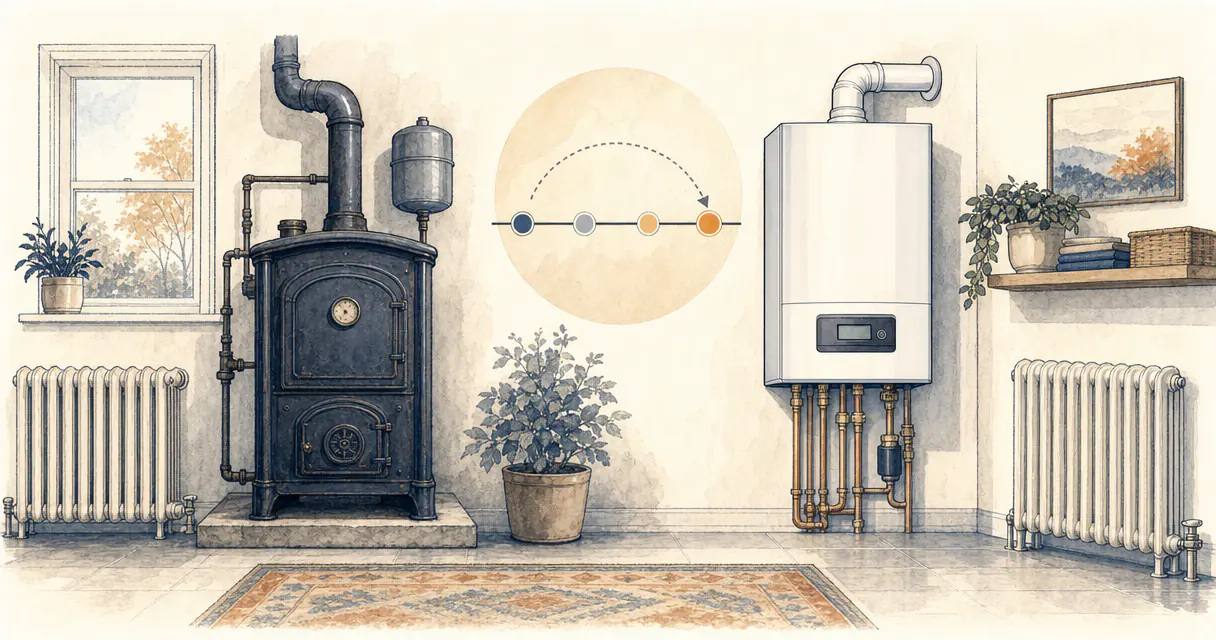
Boiler lifespan answers often swing between 10 to 15 years and 20 to 30 years because they combine different equipment and different meanings of “last.” A modern condensing unit, a cast-iron hydronic boiler, and a UK combi boiler do not age in the same way.
At Watt Wallet, we separate a boiler’s physical service life from the point when replacement becomes sensible. The useful answer combines realistic age ranges, warning signs, and a way to compare repair, replacement, and a different heating system.
Quick answer
For many residential boilers, 15 to 20 years is a useful planning range. Some conventional cast-iron boilers run for 20 to 30 years or longer, while a modern condensing boiler may need major repairs earlier. There is no universal expiration date.
| Question | Practical answer |
|---|---|
| How long do boilers usually last? | Many last 15 to 20 years. Construction, installation, maintenance, water quality, usage, and climate can move that range. |
| Is a 10-year-old boiler too old? | No. Ten years is a good point to start planning, especially if repairs or fuel use are increasing. |
| Should every boiler be replaced at 15 years? | No. ENERGY STAR uses 15 years as a replacement consideration for boilers, especially when repairs and energy bills are rising. It is a planning trigger, not a failure date. |
| Can a boiler last 30 years? | Yes. Well-maintained conventional cast-iron systems can reach 20 to 30 years or more. |
| What matters most? | The condition of the heat exchanger or boiler sections, repair history, safety, operating cost, parts support, and how well the system heats the home. |
The numbers look inconsistent because they answer different questions. A Minnesota homeowner guide says most boilers have a useful life of 20 to 30 years, depending on conditions. A U.S. Department of Energy rulemaking analysis estimated an average consumer-boiler product lifetime of 24.6 years from housing surveys and historical shipment data in its model. Meanwhile, ENERGY STAR replacement guidance says homeowners should consider replacing a boiler once it is more than 15 years old, especially when it needs frequent repairs or energy bills are increasing.
Those statements can all be true. A boiler can remain capable of making heat after its economic or practical replacement window has started.
Once replacement is on the table, the choice may extend beyond another boiler. If you are comparing an electric heating system, Watt Wallet’s heat pump rebates by state guide gives you a starting point for location-based incentives. Treat those programs as part of the project plan, not as a substitute for equipment and scope decisions.
First, identify what kind of boiler you have
“Boiler” means different things in different markets.
In the United States, a residential boiler usually heats water or produces steam, then sends that heat through radiators, baseboards, radiant-floor loops, or an air handler. In the United Kingdom, “boiler” often means a gas combi, system, or regular boiler that handles space heating and, in some cases, domestic hot water.
That distinction matters because a short lifespan quoted for a modern combi or condensing boiler should not be treated as a hard limit for an older cast-iron hot-water or steam boiler.
| Boiler type or system | Useful planning range | What changes the result |
|---|---|---|
| Modern condensing or high-efficiency boiler | Often treated as a 10-to-20-year planning range | More controls, sensors, pumps, condensate handling, and heat-exchanger conditions create more possible repair points. |
| Conventional cast-iron hot-water or steam boiler | Often 20 to 30 years, with some lasting longer | The cast-iron sections may be durable, while burners, controls, pumps, valves, venting, and the surrounding distribution system still age. |
| UK gas boiler or combi | Consumer guidance commonly uses 10 to 15 years | Annual service, installation quality, water quality, system sludge, usage, and repair cost determine whether it makes sense to keep going. |
The 10-to-20-year condensing figure comes from a contractor survey cited in the DOE analysis. The agency said the evidence was not strong enough to establish a separate average lifespan for condensing and non-condensing boilers, which is another reason to treat any single number as a planning range.
For UK readers, current consumer reporting still uses 10 to 15 years as a benchmark, while stressing that service history and condition matter more than age alone.
A boiler has more than one “end of life”
When someone says a boiler has reached the end of its life, they may mean one of four things:
- It no longer works. The boiler cannot safely produce or distribute heat.
- It is no longer reliably repairable. A core part is failing, parts are unavailable, or breakdowns keep returning.
- It is no longer economical. Fuel, service, and repair costs are too high for the comfort it provides.
- It no longer fits the home’s plan. The home has been insulated, expanded, or is ready for a different heating system.
Only the first is a clear failure. The other three are decisions.
That distinction is why replacing a functioning boiler can be reasonable in one home and wasteful in another. A 22-year-old cast-iron boiler that is safe, dry, repairable, and inexpensive to operate may have useful life left. A 12-year-old condensing boiler with repeated heat-exchanger faults, rising fuel use, and no parts support may be a poor candidate for another large repair.
Seven signs replacement is starting to make sense
1. A core component is leaking or corroded
Water around a pump, valve, fitting, or pressure-relief component may be repairable. A leak from the boiler block, heat exchanger, or cast-iron sections is a different problem. Corrosion in the main heat-producing body often changes the decision from “which part should be replaced?” to “how much longer can this system be trusted?”
2. Repairs are becoming a pattern
One failed thermostat, pump, valve, or control board does not automatically condemn a boiler. Repeated service calls suggest several aging components may be approaching failure together.
The Minnesota guide uses repairs costing 25% or more of a new boiler’s cost as a signal to consider replacement rather than repair. That is a budgeting rule of thumb, not a law. A major repair can be sensible on a reliable boiler and poor value on a system that has already needed several other repairs this season.
3. Heating costs rise without a clear change in use
A higher fuel bill can come from colder weather, higher fuel prices, a thermostat change, or a leakier home. The signal is stronger when an older boiler takes longer to warm the home, cycles more often, or uses more fuel for the same comfort. A technician can measure combustion and operating condition instead of guessing from the bill alone.
For context, ENERGY STAR’s boiler criteria set a minimum AFUE of 90% for certified gas boilers and 87% for certified oil boilers. AFUE is a standardized annual efficiency measure. A new rating does not guarantee a specific bill reduction, because the home, controls, fuel price, and installation all affect real-world costs.
4. Comfort is getting worse
Rooms that stay cold, uneven radiator temperatures, inconsistent hot water, slow warm-up, repeated pressure loss, and short cycling all deserve attention. The problem may sit in the controls, circulator, radiators, valves, insulation, air sealing, or distribution piping rather than the boiler itself. Replacing the appliance without diagnosing the system can leave the original comfort problem in place.
5. Parts, service, or technical support are disappearing
An old boiler can be worth keeping when common parts are available and a qualified technician knows the system. Replacement becomes easier to justify when a heat exchanger, control board, burner, or safety component is obsolete, difficult to source, or priced close to a new system. “Old” and “unsupported” are separate conditions.
6. The home’s heating load has changed
Insulation, air sealing, replacement windows, an addition, a finished basement, or a change in household size can alter the home’s heat demand. A boiler that was correctly sized years ago may now be oversized, while an addition may create a real capacity problem.
A replacement quote should include a heat-loss calculation. The Department of Energy’s boiler guidance says boiler and distribution systems should be sized to the calculated heating load. Reusing the old boiler’s input rating is a shortcut, not a design method.
7. There is a combustion or venting safety concern
A carbon monoxide alarm, soot, a fuel odor, a damaged flue, or abnormal combustion needs prompt professional attention. Do not keep operating a fuel-burning boiler while waiting to see whether the symptom goes away.
The U.S. Consumer Product Safety Commission urges homeowners to schedule a yearly professional inspection of fuel-burning heating systems, including boilers, chimneys, flues, and vents. Its guidance on home heating equipment treats inspection as a safety measure, not merely a way to extend equipment life.
How to extend a boiler’s useful life
Maintenance cannot turn every boiler into a 30-year boiler. It can reduce avoidable wear and give you better information before a winter breakdown.
- Schedule professional service before the heating season. A typical visit can cover combustion, heat-exchanger condition, controls, safety devices, venting, electrical connections, pressure, and system operation. ENERGY STAR’s maintenance checklist recommends annual pre-season heating checkups, and CPSC recommends yearly professional inspection for fuel-burning equipment.
- Keep the water side in good condition. Sediment, corrosion, excessive make-up water, and air in a hydronic system can increase strain on pumps, valves, and heat-transfer surfaces. System cleaning or water treatment should match the boiler and be handled by a qualified professional.
- Address small faults early. A new noise, pressure change, drip, error code, or uneven heating pattern is easier to diagnose before it becomes a no-heat call.
- Avoid excessive short cycling. Oversizing, poor controls, low system volume, or a changed heating load can make a boiler start and stop more often than it should. The right fix may be a control adjustment, a system change, or a properly sized replacement.
- Keep a service record. Save the model and serial number, installation date, service dates, repairs, efficiency readings, and any parts that have been replaced. That history gives the next technician a better starting point and makes a replacement quote more specific.
Do not open a combustion chamber, alter gas or oil controls, flush a boiler, or work on electrical components as a DIY repair. Those jobs involve combustion, pressure, electricity, or hot water.
Repair or replace? Use this decision framework
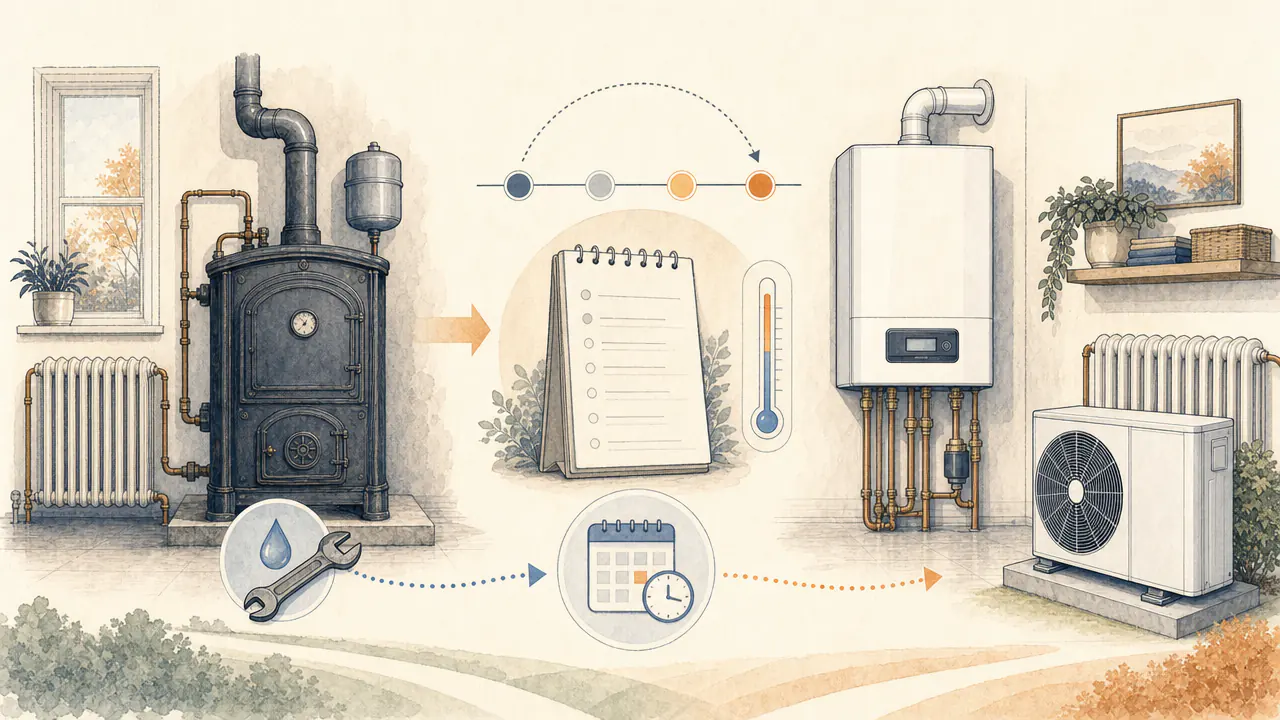
A repair is often the sensible path when the boiler is younger, the problem is isolated, the repair is affordable, the core heat exchanger or boiler sections are sound, and the system still provides consistent comfort.
Replacement deserves serious consideration when several of these are true:
- the boiler is beyond its normal planning window for its design,
- a core heat exchanger or boiler section is leaking,
- repair costs are approaching a meaningful share of replacement cost,
- service calls are becoming frequent,
- parts or qualified technicians are hard to find,
- the home is less comfortable even after ordinary repairs,
- fuel use is rising without a clear weather or rate explanation, or
- you would rather invest in a different heating system.
The answer can be “repair now and plan later.” That is often the right choice when the current fault is manageable but the boiler is old enough that a replacement should be researched before the next heating season.
What to compare when you replace a boiler
A replacement decision is about the whole heating system, not just the box on the wall or in the basement.
1. Compare the real options
A like-for-like boiler may be the right fit for a home with sound radiators, a reliable fuel supply, and a system that still meets the household’s needs. A heat pump may be worth evaluating when the goal is to reduce onsite combustion, use electricity, or combine heating and cooling. A hybrid system can make sense when the home needs a backup plan for the coldest conditions.
The best option depends on climate, heat emitters, insulation, electrical service, domestic hot water, fuel prices, and the homeowner’s longer-term plan.
2. Require an equipment and scope breakdown
A useful quote separates:
- boiler or heat-pump equipment and exact model numbers,
- heat-loss calculation and sizing assumptions,
- pumps, tanks, valves, controls, and thermostats,
- venting, chimney work, condensate drainage, or fuel connections,
- electrical work and service changes,
- water treatment, flushing, or distribution-system repairs,
- permits, inspection, startup, testing, and old-equipment removal, and
- rebates, tax credits, financing, or installer discounts.
If a contractor gives one blended “after incentives” number, use Watt Wallet’s guide to compare rebates and installer quotes before treating the savings as part of the project price.
3. Price the operating plan, not only the installation
A higher-efficiency boiler can reduce fuel use, but its value depends on the existing boiler’s efficiency, annual heating demand, fuel prices, controls, and the cost of the replacement. A heat pump changes the energy source and may also change electrical, distribution, and hot-water requirements.
Ask for the assumptions behind any projected savings. A quote should make it possible to compare guaranteed installation cost with estimated future operating cost without mixing the two.
FAQ
Is a 10-year-old boiler too old?
No. A 10-year-old boiler may have many reliable years left, especially with a good service history and no major repairs. It is also old enough that replacement planning can prevent a rushed winter decision if the system begins to fail.
Should a 20-year-old boiler be replaced?
Not automatically. A well-maintained cast-iron boiler may still be serviceable at 20 years, while a condensing boiler with repeated high-cost failures may make replacement sensible sooner. Look at the heat-producing body, repair history, efficiency, safety, parts support, and comfort together.
Can a boiler last 30 years?
Yes. Conventional cast-iron boilers can reach 20 to 30 years or more in suitable conditions. A long service life does not prove that the boiler is efficient, safe, or economical to keep. Professional inspection and operating-cost evidence matter.
Is it cheaper to repair or replace an old boiler?
A repair is usually cheaper today. Replacement can be better value when the repair is large, several components have failed, parts are unavailable, or the boiler is costing more to operate. The Minnesota guide’s 25% repair-cost signal is a useful starting point, not a substitute for a system-specific assessment.
Does a new boiler always lower energy bills?
No. A new, properly sized, high-efficiency boiler can use less fuel than an old, inefficient one. Actual savings depend on the starting efficiency, controls, heating load, weather, fuel prices, and installation quality. Better insulation or a different heating system may produce a larger change than replacing a boiler with another similar model.
Bottom line
Boilers do not have one universal lifespan. For planning, 15 to 20 years is a reasonable range for many homes, 20 to 30 years is possible for durable cast-iron systems, and some boilers need major work earlier. Age tells you when to pay closer attention. Leaks, safety concerns, repeated repairs, rising fuel use, poor comfort, and disappearing parts tell you whether replacement makes sense.
If a boiler replacement becomes a chance to compare an electric heating option, start with Watt Wallet’s heat pump rebates by state guide before you price the replacement.