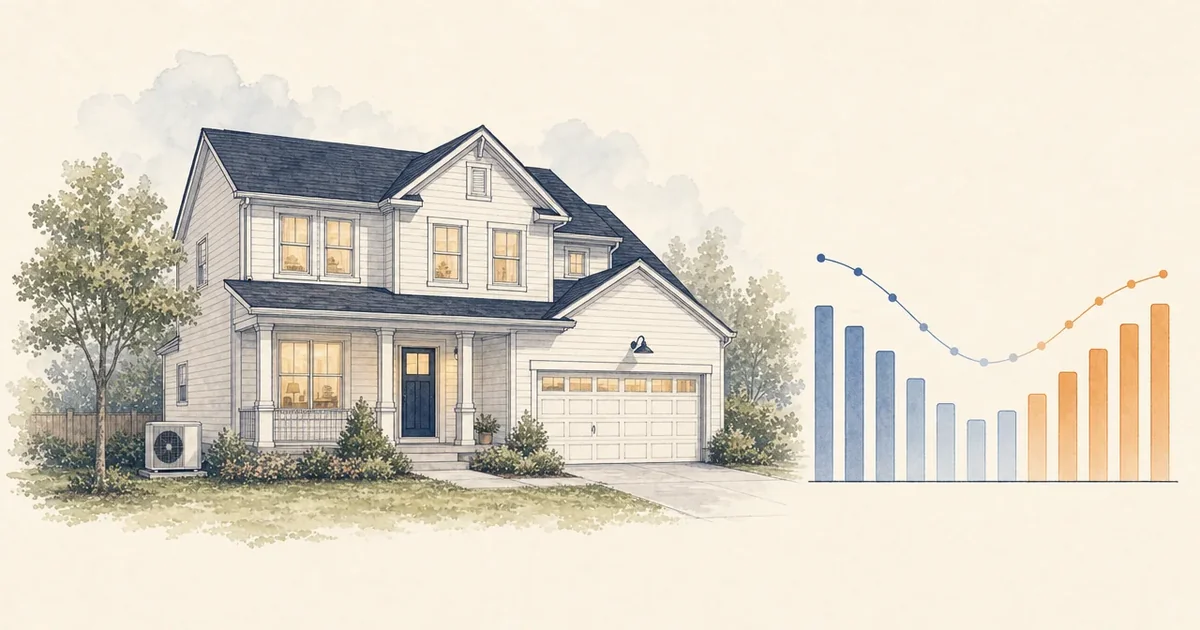
How much electricity a house uses affects your bill, solar planning, and decisions about electric upgrades. A national average gives you a starting point, but it cannot tell you whether a home is efficient or whether one seasonal load is driving a high month. For a useful comparison, separate electricity used inside the home from electricity purchased from the utility. Circuit-level monitoring can add detail when a bill total leaves questions about individual loads.
Last reviewed: November 20, 2026
How many kWh does a house use?
The latest full national household-use survey is the U.S. Energy Information Administration's (EIA) 2020 Residential Energy Consumption Survey (RECS). It estimates that primary-occupied U.S. homes used an average of 10,566 kWh each in 2020. That averages to about 881 kWh a month or 29 kWh a day. A detached single-family home averaged 12,402 kWh a year, or about 1,034 kWh a month and 34 kWh a day. EIA has scheduled its 2024 RECS consumption tables for spring 2027, so 2020 remains the latest full-survey benchmark for total household use. EIA's 2020 monthly RECS table, 2024 RECS release schedule
A kilowatt-hour (kWh) is the energy used by a one-kilowatt load running for one hour. Kilowatts (kW) describe the rate of use at a moment; annual kWh averages do not show peak demand when large loads overlap.
The same survey shows how averages shift across regions, home types, and household sizes. Monthly and daily figures are annual use divided by 12 and 365, respectively. EIA's household comparison table
| Home or household group | Annual average | Monthly average | Daily average |
|---|---|---|---|
| All primary-occupied U.S. homes | 10,566 kWh | 881 kWh | 29 kWh |
| Detached single-family homes | 12,402 kWh | 1,034 kWh | 34 kWh |
| Apartments in buildings with five or more units | 6,093 kWh | 508 kWh | 17 kWh |
| Homes in the Northeast, all types | 8,016 kWh | 668 kWh | 22 kWh |
| Homes in the South, all types | 13,376 kWh | 1,115 kWh | 37 kWh |
| One-person households | 7,184 kWh | 599 kWh | 20 kWh |
| Households with six or more people | 14,730 kWh | 1,228 kWh | 40 kWh |
Rows are separate group averages; do not add them to the national average. The 881-kWh monthly equivalent is not a flat target. EIA's 2020 monthly estimates ranged from 714 kWh in April to 1,200 kWh in July, so weather and seasonal heating or cooling can move a bill far above or below the annual average.
Why do some sources say 899 or 874 kWh a month?
The RECS figure counts electricity used at home, including electricity generated by rooftop solar and consumed there. Some other widely quoted numbers count electricity bought from the grid. EIA's FAQ reports 10,791 kWh per residential utility customer in 2022, or about 899 kWh a month, for utility purchases. Our calculation from EIA's 2025 residential sales and customer-account totals works out to about 874 kWh a month per account. These figures track utility sales, not all electricity a home consumes. EIA's utility-purchase FAQ, 2025 utility sales table
The distinction matters for homes with solar. A home may use electricity from its panels without buying those kWh from the utility, so a utility bill can show less than the household consumed. EIA's RECS includes on-site solar electricity used in the home; its utility-purchase figures do not.
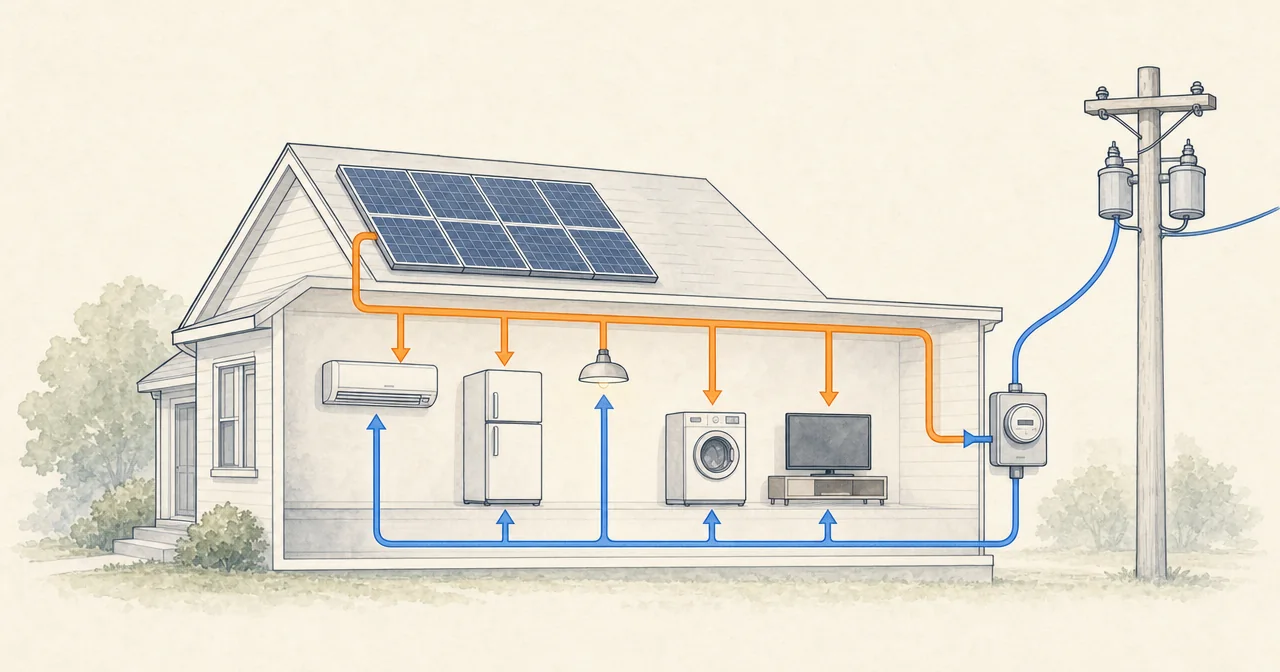
Simplified layout, not wiring instructions.
What changes a home's electricity use?
Heating, cooling, and water heating account for a large share of household electricity. In EIA's 2020 end-use breakdown, air conditioning represented 19% of residential electricity use, while space heating and water heating represented 12% each. Those are national shares, not a forecast for an individual home. EIA's electricity-use breakdown
Several differences explain why one home may use far more or less than another:
- Climate and heating fuel: Southern homes are more likely to use electric heating and air conditioning. Long cooling seasons can raise summer kWh, while electric heat affects winter use. For the bill impact of a heat pump, see our heat-pump electricity-cost guide. Homes with gas heat or water heating use less electricity for those end uses, though kWh alone does not measure all household energy.
- Home type and size: Detached homes and large-building apartments differ in space to heat or cool, shared walls, and equipment. Floor area and insulation matter too, so home type averages are context rather than an efficiency score.
- Household size and routine: More people can mean more hot water, cooking, laundry, and device use. Some loads, including refrigeration and heating, are shared, so a six-person household does not use six times as much as a one-person household.
- Added electric loads: An EV charger, pool or well pump, electric water heater, workshop, or second refrigerator can change a household's total even when the home and number of residents stay the same. For a cost estimate specific to charging at home, see our home EV-charging cost guide.
Is 1,000 or 2,000 kWh a month a lot?
A month near 1,000 kWh is close to the detached-home average of 1,034 kWh and above the 881-kWh average for all U.S. homes. 2,000 kWh is roughly twice the detached-home average and more than twice the all-home average. That is high relative to the national benchmark, but one month alone cannot show whether the use is unusual for that home. Summer air conditioning, electric space heat, EV charging, and other large loads can all change the comparison.
A one-time 2,000-kWh summer bill is different from using 2,000 kWh every month. A full year at that pace would be 24,000 kWh. Compare the same season across years and account for the home's equipment before treating one number as a sign of a problem.
How to compare your home's kWh with the average
Use a full year of bills rather than judging from one month. Add the kWh from bills covering the last 12 months, then divide by 12 for an average month. For a daily comparison, divide a bill's kWh by the number of days in that billing period. This keeps a 28-day bill from looking artificially lower than a 34-day bill. For example, a 900-kWh bill over 30 days averages 30 kWh a day; over 28 days, it averages about 32 kWh a day.
Compare like with like. A utility bill measures electricity bought from the grid; in a home with solar, it may not include solar power used inside the house. Compare summer with summer and winter with winter, and account for electric heating, air conditioning, an EV, a pool, or other large loads. Your utility history is enough for a grid-purchase comparison. Monitoring helps when you want to identify which circuits make up the total. If you want that load-by-load view, read our home energy monitor guide to choose a measurement approach that fits your question.