Last reviewed: October 28, 2026
How a whole house surge protector works
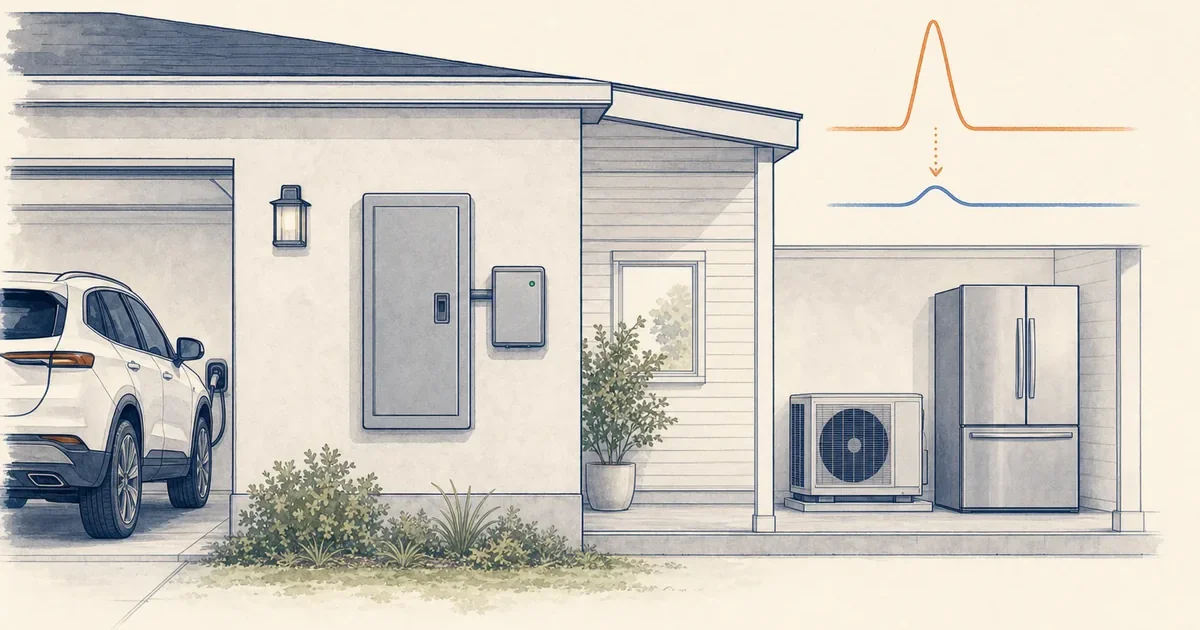
A whole house surge protector limits brief voltage spikes by diverting surge current through its protective components. The electrical name is a surge protective device (SPD). A typical panel-mounted SPD connects in parallel with the home's electrical supply, providing an additional path for surge current when voltage rises sharply.
Most residential units use metal oxide varistors (MOVs), components whose resistance changes with voltage. At normal voltage, they conduct very little current. During a spike, they conduct much more, limiting the voltage across the connections they protect. This action is called clamping. The National Electrical Manufacturers Association (NEMA) explains this surge-limiting mechanism.
| What is happening | What the protector does |
|---|---|
| Normal operation | Its protective components remain at high resistance. Appliances receive power through their ordinary circuits. |
| A transient voltage spike | The components become more conductive, diverting surge current and reducing the spike's voltage. |
| The spike subsides | An intact protector returns to its high-resistance state, ready for another event. |
Clamping reduces a spike; it does not erase it. The remaining voltage, the installation, and the surge itself determine the stress that equipment experiences.
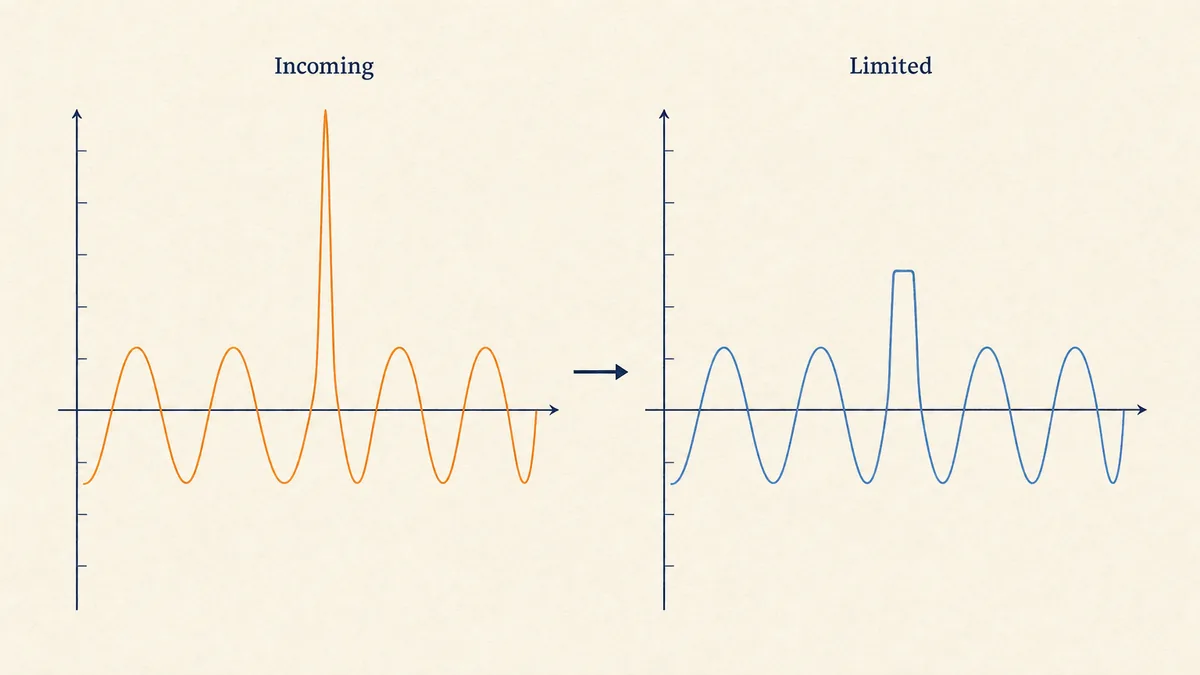
Simplified layout, not wiring instructions.
Surges can arrive from utility switching or nearby lightning, or originate when electrical loads switch inside the home. They can be too brief to notice. A blackout is a different event, even when a storm causes both.
Why one breaker can protect other circuits
The breaker feeding a panel-mounted SPD is its connection to the panel's shared supply. It does not limit the protection to one room or appliance.
In a typical U.S. 120/240-volt home, the panel distributes power from two hot legs to branch circuits. A suitable whole-house SPD connects to both legs and the other conductors required by its design. Because those connections share the supply feeding the branch circuits, the SPD can limit a transient at that common point. Our electrical panel guide explains the distribution path.
The home's normal operating current does not all flow through the surge protector. That is what a parallel connection means. It is a side path that becomes much more conductive during a transient, rather than a gate every appliance's electricity must pass through.
This also explains two common misunderstandings:
- It does not normally trip the main breaker to stop a surge. Its protective components limit voltage directly. Ordinary circuit breakers respond to excess current, which is a different problem.
- A surge-current rating is not the home's service capacity. A rating in kiloamperes describes specified surge conditions. It does not turn a 200-amp service into a larger service or describe continuous appliance current.
Where does the diverted surge current go?
“Down the ground wire” is a useful shorthand, but an incomplete explanation. Voltage is a difference between two points, and an SPD limits that difference across particular pairs of conductors.
Modes of protection are the conductor pairs an SPD protects. Depending on its design, these include hot-to-neutral, hot-to-ground, hot-to-hot, and neutral-to-ground. Surge current can return through different conductors; ground is not always the return path. NEMA explains these protection modes.
Grounding and bonding still matter. Grounding connects the electrical system to earth; bonding connects specified conductive parts together. A sound installation needs both. An SPD cannot compensate for defective grounding, improper bonding, or damaged wiring.
Why installation changes the voltage equipment sees
The wires connecting an SPD to a panel are part of its performance. During a fast-rising surge, those leads develop voltage across their own inductance. That voltage adds to the voltage across the protector itself.
The practical consequence is simple: a device's laboratory performance and the finished installation's performance are different things. Long, looping connections can leave a higher residual voltage than short, direct connections. A bigger advertised surge-current number does not cancel that effect. NEMA identifies these installation performance factors.
We favor a complete installation specification over choosing a box by its largest printed number. A licensed, qualified electrician should handle panel work, select compatible equipment, follow its connection and overcurrent-protection requirements, and address grounding and bonding. For meter-mounted equipment, availability and the permitted installation process depend on the local utility's rules and any surge-protection program.
Panel work is not a DIY task. Do not remove the screwed-on interior cover or handle conductors. Eaton's panelboard safety guidance explains that line-side terminals and conductors can remain energized with the main breaker off.
What the voltage protection rating tells you
An SPD's voltage protection rating (VPR) is a rounded-up rating derived from average measured limiting voltage in a standardized surge test. NEMA explains this voltage test rating. Compare the same protection mode on otherwise comparable devices.
For example, a 600-volt hot-to-neutral VPR is lower than a comparable 700-volt rating. Neither number is normal operating voltage or a guaranteed ceiling for every possible surge.
The rating also is not a percentage of the incoming surge removed. Actual residual voltage depends on the event and installation. UL's surge device standard does not assess whether a given VPR will prevent disruption or damage in particular connected equipment.
Three other labels answer different questions:
| Label | What it describes |
|---|---|
| Nominal discharge current | The surge-current level used in a specified repeated-surge durability test. |
| Maximum continuous operating voltage | The continuous voltage permitted across a protection mode. It is different from the voltage reached during clamping. |
| Maximum surge-current rating | A surge-handling claim under stated conditions. It is different from nominal discharge current and continuous service capacity. |
These ratings work together. Neither a large joule claim nor a large maximum-current claim, by itself, explains how much voltage equipment will experience.
Whole-house and plug-in protection have different jobs
Whole-house protection can reach hard-wired equipment, such as heating and cooling controls, that cannot use an ordinary plug-in surge strip. A point-of-use protector adds protection near sensitive plug-in electronics. The two locations serve complementary roles.
The type number primarily identifies the device's permitted installation application, rather than a universal quality ranking. The locations come from UL 1449:
| SPD type | Typical application |
|---|---|
| Type 1 | Permanently connected equipment suitable for the supply side or load side of the main service overcurrent device, within its listing and instructions. |
| Type 2 | Permanently connected equipment on the load side of the main service overcurrent device, including panel applications. |
| Type 3 | Point-of-use protection, such as certain plug-in, cord-connected, or receptacle devices, subject to their placement requirements. |
A Type 1 device can be installed at a panel when its listing permits it. “Type 1” does not simply mean outdoors, and “Type 2” does not simply mean indoors.
We recommend keeping suitable point-of-use protection for sensitive electronics after adding a panel SPD. Local protection is useful because some residual voltage remains and switching events can originate inside the home. A basic multi-outlet power strip is not automatically a surge protector.
Communications wiring creates another path. A modem or television can connect to power and incoming coaxial cable. A panel SPD does not protect that separate cable. The National Institute of Standards and Technology explains why multiple incoming connections need coordinated protection. NEMA's multi-service protection guidance explains why power and communications connections need a common voltage reference and suitable multiport protection at the equipment.
What a whole house surge protector cannot do
A transient is a brief disturbance. Several other electrical problems require different responses.
| Problem | Why an ordinary panel SPD is not the solution |
|---|---|
| A power outage | It has no backup energy supply. A battery system, generator, or appropriately sized uninterruptible power supply serves that separate need. |
| Low voltage or sustained high voltage | Transient clamping is different from voltage regulation or disconnecting a persistent fault. Prolonged overvoltage can damage an SPD itself. |
| Overloaded wiring or repeated breaker trips | An SPD does not increase circuit capacity or repair the cause of an overcurrent. |
| Shock or arcing hazards | Ground-fault protection reduces shock risk; arc-fault protection detects hazardous arcing. These electrical safety devices do different work from an SPD. |
| A direct lightning strike | A panel SPD alone is not a complete lightning-protection system or a guarantee against damage. |
The National Weather Service warns that typical surge protectors do not protect equipment from a lightning strike. Its indoor lightning guidance also says not to touch electrical equipment or unplug it during a thunderstorm.
Flickering lights, a failed circuit board, or an appliance restarting do not establish that a surge occurred. Without emergency signs, repeated breaker trips, flickering lights, or unusually warm plugs or outlets need an electrician promptly. Call the fire department immediately for a burning odor, arcing or sparking, or sizzling or buzzing from electrical equipment, even without visible flames. Massachusetts' electrical fire safety guidance distinguishes these warning signs.
For smoke or fire, leave the home and call 911 from outside. Stay out, following the U.S. Fire Administration's fire escape guidance.
Does the protector keep working after a surge?
A whole-house SPD can handle multiple events within its capabilities. It is not necessarily a one-surge disposable device. However, severe events, repeated stress, or sustained overvoltage can damage its components or activate internal disconnectors.
With a parallel-connected panel SPD, the house can still have electricity after surge protection is lost. Normal lighting and appliance operation are not proof that the SPD remains functional.
The useful signal is the device's protection-status indicator, interpreted according to that model's instructions. Indicator colors and meanings vary. A loss-of-protection indication calls for professional service or replacement; it does not invite opening the enclosure or repeatedly resetting its breaker. There is no universal calendar lifespan that fits every device and exposure.
At installation handoff, the electrician should explain the status indication and provide a replacement plan that does not require you to open electrical equipment.
Plan protection around the equipment you own
A whole-house surge protector gives surge current an alternate path and limits the voltage at its connections. Its value comes from that physical action, a suitable installation, and coordinated protection at other vulnerable connections. It cannot promise that every appliance will survive every electrical event.
For an existing home or a planned heat-pump, charging, or panel project, use our buy-or-defer checklist to decide where whole-house surge protection belongs in your electrical budget.