
A whole-house surge protector can sound like an easy yes when an electrician offers it alongside a heat pump, electric vehicle (EV) charger or panel project. The harder question is whether that particular installation addresses your home's needs at a cost you can justify. The equipment you own, existing protection, electrical condition and quote details matter more than a promise to protect “everything.”
Last reviewed: 2026-10-06
When is a whole-house surge protector worth it?
We favor whole-house surge protection when you have costly hard-wired equipment, a sound electrical system and a complete professional quote that fits your budget. Its main value is reducing exposure to damaging voltage spikes across the home's electrical system, including equipment that cannot use an ordinary plug-in surge strip.
The case is stronger when losing heating, cooling, refrigeration or other essential equipment would create a difficult repair expense or disruption. Adding protection during already-planned electrical work is also worth pricing separately, so you can see the added cost rather than judging it against the entire project.
We would defer an optional installation when urgent electrical repairs need the money first, the home already has suitable functioning protection, or the quote does not identify the device and work included. If the adopted local code requires surge protection for your project, it belongs in the required scope rather than the optional-upgrade column.
This is a risk-reduction purchase. An expensive appliance makes a failure consequential; it does not prove that failure is likely, or that a surge protector will prevent it. There is no dependable household payback calculation from appliance replacement values alone.
What you gain from whole-house protection
A surge is a brief overvoltage event, also called a transient. Surges can come from lightning, utility switching or damaged utility equipment, as well as electrical loads switching inside a building. They can damage or degrade electronics. The Electrical Safety Foundation International (ESFI) explains these surge sources and effects.
A whole-house surge protective device, or SPD, limits transient voltage by diverting surge current. It is usually installed at the service equipment or electrical panel, with some utilities offering meter-base arrangements. Our electrical panel basics explain where the panel fits in your home's electrical system.
The practical benefit is broader coverage than a protector serving only the devices plugged into it. That can include hard-wired heating and cooling equipment and other household controls. It also provides a first layer of protection for plug-in electronics.
There are two boundaries to that benefit:
- It reduces exposure rather than eliminating it. Surge size, the device, installation and the path a surge takes all matter.
- It does not diagnose past damage. A failed circuit board, flickering light or equipment restart is not proof that a surge caused the problem.
Protection also brings an installation expense and future maintenance responsibility. Those belong in the decision alongside the equipment you want to protect.
What a whole-house surge protector cannot fix
“Whole house” describes the scope of a protective layer. It does not mean protection from every electrical problem.
- A direct lightning strike: A panel SPD is not a complete lightning-protection system or a guarantee against a direct strike.
- An outage: An SPD does not supply backup power or keep appliances running.
- Low voltage or prolonged high voltage: Transient suppression does not provide voltage regulation or repair a utility or wiring fault.
- Overloaded circuits or repeated breaker trips: An SPD does not add electrical capacity or correct the cause of a trip.
- Shock or arcing hazards: Surge protection does not replace ground-fault or arc-fault protection.
- A surge entering through cable, antenna or other communications wiring: A power-side SPD alone does not cover every incoming connection.
ESFI distinguishes lightning and surge protection, including panel and point-of-use devices. Arc-fault circuit interrupters (AFCIs) and ground-fault circuit interrupters (GFCIs) address separate fire and shock hazards, as our AFCI versus GFCI guide explains.
An outage or a dimming light can have a different cause from a transient spike. The National Institute of Standards and Technology separates these different power disturbances. Buying an SPD to solve the wrong problem leaves that problem in place.
For unusually hot outlets or repeated breaker trips, call a licensed electrician promptly rather than treating surge protection as the repair. For smoke, active arcing or a burning odor at the panel, leave the home and call 911 or the fire department. Do not touch the panel or remove its cover. These electrical fire warning signs take priority over an optional protective upgrade.
Keep protection layered
A service-level SPD and a plug-in surge protector have different jobs. The first provides a broad protective layer; the second adds protection at sensitive equipment. An ordinary multi-outlet power strip is not automatically a surge protector.
The National Electrical Manufacturers Association (NEMA) recommends a cascaded protection approach, including communications circuits. A home protection plan has three parts:
- Service or panel protection. An electrician installs an appropriate SPD, or the utility supplies its approved meter-based arrangement.
- Point-of-use protection. Suitable surge protectors remain useful for sensitive plug-in electronics. A battery-backed uninterruptible power supply can also give a computer time to shut down during an outage.
- Other incoming paths and equipment. The installation assessment includes relevant cable or antenna connections, additional panels, detached buildings and connected solar, battery, generator or EV equipment.
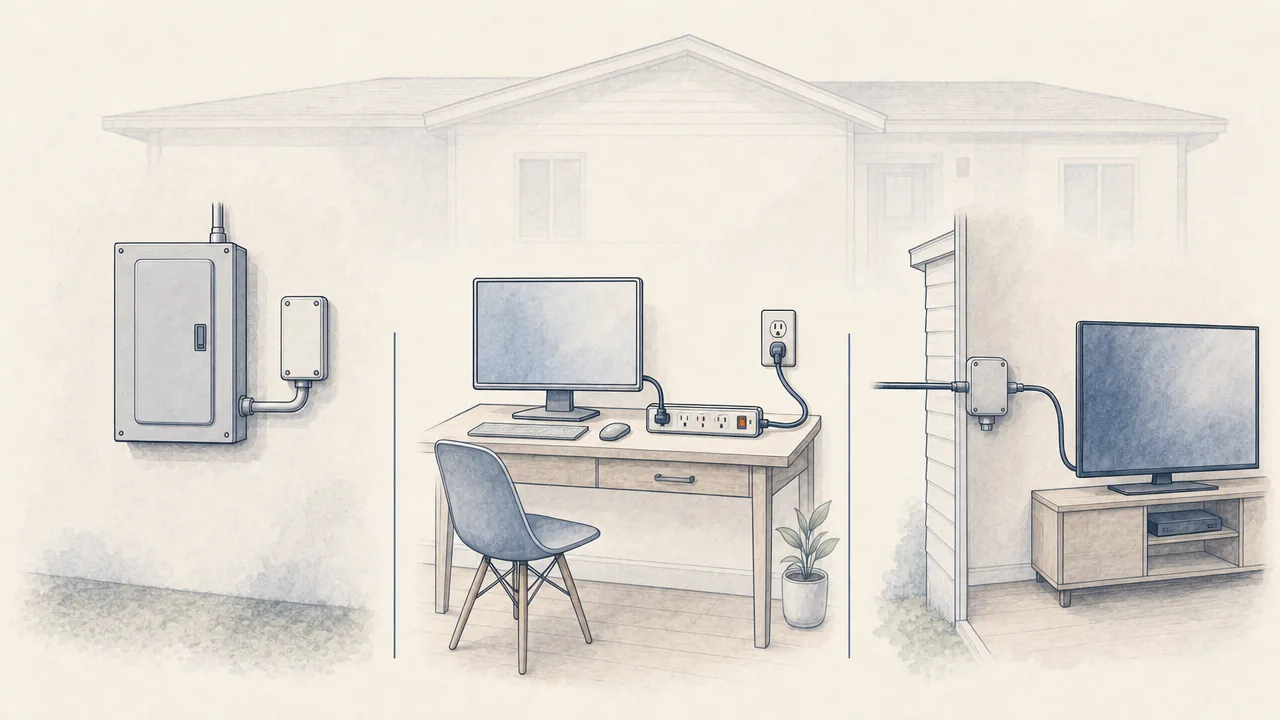
Simplified layout, not wiring instructions.
A home-office surge strip does not provide the same protection to a hard-wired heat pump. A panel SPD still leaves the computer's other incoming connections to address.
Judge the full cost, not the device price
The price of a box is not the price of a finished installation. A useful quote separates the SPD and labor from any necessary electrical corrections, permit or inspection fees, utility coordination and additional protective devices.
A utility's meter-base program is also a different purchase from a panel-mounted installation by an electrician. Some programs have recurring charges and replacement service; an owned device may have different replacement and labor obligations. Compare both the coverage and the costs over the period you expect to keep the arrangement.
For illustration, a hypothetical $8 monthly charge totals $480 over five years, before installation fees or price changes. That is budgeting arithmetic, not a national price estimate or proof that buying is better than leasing. Included maintenance and the actual device still matter.
For your own decision, separate three amounts:
- The surge-protection addition: the device, installation and any extra protection included.
- Work needed anyway: repairs or panel work that remain necessary without the SPD.
- Future obligations: recurring fees, replacement equipment, service calls and cancellation terms.
If protection is offered during a panel replacement, request its separate price within the planned job. If a quote includes a larger panel or service upgrade, the electrician should explain the independent reason for that work. Installing an SPD is not, by itself, proof that you need more service capacity. Our panel upgrade guide separates safety, breaker-space and capacity decisions.
Avoid treating surge protection as an electricity-saving upgrade. Suppressing transients does not deliver the promised bill savings sometimes associated with “power-saving” boxes, as this power-quality technical paper explains. Count its value as reduced exposure to damage and disruption, without assuming annual savings or an insurance discount.
Your buy-or-defer checklist
Add it to the project when these conditions fit
- You have equipment beyond your plug-in protectors' reach. Hard-wired heating, cooling and other controls are part of the protection goal.
- A failure would be difficult to absorb. Repair costs and disruption matter to your household, even though the chance of a damaging event remains uncertain.
- The electrical system is suitable. The electrician's assessment addresses condition, grounding, bonding and compatibility.
- The quote is complete and affordable. You know the model, installed scope, exclusions and future costs.
- You will maintain the protection. There is a clear status indicator and a replacement process, with a person or provider responsible.
A home adding a heat pump and other new appliances may have a strong reason to include surge protection in the electrical quote. The reason is broader equipment coverage, not a guaranteed extension of appliance life.
Defer the optional purchase or narrow the scope when these conditions fit
- A safety defect needs attention first. Fund the repair; an SPD cannot substitute for it.
- Your main concern is outages or ongoing voltage trouble. Have the electrician or utility address that problem and the appropriate remedy.
- Existing protection already meets the goal. Have the electrician identify its model, location and protection status before paying for a duplicate installation.
- The immediate goal is a few plug-in electronics. Suitable point-of-use protection may be a practical first purchase while you budget for broader coverage.
- The proposal is vague. “Protects everything” and a large warranty dollar figure are not a device specification or an installed scope.
Deferring should leave you with a next action, such as correcting a defect, using suitable point-of-use protection or getting a more complete quote. It should not leave a suspected electrical hazard unresolved.
What to require from the installer
Use a qualified, licensed electrician for panel or hard-wired SPD installation. Meter-based work must follow the utility's authorized process. Do not remove the panel cover, handle conductors or attempt voltage tests yourself.
Require these details in writing:
- Exact model and listing. The complete device should be listed to UL 1449 for its intended use, rather than described only as containing recognized components.
- Installation type and compatibility. The electrician should specify the appropriate SPD type, voltage, panel compatibility and indoor or outdoor enclosure. Type numbers describe permitted installation locations, not a universal quality ranking.
- Relevant performance ratings. Include voltage protection rating and nominal discharge current, plus the ratings needed for compatibility with your system. A large advertised maximum surge-current number alone does not answer those questions. NEMA explains the UL 1449 rating distinctions.
- Installation and electrical condition. Include manufacturer-required overcurrent protection and a grounding and bonding assessment. Connections and lead length influence performance, so professional installation is part of the value, not just a labor charge. NEMA identifies these installation performance factors.
- Local requirements. State the adopted code requirement for this project, permit responsibility and any inspection or utility steps. A model-code change does not establish that every existing home must retrofit an SPD immediately.
- Coverage boundaries. Identify additional panels, buildings, equipment or incoming connections that need separate attention.
- Handoff and replacement. Include the protection-status indicator's meaning, maintenance instructions, replacement responsibility, labor coverage and warranty exclusions.
For wider panel work, our panel permit guide helps organize the permit and utility questions. The local rule for a standalone SPD installation still belongs in that specific quote.
Two ownership questions before you commit
How long will a whole-house surge protector last?
There is no universal replacement interval that fits every model and exposure. Protective components can degrade or reach end of life. The manufacturer's instructions and the device's protection-status indication determine the maintenance plan.
A light showing that equipment has power is not automatically proof that surge protection remains active. Have the installer explain the exact indicators at handoff and provide a replacement plan that does not require you to open electrical equipment.
Does a connected-equipment warranty make it worth buying?
Treat that warranty as a conditional benefit, not guaranteed reimbursement. The maximum advertised amount does not tell you which equipment, events, installation conditions, claim documents or labor costs are covered. Require those terms with the quote and judge the installation on its protective role first.
Make the purchase about coverage
Whole-house surge protection is worth considering when it covers equipment you care about at an affordable, fully specified installed cost. Keep point-of-use protection, address other incoming paths and put electrical defects first. You are buying a protective layer with limits and maintenance needs, not a promise that nothing will fail.
Bring your equipment list and buy-or-defer checklist to a licensed electrician and request an itemized surge-protection quote.