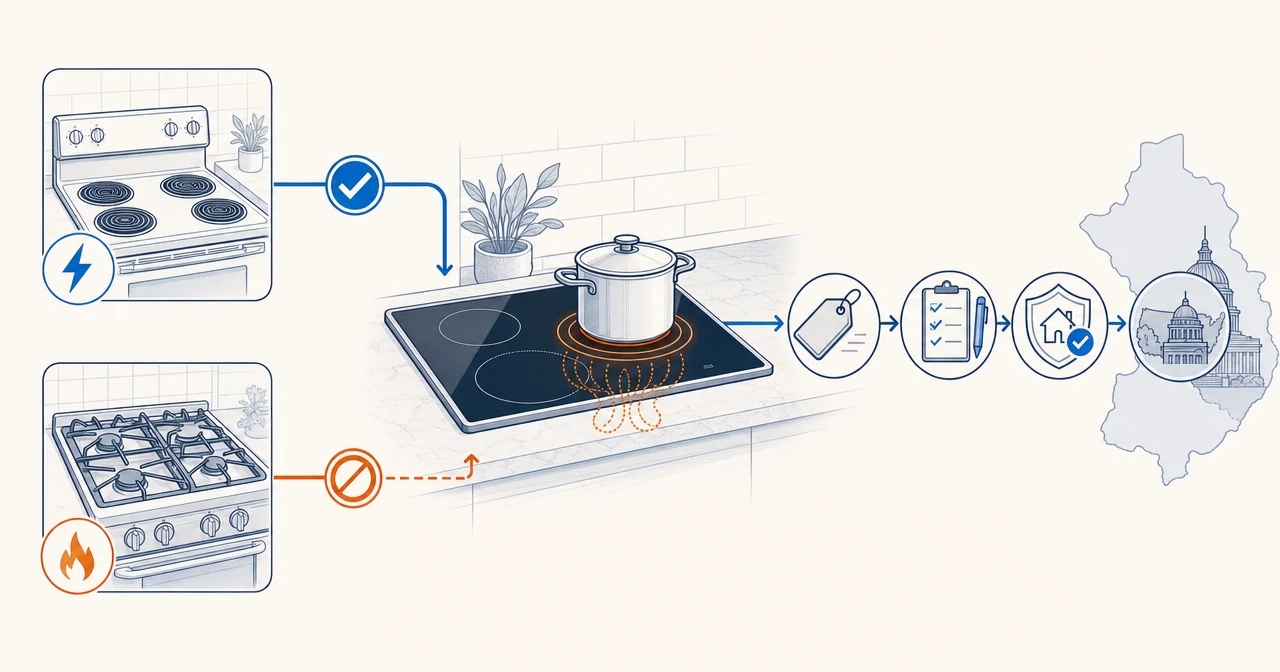
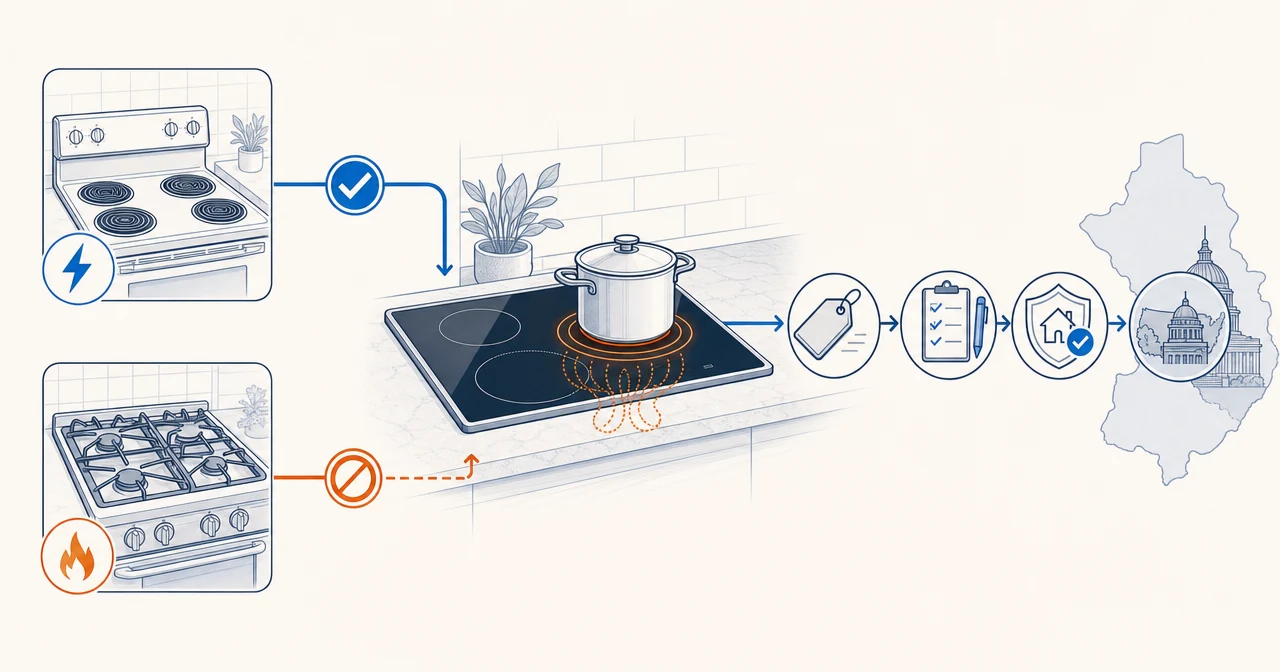
An induction stove rebate can come from a federal program run by your state, a utility, or a local energy office. Those paths use different fuel-switching rules, income tests, deadlines, and paperwork. In 2026, the difference between replacing a gas range with an induction one and replacing an electric range with induction matters more than the product label. We separate the programs, show representative live rules, and lay out the paperwork sequence before you buy.
Last reviewed: September 17, 2026 (UTC)
Quick answer
| Incentive path | Gas-to-induction retrofit | Electric-to-induction retrofit | New construction | Amount or status |
|---|---|---|---|---|
| HEEHR federal rebate | No for a new retrofit under Program Notice 26-2, except for an already approved reservation under the old rules | Potentially, if an existing electric appliance is replaced with a qualifying, more efficient electric model and the state measure is open | Yes, electric appliances in new construction remain allowable under the federal guidance | Up to $840 for the electric stove, cooktop, range, or oven measure; income-qualified and state-administered |
| Utility or local rebate | Sometimes, if the administrator's own rules allow the fuel switch | Sometimes | Sometimes | Amount, product rules, funding, and deadline vary by administrator |
| Federal 25C or 25D tax credit | No | No | No | Neither credit covered a standalone stove, and the broader credits ended for post-2025 property or expenditures under current IRS rules |
The $840 figure is a federal measure cap, not a nationwide payment. A state can offer fewer measures, limit the eligible equipment, require a reservation, or have no live appliance path. A utility or city can still pay for a gas-to-induction project even while HEEHR does not.
1. Separate HEEHR from utility and local rebates
HEEHR is federal funding with a state application
The High-Efficiency Electric Home Rebates program, or HEEHR, is the federal rebate path created under Section 50122 of the Inflation Reduction Act. Older pages may call it HEAR or HEEHRA. DOE's 2026 notice uses HEEHR.
The federal framework includes an ENERGY STAR-certified electric stove, cooktop, range, or oven with a maximum rebate of $840. It also sets broad income bands:
- Households below 80% of area median income (AMI) can receive up to 100% of eligible project cost, subject to the measure cap.
- Households from 80% to 150% of AMI can receive up to 50% of eligible project cost, subject to the measure cap.
- Households above 150% of AMI generally fall outside the HEEHR income limit.
The full HEEHR package has a maximum combined federal amount of $14,000 across eligible measures. That ceiling does not make every measure available in every state. DOE says Home Energy Rebates are live in select states and directs residents to their state or territory energy office for status and eligibility. Our HEEHR rebates guide explains the income bands and state-administered application paths in more detail.
Utility and local programs use their own rulebook
A utility rebate is tied to a service territory. A city or local energy office may limit its offer to residents, account holders, or a defined building type. These programs can cover gas-to-induction conversions, electric-to-induction replacements, or new construction even when HEEHR uses a different rule.
The administrator decides the amount, eligible model, purchase window, proof of fuel change, application deadline, and payment method. HEEHR income limits do not automatically apply to a utility offer. HEEHR approval does not automatically qualify a project for a utility rebate either.
Keep those applications separate in your quote and records. A local offer that pays $800 for a gas-to-induction swap is evidence of that local program's terms, not evidence that the federal HEEHR path still covers fuel switching.
Federal tax credits are a separate path
There is no federal tax credit for buying an induction stove, induction cooktop, range, or oven. The 25C rules covered specified home improvements, and the 25D rules covered qualifying clean-energy property. A standalone cooking appliance is not on either eligible-property list.
The IRS termination FAQ also gives the post-2025 deadlines for other qualifying work: 25C is unavailable for property placed in service after December 31, 2025, while 25D is unavailable for expenditures made after December 31, 2025. Filing a return in 2026 does not turn a 2026 stove purchase into a federal stove credit. Watt Wallet's 2026 federal tax-credit guide covers the remaining filing questions for older qualifying projects.
2. Read the 2026 HEEHR rule in the right order
DOE removed HEEHR fuel-switching rebates for retrofits
DOE Program Notice 26-2 took effect on May 29, 2026. It removed HEEHR allowances for replacing non-electric appliances and instead limited retrofit appliance upgrades to moves from existing electric equipment to more efficient electric equipment. The notice says electric appliances in new construction remain allowable. For a launched program, the default implementation window ended around August 29, 2026, unless DOE approved more time.
That creates a clear federal distinction:
- Gas, propane, or oil to induction in an existing home: a fuel-switching retrofit, so it is outside the revised HEEHR retrofit design.
- Electric coil or radiant range to induction: the project shape that can fit the revised HEEHR design, provided the model, income tier, and state program rules qualify it.
- Induction in new construction: still allowable under the federal HEEHR guidance because new construction does not need an existing electric appliance to replace.
The change is specific to HEEHR. The notice's allowance for a home to keep an existing fossil-fuel HVAC system while adding a heat pump does not create an exception for a gas cooking appliance.
An approved reservation is different from an application
For a launched state program, DOE gave the administrator three months to make the change unless DOE approved more time. The notice allows an existing, approved rebate reservation under the previous guidance to be executed. It also says that no new reservation may be approved for a project that does not conform to the new strategy.
An estimate, contractor promise, submitted form, or unfinished application is not the same thing as an approved reservation. If a project did not have an approved reservation under the old rules, the grandfathering language does not make it eligible.
Programs that had not launched were required to align with the new requirements before launch. That is why a state page can show an appliance category and still have no live application for it.
Why a generic ENERGY STAR page can show older language
The generic ENERGY STAR HEAR table still describes an appliance purchase as part of new construction, a replacement for a non-electric appliance, or a first-time purchase. It is useful for the older federal cap table, ENERGY STAR product requirement, and the warning that states can narrow their offerings.
For the 2026 HEEHR fuel-switching question, the newer DOE Program Notice takes precedence over that generic table. For the actual application, the current written terms from the state, territory, Tribal, or local administrator control the live measure, funding, reservation process, and deadline. A generic table cannot override a later program notice or a state implementation rule.
HEEHR is also separate from HOMES, the performance-based Home Owner Managing Energy Savings program. DOE describes HOMES as a whole-home path based on modeled energy savings, with appliances among the possible project components. That does not make HOMES a standalone $840 induction-stove rebate, and Notice 26-2 is a HEEHR notice. Keep the two federal rebate programs separate when reading a state portal.
3. Current examples and a reliable lookup path
The examples below are administrator-specific snapshots for September 17, 2026. They show why there is no universal state amount or national gas-to-induction answer.
DC Sustainable Energy Utility, 2026 terms. The DCSEU stove program lists $600 for an induction range or stovetop replacing an electric model and $800 for a gas-to-electric replacement. The product must meet ENERGY STAR specifications, the receipt must be dated, and the limit is one stove rebate per utility account per fiscal year. The page lists installations after October 1, 2025 and says gas-to-electric applicants need proof such as before-and-after photos, gas bills, or an invoice showing the old gas equipment was capped. The page does not publish a fixed end date and says amounts can change. It routes applicants to the DCSEU online rebate center.
ComEd Energy Efficiency Program, 2026 offer. The ComEd application lists a $100 rebate for select induction cooktops and ranges. Portable units and dual-fuel models are excluded. ComEd says select induction products do not have to be ENERGY STAR certified, so its local rule differs from the HEEHR product rule. The appliance must be installed at the ComEd residential delivery address, and the applicant needs a ComEd residential account number. The purchase deadline is December 31, 2026. The application is due within 60 days of purchase or by February 28, 2027, whichever comes first.
Hawaiʻi State Energy Office, eHALE status in 2026. Hawaiʻi's eHALE page says its HEEHR pathway is pending DOE approval of launch. It lists an ENERGY STAR electric induction stove, cooktop, range, or oven as an intended measure, with up to 100% of eligible cost below 80% AMI and up to 50% from 80% to 150% AMI, subject to the federal measure cap. The page says work completed before the official launch will not receive a retroactive rebate, and it expressly says fuel switching from propane or natural gas to induction is not eligible under HEEHR. It also says new and existing homes can qualify after launch, while the launch timeline remains unknown.
For a broader search, use DOE's Home Energy Rebates program page for the federal state-status starting point. For utility and product offers, the ENERGY STAR Rebate Finder lets you search by ZIP code and electric cooking category. Treat the result as a lead list. The administrator's dated terms are the final record for the amount, model, fuel source, deadline, and application path.
4. Purchase, documentation, and application checklist
Before you order
- Label the starting fuel. Write down whether the old appliance is gas, propane, oil, electric coil, electric radiant, or absent because the home is new construction. “Induction” describes the new appliance, not the eligibility path.
- Name the administrator. Put HEEHR, HOMES, utility, city, state, or retailer on separate lines. Do not use a HEEHR cap as a placeholder for a local rebate.
- Match the exact model. Save the manufacturer, model number, voltage, and product category. HEEHR commonly requires an ENERGY STAR-certified appliance. Local programs may use a different qualified-product list.
- Set the application sequence. Some HEEHR paths use income approval and a reservation before purchase or installation. Some utilities accept a post-purchase claim. The program's written sequence controls, so an order receipt alone does not reserve federal rebate funds.
- Get an itemized quote. Separate the appliance, electrical circuit or panel work, gas shutoff and capping, permits, countertop work, delivery, and disposal. List each incentive by administrator, amount, and payment timing.
Save the evidence
Keep one document bundle for each program:
- income or AMI records, if the program requires them
- the application, approval, reservation, or waitlist message
- the exact model number and product-eligibility record
- dated receipt, itemized invoice, and proof of payment
- installation date and service address
- before-and-after photos when a fuel change is part of the rule
- gas bills or contractor documentation showing gas equipment was capped, when required
- permit, inspection, and completion records for electrical or gas work
- the utility account number and any landlord or owner approval
For a gas-to-induction project, the old gas appliance and the gas-capping work are often the proof that separates a valid local claim from an ordinary appliance purchase. HEEHR's retrofit rule still treats that same fuel change differently.
Submit and reconcile
Submit each claim through its own administrator and keep the confirmation. A point-of-sale discount, a later utility check, and a state reimbursement are different payment events. Keep them separate from the gross contract price.
HEEHR rebates also cannot be combined with another federal grant or rebate for the same qualified electrification project. A utility or local program may have its own stacking rules. The practical way to handle both is to assign each incentive to a specific cost line and keep the administrator's written terms with that line. Watt Wallet's tax credit versus rebate guide shows how to keep a contractor's “after incentives” number from blending unrelated savings.
FAQ
Is there a federal tax credit for an induction stove in 2026?
No. Neither 25C nor 25D covered a standalone induction stove, cooktop, range, or oven. The IRS also ended 25C for property placed in service after December 31, 2025 and 25D for expenditures made after December 31, 2025. A qualifying older project follows the tax year and rules for that project.
Can I get HEEHR for replacing a gas stove with induction?
As of September 17, 2026, a new gas-to-induction HEEHR retrofit reservation does not fit the revised federal design. Gas-to-induction is fuel switching. An approved reservation made under the previous rules can be executed, and a separate utility or local program can still cover the conversion under its own terms.
Can an electric-to-induction replacement qualify?
Potentially. Replacing an existing electric coil or radiant appliance with a qualifying, more efficient electric model fits the revised HEEHR retrofit design. The state measure must be open, the household must meet the program rules, and the exact appliance must qualify. Local programs can use different rules.
Does a new home qualify for an induction rebate?
New-construction electric appliances remain allowable under HEEHR, so an existing electric stove is not required. The home, household income, product, and state program still have to meet the live requirements. A new home can also fall under a utility or local program with different terms.
Can I combine HEEHR with a utility induction rebate?
Sometimes. HEEHR and utility programs are separate tracks, and the utility's rules decide whether the same purchase can receive both. HEEHR also bars another federal grant or rebate for the same qualified electrification project. Keep the amounts and eligible costs separate before relying on a combined total.
Bottom line for 2026
There is no federal tax credit for an induction stove. HEEHR still has a federal $840 appliance category. The 2026 federal rule removes new gas-to-induction retrofits from that path, subject to the approved-reservation exception. Electric-to-induction replacements, new construction, and local or utility rebates remain possible under different rules.
If you are pricing an induction upgrade now, start with Watt Wallet's HEEHR rebates guide, then build the quote around the live administrator terms rather than the old $840 headline.