Last reviewed: 2026-06-11 (UTC)
If you are searching for the energy efficient home improvement tax credit, the short answer is this:
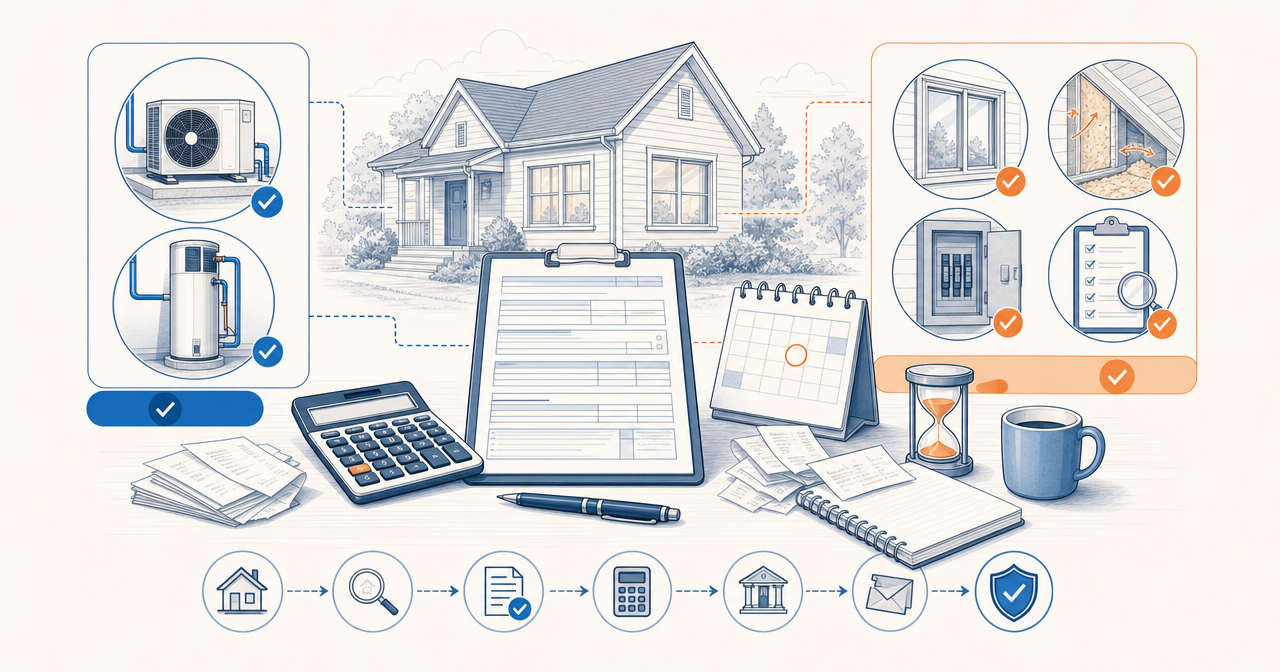
This is the broad federal 25C-style home energy tax credit that covers many common upgrades such as:
- heat pumps
- heat pump water heaters
- insulation and air sealing
- exterior doors
- windows and skylights
- certain central air conditioners, water heaters, furnaces, and boilers
- some panel-related enabling work
- home energy audits
On the current official IRS and ENERGY STAR pages available as of this review date, the credit is generally framed as 30% of eligible cost, with an annual structure of:
- up to $1,200 for many common home-efficiency categories, with smaller sub-limits inside that bucket
- up to $2,000 in a separate annual bucket for qualifying heat pumps, heat pump water heaters, and biomass equipment
The reason homeowners still get confused is that 30% up to $3,200 is only the headline. The real planning questions are:
- which upgrades fall into the $1,200 bucket versus the $2,000 bucket
- which categories count labor and which do not
- whether the credit still applies for the installation year you care about
- what changed in 2025 for qualified manufacturers and IDs
- how to file the claim correctly on Form 5695
This guide answers those questions directly, then points you to the right next step when Watt Wallet already has a deeper page on that upgrade or filing question.
This page is informational, not tax advice. Use current IRS guidance and your tax professional as the final authority for filing decisions.
Quick answer
| Question | Short answer |
|---|---|
| What is it? | The federal Energy Efficient Home Improvement Credit, often referred to as the 25C home-improvement credit. |
| Credit rate | 30% of certain qualified expenses. |
| Big annual limits | Up to $1,200 for many common categories, plus a separate $2,000 annual bucket for qualifying heat pumps, heat pump water heaters, and biomass equipment. |
| Filing form | Usually IRS Form 5695, Part II. |
| Carryforward | The current official pages say this credit is nonrefundable and you cannot apply excess credit to future tax years. |
| Current timing | OBBBA terminated this credit for property placed in service after Dec. 31, 2025. It applies only to qualifying property placed in service through Dec. 31, 2025. |
If you are planning a 2026 or later installation, the federal 25C credit no longer applies: OBBBA ended it for property placed in service after Dec. 31, 2025. For those projects, pivot to the savings paths that are still live: state and utility incentives, and the restarted IRA Home Energy Rebates (HEEHR) where your state offers them. Those rebates are now electric-to-electric only and do not fund fuel-switching, so confirm the current rules with your state energy office. For the full 2026 picture, see Watt Wallet's guide to federal home energy tax credits in 2026.
Does the 25C home energy tax credit still apply?
That depends on the install year you are talking about.
The One Big Beautiful Bill Act (OBBBA), signed July 4, 2025, terminated the Energy Efficient Home Improvement Credit for any property placed in service after Dec. 31, 2025. The IRS Energy Efficient Home Improvement Credit page and the Form 5695 instructions confirm you cannot claim the credit for expenditures or property placed in service after that date.
That timing matters because many searches in 2026 are really asking one of two different questions:
- I installed qualifying property in 2025. Can I still file for it now? Yes. That is a filing question tied to the 2025 return.
- I want to install something in 2026 or later. Can I still count on this credit? No. The credit is gone for installs after the end of 2025.
So the most practical rule is:
- if your project was placed in service in 2025, you can still claim it on your 2025 federal return
- if your project is placed in service in 2026 or later, the federal 25C credit does not apply
What qualifies under the energy efficient home improvement tax credit?
This is the main part many general explainers blur.
The credit does not work like one giant bucket where every upgrade follows the same rules. It covers different categories, and the caps, labor treatment, and residence rules differ.
1) Building-envelope improvements inside the $1,200 bucket
These are the classic envelope items:
- insulation materials or systems
- air-sealing materials or systems
- exterior doors
- exterior windows and skylights
Important rules here:
- this category sits inside the broader $1,200 annual bucket
- exterior doors are capped at $250 per door and $500 total
- windows and skylights are capped at $600 total
- for building-envelope components, labor does not count toward the credit
For windows or insulation, use the current IRS and ENERGY STAR category tables plus the manufacturer's certification details. Those sub-caps and qualification rules are easy to misread if you rely on a stale roundup.
If your project is specifically about qualifying exterior windows, read the dedicated window replacement tax credit walkthrough for the $600 cap, Most Efficient rule, and timing details.
2) Residential energy property also inside the $1,200 bucket
The Form 5695 instructions and IRS guidance also place several equipment categories in the broader $1,200 annual bucket, including:
- central air conditioners
- natural gas, propane, or oil water heaters
- natural gas, propane, or oil furnaces or hot water boilers
- improvements to or replacement of panelboards, subpanelboards, branch circuits, or feeders
- home energy audits
Important sub-limits and caveats:
- home energy audits are capped at $150
- qualifying panel-related enabling work has a $600 item limit and must meet stricter conditions
- unlike building-envelope components, these residential energy property categories can include labor costs when the official rules allow them
The panel category is especially easy to misunderstand. A panel upgrade does not qualify just because it was expensive. Under the current guidance, the work must support qualifying energy property, meet the National Electric Code, and satisfy the credit's specific enabling-property rules.
For deeper reading, pair this page with:
3) The separate $2,000 annual bucket
A separate annual limit applies to:
- qualifying heat pumps
- qualifying heat pump water heaters
- biomass stoves or boilers
This is the most valuable part of the credit for many electrification projects. The IRS and ENERGY STAR both frame these categories as a separate up to $2,000 annual bucket, not part of the standard $1,200 cap.
That is why a homeowner might claim:
- up to $2,000 for a qualifying heat pump project, and
- additional value in the $1,200 bucket for other eligible upgrades in the same tax year
For specific upgrade pages, use:
If you are pricing a ductless system, use the heat-pump guide and confirm the exact model's certification and manufacturer-code paperwork before you file.
How the yearly caps actually work
This is where homeowners often overestimate the benefit.
The broad homeowner summary is often phrased as up to $3,200 per year, but the mechanics matter:
The standard annual bucket: up to $1,200
This bucket can include combinations of:
- insulation and air sealing
- exterior doors
- windows and skylights
- central air conditioners
- certain fossil-fuel water heaters
- certain fossil-fuel furnaces and boilers
- panel-related enabling work
- home energy audits
But that bucket still has tighter internal caps:
- $500 total for exterior doors
- $600 total for windows and skylights
- $600 per item for panel-related enabling property
- $150 for home energy audits
The separate annual bucket: up to $2,000
This separate bucket is for:
- heat pumps
- heat pump water heaters
- biomass stoves and boilers
A simple planning example
A homeowner in the currently published 2025 rules might install:
- a qualifying heat pump -> potentially up to $2,000
- qualifying windows -> potentially up to $600
- a home energy audit -> potentially up to $150
That does not mean every dollar of the project qualifies. It means the project has to be broken into the right categories, with the right sub-caps, under the right install-year rules.
This is also why one blended after incentives quote number can be misleading. A cleaner workflow is:
- calculate each upgrade category separately
- apply the correct annual cap to each category
- keep rebates separate from tax-credit assumptions
Who can claim the credit?
The broad IRS rule is that this credit applies to an existing home in the United States that you improve or add onto, not a newly built home.
The high-level IRS page also says:
- the home must be located in the United States
- in most cases, it must be your primary residence
- you generally cannot claim the credit if you are a landlord or other property owner who does not live in the home
But the category rules are not perfectly identical across every upgrade.
ENERGY STAR's current category notes say:
- for doors, windows, skylights, insulation, and air sealing, the home must be owned and used by the taxpayer as the taxpayer's principal residence and does not include renters or second homes
- for central air conditioners, certain water heaters, furnaces, boilers, heat pumps, heat pump water heaters, biomass equipment, and qualifying panel improvements, the home must be used as a residence in the United States and can include a second home and renters who make eligible improvements
- for home energy audits, the home must be the taxpayer's principal residence, but renters may still be eligible if they make the improvement
The practical takeaway:
- for envelope upgrades, assume principal residence rules are stricter
- for some residential energy property categories, the current ENERGY STAR notes are broader
- if your ownership or occupancy status is unusual, verify the category-specific rule before you budget around the credit
What costs count and what does not?
The answer depends on the category.
Costs that usually count
Under the current official guidance, the credit can be based on:
- qualified product cost
- labor for installation of qualifying residential energy property where the rules allow it
- the qualified fee for a home energy audit
Costs that often do not count
Homeowners often miss these exclusions:
- labor does not count for building-envelope components such as insulation, air sealing, doors, windows, and skylights
- not every electrical line item qualifies just because it was part of a broader project
- unrelated repairs, cosmetic finish work, and non-qualifying scope do not become creditable just because they appeared on the same invoice
That is why an itemized invoice matters so much. If a contractor quote mixes eligible equipment, ineligible finish work, rebates, and separate electrical scope into one lump sum, the filing side gets messy fast.
What changed in 2025?
One of the most important changes in the current filing cycle is the qualified manufacturer / QMID requirement.
The IRS says that for each qualifying item placed in service in 2025, no credit is allowed unless the item was produced by a qualified manufacturer and the taxpayer reports the Qualified Manufacturer Identification Number (QMID) for the item on the tax return.
ENERGY STAR adds a practical homeowner note: because manufacturer registration is still in process, it is sufficient for 2025 installations to include the manufacturer's four-digit QM code on the 2025 return for the applicable products.
That change does not hit every category equally.
A useful homeowner distinction is:
- many specified 2025 products do require the manufacturer ID workflow
- insulation and air-sealing materials are the main carveout on the IRS high-level page and do not use the qualified-manufacturer / PIN requirements the same way many other 2025 items do
That is one reason category-specific pages are still useful even after you read this broader hub.
How to claim the credit on Form 5695
The IRS says to claim the Energy Efficient Home Improvement Credit using Form 5695, Part II.
A simple homeowner map looks like this:
- Part II, Section A -> building-envelope items such as insulation, doors, and windows/skylights
- Part II, Section B -> residential energy property such as central air, certain water heaters, furnaces/boilers, panel-related enabling work, home energy audits, and heat pumps
- Line 29 -> the separate heat-pump / heat-pump-water-heater / biomass bucket
- Line 32 -> the final energy efficient home improvement credit amount that flows to Schedule 3
Two filing rules matter across almost every project:
- The credit is tied to the year the property is placed in service.
- You need documentation that matches the category you are claiming, not just a generic contractor proposal.
A clean filing folder should include:
- the correct tax-year Form 5695 instructions
- final itemized invoice
- proof of payment
- placed-in-service date
- any required QMID or QM-code information
- manufacturer qualification documentation where applicable
- rebate or subsidy records that could reduce the cost basis
If you want the line-by-line version, use Watt Wallet's Form 5695 Instructions guide.
How to plan the best use of the 25C caps
The best homeowners do not treat this as a one-time shopping coupon. They plan the categories deliberately.
A smart planning workflow is:
- Figure out which bucket your upgrade belongs to.
- Heat pump? Separate $2,000 bucket.
- Windows or insulation? $1,200 bucket with tighter internal caps.
- Separate tax-credit planning from rebate planning.
- A rebate is not the same thing as the federal claim.
- Remember the multi-year strategy only applied through 2025.
- ENERGY STAR previously noted the annual structure could make it prudent to spread improvements over a few years, but OBBBA ended the credit for property placed in service after Dec. 31, 2025, so this no longer helps a 2026 install.
- Use the broad hub for strategy, then go to the category page for details.
Helpful next steps:
- Can You Stack Rebates and Tax Credits?
- How to Compare Rebates, Tax Credits, and Installer Quotes
- Heat Pump Rebates by State
Common mistakes to avoid
1) Treating 25C like one simple 30%-off coupon
The credit has different buckets, different sub-caps, and different cost-treatment rules depending on the category.
2) Confusing the energy efficient home improvement credit with the residential clean energy credit
Solar, geothermal, battery storage, and some other renewable-energy equipment belong in the Residential Clean Energy Credit track, not this 25C / Part II home-improvement credit.
3) Assuming labor always counts
It does not. Labor treatment changes by category.
4) Assuming every category has the same residence rule
It does not. Envelope items, home energy audits, and residential energy property categories are not all identical.
5) Forgetting the 2025 manufacturer-ID change
For many 2025 specified property types, the filing details got stricter.
6) Ignoring rebates or subsidies when calculating the federal claim
The IRS says some subsidies, rebates, and other financial incentives may reduce the qualified cost used for the credit.
7) Assuming unused credit carries forward
The current official energy efficient home improvement credit guidance says the credit is nonrefundable and excess does not carry forward to future tax years.
FAQ
Is the energy efficient home improvement tax credit the same as the 25C tax credit?
Yes. Homeowners often use 25C tax credit, home energy tax credit, and energy efficient home improvement tax credit to refer to the same broad federal home-improvement credit.
What is the maximum annual value of the credit?
Under the current official pages available at this review date, homeowners often summarize the structure as up to $3,200 total per year, made up of up to $1,200 for many common categories plus a separate $2,000 annual bucket for qualifying heat pumps, heat pump water heaters, and biomass equipment.
Does the credit cover heat pumps?
Yes. Qualifying heat pumps are one of the biggest categories under the credit and use the separate up to $2,000 annual bucket.
Are windows and insulation part of the same credit?
Yes, but they do not follow the same exact rules as heat pumps. Windows, skylights, doors, insulation, and air sealing sit inside the broader $1,200 annual bucket and have their own eligibility details.
Can I claim more than one type of upgrade in the same year?
Potentially, yes. Many homeowners can combine a qualifying heat-pump project with separate eligible improvements in the $1,200 bucket, subject to the category-specific caps and tax-liability limit.
Does unused 25C credit carry forward?
The current official guidance says no. This credit is nonrefundable, and you cannot apply any excess to future tax years.
What form do I use to claim the credit?
Typically IRS Form 5695, Part II.
Related Watt Wallet pages
- Form 5695 Instructions
- Heat Pump Tax Credit
- Electric Panel Tax Credit: Eligibility Guide
- Heat Pump Water Heater Tax Credit Guide
- Can You Stack Rebates and Tax Credits?
- How to Compare Rebates, Tax Credits, and Installer Quotes
- Heat Pump Rebates by State