Last reviewed: 2026-07-29 (UTC)
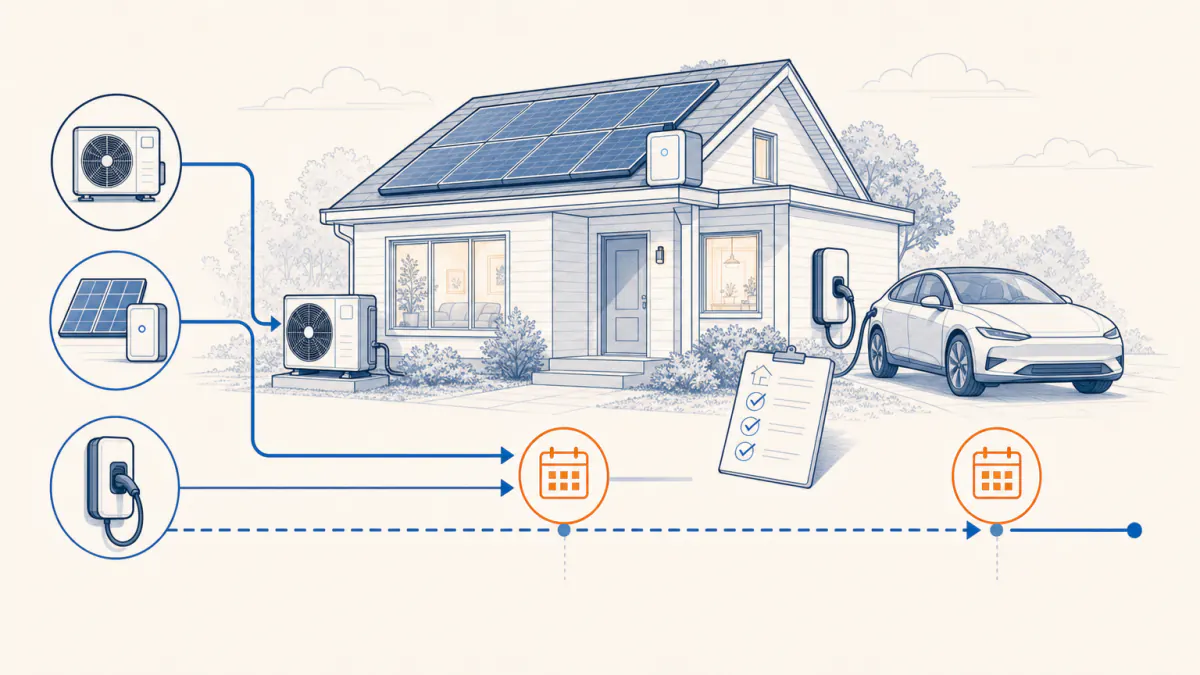
Quick answer: The Energy Efficient Home Improvement Credit (25C) and Residential Clean Energy Credit (25D) do not cover new 2026 projects. A qualifying 2025 project can still be claimed on the 2025 return filed in 2026. The individual Alternative Fuel Vehicle Refueling Property Credit (30C) lasted longer: an eligible home EV charger had to be operational and placed in service by June 30, 2026. The IRS termination table confirms all three dates.
What to do next depends on when the project was ready for use:
- 25C property placed in service or a 25D installation completed in 2026: no 25C or 25D credit.
- A qualifying project completed in 2025 but not yet claimed: use the final 2025 Form 5695, even if you physically file or amend the return in 2026.
- A home EV charger placed in service from January 1 through June 30, 2026: it may qualify under 30C if the home and charger meet the other IRS rules. Claim it on the 2026 return, normally filed in 2027.
This guide is general information, not personal tax advice. Use the final IRS form for the applicable tax year, and ask a qualified tax professional how the rules apply to your return.
Which federal home energy credits can still be claimed in 2026?
The IRS law-change FAQ is the controlling source for the three accelerated termination dates below.
| Credit | Last qualifying date | Who may still have a claim | Filing path |
|---|---|---|---|
| 25C: Energy Efficient Home Improvement Credit | Property had to be placed in service by December 31, 2025. The credit is not allowed for property placed in service after that date. | A taxpayer with a qualifying 2025 heat pump, heat pump water heater, insulation, air sealing, window, door, HVAC, panel-enabling project, or home energy audit. | Claim on 2025 Form 5695, Part II. The credit is nonrefundable and unused credit does not carry forward. See the IRS 25C rules. |
| 25D: Residential Clean Energy Credit | The qualifying expenditure had to be made by December 31, 2025. For installed property, the IRS treats the expenditure as made when the original installation is completed. | A taxpayer with a qualifying 2025 solar, battery, geothermal, small-wind, solar-water-heating, or fuel-cell project, plus anyone carrying forward unused 25D credit from an earlier year. | Claim a 2025 project on 2025 Form 5695, Part I. Unused credit can carry forward. See the IRS 25D rules. |
| 30C: Alternative Fuel Vehicle Refueling Property Credit | Property had to be placed in service by June 30, 2026. | An individual with a new charger whose original use began with them, installed at a main home in an eligible census tract by the cutoff. | Claim on Form 8911 for the tax year the charger was placed in service. A qualifying first-half 2026 installation belongs on the 2026 return. See the IRS individual 30C guide. |
The One Big Beautiful Bill Act moved these termination dates forward. Under current law, ordering equipment, paying a deposit, or signing a contract before a deadline is not enough by itself. The applicable property or installation had to reach the tax rule's placed-in-service or completion point by the cutoff.
Is the Energy Efficient Home Improvement Credit available in 2026?
The Energy Efficient Home Improvement Credit is unavailable for 25C property placed in service after December 31, 2025. That means a heat pump, heat pump water heater, insulation, window, door, central air conditioner, qualifying furnace or boiler, or electrical-panel enabling project placed in service in 2026 does not qualify. The 25C credit is also unavailable for a home energy audit performed in 2026.
What about solar, batteries, and other 25D projects?
The same current-year answer applies to 25D projects. A solar, battery, geothermal, small-wind, solar-water-heating, or fuel-cell installation completed in 2026 does not qualify for the Residential Clean Energy Credit. A 2025 payment or deposit does not preserve the credit when the original installation was not completed until 2026, according to the IRS timing guidance.
Use current solar installation cost benchmarks to set a gross budget before subtracting any state, utility, or local offer.
For the equipment standards that applied to 2025 projects, use the relevant guide:
- Energy Efficient Home Improvement Credit (25C)
- Heat Pump Tax Credit
- Heat Pump Water Heater Tax Credit
- Window Replacement Tax Credit
- Electric Panel Upgrade Tax Credit
These pages explain whether an older project met its equipment and cost rules. They do not reopen the credit for a new 2026 installation.
If you completed a qualifying project in 2025 but are filing in 2026
A 2025 project belongs on the 2025 tax return. Filing that return, an extended return, or an amended return during calendar year 2026 does not turn the expense into a 2026 project.
Use this sequence:
- Confirm the controlling date. For 25C, confirm when the property was ready and placed in service. For 25D, confirm when the original installation was completed.
- Use the final 2025 form. Claim 25D in Part I and 25C in Part II of 2025 Form 5695. Watt Wallet's Form 5695 instructions guide can help you organize the inputs, but the archived 2025 IRS instructions control.
- Gather the evidence. Keep invoices, receipts, installation records, product specifications, manufacturer certification statements, and records of rebates or subsidies that affect qualified cost.
- Find each required QMID. For specified 25C property placed in service in 2025, the archived 2025 instructions require the four-character qualified manufacturer identification number (QMID) on the return. The QMID requirement does not apply to insulation and air-sealing materials or home energy audits.
- Attach the form to the right return. If the original or extended 2025 return has not been filed, include Form 5695 with that return. If the 2025 return was already filed without the credit, amend it rather than putting the expense on a 2026 return.
- Check the amendment deadline. The IRS says a taxpayer who omitted a qualifying credit may generally amend within the later of three years after filing the original return or two years after paying the tax. Check the separate IRS timing FAQs for 25C and 25D, then confirm your deadline for your own return.
Do not mix up the carryforward rules
- 25C does not carry forward. It is nonrefundable. If the credit exceeds your federal income-tax liability for that year, the unused portion is lost.
- 25D can carry forward. It is also nonrefundable, but unused 25D credit can reduce tax in a later year. The archived 2025 Form 5695 instructions specifically provide for a 2025 unused amount to carry to 2026.
How much could a qualifying older project claim?
25C for property placed in service in 2025
The credit was generally 30% of qualified expenses, subject to annual and item limits. The IRS 25C overview groups the limits this way:
- up to $1,200 for the general annual bucket, with smaller item limits inside it;
- a separate combined limit of up to $2,000 for qualifying heat pumps, heat pump water heaters, biomass stoves, and biomass boilers.
A taxpayer with enough qualifying expenses in both buckets could reach a combined $3,200 for the year. The 25C guide covers the item limits and equipment rules. Product standards, home-use rules, labor treatment, QMID requirements, rebates, and federal income-tax liability can reduce the allowed amount.
25D for an installation completed in 2025
The Residential Clean Energy Credit was generally 30% of qualified costs for eligible solar electric, solar water heating, small-wind, geothermal heat-pump, fuel-cell, and battery-storage property. The IRS 25D overview has the property and expense rules. Most categories did not have an overall annual dollar cap; fuel cells had a separate capacity-based limit.
30C for an eligible home charger placed in service by June 30, 2026
For an individual installing qualified charging property at a main home, 30C was 30% of eligible cost, up to $1,000 per single item or charging port. Eligible cost can include installation labor and associated property directly attributable and traceable to the charger. The home had to be in an eligible census tract on the placed-in-service date.
The homeowner credit is nonrefundable, so it is limited by your federal income-tax liability, and unused credit does not carry forward. Follow the IRS individual 30C steps, complete one Schedule A (Form 8911) for each item, and file Form 8911 for the correct tax year.
What incentives should you check for a new 2026 project?
The end of a federal income-tax credit does not end every incentive. State energy offices, utilities, local governments, and the federal Home Energy Rebates program follow separate rules and schedules.
For a new project:
- Check the Department of Energy's Home Energy Rebates program and your state energy office. Availability, eligible equipment, income rules, and funding status vary by state and can change.
- Use Heat Pump Rebates by State for official state and utility starting points when the project includes a heat pump.
- Use Watt Wallet's ENERGY STAR Rebate Finder guide to search for additional local programs, then verify the result with the program administrator.
- Keep each rebate, financing offer, and tax item separate when reviewing a contractor's “after incentives” price. The tax credit vs. rebate guide shows how to compare those buckets without double-counting them.
Planning a project now? Do not subtract an expired 25C or 25D credit from a 2026 quote. Verify a live state, utility, or local program before you sign.
Common timing questions
What if I filed an extension or already submitted my 2025 return?
If the original or extended 2025 return has not been filed, include Form 5695 with it. If the 2025 return was already filed without a qualifying 25C or 25D credit, amend that return. Do not move a 2025 expense to the 2026 tax return.
Does a 2025 deposit preserve 25C or 25D for a 2026 installation?
No. A deposit does not override the controlling completion rule. For 25C, the property had to be placed in service by December 31, 2025. For 25D, the IRS treats the expenditure as made when the original installation is completed, so a project completed in 2026 misses the cutoff.
Can unused 25D credit still carry into 2026 after 25D ended?
Yes. The end of new 25D expenditures does not erase a valid carryforward. Use the applicable Form 5695 to calculate the amount carried into the next tax year.
Could a home EV charger installed in 2026 qualify?
Only if it was operational and placed in service by June 30, 2026, at a main home in an eligible census tract, and it met the other IRS 30C requirements. Property placed in service on or after July 1, 2026 does not qualify.
Official sources
- IRS: OBBB energy-credit termination FAQs
- IRS: Archived 2025 Instructions for Form 5695
- IRS: Energy Efficient Home Improvement Credit (25C)
- IRS: Residential Clean Energy Credit (25D)
- IRS: Alternative Fuel Vehicle Refueling Property Credit for Individuals (30C)
- IRS: About Form 8911
- U.S. Department of Energy: Home Energy Rebates program