Last reviewed: November 20, 2026
Who is responsible for replacing an electric meter box?
In a common U.S. residential arrangement, the property owner is responsible for replacing the meter box or socket, while the electric utility owns and maintains the meter itself. The owner hires a licensed electrician for customer-owned equipment; the utility handles its meter and service work under its own authorization rules.
That split is explicit in Unitil’s equipment guidance: the meter belongs to Unitil, while the protective socket belongs to the customer. Con Edison likewise assigns the meter to itself and the meter pan or enclosure to the customer in its repair responsibility guide.
This is a starting point for a U.S. home, not a nationwide ownership rule. Utility service standards and the particular equipment can change who supplies a replacement, who installs it, and which charges fall to the customer.
Meter, socket, and breaker panel mean different things
- Electric meter: The utility’s device that measures electricity use, often the round unit with a digital display.
- Meter socket, base, pan, or box: The fixed assembly that holds the meter and its electrical connections. Utilities use different names for this equipment.
- Meter-main combination: Equipment that combines the meter socket and a main disconnect in one assembly. A quote for this equipment can include more than a standalone socket replacement.
- Breaker panel: The equipment that distributes power to household circuits. It may be separate from the meter equipment.
The round measuring device and the surrounding enclosure can have different owners even though they look like one piece of equipment. A utility seal also does not establish that the utility owns the entire box.
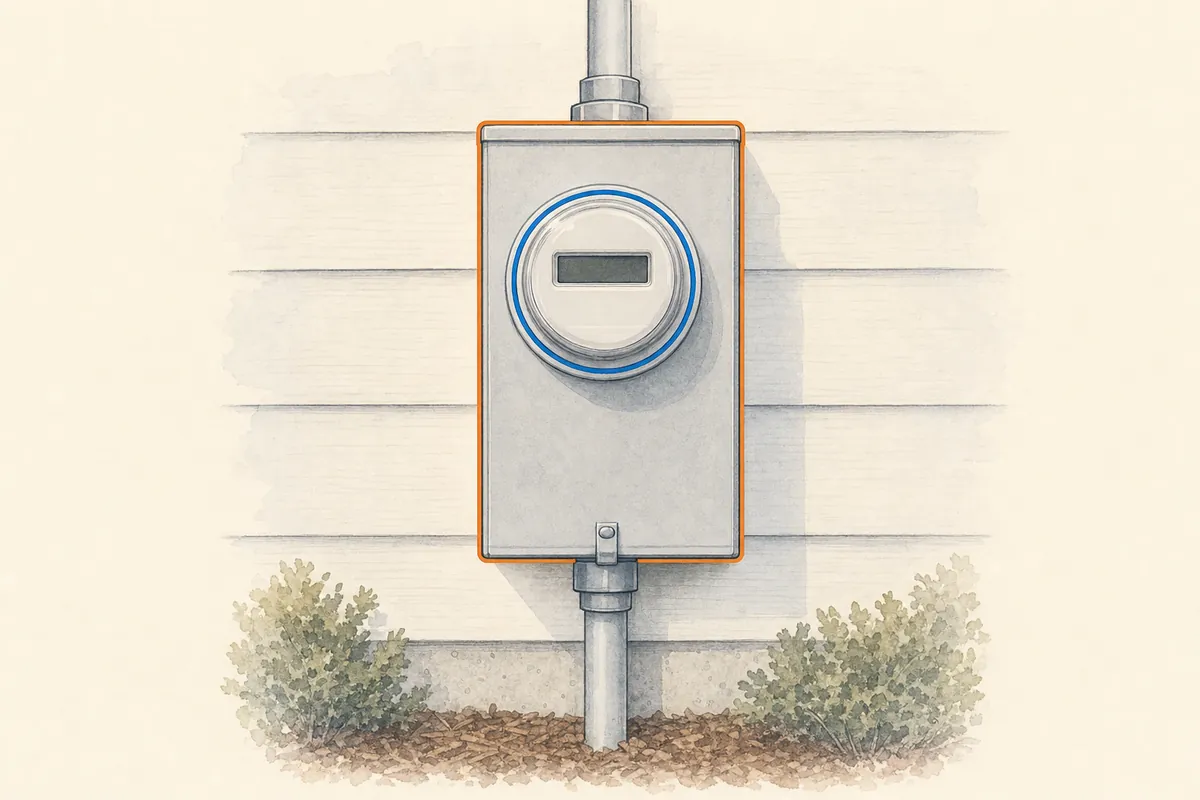
Simplified layout, not wiring instructions.
Ask for the exact failed component on the repair notice and estimate. If the work also includes the breaker panel or a larger service, our electrical panel upgrade guide explains those separate scopes.
Treat damage as a safety problem first
For fire, active sparking, or an immediate threat to life or property, move away and call 911. UPPCO directs customers to call the utility about a loose or unsecured meter cover or a meter that appears partly out of its socket. Its meter safety guidance says UPPCO meters are not homeowner-serviceable and only trained, authorized UPPCO personnel should work on or handle them.
Do not open the enclosure, break a seal, pull the meter, or try to secure a loose cover yourself. As InterNACHI’s panel guidance explains, the service-side main terminals can remain energized when utility service is connected, even with the main breaker off. Do not touch those terminals or attempt repairs yourself.
Who pays, and who performs each part?
For customer-owned meter equipment, the owner generally arranges and pays for the electrician’s replacement work. That does not give the owner or electrician unrestricted permission to handle the utility meter.
Keep these responsibilities separate in the written scope:
| Responsibility | Usual lead for customer-owned socket replacement | What must be assigned |
|---|---|---|
| Identify the failed equipment | Utility and electrician | Meter, socket, enclosure, meter-main, or other service equipment |
| Supply the replacement socket | Owner’s electrician, unless the utility supplies it | Approved equipment and who purchases or furnishes it |
| Replace customer-owned equipment | Licensed electrician | Labor, related repairs, and exclusions |
| Disconnect service and handle the meter | Utility or personnel it authorizes | Appointment, authorization, meter removal, and resealing |
| Permit and inspection | Contractor and local permitting authority | Applicant, fees, inspection booking, and approval |
| Restore service | Utility or its authorized process | Required release, scheduling, and any charges |
Ownership also does not guarantee that every meter-related charge is free. Norwich Public Utilities, for example, assigns socket maintenance and repair to the customer and charges for negligent damage to its meter under its meter installation handbook.
We recommend a scope that names the party responsible for every handoff. “Meter box replacement included” leaves too much room for an unbooked disconnect, a missing permit, or an inspection release that nobody sends.
Utility exceptions can split the equipment and labor bill
The question “Who owns it?” does not always answer “Who supplies it?” or “Who installs it?” Two utility examples show why those distinctions matter.
A utility may supply the socket while the customer arranges installation
FirstEnergy’s West Virginia service guide, section 7.1, says the company furnishes basic self-contained, single-position sockets and the customer installs them. For a failed company-owned standard socket, the company repairs it or provides a replacement, while the customer remains responsible for installing the replacement. Equipment beyond the basic model, such as a combination socket, is the customer’s responsibility.
That is a West Virginia service-guide provision, not a rule for every FirstEnergy territory or every socket. It illustrates a practical distinction: a utility-supplied part can still leave installation work on the customer’s side of the project.
An electrician’s license does not automatically authorize meter removal
Norwich Public Utilities allows its authorized employees, or licensed electricians with prior approval, to remove and set meters or handle seals. Its handbook separately makes the customer responsible for the socket.
The contractor therefore needs both the qualifications for the electrical work and whatever utility authorization applies to the meter. A general promise that “the electrician will pull the meter” is incomplete without the utility’s approved process.
How disconnect, permits, inspection, and reconnection fit together
A meter-socket replacement involves several organizations. The utility controls its service and meter requirements. The local permitting and inspection authority, often called the authority having jurisdiction, controls the applicable permit and inspection requirements. One approval does not stand in for the other.
The precise order varies, but a well-scoped project addresses five handoffs:
- Define the repair. The utility identifies its equipment and authorization requirements. The electrician identifies the customer-owned work and whether the proposal is a repair, replacement, relocation, or service upgrade.
- Approve the equipment and utility request. The contractor obtains the utility’s acceptance of the proposed socket or combination equipment and completes any required service application before ordering or scheduling around it.
- Assign the permit and outage appointments. The written agreement names who obtains the permit and coordinates the disconnect, electrician, and inspector. Household plans should account for the full outage window, including a possible delayed reconnect.
- Complete professional work and required inspection. The electrician performs the permitted work after the necessary service isolation. The inspector approves it where required, and the responsible party sends the release through the utility’s required channel.
- Complete reconnection and closeout. The utility or authorized personnel restores service once its requirements are satisfied. The owner receives the final scope, final inspection record, and warranty documents.
For a concrete local example, Homestead, Florida’s disconnect and reconnect process requires an electrical permit before disconnection and a passing inspection before reconnection. Its process assigns tasks among the owner, electrician, inspector, and utility. Homestead says that when final inspection approval occurs after 2 p.m., reconnection may happen the following business day unless expedited reconnection is requested; fees may apply.
Those are Homestead requirements. Elsewhere, the permit scope, inspection release, authorized workers, and scheduling rules differ. Our panel permit guide explains the distinction between the electrical permit and utility coordination when panel work is part of the same project.
PG&E’s application examples for disconnect-reconnect work
PG&E’s disconnect and reconnect guidance says customers requesting a disconnect-reconnect for any listed reason must also apply through Your Projects for Relocation or Rearrangement of Service. The listed reasons include a meter-panel changeout that increases panel size and, separately, replacement with no change to service, illustrated by an old 100-amp panel replaced by a new 100-amp panel. The guide does not establish that the same application is required for a stand-alone meter-socket swap.
Confirm any equipment-type, location, or clearance requirements with the utility or local inspector rather than assuming the existing installation can be copied unchanged. Minnesota Power’s repair requirements distinguish general socket or service-panel maintenance from significant changes or upgrades, and note that the governing authority may require permits beyond Minnesota Power’s list.
What to ask before authorizing replacement
Use these questions to turn an ownership answer into an executable repair plan.
Ask the utility:
- Which exact component is damaged, and who owns that component at this address?
- Does the utility furnish any replacement equipment, or does the electrician supply all of it?
- Which socket or meter-main equipment is acceptable for this service?
- Who is authorized to remove the meter, break seals, disconnect service, and reconnect it?
- Is a service application needed for this scope, including a same-amperage replacement?
- What inspection release or other documents are needed before reconnection?
- What are the appointment rules, possible utility charges, and arrangements if the work misses the reconnect window?
Ask the electrician:
- Is the estimate for the socket alone, a meter-main assembly, or a larger service project?
- Who handles the utility request, permit, inspection booking, and release paperwork?
- Which related repairs or required changes are included, and which are excluded?
- What outage should the household plan for, and who coordinates a delayed inspection or failed inspection?
- Who repairs affected siding or other building surfaces, and what completion records and warranty will we receive?
If a repair notice has a deadline, share it with the contractor immediately. Minnesota Power’s fix-it process allows disconnection for hazardous customer-owned equipment and for unresolved repairs. A notice is a coordination task with a deadline, even when the lights still work.
If you rent or share a meter bank
Report the problem to the utility and property owner or manager. For a condominium or shared meter bank, include the association or building manager before authorizing work on common equipment. Ask them to identify the responsible owner and contracting party in writing.
Have the owner, manager, or association resolve payment and contracting responsibility for the building’s equipment. Keep immediate safety reporting separate from that decision, rather than waiting for a billing dispute to be settled.
For a typical homeowner, the practical answer is straightforward: expect to arrange the electrician for a customer-owned socket, and expect utility involvement for its meter and service. Before authorizing replacement, get one written plan that assigns the equipment, labor, permit, disconnect, inspection release, and reconnect.