Last reviewed: November 19, 2026
If a wire is down or damaged, stay away
Treat every fallen wire as energized. Stay at least 35 feet from fallen power lines and anything they touch, including trees, fences, vehicles, and standing water. Call 911 and the electric utility from a safe location. The American Red Cross gives the same 35-foot safety guidance.
Report a sagging line, damaged attachment, or meter equipment pulling away from the house to the utility, even if the lights still work. Keep people and pets away. Do not lift a line, move a branch off it, reattach equipment, remove a meter, or approach for a closer photograph. Ownership can wait until the utility has addressed the hazard.
Who is responsible for the power line from pole to house?
For a typical U.S. overhead residential connection, the utility maintains the service drop, the wires spanning from its pole to the home's connection point. The homeowner usually maintains the attachment hardware, weatherhead, mast or conduit, service-entrance conductors, and meter base. The utility usually owns and maintains the electric meter itself.
That split appears in National Grid's equipment guide. It is a common arrangement, not a nationwide ownership rule. Your utility's service requirements, applicable tariff, and the installation's specific arrangement determine the boundary.
“Everything before the meter belongs to the utility” is an unreliable shortcut. Customer-owned service-entrance wiring and supports can be ahead of the meter.
The useful distinction is between the wire bringing power to the house and the house equipment that receives and supports it.
The equipment, part by part
An overhead service drop spans through the air. A service lateral runs underground. The point of attachment mechanically supports an overhead drop; the connection point is where utility and customer conductors join. Those points can be close together without being the same component.
The table describes a common residential arrangement. “Homeowner” means arranging qualified repairs, not doing the work yourself.
| Component | What it does | Common repair responsibility |
|---|---|---|
| Utility distribution pole and transformer | Support the street network and supply the home's service | Utility; customer service-pole exceptions vary by territory |
| Overhead service drop | Carries power from the pole to the home's service connection | Usually utility |
| Attachment bracket, anchor, or insulator | Secures the overhead span to the building or mast | Often homeowner; utility-specific |
| Weatherhead | Caps the overhead service entrance against weather | Usually homeowner |
| Service mast, riser, or conduit on the house | Supports or protects service-entrance conductors | Usually homeowner |
| Service-entrance conductors | Carry power from the overhead connection toward the meter and service equipment | Usually homeowner |
| Electric revenue meter | Measures electricity for billing | Usually utility |
| Meter base, socket, pan, or enclosure | Holds the meter and associated connections | Usually homeowner; utility supply of the box does not necessarily include installation or replacement |
| Main disconnect, panel, and home wiring | Disconnect and distribute power within the home | Usually homeowner |
| Underground service cable and conduit | Bring power below ground to the service entrance | Utility-specific; cable, conduit, excavation, and surface repair can have different responsibilities |
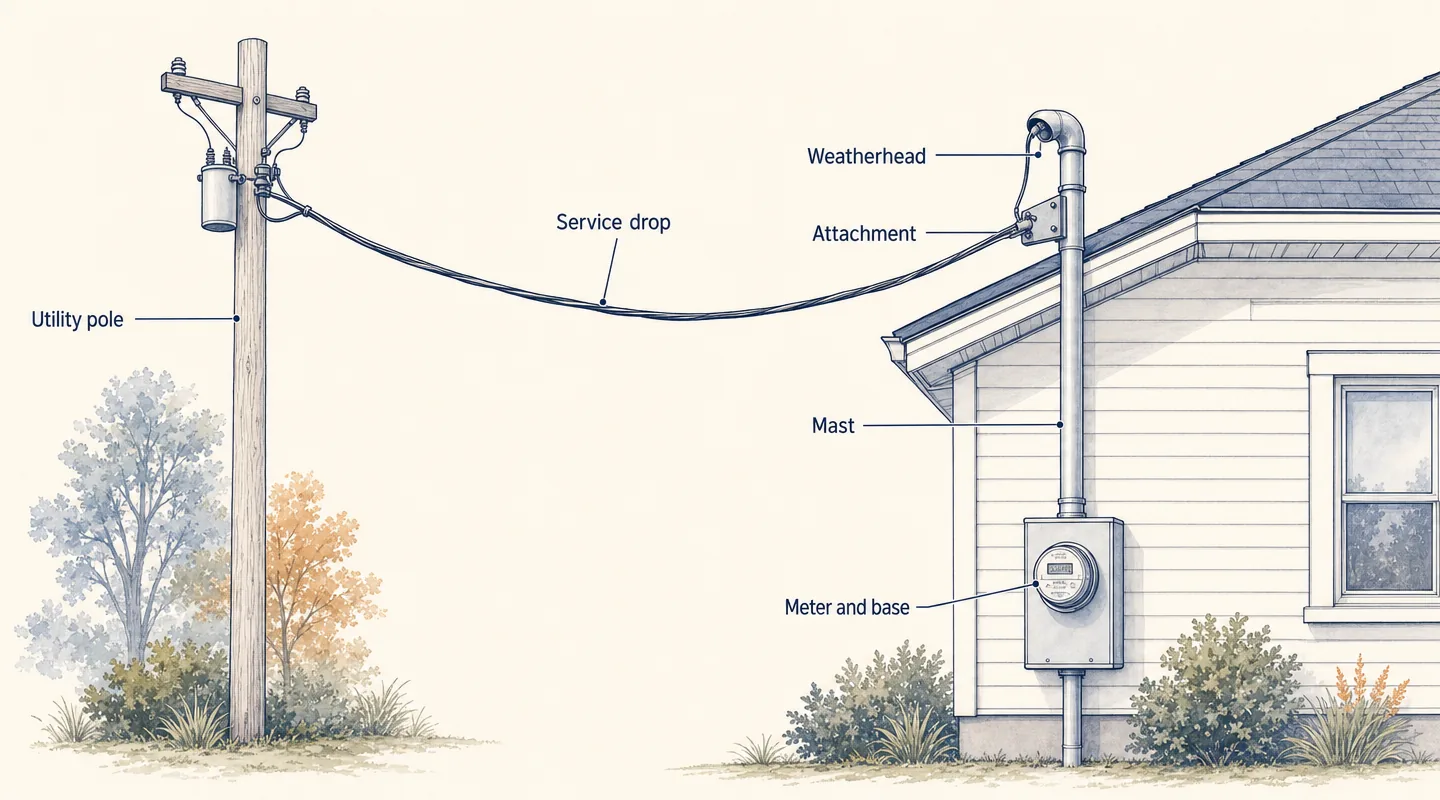
Simplified layout, not wiring instructions.
Underground power lines have no single national split
A buried cable reaching your meter is not automatically the utility's responsibility. The installation type can change the answer even within one utility territory.
For example, Central Hudson's underground rules distinguish among:
- Single lots: Homeowners are responsible for underground electric-line repairs.
- Developments of two to four lots: The utility handles repairs until the lines serve only one customer; the homeowner handles that individual portion.
- Developments of five or more lots: The utility handles underground service-line repairs in the qualifying development.
By contrast, Con Edison's equipment breakdown places underground service wires on the utility side, while identifying the meter enclosure and the sweep or customer conduit rising toward the meter as customer equipment. These examples show why a rule from a neighbor's utility cannot settle your repair bill.
Cable and conduit ownership can also split: Duquesne Light owns and maintains the cable from the transformer to the meter base, while the customer owns and maintains the conduit.
For an underground repair, the written scope needs separate answers for the cable, conduit, excavation, backfill, and lawn or pavement restoration. “The utility owns the wire” does not establish who handles every part of the job. A line from the house to a detached garage is also a different circuit from the incoming utility service.
Leave locating, excavation planning, and electrical repair to the utility and qualified contractors. Do not dig to expose a suspected fault.
Who to call, and in what order
For damaged incoming service, start with the electric delivery utility, the company responsible for the local wires and outage response. In a competitive electricity market, that can be different from the supplier selling the energy on your bill.
The normal coordination sequence is:
- Report the damage to the utility. Give the service address and describe what is visible from a safe location: a fallen span, bent mast, loose meter box, or damaged pole. Report the outage separately if the utility requires it.
- The utility makes its equipment safe and identifies the service problem. It determines whether disconnection is needed and which customer-side repairs must happen before service can return.
- A licensed electrician repairs customer equipment. The scope can include the attachment, mast, weatherhead, conductors, or meter base. The utility controls work on its own equipment and the authorized disconnect and reconnect process.
- The required inspection and release are completed. Local permit rules and the utility's restoration requirements determine the paperwork and who sends it.
- The utility reconnects or finalizes service. Completion of the electrician's work alone may not place a reconnection order.
Wallingford Electric Division, for example, requires customer-side repairs and an electrical inspection before it restores service, as its overhead responsibility notice explains. Our electrical panel permit guide explains the separate roles of permits, inspection, and utility authorization.
Some utilities can make temporary repairs to restore power when conditions allow. PSEG Long Island distinguishes that emergency work from the homeowner's obligation to arrange permanent equipment repairs. A temporary reconnection does not mean the damaged equipment has become utility-owned or the job is finished.
Questions for the utility before repairs are booked
The goal of the utility call is an address-specific assignment of work. Keep the service-request number and the answers together for the electrician.
| Question | What the answer needs to establish |
|---|---|
| Where is the service connection or delivery point for this address? | The actual utility/customer boundary, with a diagram or applicable service requirement |
| Which damaged parts belong to the utility, and which must the owner repair? | Named components rather than “your side” or “the line” |
| Who supplies each replacement part, and who installs it? | Any split between providing hardware and paying for labor |
| Who arranges disconnection and reconnection? | The authorized process and the person responsible for booking each visit |
| Is a permit, inspection, or electrical release required? | The approving office and how the utility receives clearance |
| Who places the final restoration order? | Whether the electrician, inspector, or account holder must contact the utility |
| For buried service, who handles cable, conduit, digging, and restoration? | Separate responsibilities for electrical work and property repair |
| Are fees or a service agreement involved? | Any quoted utility charges, customer contributions, or separate contractor work |
If the utility and electrician describe the boundary differently, have them resolve the named component and applicable service requirement before the repair scope is finalized. An invoice labeled only “repair service line” leaves too much unclear.
Trees, private poles, and requested upgrades
A utility-owned wire can still need homeowner-arranged tree work
Line ownership and tree maintenance are separate questions. Unitil, for example, generally leaves branches affecting an individual customer service line to the property owner and provides a disconnect/reconnect process for qualified tree work. Its service equipment guidance also warns against pruning around energized lines yourself.
For a branch resting on a line or storm damage involving wires, call the utility first. A tree crew needs the utility's safety coordination before working near that equipment. Debris removal after emergency clearance may be another separate responsibility.
Service-pole responsibility: local examples
In Central Hudson's territory, a homeowner whose house is a considerable distance from the road may own the poles and electric lines, as its service-line guidance explains.
South Central Power's rules give a specific meter-pole example. When a meter pole serves only the consumer's property, the consumer is responsible for the pole, guy wires, and anchors. When the line continues to other properties, the cooperative is responsible for those parts. This arrangement applies to South Central Power's system.
Repairs and elective service changes are different jobs
Replacing damaged equipment, relocating a service, burying an overhead drop, and increasing service capacity have different scopes. Utility ownership of the existing drop does not establish the price or terms of a requested change.
When a repair becomes part of a larger electrical project, separate the necessary restoration work from optional upgrades. Our 200-amp service guide breaks down the meter, service, panel, and utility work that can sit behind an upgrade quote.
Get one clear repair scope
For overhead service, the common split is utility service drop and meter, homeowner attachment and service-entrance equipment. Underground arrangements vary more. In either case, the repair needs three clear assignments: who fixes each part, who authorizes the work, and who triggers reconnection.
Once the utility has addressed the hazard and assigned responsibility, use our quote-comparison guide to turn the electrician's proposal into an itemized scope before you commit.