Last reviewed: November 16, 2026 (Pacific)
What is a whole-house dehumidifier?
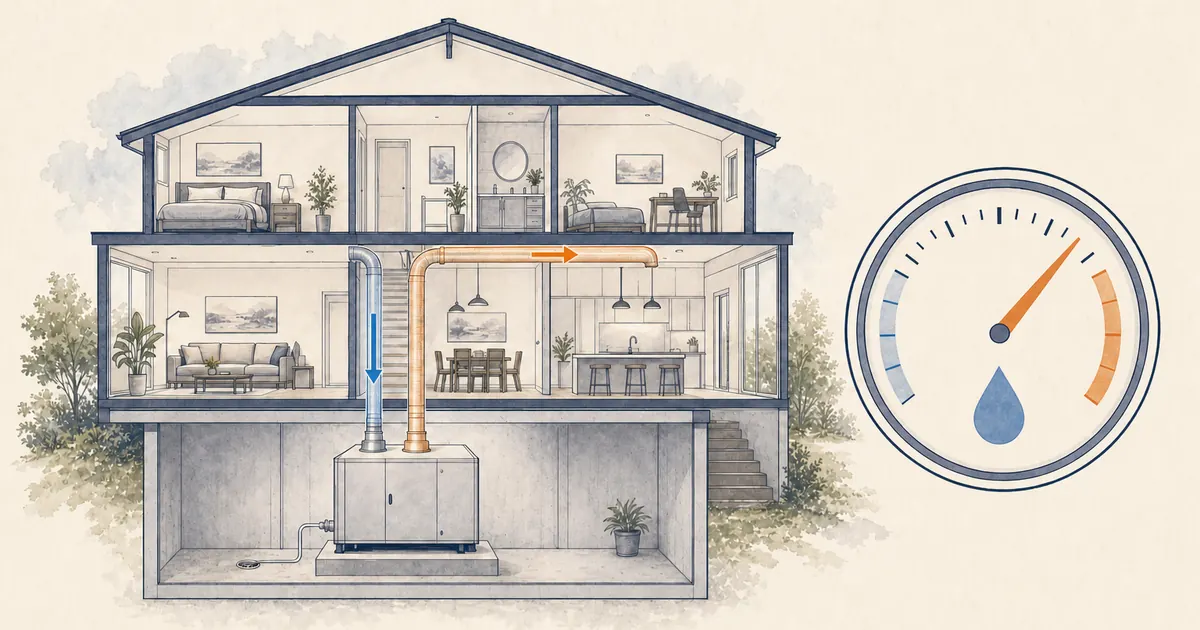
A whole-house dehumidifier is a permanently installed appliance that removes water vapor from indoor air and uses ducts to distribute the drier air. It can connect to the central heating and cooling ducts or use a separate set of ducts. A large portable appliance sitting in a basement does not provide the same controlled distribution through a multistory home.
Most residential systems use refrigeration. A fan pulls humid air across a cold coil, where water condenses. The water flows to a drain, while the air passes over a warm coil and returns to the house drier and warmer. A humidistat measures relative humidity and calls for operation when the level rises above its setting.
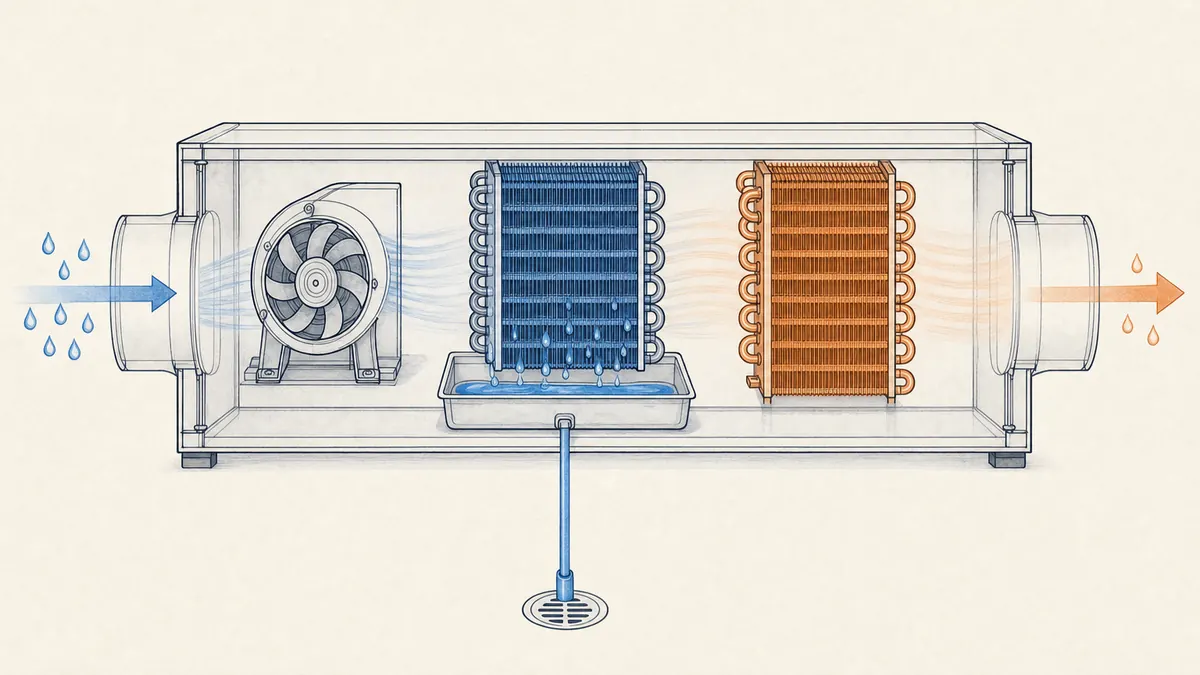
Simplified layout, not wiring instructions.
That warm discharge matters: a dehumidifier does not replace air conditioning. It removes moisture without needing to cool the rooms further. The air conditioner or heat pump remains responsible for cooling.
When is a whole-house dehumidifier worth it?
A ducted system is worth considering when excess humidity persists across several rooms after water intrusion, ventilation faults, and heating or cooling problems have been addressed. It is harder to justify the installed cost when only one isolated space needs drying.
ENERGY STAR identifies relatively well-sealed homes with central air and humidity consistently above 55% throughout the house as candidates for whole-home dehumidification. That is a reason to investigate the moisture load, rather than a universal installation threshold.
| What is happening at home? | The more useful starting point |
|---|---|
| Several rooms stay humid despite comfortable temperatures | A house-wide moisture assessment and ducted-system proposal |
| Only the basement or one room is damp | A room-level dehumidifier and correction of local moisture sources |
| Humidity rises mainly after showers or cooking | Effective exhaust ventilation at those sources |
| Water enters through the roof, plumbing, foundation, or crawl space | Repairing the water source and drying affected materials |
| The air conditioner cools in short bursts and leaves rooms clammy | Cooling-system sizing, airflow, and control diagnosis |
Relative humidity, or RH, describes how close air is to saturation at its current temperature. The EPA recommends keeping indoor RH below 60%, ideally between 30% and 50%. A dehumidifier can help maintain that range, but it cannot repair leaks or remove existing mold from building materials. EPA moisture guidance puts correcting the moisture source at the center of prevention and cleanup.
Room-by-room humidity and temperature readings are useful evidence for the contractor. Readings over several days reveal more than a single measurement immediately after a shower. The important distinction is persistent house-wide humidity versus a brief spike or a cold, damp corner.
Why the air conditioner may not be enough
Air conditioners remove moisture when water condenses on their cold coils. They stop cooling when the thermostat is satisfied, even if humidity is still high.
This becomes noticeable during mild, humid weather. The house needs little temperature reduction, so cooling runs briefly while moisture continues entering through ventilation, air leakage, and daily activities. Efficient homes can have low cooling demand and still need moisture removal. Oversized cooling equipment can also shut off too quickly.
The Department of Energy's Building America guidance explains these temperature and moisture loads separately. Supplemental dehumidification should not conceal excessive building leakage or an oversized air conditioner. Those problems belong in the diagnosis before another compressor is added.
Two ways a ducted system can serve the house
The two arrangements differ in whether they share the heating, ventilation, and air conditioning (HVAC) ducts. Existing central ducts are useful, but they are not required.
| Arrangement | How it distributes dry air | Main design issue |
|---|---|---|
| HVAC-integrated | Connects to the central system's ducts | Airflow, backflow prevention, and coordination with the air-handler fan |
| Independent ducted | Uses dedicated return and supply grilles | New duct routes and enough separation between intake and discharge |
An independent ducted system can serve a home with mini-splits or other ductless heating and cooling. An integrated system can share existing distribution, although some layouts require the central blower to run whenever the dehumidifier operates.
In either arrangement, the equipment needs a path from the rooms to its inlet and back to the rooms. A unit hidden in a crawl space will not automatically control upstairs bedrooms. Closed doors, separate HVAC zones, and restricted return paths affect distribution.
A useful installation proposal identifies the air route, the condensate drain, and the operating sequence. It also states whether dry air reaches the house when the air conditioner is off. Our dehumidifier installation guide covers those layout and contractor-scope decisions in detail.
Ventilation is a separate decision
An energy recovery ventilator (ERV) or heat recovery ventilator (HRV) exchanges indoor and outdoor air. An HRV recovers heat; an ERV transfers heat and some moisture between the air streams. Neither provides the same active moisture removal as a dehumidifier.
An ERV can reduce the moisture brought in with ventilation during humid weather, yet the incoming air can still add humidity. The Department of Energy's ventilation selection guidance makes that distinction explicit. A tightly sealed home may need both ventilation and supplemental dehumidification.
Some dehumidifiers also have an outdoor-air intake. That feature needs its own ventilation rate and controls in the proposal; a recirculating dehumidifier alone does not supply fresh air.
Size for moisture removal, not floor area alone
Capacity is normally expressed as pints of water removed per 24 hours. That is a removal rate under stated conditions, not a tank size or a promise that the appliance will collect that much water every day.
Square footage helps describe the job, but two equally sized homes can have different moisture loads. Climate, air leakage, ventilation rate, occupants, damp foundations, and cooling runtime all matter. So does the indoor humidity target.
A defensible capacity recommendation includes:
- The indoor temperature and RH the system is meant to maintain.
- The moisture load, including outdoor air and indoor sources.
- The moisture removal expected from the existing cooling system.
- The selected unit's performance at those operating conditions.
- The duct airflow and pressure the unit will actually encounter.
The Air Conditioning Contractors of America's Manual S guidance covers residential dehumidification equipment selection using loads, manufacturer performance data, and design conditions. A capacity copied from a square-foot coverage badge leaves those inputs unexplained.
Compare pint ratings under the same conditions
Dehumidifier capacities are easy to misread because different test conditions produce different removal rates.
| Current federal rating category | Air temperature | Relative humidity |
|---|---|---|
| Portable dehumidifier | 65°F | 60% |
| Whole-home dehumidifier | 73°F | 60% |
These conditions come from the federal test method. They mean a whole-home and portable unit's pint labels are not a same-temperature comparison.
Some marketing also displays a much larger capacity at hot, very humid or “saturation” conditions. That figure does not describe performance in a comfortable living room. A proposal should identify the rated capacity and its temperature and RH together, with performance data for the intended indoor conditions. A cooler basement or a lower humidity target can reduce water removal.
Use efficiency to compare similar options
Integrated energy factor, or IEF, expresses liters of water removed per kilowatt-hour (kWh) of electricity. Higher IEF means more moisture removed per unit of energy under the test conditions. ENERGY STAR criteria define the measure and distinguish whole-home equipment from portable appliances.
Capacity answers how much moisture a unit can remove. IEF answers how efficiently it does so under its rating conditions. Neither number, by itself, predicts the installed system's monthly electricity bill.
What does a whole-house dehumidifier cost?
Angi places typical professional installation at $1,300 to $2,800 in its published cost data. Treat that as a basic-project benchmark. New ductwork, a higher-capacity unit, difficult access, drainage changes, or electrical work can put a proposal above it.
The equipment price is only part of the purchase. A complete price includes the duct connections, drain or condensate pump, humidity controls, power connection, labor, and startup work. An attic installation may also need secondary water containment and overflow protection.
Our dehumidifier cost guide separates those line items. For a buying decision, the main point is simple: compare complete installed scopes before comparing totals.
Running cost includes more than the dehumidifier
We treat a whole-house system as three possible electricity costs:
- The dehumidifier itself, including its compressor and internal fan.
- Extra central-blower operation, if the duct layout needs it.
- A change in cooling use, because the dehumidifier releases heat indoors and humidity control may change thermostat habits.
Building Science Corporation's hot-humid community study accounts for both the dehumidifier's electrical draw and the additional cooling associated with its indoor heat release. Lower humidity can improve comfort, but it does not guarantee a lower combined electricity bill.
For a simple operating estimate:
Monthly cost = input watts ÷ 1,000 × operating hours per day × days × electricity price per kWh.
Suppose a unit draws 600 watts while dehumidifying, runs six hours per day, and electricity costs $0.20 per kilowatt-hour:
0.6 kW × 6 hours × 30 days = 108 kWh, or $21.60 per month.
If that installation also needs an additional 200 watts of central-blower operation for the same six hours, the blower adds 36 kWh, or $7.20. The combined example becomes $28.80, before any change in cooling, pump use, or other operating modes.
Those are illustrative inputs, not typical equipment specifications or a bill forecast. Only blower hours added by dehumidification belong in that extra-cost line; hours already needed for cooling are not an additional charge caused by the new unit.
This is why a higher-efficiency appliance and a lower-energy installation are different questions. The written operating sequence determines whether the central blower runs, while weather, moisture sources, and humidity settings determine demand. A savings estimate that omits those effects is incomplete.
What ownership involves
Whole-house systems usually drain continuously, so there is no daily bucket to empty. They still need maintenance and service access.
The filter needs cleaning or replacement on the model's schedule. The drain, pump if fitted, and overflow protection need attention because a blockage can stop moisture removal or cause water damage. Coils and fans also need to stay clean. Filter and drain access should be possible without dismantling surrounding equipment.
A humidity setpoint around 50% is a reasonable starting point for many homes, within the EPA's preferred range. Colder weather can require lower indoor humidity to prevent condensation on cold surfaces. Setting the control much lower than necessary increases the moisture-removal demand; continuous operation is not a goal in itself.
Noise deserves a place in the equipment-location decision. A compressor kept away from bedrooms can still transmit vibration or airflow noise through ducts. The installation scope should account for support, isolation, duct routing, and service clearance rather than relying on an appliance sound rating alone.
A whole-house dehumidifier earns its cost when the home needs ongoing, distributed humidity control and the proposed air path can deliver it. The useful purchase is a complete system with a justified capacity, reliable drainage, and a clear operating sequence. Use our HVAC contractor questions to put those decisions into the quote before you commit.