Last reviewed: September 23, 2026 (UTC)
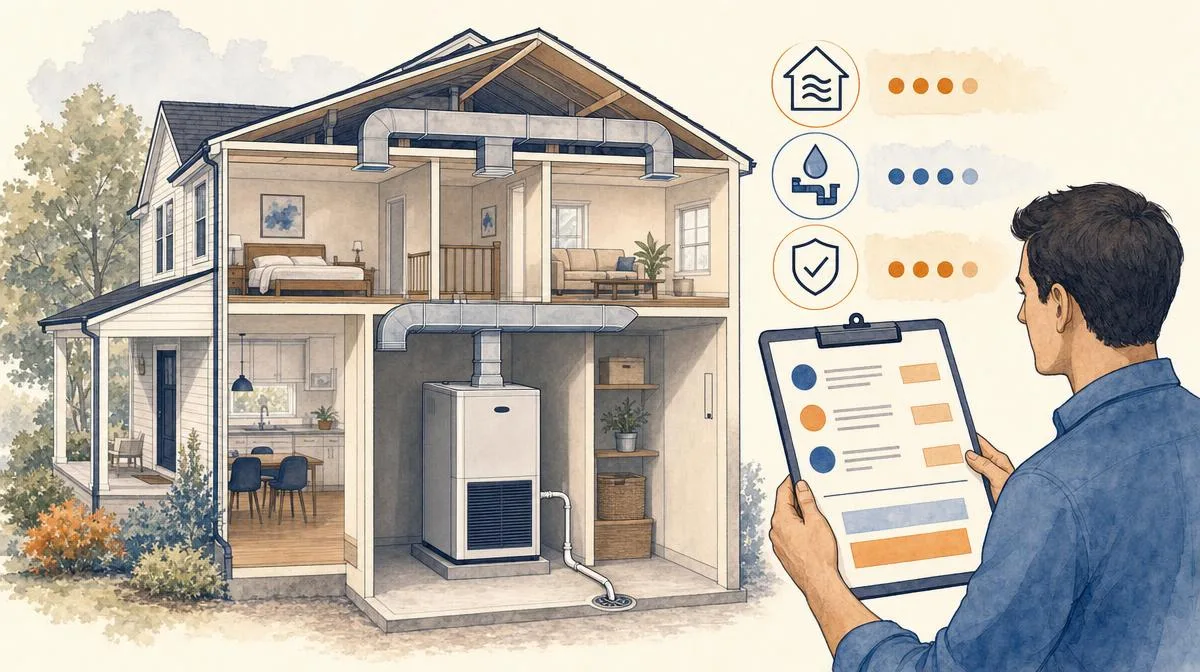
Whole-house dehumidifier cost is usually a project price, not an appliance price. For a basic professional installation with accessible ductwork, a nearby drain, and usable power, current 2026 cost guides cluster around $1,300 to $2,800 installed. New ductwork, a condensate pump, electrical work, difficult access, or permits can push the total higher. The useful comparison is the scope behind each quote.
Whole-house dehumidifier cost at a glance
These are 2026 U.S. planning ranges, not promises or quotes. They help you decide whether two proposals describe the same job.
The catalog price for a whole-house dehumidifier is only the equipment line. Installed cost also covers the air path, condensate route, controls, power, labor, and local approvals.
| Project scope | Planning range | What the range assumes |
|---|---|---|
| Equipment only | About $1,100 to $2,500 | A ducted whole-home unit, before labor, duct changes, drainage, electrical work, and permits |
| Basic installed project | About $1,300 to $2,800 | Accessible equipment location, a compatible central-duct connection or simple duct path, nearby gravity drain, usable power, standard controls, and startup testing |
| Expanded or complex project | About $2,800 to $4,500 or more | New return or supply ductwork, long runs, a pump, a new circuit, difficult attic or crawl-space access, permit work, removal, or several items missing from the basic scope |
Angi's July 8, 2026 cost update and HomeAdvisor's June 19, 2026 update each place a typical complete professional installation at $1,300 to $2,800. HomeGuide's February 6, 2026 data shows a wider $1,500 to $3,500 average range, with reported project costs from $1,200 to $4,000. The spread is a useful warning: a national average cannot tell you whether a bid includes ductwork, a pump, electrical work, or inspection. See the Angi 2026 cost breakdown and HomeAdvisor 2026 cost guide for the underlying published ranges.
What counts as a whole-house system?
The phrase “whole house” describes the area the system is intended to control. It does not describe one universal air path or installation price.
| System type | What you are paying for | Cost effect |
|---|---|---|
| Portable unit | A self-contained appliance serving one room or zone | Lower purchase price, with limited distribution and more hands-on drainage |
| Independent ducted unit | Its own return and supply grilles, separate from the central HVAC ducts | More ductwork, but it can fit a home with ductless heating and cooling |
| Integrated ducted unit | A dehumidifier connected to the central air handler's return or supply side | Existing ducts may reduce new ductwork, while airflow, fan controls, and static pressure add planning work |
The DOE Building America dehumidification guidance distinguishes independent ducted and integrated ducted systems. That distinction matters for cost. A home without central ducts may need two new air paths. A central system may need transitions, dampers, blower coordination, and an airflow check.
If the problem is limited to a basement, laundry room, or crawl space, a zoned solution may be a better fit than paying to distribute dry air through the entire house. If humidity is high throughout a relatively well-sealed home with central air, a whole-home system becomes more reasonable. A dehumidifier also does not automatically provide balanced fresh-air ventilation. A proposal that includes outdoor air should name the ventilation equipment, intake rate, damper controls, and filters. For the separate ventilation decision, see Watt Wallet's whole-house ventilation system guide.
The line items that move the installed price
Equipment and capacity
The unit is usually the largest single material cost. Whole-house capacity is commonly listed in pints of water removed per 24 hours, but the number is meaningful only alongside the rating conditions and the home's moisture load.
Ask for the exact model, rated capacity, efficiency metric, control package, filter size, warranty, and replacement-filter cost. Do not accept a capacity chosen from square footage alone. Climate, air leakage, insulation, basement or crawl-space conditions, occupants, indoor moisture, ventilation, and air-conditioner runtime can all change the load.
Building America explains that air-conditioning design has both sensible and latent loads, and that an oversized air conditioner can reach the temperature setpoint before it removes enough moisture. ACCA's Manual S equipment-selection guidance covers dehumidification equipment and calls for local climate, load information, design conditions, and manufacturer performance data.
Use the same evidence in a cost comparison. ENERGY STAR says capacity is measured in pints per day and describes integrated energy factor, or IEF, in liters of water removed per kilowatt-hour. A higher IEF indicates better efficiency under the test conditions. Two units with similar pint ratings can still have different operating costs.
Labor and access
Labor includes site protection, mounting or supporting the equipment, connecting the air path, routing drainage, setting controls, testing the system, and explaining maintenance. It also includes the time required to work around stored items, finished surfaces, tight crawl spaces, attic access, or an existing air handler.
Published cost guides show why labor allowances vary. HomeGuide lists roughly $400 to $1,200 for dehumidifier installation labor, while Angi lists about $500 to $700 for a typical installation. Treat these as broad planning inputs, not a local rate card. The quote should state whether equipment removal, disposal, travel, attic platforms, secondary containment, and finish repair are included.
Ductwork and airflow changes
An integrated system may need a return connection, a supply connection, a bypass path, dampers, a plenum transition, sealing, and insulation in unconditioned space. An independent ducted system may need new grilles and longer runs. Each choice changes labor, materials, service access, and commissioning.
HomeGuide's 2026 cost data uses about $270 to $500 for a new duct run as a planning allowance. A real quote should replace that allowance with the number, size, route, insulation, sealing, grille, and access conditions for your home. It should also say whether the contractor will measure airflow or static pressure when the new equipment connects to existing ducts.
The detailed airflow tutorial belongs in Watt Wallet's whole-house dehumidifier installation guide. Use that companion page when you need to plan a layout. Keep the cost page focused on whether the proposed layout is included and priced consistently across bids.
Drainage and condensate protection
Whole-home units generally drain continuously rather than collecting water in a bucket. ENERGY STAR says most whole-home systems should be routed to a floor drain or condensate pump by an HVAC professional.
A gravity drain can cost less when the unit is close to an approved drain and the line can maintain the required slope. A pump may be needed when the equipment sits below the drain or the route requires lift. Published 2026 estimates vary by pump type: Angi lists about $150 to $500 for an internal pump, while HomeGuide lists about $50 to $300 for an external pump.
Ask the quote to identify the drain route, pump model if applicable, trap or air-break requirements, discharge point, overflow switch, secondary pan, and water test. Our condensate pump guide explains the drainage and safety details that can turn a small accessory into a real scope item.
Electrical work
An existing, suitable power connection may be included in a basic installation. A new circuit, disconnect, outlet, wiring route, or panel work is separate electrical scope. The price depends on the equipment requirements, distance, access, panel capacity, and local inspection process.
The written proposal should name the electrical contractor or trade responsible for the work, identify what is included, and state who pulls the permit and schedules inspection. Do not remove a panel cover, add a circuit, or wire a control as a DIY project. The equipment instructions and local code control the final connection.
Controls and blower coordination
A whole-home system needs a control sequence, not only a humidistat on a wall. The scope should identify the humidistat location, target relative humidity, deadband or lockout settings when relevant, central-blower interlock, outdoor-air damper sequence if present, and any smart-control subscription or replacement cost.
An integrated design may run the air handler when the dehumidifier calls. An independent ducted system may use its own fan. That choice affects wiring, runtime, noise, airflow testing, and operating cost. A line that says “connect controls” leaves too much of the project undefined.
Permits, inspection, removal, and closeout
Permit requirements vary by location and by the work included. Duct changes, electrical circuits, drainage, structural supports, and equipment installation can fall under different local processes. A national cost range cannot tell you which approvals apply to your address.
The quote should state whether permit fees, plan review, inspection scheduling, equipment removal, disposal, labels, warranty registration, and final documentation are included. The contractor should also record the model and serial numbers and show the drain, control call, filter access, and airflow response at startup.
Use a diagram to normalize quote scope
Every bid should describe the same basic paths: equipment, air, water, power, controls, and approval or closeout. When one proposal combines these into “standard installation” and another lists them separately, the totals are not comparable yet.
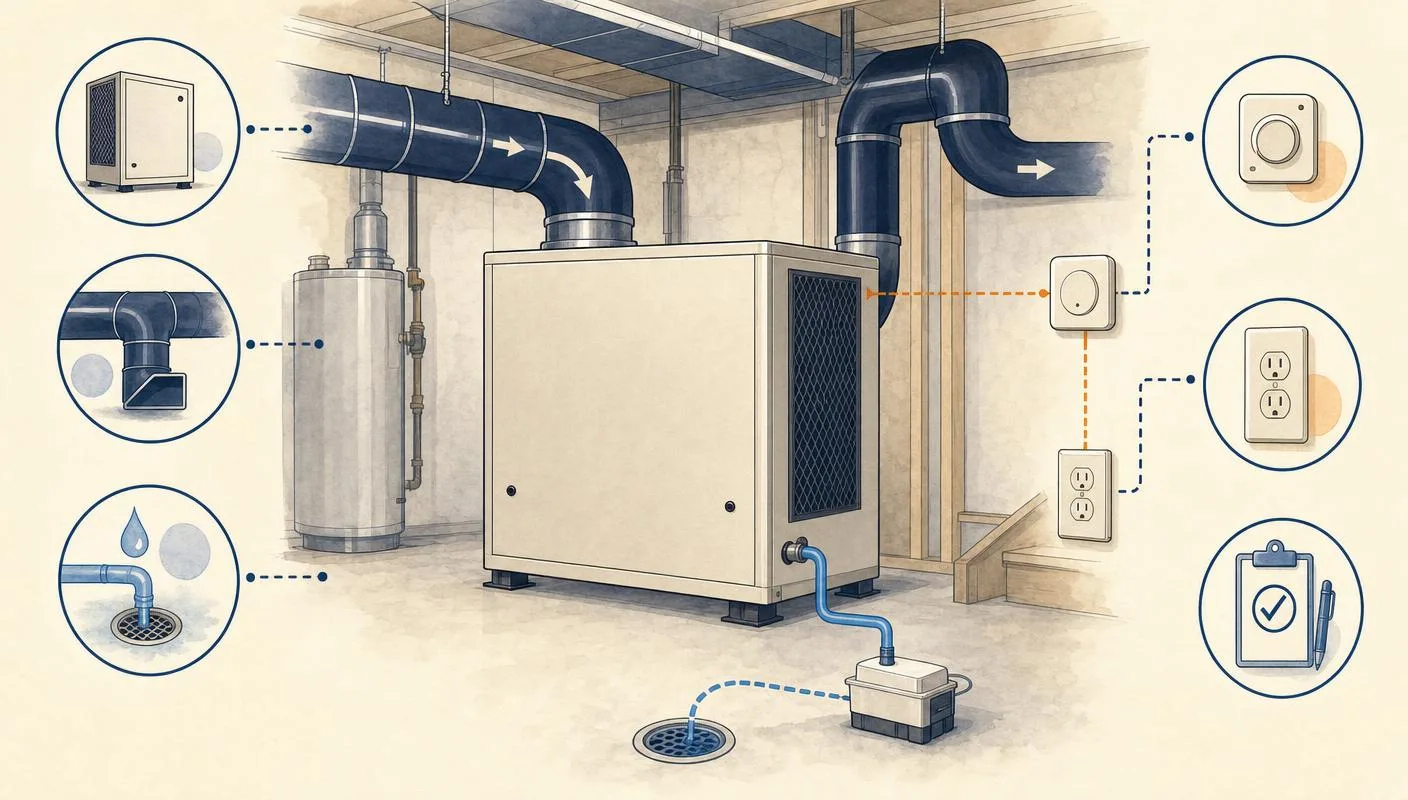
Simplified layout, not wiring instructions.
Whole-house dehumidifier operating cost
A universal monthly electricity bill would be misleading. Operating cost depends on the unit's input power or efficiency, runtime, humidity load, setpoint, season, air leakage, ventilation, air-conditioner runtime, pump operation, and local electricity rate.
Use this formula for a seasonal or monthly estimate:
Energy cost = input power in watts ÷ 1,000 × operating hours × local electricity price per kWh
Use the manufacturer's input power or tested energy-use data for the selected model. If the documentation gives IEF instead, estimate energy from the amount of water removed divided by liters per kilowatt-hour, then multiply by the local rate. The result is still an estimate because the unit's actual runtime changes with weather and moisture load.
| Operating-cost input | Why it changes the result |
|---|---|
| Input power or IEF | More efficient moisture removal can use less electricity for the same water load |
| Runtime | A humid coastal summer, a damp crawl space, and a tight shoulder-season home will not produce the same hours |
| Local electricity rate | The same kWh use costs different amounts across utilities and rate plans |
| Control sequence | A central blower or condensate pump can add runtime beyond the compressor alone |
| Moisture load | Leaks, outdoor-air leakage, indoor drying, and poor HVAC sizing can increase demand |
ENERGY STAR's dehumidifier guidance explains IEF and notes that whole-home systems can be a fit for relatively well-sealed homes with central air that stay above 55% relative humidity. The guidance also says sealing ducts and the home can improve performance. That is a reason to include envelope and duct conditions in the quote discussion, not a reason to promise savings.
Check whether the project is solving the right problem
Start with measured relative humidity in the main living area and the dampest room. The EPA recommends keeping indoor humidity below 60%, ideally between 30% and 50%. A hygrometer reading helps establish whether the issue is widespread and seasonal or limited to one location.
Before accepting a whole-home price, ask the contractor to look for:
- plumbing, roof, foundation, crawl-space, or HVAC drain leaks
- wet soil, poor grading, or outdoor water entering the foundation area
- bathroom and kitchen exhaust that does not vent outdoors
- a clothes dryer or other appliance releasing moisture indoors
- outdoor air entering through duct leaks, gaps, or an unbalanced ventilation system
- an air conditioner that reaches the temperature setpoint quickly and cycles off before removing enough moisture
The EPA's moisture guidance recommends addressing the water or moisture source and drying wet materials promptly. A dehumidifier controls moisture in the air. It does not repair a leak, replace a ventilation system, or clean up water-damaged materials.
Compare installed quotes like for like
Give every bidder the same written scope and ask for these fields in the same order:
| Quote line | Require this detail |
|---|---|
| Equipment | Exact model, pints per day, efficiency metric, controls, filter, warranty, and removal of the old unit if needed |
| Capacity basis | Target humidity, measured conditions, load method, existing air-conditioner contribution, and manufacturer data used |
| Labor and access | Crew, expected hours, mounting or support, access limits, protection, removal, disposal, and finish repair exclusions |
| Ductwork | Independent or integrated path, return and supply locations, sizes, dampers, transitions, sealing, insulation, and airflow or static-pressure checks |
| Drainage | Gravity or pump, exact route, pump model, termination, trap or air break, pan, overflow protection, and testing |
| Electrical | Existing connection or new circuit, disconnect, control wiring, labels, responsible trade, permit, and inspection |
| Controls | Humidistat location, target range, blower interlock, ventilation sequence, and smart-control fees |
| Closeout | Startup test, drain test, filter handoff, model and serial records, warranty documents, and service instructions |
| Exclusions | Tax, permit fees, drywall or paint, duct repairs, panel upgrades, long concealed routes, and change-order rates |
The first quote is not necessarily the lowest-cost quote. A $2,000 proposal that excludes a pump, new circuit, return grille, permit, or startup testing is not the same project as a $2,700 proposal that includes them. Normalize the scope before negotiating the total.
Whole-house dehumidifier cost FAQ
How much does it cost to install a whole-house dehumidifier?
For a basic professional installation, plan around $1,300 to $2,800 in 2026 U.S. dollars. Equipment-only pricing commonly falls around $1,100 to $2,500 in published cost guides. New ductwork, drainage, electrical work, difficult access, permits, or removal can put a project above those ranges.
Is a whole-home dehumidifier more expensive than a portable unit?
Yes, the installed price is higher because a whole-home system adds permanent equipment, duct or grille connections, controls, drainage, and professional commissioning. A portable unit may be appropriate for a single room or as a short diagnostic step. Multiple portable units can also create ongoing bucket, drainage, and distribution work.
Does a whole-house dehumidifier need a permit?
Sometimes. The answer depends on local rules and whether the project changes ducts, electrical circuits, plumbing or condensate drainage, structural supports, or other building systems. Put permit and inspection responsibility in the written quote instead of assuming they are included.
Does a whole-house dehumidifier replace air conditioning or ventilation?
No. Dehumidification removes moisture and usually adds some heat to the discharge air. Air conditioning remains the temperature-control system. Balanced ventilation has a separate outdoor-air and exhaust purpose. If a quote combines these functions, require the equipment, airflow rate, controls, and operating sequence to be named separately.
Sources
- EPA moisture guidance
- DOE Building America dehumidification guide
- ENERGY STAR dehumidifier guidance
- ACCA Manual S overview
- Angi 2026 cost data
- HomeAdvisor 2026 cost data
- HomeGuide 2026 cost data
When you have bids, use Watt Wallet's questions to ask an HVAC contractor checklist to compare the written scope before you approve a price.